
 Author:
Short answer: in the U.S., it's legal to create music with AI tools. The harder questions come after you've made the song — who owns it, whether you can copyright it, whether you can sell it, and what happens if it sounds like someone else. Those answers depend on how much of the song you wrote yourself, which app you used, and where you plan to put the song.
This guide pulls together what the U.S. Copyright Office, the major streaming platforms and the ongoing label lawsuits say as of September 2026, in plain language. It's a starting point, not legal advice — if you're planning a commercial release, talk to a qualified lawyer.
Is it legal to create AI music?
Yes. Using an AI song generator to write, sing or produce a track isn't illegal in the U.S. What the law cares about is what goes into and out of the process: whether the tool was trained lawfully (the question at the center of the label lawsuits), whether your output copies someone else's protected work, and whether you're using a real person's voice or likeness without permission.
Can you copyright a song made with AI?
Partly. In its January 29, 2025 report on copyrightability, the U.S. Copyright Office reaffirmed that copyright requires human authorship. The key points:
- Prompts alone aren't enough. The Office concluded that prompts don't give users enough control over the expressive output to count as authorship — even detailed, revised prompts.
- Your own expressive input is protected. If you write the lyrics and they appear in the finished song, those lyrics are yours.
- Human selection, arrangement and edits can be protected when they're original enough — but only the human parts, not the AI-generated material itself.
- Disclose AI use when you register. Registrations should accurately describe which parts were AI-generated.
(U.S. Copyright Office: Copyright and Artificial Intelligence; summary via Jenner & Block)
What that means in practice: the more of the song that's really yours, the more you can protect. Writing your own chorus or full lyrics is the simplest way to add human authorship.
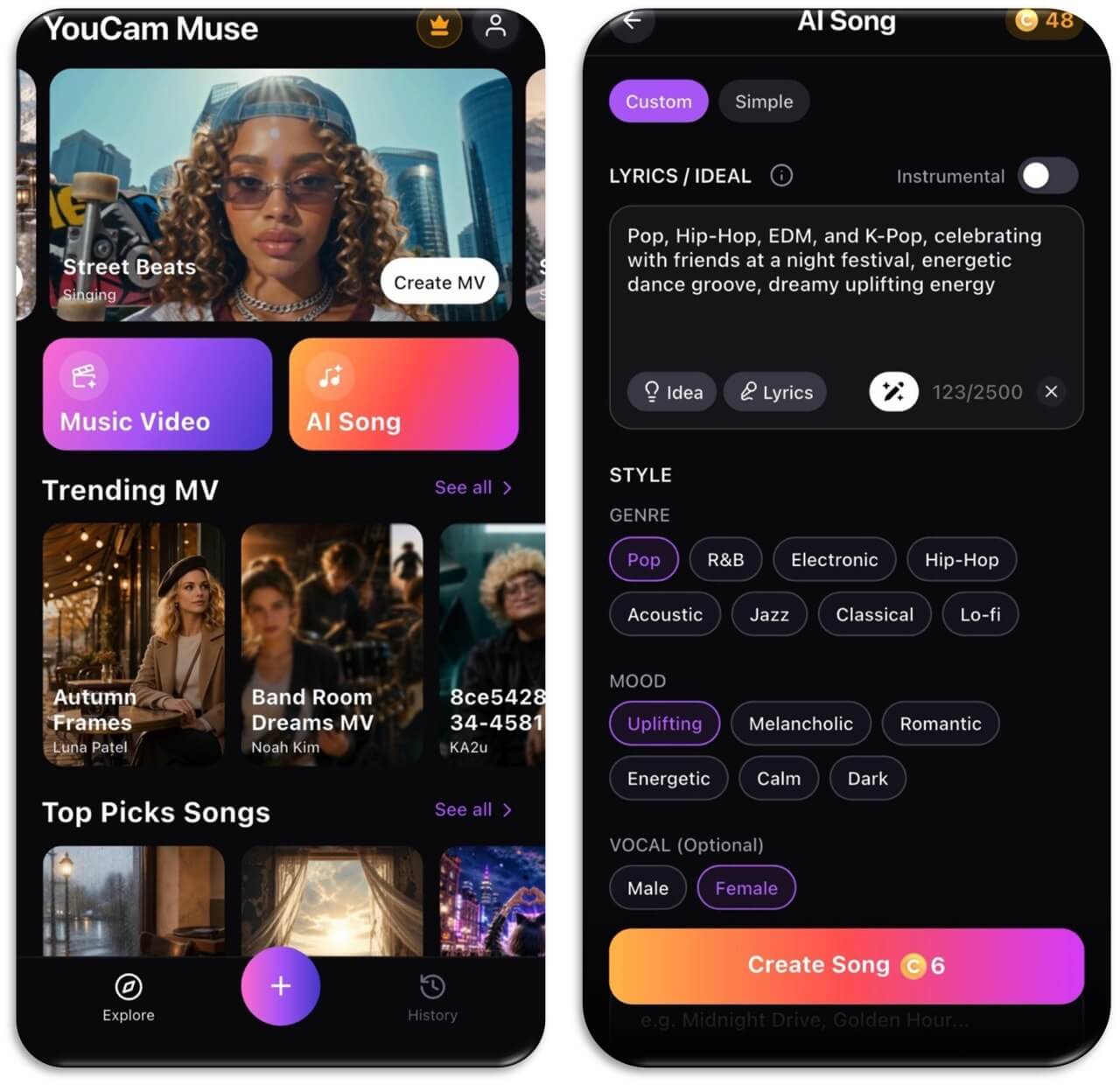
In YouCam Muse's AI Song, for example, the Lyrics / Idea box takes up to 2,500 characters, so you can paste lyrics you wrote and let the AI handle the melody, arrangement and vocal. Keep a copy of your drafts — the Copyright Office recommends documenting how you used AI.
Who owns an AI-generated song?
Ownership of the file and copyright in the work aren't the same thing. The app's terms of service decide what rights it passes to you; copyright law decides what's protectable at all.
| Question | What decides it | What to do |
|---|---|---|
| Can I use the song at all? | The app's terms of service | Read the terms for your specific plan |
| Can I sell or monetize it? | The app's terms (usually paid plans only) | Check whether commercial rights apply to songs made while subscribed |
| Can I register copyright? | U.S. copyright law (human authorship) | Register only the human-authored parts and disclose AI use |
| Can I upload it to streaming? | The distributor's and platform's policies | Disclose AI involvement where asked; never impersonate a real artist |
Can I sell music made with AI?
Often, yes — on the right plan. Suno's Pro and Premier plans grant commercial rights for songs made while you're subscribed; its free plan is limited to personal, non-commercial use. Mureka's paid plans include commercial rights too. Udio has disabled downloads on all plans since October 2025, which makes selling Udio songs impractical for now. (Dubspot)
Whatever tool you use, read its current terms before you release anything. They've changed several times in the past year.
What's happening with the AI music lawsuits?
In June 2024, the major labels sued Suno and Udio over the recordings used to train their models. Since then:
- Universal Music Group settled with Udio (October 30, 2025), and Warner Music Group settled with Udio (November 19, 2025) and Suno (November 25, 2025), turning the disputes into licensing partnerships.
- UMG and Sony are still suing Suno, and Sony is still suing Udio. Both companies have acknowledged training on copyrighted recordings, so fair use is the central open question.
- Suno moved to licensed v6 models in September 2026 and stopped free-plan downloads.
These cases are about the companies, not about you as a user making a song. But they're why terms, download rules and licensed models keep changing.
What about streaming platforms?
In September 2025, Spotify announced a three-part AI policy: a spam filter against mass uploads and duplicates, a ban on unauthorized AI voice clones and impersonation, and an AI-credits disclosure standard built with DDEX so tracks can say where AI was used. Spotify said it removed 75 million spam tracks in the prior year. (eWeek)
AI-assisted music is allowed; spam and impersonation aren't.
How to stay on the safe side
- Write your own lyrics, or at least the chorus. It's the easiest way to add protectable human authorship.
- Don't prompt for a real artist's voice or name. Describe the sound instead: era, instruments, vocal style and mood.
- Use a plan with commercial rights if you plan to sell or monetize.
- Keep records of your lyrics, prompts and edits.
- Disclose AI use when a distributor, platform or registration form asks.
AI Song & Music Video Maker
Write your own lyrics or describe a moment.
Get a finished song in minutes.
Try it now
If you've got lyrics in your notes app, YouCam Muse's AI Song can turn them into a finished track — your words, AI melody and vocals — and then into a music video. Just check the app's terms before you use a song commercially.
AI Song & Music Video Maker
From one idea to a finished song and music video.
No instrument or music theory needed.
FAQ
Is it legal to create AI music?
Yes. There's no U.S. law against using AI tools to make music. Legal issues come from copying protected work, impersonating a real artist's voice, or breaking an app's terms.
Is AI-generated music copyrighted?
Purely AI-generated music isn't protected by U.S. copyright. Human-authored parts, like lyrics you wrote or meaningful edits and arrangements you made, can be.
Can I get sued for using AI music?
The current lawsuits target the AI companies, not their users. You could face problems if your song copies someone else's protected work or uses a real artist's voice without permission, so avoid both.
Can I put AI music on Spotify?
AI-assisted music is allowed on Spotify, but spam uploads and unauthorized voice clones aren't. Expect your distributor to ask whether AI was used.
Do I own the songs I make with an AI app?
That depends on the app's terms and your plan. Many apps grant you rights to use or monetize songs on paid plans, while free plans are usually personal-use only. Copyright protection still only covers the human-authored parts.
Is it legal to make a song that sounds like a famous artist?
Describing a general style, like "90s R&B slow jam," is fine. Imitating a specific artist's voice or likeness without permission can break platform rules and, in some states, the law.