 Author:


What Is an AI Dermatologist Support Tool?
Skincare has always been a highly personal category — but for decades, access to accurate, personalized skin assessment depended almost entirely on whether a customer could get in front of a trained professional. Most couldn't, or wouldn't. In a retail or e-commerce environment, that gap translated directly into guesswork at the shelf and high return rates on products that simply didn't match the customer's actual skin condition.
The AI dermatologist support tool addresses this gap with precision that wasn't commercially viable even five years ago. These are software-powered systems that analyze high-resolution facial images using deep learning models trained on large, annotated datasets of documented skin conditions — covering everything from acne and hyperpigmentation to barrier damage and periorbital aging.
"The most meaningful shift in beauty tech isn't the technology itself — it's that clinical-grade skin insight is finally scalable. That's a fundamentally different business proposition than anything the industry has seen before." — Beauty technology consultant perspective
Unlike general-purpose image recognition, a well-built AI dermatologist tool is optimized specifically for skin physiology: how light interacts with different skin tones, how depth and texture patterns correlate with conditions like rosacea or dehydration, and how consistent scoring can track change over time. It delivers fast, quantified skin assessments at scale — whether embedded in a mobile app, deployed through an in-store kiosk, or integrated into a telehealth intake workflow.
Critically, these tools are not clinical diagnostic instruments in the medical-legal sense. They function as high-quality triage and personalization engines — capable of giving customers far more useful guidance than a questionnaire-based routine finder, while stopping short of replacing a licensed dermatologist's judgment for complex or pathological presentations.
Why the Industry Is Shifting Toward AI-Driven Skin Analysis
The beauty retail and clinical skincare landscape has changed substantially over the past decade — and the drivers behind AI dermatology adoption aren't primarily technological. They're operational and economic.
Prestige skincare brands are under growing pressure to justify premium pricing with demonstrably personalized service. At the same time, staff turnover in retail remains high, and training a beauty advisor to deliver consistent, credible skin consultation takes months. Med spas and aesthetic clinics face a different version of the same problem: consultation time is expensive, and intake workflows that rely entirely on practitioner interviews don't scale efficiently when client volume increases.
"Personalization in beauty has moved from a marketing promise to an operational requirement. Brands that can't deliver it at point of sale are losing the conversion — and the customer relationship." — Industry analyst observation
According to McKinsey's research on beauty industry trends, consumers increasingly expect personalized product experiences as a baseline, not a differentiator. What was a premium service in 2018 is now table stakes for brands competing in the prestige and wellness segments.
AI skin analysis is also responding to a structural shift in how consumers research and purchase skincare. A significant portion of skincare discovery now happens through digital channels — brand apps, e-commerce platforms, and social commerce — where there's no human advisor available. An embedded AI dermatologist capability fills that consultation gap at exactly the moment of highest purchase intent.
For med spas and clinical skincare providers, the operational case is even more specific. AI skin assessment tools used pre-consultation give practitioners a documented baseline of the client's skin condition before the appointment begins — reducing intake time, improving treatment consistency across practitioners, and creating a trackable record that supports upsell conversations at follow-up visits.
The adoption curve is still early enough that deploying well creates a meaningful competitive signal. But the window for differentiation is narrowing as more brands move from pilot programs to full-scale integration.
How AI Dermatologist Support Tools Actually Work
Understanding what these systems do at a functional level matters for anyone evaluating them for deployment — because the quality of the output depends heavily on factors that aren't always visible in a demo environment.
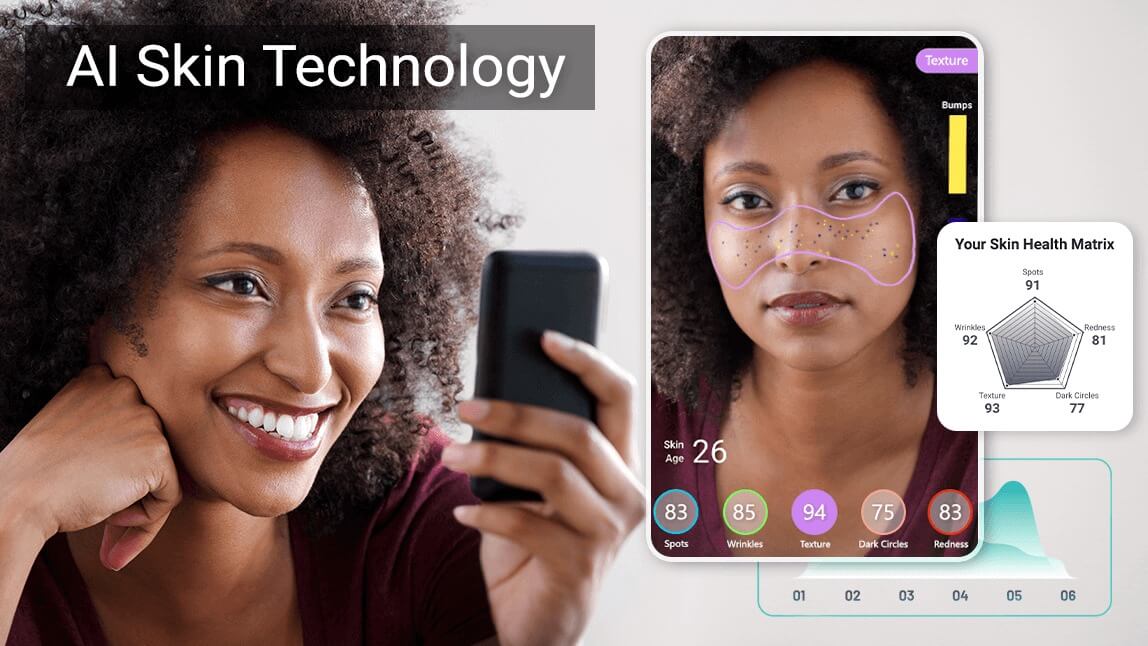
The user-facing process is straightforward: a customer uploads a selfie or activates a live camera scan, and the system returns a structured skin analysis within seconds. Behind that interaction is a pipeline of computer vision models that detect facial landmarks, segment skin regions, and evaluate multiple skin health metrics against trained classification benchmarks. Common parameters include:
- Wrinkle depth and distribution (forehead lines, periorbital area, nasolabial folds)
- Pore visibility and congestion patterns
- Skin tone evenness, redness, and pigmentation mapping
- Blemish detection and severity scoring
- Surface texture and hydration indicators

Perfect Corp.'s AI skin analysis platform adds a layer of comparative benchmarking — assigning a skin score or estimated "skin age" relative to population norms, and tracking condition changes over multiple sessions for users who return to the platform.
"The difference between a marketing tool and a genuinely useful clinical support instrument comes down to one thing: reproducibility. If the same face scanned twice in the same session returns different severity scores, the system isn't ready for professional deployment." — Skincare technology evaluator perspective
A few operational realities are worth understanding before deployment — and they're also a useful lens for evaluating the maturity of any AI skin analysis platform.
Image quality is one of the most common points of failure in real-world deployments. Perfect Corp. addresses this directly: the platform validates three capture conditions in real time — lighting quality, facial alignment, and face position — using a live three-state indicator before analysis begins. Analysis only runs once all conditions meet the detection threshold, ensuring consistent input quality regardless of the capture environment.
Skin tone and demographic accuracy is the second critical dimension. Perfect Corp.'s model was developed through clinical research across diverse ethnicities, skin tones, ages, and genders, achieving a 95% test-retest reliability rate and benchmarking favorably against VISIA — a clinical-grade complexion analysis instrument used in professional dermatology settings. For brands with multicultural customer bases, this level of validated cross-demographic accuracy is a prerequisite, not a nice-to-have.
The third dimension is recommendation quality. The analysis engine is only as commercially useful as the recommendation logic built on top of it. Perfect Corp's platform uses an extensively trained matching model to connect skin condition findings with appropriate product formulations — and brand partners can integrate their own product databases directly, enabling the system to surface specific SKUs from the brand's own range rather than generic category guidance.

Benefits of Using AI for Skin Analysis
The business case for AI dermatology tools is real, but it's more nuanced than vendor materials typically acknowledge. The benefits are genuine — they just come with operational context.
Immediate, data-backed customer engagement. Unlike a traditional product quiz, an AI skin analysis gives customers something they didn't have before the interaction: an objective, structured assessment of their actual skin condition. That shift — from "here's what we recommend" to "here's what we found, and here's why we recommend this" — meaningfully changes the customer's relationship with the brand. Customers who receive a credible, personalized assessment show higher engagement rates and are more likely to return.
Scalable consultation at the point of digital purchase. For e-commerce, the consistent challenge has been that no human advisor is present at the moment of decision. An AI dermatologist tool embedded at the product page or in the brand app replicates a version of the consultation experience that would otherwise require a store visit. This is particularly relevant for brands where the product portfolio is complex enough that customers need guidance to avoid buying the wrong thing.
Staff consistency and consultation quality control. In multi-location retail or clinic environments, one of the hardest operational challenges is ensuring that customer-facing consultation quality doesn't vary significantly between advisors or locations. AI-assisted skin analysis creates a consistent baseline that every consultation starts from — reducing the risk of customers receiving very different assessments depending on which staff member they happen to interact with.
Documented skin history for retention. For med spas and skincare clinics in particular, the ability to track a client's skin condition over time creates a clinically and commercially valuable record. Progress documentation — showing measurable improvement from treatments or product protocols — is one of the most effective tools for client retention and treatment plan compliance.
"The ROI conversation for AI skin analysis has matured. It's no longer just about engagement metrics — brands are quantifying it through basket size, consultation-to-purchase conversion, and client return frequency." — Beauty retail operations analyst
Realistic caveats on personalization claims. The quality of personalized recommendations is only as good as the recommendation logic built on top of the analysis. A highly accurate skin assessment that routes customers to generic product categories doesn't deliver the personalization value the technology is capable of. Brands that invest in connecting analysis outputs to curated, condition-specific product recommendations realize substantially better commercial results than those that treat the analysis as a standalone feature.
Business Applications: AI Dermatologist Support Tool for Brands
The use cases for AI dermatologist tools vary meaningfully depending on the business model and customer interaction context. What works for a mass-market e-commerce integration looks quite different from what a prestige skincare retailer or a med spa needs.
E-commerce and mobile app integration. Embedding an AI skin analysis capability in a brand's app or website is the most common starting point. The practical value is clearest when the analysis is connected directly to the product catalog — routing customers to specific SKUs based on their skin condition scoring, rather than to a general product category page. Brands that have done this well report measurable improvement in average order value and reduction in product returns.

In-store consultation augmentation. Deploying AI skin analysis on tablets or dedicated kiosks in retail environments serves a different purpose: it gives beauty advisors a structured, objective data point to anchor their consultation on. This is particularly useful in high-traffic retail settings where advisors are managing multiple customers simultaneously. The AI assessment gives the customer something substantive to engage with while the advisor is available, and gives the advisor a consistent starting framework rather than relying on an unstructured conversation.
Med spa and clinic intake. This is arguably where AI skin analysis delivers the highest operational value. When clients complete a skin assessment before their appointment — either at home through a patient portal or at check-in on a clinic tablet — the practitioner enters the consultation with a documented baseline. That changes the consultation dynamic: instead of spending the first portion of the appointment gathering basic skin history, the practitioner can focus on treatment planning and clinical recommendations. For high-volume med spas managing 30+ clients per day, this intake efficiency is operationally significant.
Telehealth and digital-first skincare services. AI dermatologist support tools are increasingly being used as a first-pass triage mechanism in telehealth skincare platforms. Customers submit a skin assessment before connecting with a practitioner, allowing the practitioner to prioritize cases and prepare condition-specific recommendations before the session begins. This model improves the perceived quality of the consultation while reducing the time burden on practitioners.
"In clinic settings, the most underappreciated benefit of AI skin analysis isn't the diagnosis — it's the documentation. Having a quantified baseline that you can return to at follow-up visits changes how practitioners talk about results, and how clients perceive treatment value." — Medical aesthetics practice consultant
AI Dermatologist vs. Human Dermatologist: Complement or Competitor?
This framing — AI versus human — is increasingly a distraction from the more productive question, which is: where does each add value, and how do they work most effectively together?
Licensed dermatologists are trained to diagnose, treat, and manage pathological skin conditions — melanoma, psoriasis, eczema, contact dermatitis — that require clinical judgment, physical examination, and in many cases, biopsy or lab work. No current AI skin analysis tool operates in this space meaningfully, nor should it be marketed as doing so. That distinction matters enormously both for clinical safety and for regulatory clarity.
Where AI dermatologist tools do add genuine value is in the space that clinical dermatology has never been designed to serve: the ongoing, day-to-day skincare decision-making that happens between medical appointments, at the retail shelf, or in the consumer's bathroom. Most people don't see a dermatologist for their hyperpigmentation or their dull skin texture — the barrier to accessing clinical care is too high and the need doesn't feel medical enough to justify it. AI skin analysis fills that gap.
| Dimension | AI Dermatologist Tool | Licensed Dermatologist |
| Skin condition scope | Cosmetic concerns, surface conditions | Cosmetic and pathological |
| Access and availability | On-demand, any device | Appointment-based |
| Consistency | High (same algorithm) | Variable across practitioners |
| Scalability | Unlimited concurrent users | Highly constrained |
| Clinical authority | None (support tool only) | Full medical authority |
| Cost per interaction | Very low at scale | High |
| Complex case handling | Limited / flags for referral | Full clinical management |
For telehealth platforms, the complementary model is particularly well-developed. AI skin assessment handles the intake and triage function — documenting the client's current skin condition in a structured, quantified format — while the human practitioner focuses their time on the clinical judgment and treatment planning that actually requires their expertise. This isn't AI replacing the dermatologist; it's AI handling the work that didn't need a dermatologist in the first place.
"AI skin analysis and clinical dermatology occupy different lanes. The tools that try to blur that line create liability and erode trust. The ones that stay in their lane — and make the human practitioner's job easier — are the ones getting adopted at scale." — Digital health strategy consultant
Limitations and Implementation Challenges
Any credible evaluation of AI dermatologist technology needs to include an honest look at where these systems fall short — both technically and operationally. Vendors who don't address this are worth approaching with appropriate skepticism.
Imaging environment variability — and how it should be handled. AI skin analysis models are typically trained on images captured under controlled or near-ideal conditions. Real-world deployment is messier: fluorescent retail lighting, smartphone cameras of varying quality, and users holding their phone at inconsistent angles all introduce variability that affects scoring accuracy. This is an area where engineering investment separates professional-grade platforms from consumer-facing tools. Perfect Corp.'ssystem addresses this through real-time camera validation: before any analysis begins, the platform continuously evaluates three capture conditions — lighting quality, facial alignment, and face position — signalling readiness through a live three-state indicator (green, amber, red). Analysis only initiates once all three conditions meet the detection threshold. In practice, this means the model is always working from a qualifying image rather than compensating for a poor one after the fact — a meaningful difference in deployment environments where capture conditions can't be controlled.
"The difference between a useful clinical support tool and a frustrating consumer gimmick often comes down to whether the system knows when not to run. Real-time capture validation is one of the more underappreciated engineering decisions in AI skin analysis." — Skincare technology evaluator perspective
Dataset representation and cross-demographic accuracy. Skin type classification accuracy is one of the most technically demanding aspects of AI dermatology — and one of the most commercially consequential. Models trained on narrow datasets routinely underperform on deeper Fitzpatrick types, which is not a minor technical footnote for brands with diverse customer bases. Perfect Corp. has addressed this through structured clinical research conducted in partnership with dermatological researchers, using a test population that spans multiple ethnicities, skin tones, age groups, and genders. The outcome is a model achieving a 95% test-retest reliability rate — meaning the system returns consistent severity scores when analyzing the same skin condition across repeated sessions. In comparative benchmarking against VISIA, the clinical-grade complexion analysis system widely used in professional dermatology practices, Perfect Corp's platform demonstrated accuracy at a comparable level. For brands evaluating AI skin analysis for clinical-adjacent or prestige deployments, that benchmark provides a credible reference point that goes beyond marketing claims.
"Reproducibility and cross-demographic accuracy aren't marketing metrics — they're the foundation of clinical credibility. A platform that scores differently depending on skin tone or session variance isn't ready for professional use." — Dermatology research perspective
The recommendation layer: where most deployments succeed or fail. The analysis engine and the product recommendation system are separate components, and many deployments invest heavily in the former while underbuilding the latter. An accurate skin assessment that routes a customer to a broad product category rather than a specific, condition-matched SKU doesn't deliver the personalization value the technology is capable of. Perfect Corp.'s recommendation engine approaches this differently: it is trained on large volumes of skin condition and product efficacy data, building associations between specific skin findings and the ingredient or formulation profiles most likely to be effective for each condition. Critically, brand partners can build and maintain their own product database within the platform — meaning recommendations surface actual SKUs from the brand's current lineup rather than generic category guidance. This is the operational difference between "you need a hydrating serum" and "based on your barrier score and pigmentation findings, these specific products from your range are most relevant." Maintaining that recommendation quality as product lines evolve requires ongoing catalog management, which brands should plan for as part of the integration — not as an afterthought.
Customer skepticism and trust calibration. A meaningful segment of consumers — particularly older demographics and those with previous negative experiences with tech-driven beauty recommendations — approach AI skin analysis with skepticism. Brands that present the tool as definitive or clinical in its authority often create more resistance than those that position it transparently as a personalization aid. Framing matters for adoption.
Privacy and data governance. Facial biometric data is subject to increasingly specific regulatory frameworks depending on jurisdiction — Illinois BIPA being the most prominent in the US context, with GDPR implications for European deployments. Brands deploying AI skin analysis tools need explicit consent mechanisms, clear data retention policies, and contractual clarity on how their technology vendor handles user data. This is not a legal formality; it's becoming a material customer trust issue as awareness of biometric data use grows.
"The brands that are struggling with AI skin analysis adoption aren't failing because the technology doesn't work — they're failing because they didn't think carefully enough about the consent experience, the recommendation quality, or the staff training needed to position the tool credibly." — Beauty tech implementation consultant
APIs and SDKs: How Brands Actually Integrate AI Dermatology
For most brands, building an AI dermatologist capability from scratch is neither practical nor necessary. The development cost, dataset requirements, and ongoing model maintenance involved in building a competitive skin analysis model are substantial — more suited to a dedicated AI research organization than a skincare brand's technology team.

The more realistic path is integration through APIs and SDKs from established beauty AI platforms. This approach allows brands to add AI skin analysis capabilities to their existing digital touchpoints — app, website, kiosk, or tablet — without the infrastructure investment of building from scratch.
Key considerations when evaluating API-based solutions:
Integration complexity and timeline. Well-documented APIs with SDK support for major mobile platforms (iOS and Android) and web environments can typically be integrated in weeks rather than months. The technical lift is real but manageable for brands with competent development resources. Where timelines extend significantly is in building the recommendation logic and product catalog integration on top of the analysis output.
White-label flexibility. Most enterprise AI skin analysis solutions offer customizable UI and branding, which matters for brands where the in-app experience needs to feel native to their visual identity rather than a third-party tool. The degree of customization available — and the constraints that come with it — varies meaningfully between platforms.
Algorithm update cadence and support. Skin analysis models improve over time as training datasets expand and model architecture evolves. Brands should understand how algorithm updates are deployed — whether automatically or requiring integration work on the brand side — and what vendor support looks like for version transitions.
Scalability and latency at volume. For high-traffic e-commerce implementations, the question of how the system performs under load is practical, not theoretical. Cloud-based processing that performs well at hundreds of daily users may behave differently during a product launch or seasonal traffic spike.
Perfect Corp's AI Skin Analysis platform offers enterprise-grade API and SDK access with white-label customization, enabling brands to deploy AI dermatology support across digital and in-store channels without building the underlying technology themselves.
"The build-vs-buy decision for AI skin analysis is straightforward for most brands: the time-to-market and dataset quality advantages of established platforms are too significant to ignore. The differentiation comes from how intelligently you connect the analysis output to your product and customer experience." — Beauty technology strategist
*Adjust the size of images ONLY. Please go to Strapi to edit the materials info.
The Future of AI in Dermatology
The trajectory for AI in skincare and dermatology is clearer than most emerging technology predictions — because the underlying commercial demand is already established and the technical progress is measurable rather than speculative.
Several developments are likely to meaningfully expand what AI dermatologist tools can do over the next three to five years:
Longitudinal skin tracking as a retention tool. The ability to document a customer's skin condition over time — and show measurable change from product use or clinical treatments — is arguably underdeveloped relative to its commercial potential. Brands that build structured skin tracking into their customer relationship model, rather than treating each analysis as a standalone interaction, will have a substantially richer dataset for personalization and a more compelling story for customer retention.
Wearable and environmental integration. Skin condition doesn't exist in isolation — it responds to sleep quality, UV exposure, humidity, and hormonal cycles, among many other factors. As wearable health tracking matures and integration standards improve, the most sophisticated AI skin analysis platforms are likely to incorporate contextual data alongside image analysis, producing recommendations that account for the environmental and behavioral factors affecting the customer's skin.
Predictive modeling and treatment simulation. Current AI dermatologist tools are primarily diagnostic — they assess what's present now. The next meaningful capability layer is predictive: showing customers what their skin is likely to look like in two or five years under different treatment or product protocols, or simulating the expected result of a clinical procedure before it's performed. This capability exists in limited form already and will become more accurate and clinically relevant as models improve.
Deeper clinical integration. As telehealth skincare expands and regulatory frameworks for digital health tools become clearer, the line between cosmetic AI skin analysis and clinical decision support will become more defined — and more deliberately managed. AI tools that can reliably flag presentations warranting clinical referral will become a meaningful part of the telehealth intake workflow.
"We're still in the early stages of what AI-assisted skin analysis will look like at maturity. The tools available today are genuinely useful — but they're capturing perhaps 20% of the value that longitudinal, context-aware skin intelligence will eventually deliver." — Beauty AI industry analyst
The brands and platforms that invest now in building the data infrastructure, customer trust, and recommendation quality that make AI skin analysis genuinely useful are positioning themselves for an advantage that will be difficult to replicate once the market matures. The technology is accessible; the differentiation will come from how intelligently it's deployed.
Shared Materials by Strapi
*Adjust the size of images ONLY. Please go to Strapi to edit the materials info.
Conclusion
AI dermatologist support tools represent a meaningful capability shift for skincare brands, retailers, and clinical practices — not because the technology is new, but because it's now mature enough to deliver consistent, commercially viable value at scale.
The most important thing to understand about this category is what it does and doesn't do. It doesn't replace clinical dermatology. It doesn't guarantee personalization outcomes without thoughtful recommendation logic on top of it. And it doesn't solve the customer trust challenge automatically — that requires transparent positioning and a quality experience that delivers on the promise.
What it does do, done well, is give every customer — whether shopping online at midnight or sitting in a med spa waiting room — access to a structured, objective skin assessment that they couldn't get any other way. For brands, that's a fundamentally different starting point for the customer relationship.
For businesses evaluating how to deploy AI skin analysis, the most useful next step is seeing how the technology actually performs in a real product environment rather than a controlled demo.