 Author: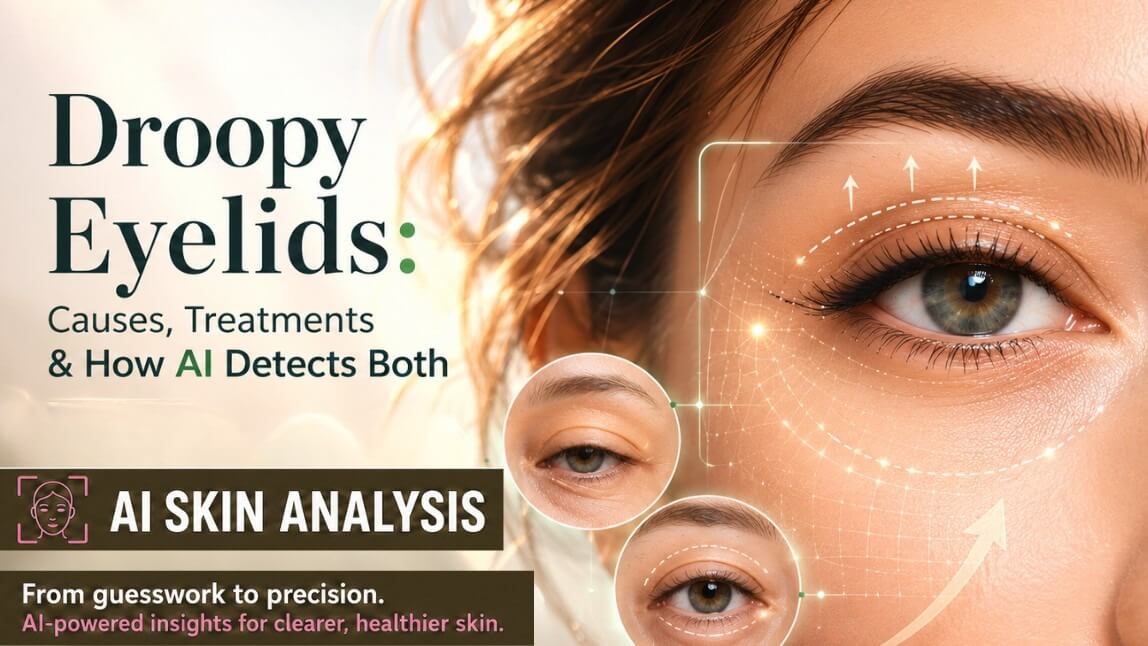
A drooping eyelid changes everything about how a face reads — and how a person feels about what they see in the mirror. It adds years. It creates a persistent look of tiredness or sadness, regardless of how rested someone actually is. And in more significant cases, it literally narrows the field of vision, making everyday tasks like reading, driving, and screen time more effortful.
But ""droopy eyelid"" is not a single condition. Upper eyelid drooping and lower eyelid drooping are anatomically distinct, caused by different structural failures, and treated in fundamentally different ways. Confusing them — or treating them as one generalized ""sagging"" problem — is one of the main reasons eyelid treatments underdeliver.
This guide covers the complete picture: what causes droopy upper and lower eyelids, how they differ, which treatments work for which type, and how AI skin analysis now detects both — independently, in real time — giving beauty brands and aesthetic clinics the diagnostic precision that used to require an in-person oculoplastic evaluation.
What Are Droopy Eyelids — Upper vs. Lower?
The eyelid system is composed of two structurally different regions — the upper lid and the lower lid — each supported by its own set of muscles, tendons, and fat compartments. When either fails, the result is visible drooping. But the mechanism, severity scale, and treatment pathway diverge significantly depending on which lid is affected.
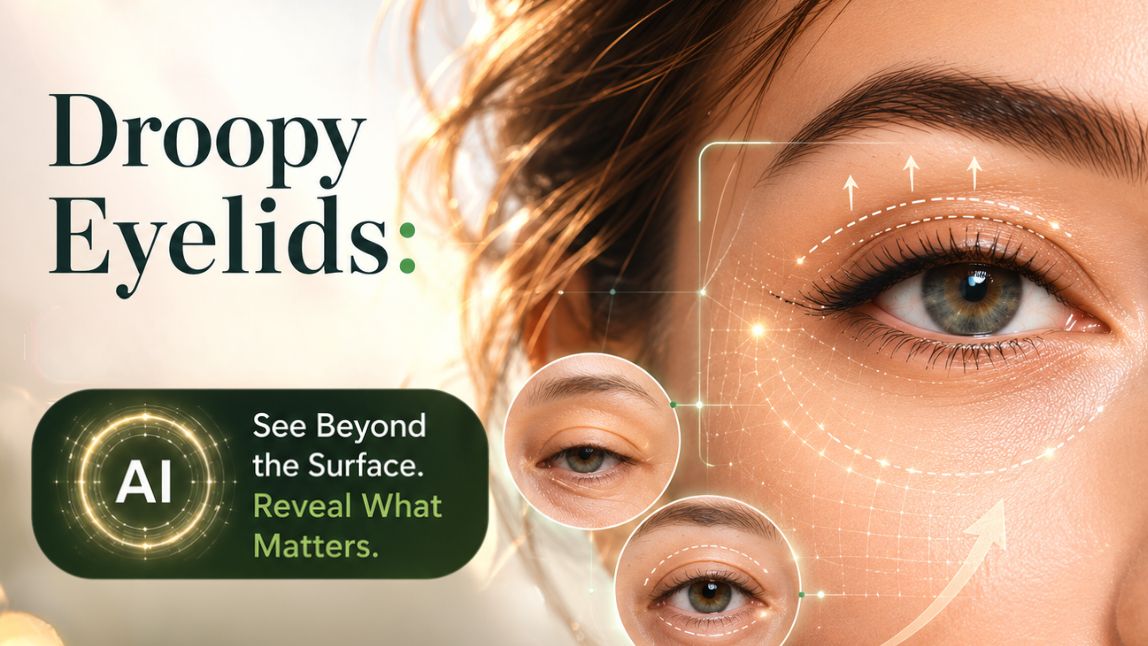
Droopy Upper Eyelid (Ptosis / Dermatochalasis)
Upper eyelid drooping has two primary clinical forms. Ptosis occurs when the levator palpebrae superioris muscle — the muscle responsible for actively lifting the upper eyelid — weakens, stretches, or loses nerve input. The lid descends and may partially or fully cover the pupil. Dermatochalasis refers to excess, redundant upper eyelid skin caused by collagen and elastin loss — the skin overhangs the lash line and creates heaviness and visual obstruction without true muscle dysfunction.
Both conditions may be present simultaneously, and both contribute to the ""heavy-lidded,"" fatigued appearance that ages the upper face significantly.
Droopy Lower Eyelid (Lower Lid Laxity / Ectropion)
Lower eyelid drooping is structurally different. The lower lid doesn't have an active muscle lifting it — it's held in position by a network of tendons, canthal ligaments, and the tarsal plate. As these structures weaken with age (or are damaged by sun exposure, trauma, or previous surgery), the lower lid loses its tone, sags away from the eye, and in more advanced cases turns outward — a condition called ectropion. Lower lid laxity can also cause fat herniation (eye bags), tear drainage problems, and eye irritation from insufficient closure.
What Causes Droopy Eyelids? A Complete Breakdown
1. Aging — The Primary Driver
Age-related changes affect both upper and lower eyelids but through different mechanisms. In the upper lid, the levator muscle aponeurosis gradually stretches or disinserts — a condition called involutional or aponeurotic ptosis. The eyelid crease rises, and the lid margin descends. In the lower lid, the canthal tendons and orbital septum weaken, allowing fat to herniate forward and the lid to lose positional stability. Dermatochalasis (excess skin from collagen loss) affects both lids and is among the most common eyelid findings in people over 50.
2. Genetics and Congenital Factors
Congenital ptosis occurs when the levator muscle fails to develop properly in utero, producing a drooping upper lid from birth or early childhood. If untreated, it can lead to amblyopia (lazy eye) — the developing brain suppresses input from the obstructed eye. A family history of early eyelid laxity or heavy upper lids is also a predictor of earlier-onset dermatochalasis in adulthood.
3. Sun Damage and Skin Aging
UV exposure degrades collagen and elastin in the eyelid skin — the thinnest skin on the face. The cumulative effect is dermatochalasis: excess skin that overhangs the upper lash line and weighs down the upper lid. Repeated sun exposure also accelerates the weakening of the orbital septum in the lower lid, contributing to fat herniation and lower lid laxity over time.
4. Neurological and Medical Conditions
Acquired ptosis can result from neurological conditions that affect the nerve supply to the levator muscle. These include Horner syndrome, myasthenia gravis, third cranial nerve palsy, and external ophthalmoplegia. Drooping caused by these conditions is neurogenic in origin and requires medical evaluation before any cosmetic intervention.
Important: Any sudden or rapidly progressive eyelid drooping — particularly if accompanied by double vision, pupil asymmetry, facial weakness, or headache — warrants urgent medical evaluation to rule out stroke, aneurysm, or other neurological emergencies.
5. Cosmetic Procedures (Botox-Related Ptosis)
If botulinum toxin migrates from a forehead or glabellar injection site to the levator palpebrae superioris muscle, it can cause temporary upper lid ptosis — typically lasting 4–8 weeks as the toxin wears off. This is technique-dependent and preventable with proper injection placement and dosing.
6. Trauma and Eye Surgery
Injury to the periorbital area, or surgical instrumentation during eye procedures, can damage the levator aponeurosis or lower lid supporting structures, producing post-traumatic or post-surgical ptosis. Previous eye surgery is a recognized risk factor for developing eyelid laxity over time.
7. Contact Lens Wear
Long-term hard contact lens wear has been associated with acquired ptosis. The repeated mechanical force of removing rigid lenses can gradually stretch and disinsert the levator aponeurosis, producing late-onset drooping in long-term wearers.
Upper vs. Lower Droopy Eyelid: Key Differences at a Glance
| Droopy Upper Eyelid | Droopy Lower Eyelid | |
| Medical term | Ptosis / Dermatochalasis / Blepharoptosis | Lower lid laxity / Ectropion / Lower dermatochalasis |
| Primary structure failing | Levator muscle, aponeurosis, or excess skin | Canthal tendons, orbital septum, tarsal plate |
| Visual appearance | Lid margin descends; heavy, hooded look; eyelid crease rises | Lower lid sags away from eye; may turn outward; eye bags worsen |
| Functional risk | Visual field obstruction; reading difficulty | Tear drainage problems; corneal exposure; eye irritation |
| Primary surgical fix | Upper blepharoplasty; ptosis repair (levator resection / advancement) | Lower blepharoplasty; canthoplasty; ectropion repair |
| Can both occur together? | Yes — very commonly in age-related periocular aging | Yes — very commonly in age-related periocular aging |
Ptosis vs. Dermatochalasis: Why the Distinction Matters
Even within the upper eyelid, two separate conditions are frequently confused — and they require different surgical approaches:
- Ptosis: The levator muscle or its aponeurosis has stretched, weakened, or disinserted. The eyelid margin itself sits too low. Treatment: ptosis repair surgery — tightening or re-anchoring the levator to raise the lid margin.
- Dermatochalasis: The levator is intact, but excess redundant skin overhangs the lash line due to collagen loss. Treatment: upper blepharoplasty — surgical removal of excess skin and, if needed, herniated fat.
Both can coexist. A surgeon addressing dermatochalasis who misses an underlying ptosis will produce a less-than-ideal surgical result. This is precisely why accurate pre-operative eyelid assessment — both conditions, both lids — matters so much.
Non-Surgical Treatments for Droopy Eyelids
- Retinoids and peptides: Stimulate collagen production in the periorbital skin, slowing dermatochalasis progression. A randomized controlled trial confirmed that retinyl propionate combined with niacinamide and peptides significantly improved periorbital smoothness and eyelid skin texture after four weeks.
- Radiofrequency (RF) and HIFU: Energy-based skin tightening that delivers heat to eyelid skin to stimulate collagen contraction. Effective for mild skin laxity and early hooding — not for true ptosis from muscle dysfunction.
- Botox (for brow ptosis): Strategically placed botulinum toxin can elevate the brow arch, reducing the appearance of upper lid hooding caused by brow descent.
- Eyelid tapes and strips: Provide temporary mechanical lifting — practical for special occasions, not a long-term solution.
- Targeted skincare (caffeine, niacinamide, ceramides): Support periorbital skin health, reduce puffiness that worsens laxity appearance, and maintain barrier integrity in the delicate eyelid area.
Surgical Treatments for Droopy Eyelids
Upper Eyelid Procedures
- Upper Blepharoplasty: Surgical removal of excess upper eyelid skin and fat. The most commonly performed eyelid procedure globally. When visual field obstruction is documented, it may be covered by medical insurance.
- Ptosis Repair (Levator Resection / Advancement): Tightens or re-anchors the levator aponeurosis to raise the lid margin to a normal position.
- Müller's Muscle-Conjunctival Resection (MMCR): An internal approach that leaves no external scar. Used for mild ptosis where levator function is intact.
Lower Eyelid Procedures
- Lower Blepharoplasty: Addresses lower lid fat herniation and excess skin. Transconjunctival approach preserves the outer eyelid surface.
- Canthoplasty / Canthopexy: Tightens the lateral canthal tendon anchoring the lower lid. The primary surgical solution for lower lid laxity and ectropion correction.
- Fat Repositioning: Repositions herniated fat into the tear trough — addressing both lower lid bags and hollowing simultaneously.
Treatment Timeline
| Treatment | Results Timeline | Duration | Best For |
| Retinoids + peptides (topical) | 4–12 weeks | Ongoing use required | Early skin laxity, dermatochalasis prevention |
| RF / HIFU skin tightening | 2–6 months | 12–18 months | Mild hooding, early skin laxity |
| Brow Botox (brow lift) | 3–7 days | 3–4 months | Brow-driven hooding (not true ptosis) |
| Upper blepharoplasty | 2–4 weeks (swelling) | Long-lasting | Moderate-severe dermatochalasis |
| Ptosis repair | 2–4 weeks (swelling) | Long-lasting | True levator weakness |
| Lower blepharoplasty / canthoplasty | 2–6 weeks (swelling) | Long-lasting | Lower lid laxity, ectropion, fat herniation |
How AI Detects Both Upper and Lower Droopy Eyelids
Eyelid assessment has historically required an in-person oculoplastic evaluation — measuring marginal reflex distance, checking levator function, grading dermatochalasis, testing lower lid snap-back. These are clinical maneuvers. They don't scale to a digital brand experience.
AI skin analysis changes that. Perfect Corp.'s AI Skin Analysis detects both droopy upper eyelids and droopy lower eyelids as separate, independently scored concerns within its 15-concern full-face analysis. Using 180° HD face mapping, the system assesses each eyelid zone bilaterally — left and right — to produce a comprehensive periorbital picture that includes:
- Droopy Upper Eyelid score: Measures the degree of upper lid descent and skin hooding relative to the eye aperture — detecting mild, moderate, and significant laxity
- Droopy Lower Eyelid score: Assesses lower lid position, sag, and structural laxity — independently from the upper lid assessment
- Cross-referenced with eye bags, dark circles, and tear trough findings — delivering a complete under-eye and periorbital profile in one scan
This bilateral, independently scored approach is clinically significant. Upper and lower lid drooping often coexist but don't always — and they require completely different product and treatment recommendations. An AI system that distinguishes between them, scores them separately, and generates appropriate recommendations for each offers diagnostic nuance that no self-assessment quiz or generic ""eye area concern"" dropdown can replicate.
A medical study confirms Perfect Corp.'s AI Skin Analysis achieves a 95% test-retest reliability rate across its 15 skin concerns — including the eyelid-specific assessments.
Want to detect upper and lower droopy eyelids with clinical-grade AI precision?

Why Eyelid Assessment Matters for Beauty and Aesthetic Brands
The periorbital zone is consistently ranked as the top aging concern across consumer surveys — more than wrinkles, pigmentation, or skin texture. And yet it's the zone where generic recommendations fail most visibly, because the concerns are too anatomically specific to be addressed by one-size-fits-all solutions.
Droopy upper eyelids, droopy lower eyelids, eye bags, dark circles, and tear trough hollowing are five distinct concerns that frequently coexist and require different interventions. A brand that can identify which of these a customer actually has — and recommend accordingly — is offering a fundamentally different and higher-value experience.
The global AI skin analysis market is valued at USD 2.13 billion in 2026 and projected to reach USD 6.30 billion by 2033 at a CAGR of 16.8%. Periorbital detection — including eyelid laxity — is one of the highest-engagement use cases in consumer AI skin diagnostics.
See how leading aesthetic brands use AI periorbital detection to drive conversion and loyalty.

When to See a Doctor About Droopy Eyelids
Consult a physician or ophthalmologist if:
- Eyelid drooping appeared suddenly — especially if accompanied by double vision, pupil changes, facial weakness, or headache
- One eyelid droops significantly more than the other (asymmetric ptosis)
- The droop is obstructing your upper visual field or making reading and screen work difficult
- You are a child or parent of a child with drooping eyelids — early treatment prevents amblyopia
- Lower lid is turning outward, causing eye dryness, tearing, or irritation
Frequently Asked Questions
What is the difference between ptosis and dermatochalasis?
Ptosis is drooping caused by weakness or disinsertion of the levator palpebrae superioris muscle — the lid margin descends. Dermatochalasis is excess redundant upper eyelid skin caused by collagen and elastin loss — the lid margin may be at normal height, but overhanging skin creates a hooded appearance. Both are upper eyelid concerns but require different surgical corrections, and they frequently coexist.
Can droopy eyelids cause vision problems?
Yes. Moderate-to-severe upper eyelid ptosis or dermatochalasis can obstruct the superior visual field. Lower lid ectropion can cause corneal exposure, dryness, and irritation. In children, untreated congenital ptosis can cause amblyopia through visual deprivation during critical development windows.
Can AI detect droopy eyelids accurately?
Yes. Advanced AI skin analysis platforms like Perfect Corp's use HD computer vision to assess upper and lower eyelid position, skin laxity, and lid aperture from facial imaging — detecting both droopy upper and droopy lower eyelids as independently scored concerns. The system achieves a 95% test-retest reliability rate across its periorbital assessments.
Is there a non-surgical fix for droopy upper eyelids?
For mild cases or early-onset skin laxity, radiofrequency skin tightening, strategic brow-lifting Botox, and retinoid-based topicals can improve the appearance of upper lid hooding. For true ptosis from muscle dysfunction, or significant dermatochalasis that obstructs vision, surgery remains the most effective and durable solution.
What causes droopy lower eyelids?
Lower lid drooping is caused by weakening of the canthal tendons and orbital septum — structures that anchor and support the lower lid. This is primarily age-related, but can be accelerated by sun damage, previous eye surgery, or trauma. It is structurally distinct from upper lid drooping and requires different treatment approaches.
How do beauty brands use AI eyelid detection?
Brands use AI upper and lower eyelid assessment to deliver precise, personalized recommendations — matching customers to targeted eye care products or clinical referrals based on their specific laxity pattern. This dramatically improves recommendation accuracy compared to generic ""eye area"" categorization, reducing returns and improving customer satisfaction.
The Bottom Line
Droopy eyelids are not one problem — they're a family of distinct structural concerns across two anatomically different lid systems. Upper lid drooping, lower lid laxity, ptosis, dermatochalasis, and ectropion each have their own mechanisms, treatment pathways, and product implications. Getting the assessment right is the first step toward getting the recommendation right.
Perfect Corp.'s AI Skin Analysis detects droopy upper eyelids and droopy lower eyelids as separately scored concerns — cross-referenced with eye bags, dark circles, and tear trough hollowing — delivering a complete periorbital diagnostic picture from a single selfie scan, with clinical-grade reliability.
Ready to bring AI upper and lower eyelid detection to your platform?

Sources
- Cleveland Clinic – Ptosis (Droopy Eyelid): Causes & Treatment. clevelandclinic.org
- WebMD – Droopy Eyelid (Ptosis): 5 Causes of Drooping Eyelid & Treatment (reviewed March 2026). webmd.com
- Healthline – Ptosis: Droopy Eyelid Causes, Symptoms, and Treatment (updated April 2025). healthline.com
- Medscape – Dermatochalasis: Background, Pathophysiology, Epidemiology. emedicine.medscape.com
- NCBI / StatPearls – Lower Eyelid Laxity Examination. ncbi.nlm.nih.gov
- NIH / PMC – Synchronous Surgical Treatment of Lower Eyelid Involutional Entropion and Ptosis (2018). ncbi.nlm.nih.gov
- NHS – Ectropion. nhs.uk
- Coherent Market Insights – AI Skin Analysis Market Size, Trends & Forecast 2026–2033. coherentmarketinsights.com
- Perfect Corp. – AI Skin Analysis Solution for Beauty Brands & Clinics. perfectcorp.com