 Author:


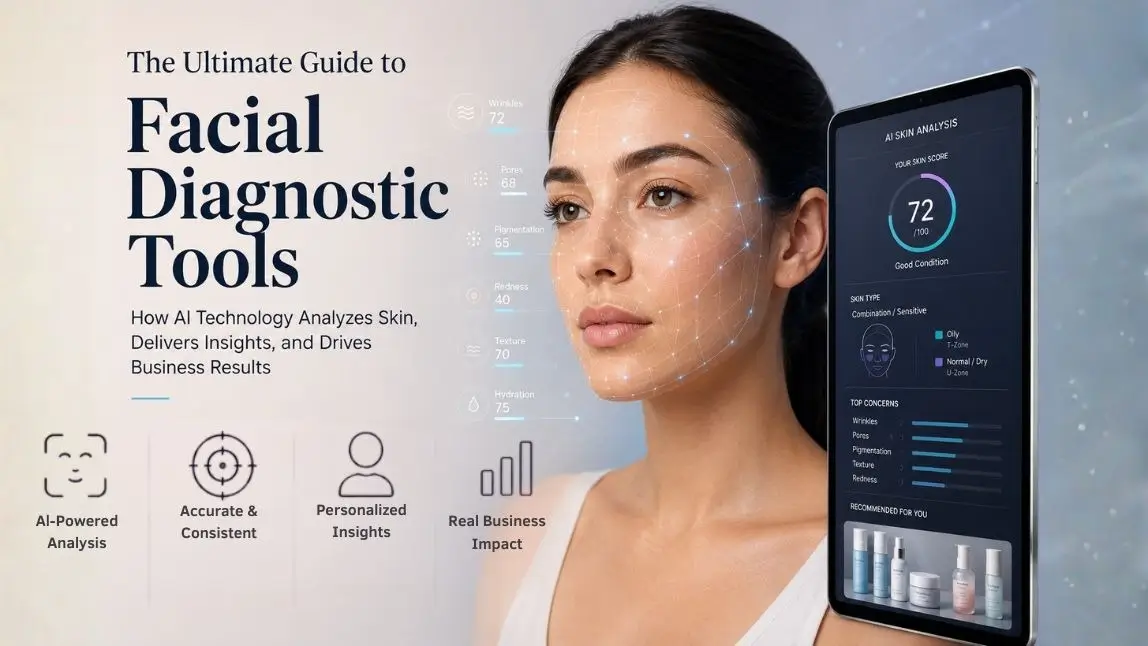
The phrase "facial diagnostic tool" covers a wide spectrum — from the UV imaging devices you'd find in a dermatologist's back room to software-based AI systems running on a retail iPad. But for most businesses looking at this category today, the operative question is the same: how do we move beyond "what's your skin type?" and give customers a genuine, data-supported skin assessment at scale?
This article breaks down what facial diagnostic tools actually are, how the underlying technology works, where they fit across different business contexts, and what separates tools that create real commercial value from those that don't.
What Is a Facial Diagnostic Tool?
A facial diagnostic tool is any system — hardware, software, or a combination of both — designed to assess the visible condition of a person's skin and produce a structured output: a skin profile, a set of scored parameters, or a recommendation based on what was detected.
The category has two broad branches:
Hardware-based diagnostic devices use specialized imaging technology — multispectral cameras, Wood's lamp UV analysis, cross-polarized light — to capture skin data that goes beyond what a standard camera can see. These systems can reveal sub-surface pigmentation, sebum distribution, and early-stage conditions not yet visible to the naked eye. They are common in clinical settings: dermatology offices, medical spas, aesthetic medicine clinics. The trade-off is cost, footprint, and the need for trained operators.
Software-based AI facial diagnostic tools use computer vision and machine learning to analyze standard camera images — from a smartphone, tablet, or webcam — and detect visible skin concerns: wrinkles, pore size, uneven tone, texture irregularities, redness, dark spots, and hydration indicators. These systems sacrifice some of the depth of clinical imaging but gain significant advantages in accessibility, cost, and scalability. A brand can deploy the same diagnostic capability across a website, a flagship store, a third-party retailer, and a mobile app — simultaneously, at consistent quality.
For most skincare brands, beauty retailers, and aesthetic clinics operating at scale, the latter category is the more operationally relevant one. The question is not whether AI-based facial diagnostic tools are as technically deep as clinical imaging devices — they are not. The question is whether they are accurate and consistent enough to improve consultation quality, increase customer confidence, and support better product or treatment decisions. For well-built systems, the answer is yes.

How AI-Based Facial Diagnostic Technology Works
Understanding what happens inside a modern AI facial diagnostic tool helps separate credible systems from superficial ones — and informs what to look for when evaluating options.
Image Capture and Preprocessing
The process begins with image acquisition: a front-facing camera captures the user's face in either photo or live mode. Before any analysis runs, the system preprocesses the image to normalize for variables that would otherwise distort results — ambient lighting, image resolution, color temperature, facial orientation, and skin tone. This preprocessing stage is where a lot of real-world performance variability lives. A well-engineered system handles inconsistent retail lighting or a slightly off-angle selfie and still returns reliable output. A poorly engineered one degrades quickly outside controlled conditions.
Skin Condition Detection
The preprocessed image is then run through computer vision models trained on large, labeled dermatological datasets. Each model is responsible for detecting and scoring a specific skin parameter: wrinkle depth and distribution, pore visibility, oiliness, redness, hyperpigmentation, dark circles, texture, firmness, hydration level, and so on.
The accuracy of these models is directly dependent on the diversity and quality of the training data — both in terms of the range of skin conditions represented and the demographic breadth of the images used. Systems trained predominantly on a narrow range of skin tones will underperform on others. This is worth asking about explicitly when evaluating any vendor.
Perfect Corp.'s AI skin diagnostic model was trained on over 70,000 clinically annotated images and has been validated against physician assessments, achieving a 95% test-retest reliability rate and an 80% correlation with professional dermatologist evaluations. Those numbers matter not as marketing benchmarks but as indicators that the detection models have been developed with clinical rigor rather than optimized purely for visual output.
Skin Type Classification
Beyond individual parameter scoring, a well-designed facial diagnostic tool also classifies overall skin type. This typically involves zone-based analysis — evaluating the T-zone and U-zone separately for oiliness, dryness, and reactivity — to assign a skin condition classification: oily, dry, combination, sensitive, or normal.

More sophisticated systems also classify Fitzpatrick skin type, which reflects how the skin responds to UV exposure and is relevant for both product recommendation and treatment safety. This is particularly important for clinics and professional brands working with clients across a full range of complexions.

Recommendation Generation
The structured skin profile feeds into a recommendation layer that maps detected conditions to product SKUs or treatment protocols. In a consumer-facing deployment, this produces a personalized skincare routine. In an enterprise deployment, the recommendation logic is configured to the brand's own product catalog or treatment menu — so the output is grounded in what the business actually offers, not a generic category list.
This layer is often where the real commercial value is created or lost. A diagnostic engine that produces accurate skin data but feeds into a generic or poorly configured recommendation layer loses most of its conversion value.
Data Output
Results are returned as structured data — a skin report the customer sees, plus underlying scores that can feed into CRM systems, loyalty platforms, or clinical record software. The richness of the data output, and how well it integrates with existing business systems, is a meaningful differentiator across enterprise solutions.
Types of Facial Diagnostic Tools: A Practical Overview
Not all facial diagnostic tools serve the same purpose or fit the same business context. Here is a working breakdown of the main categories and where they apply:
AI Software Diagnostic (Camera-Based)
Best for: Skincare brands, beauty retailers, e-commerce, med spas at scale, DTC platforms
Analyzes standard camera images using computer vision. Detects visible skin parameters. Deployable across web, app, and in-store environments without specialized hardware. Results are generated in seconds.
The primary limitation is scope: AI camera-based tools assess what the camera can see. Sub-surface conditions, early-stage pigmentation forming below the epidermis, and physiological factors like cortisol levels or transepidermal water loss are outside the detection range.
Multispectral and UV Imaging Devices
Best for: Dermatology clinics, advanced aesthetic medicine, clinical research
Hardware-based systems that use multiple light sources — visible, UV, cross-polarized, parallel-polarized — to visualize conditions not apparent under standard lighting. Can reveal sun damage accumulation, sebum distribution, and early-stage pigmentation changes. Require trained operators and controlled lighting environments.
High diagnostic depth, but limited to clinical settings and not scalable across a retail or e-commerce footprint.
Smart Mirror and Kiosk Systems
Best for: In-store retail, beauty activations, flagship experiences
Integrated hardware-software systems combining AI analysis with a physical display interface. Typically uses front-facing cameras embedded in a mirror or kiosk form factor. The diagnostic capability is usually software-based (same as category one), but the hardware context creates a more immersive in-store experience.

Deployment cost and installation complexity are higher than tablet-based solutions. Best suited to flagship or high-traffic locations rather than broad multi-door rollouts.
Professional-Grade Consultation Software (Clinical)
Best for: Aesthetic clinics, dermatology practices with structured patient workflows
Software platforms designed for practitioner-led consultation — intake documentation, longitudinal skin tracking across visits, treatment planning. Often integrates with clinical record systems. The diagnostic component may be AI-based, imaging-based, or a combination.
Emphasizes data structure and clinical workflow integration over consumer-facing user experience.
Where Facial Diagnostic Tools Create Real Business Value
The commercial case for facial diagnostic tools rests on a few specific outcomes that have shown consistent evidence across enterprise deployments.
Consultation Quality Without Staff Dependency
The most persistent operational problem in skincare retail is consultation inconsistency. A brand's flagship counter and its department store presence may sell the same products, but the quality of skin consultation a customer receives depends entirely on which associate is working. A trained esthetician gives a meaningfully different recommendation than a new associate relying on a questionnaire.
AI facial diagnostic tools create a floor of quality — a structured, data-supported skin assessment that produces consistent output regardless of who is operating it. The associate's role shifts from skin assessment to product conversation, which is where their expertise actually adds value.
As one esthetic industry consultant with multi-brand retail experience has noted: "The biggest operational win from AI skin diagnostics isn't the technology itself — it's that it stops consultation quality from being a function of staff turnover."

Conversion and Basket Size
When a product recommendation is grounded in an actual skin scan rather than a self-reported quiz, customers have a concrete reason to trust it. The purchase decision becomes easier because the rationale is visible. Brands consistently report conversion rate improvements when scan-driven recommendations replace category-based browsing or questionnaire outputs — not because the products changed, but because the customer's confidence in the recommendation did.
This effect is strongest for higher-margin products where the customer might otherwise hesitate without justification. A serum recommended because the diagnostic tool flagged low firmness scores in the cheek and jaw area is a different purchase decision than the same serum sitting on a shelf.
Longitudinal Tracking and Treatment Efficacy
For clinics and professional skincare brands, the ability to rescan a customer over time — and show measurable changes in the skin parameters being addressed — changes the nature of the consultation. Progress becomes visible rather than reported. Treatment efficacy conversations shift from claims to evidence.
This longitudinal dimension is also commercially useful for subscription-based skincare services. A customer who can see that their dark circle scores improved after three months on a specific routine has a concrete reason to continue.
Aggregate Skin Data as a Business Asset
Every scan generates structured data. Across a customer base, that data reveals which skin concerns are most prevalent in which demographic and geographic segments — information that is useful for product development, promotional strategy, and treatment menu decisions in ways that purchase history alone cannot provide.
A brand that knows that 62% of its customers scanning in a specific retail region score high on redness and texture concerns has actionable input for both its inventory allocation and its content marketing. Most brands are not yet using AI diagnostic data at this layer — which is precisely why those that do have a structural advantage.
Evaluating a Facial Diagnostic Tool: What Actually Matters
For businesses in vendor selection, the evaluation criteria that matter most are not always the ones that get the most attention in sales conversations.
Training data quality and diversity. Ask specifically about the demographic breadth of the training dataset and whether the system has been validated across Fitzpatrick types I through VI. Accuracy on a homogeneous training set does not translate to accuracy across a diverse customer base.
Accuracy methodology. "High accuracy" is not a specification. Ask for validation methodology: what the model was tested against (self-reported labels, dermatologist assessments, repeat-scan reliability), what sample size was used, and what populations were tested. Perfect Corp.'s system, for instance, cites a 95% test-retest reliability rate and 80% physician-correlation rate — specific metrics derived from clinical validation, not internal optimization.

Environmental robustness. How does the system perform in variable lighting? What happens with different device cameras? Enterprise deployments encounter real-world conditions that demo environments do not. Systems that degrade significantly outside controlled conditions create inconsistent customer experiences.
Recommendation configuration. Can the recommendation layer be mapped to your own product catalog or treatment menu? A diagnostic tool that generates accurate skin data but feeds into a generic recommendation list is only half-built for enterprise use.
Integration architecture. How does the system return data? REST API, SDK, pre-built widget? What CRM or platform integrations are supported or documented? The procurement conversation often focuses on diagnostic capability; the implementation pain usually lives in the integration layer.
Privacy and data handling. Skin biometric data is sensitive. Understand what data is stored, for how long, how it is secured, and what consent framework the vendor supports. For businesses operating in the EU, California, or other regulated jurisdictions, GDPR and CCPA compliance is not optional.
Facial Diagnostic Tools Across Business Types
Skincare Brands and Specialty Retail
The core deployment model is consultation augmentation: a tablet or web widget enables a structured skin scan at the point of consultation or purchase, and the output informs a product recommendation. In-store, this typically runs on an iPad at the consultation counter. Online, it runs as an embedded module on the brand's product or recommendation page.
The key operational consideration is workflow integration — how the scan output feeds into the associate's conversation, and whether the system is configured to recommend from the brand's own product range rather than generating generic suggestions.
Decorté, the Japanese luxury skincare brand, integrated Perfect Corp.'s AI skin analysis specifically because of the diagnostic rigor: "When we saw that Perfect Corp. used 70,000 clinical images and validated results with dermatologists and skincare experts, we knew we could use this to help our customers achieve the results and aspirations they have for their skincare."
Medical Spas and Aesthetic Clinics
In clinical settings, a facial diagnostic tool serves two distinct functions. The first is intake documentation: a standardized, timestamped skin baseline created at each visit, freeing the practitioner to focus on treatment planning rather than baseline assessment. The second is longitudinal tracking: repeat scans over the course of a treatment program that produce a comparative record demonstrating measurable skin change.
Multi-location clinic groups are also beginning to use aggregate diagnostic data to identify which concerns are most prevalent across their patient populations — informing treatment menu priorities and targeted marketing.
The consideration for clinical deployment is whether the system's output is structured for clinical use: organized by parameter, time-stamped, and exportable to intake or record systems.
E-Commerce and DTC Platforms
For direct-to-consumer skincare brands and beauty subscription services, the challenge is delivering consultation-quality personalization without a physical touchpoint. AI facial diagnostic tools solve this by giving customers a data-grounded assessment at the start of the purchase journey — before they navigate a category page or add to cart.
Cetaphil's integration with Perfect Corp.'s platform reflects this use case directly. As their team described it: "Scanning someone's skin and giving them an AI-generated score identifying their skin status, then giving them customized product recommendations and tips and tricks — this was a great way to leverage AI technology."
The downstream commercial benefit is measurable: recommendation fit improves, return rates decline, and post-purchase satisfaction increases when the product was chosen based on actual skin data rather than general browsing.

Limitations Worth Acknowledging
A credible assessment of any technology includes its real boundaries. AI-based facial diagnostic tools have several:
Depth of detection. Camera-based AI analysis is limited to what is visible at the skin surface. Sub-surface conditions — early pigmentation forming below the epidermis, dehydration at the dermal layer, vascular irregularities — are outside detection range. For clinical diagnoses, these tools supplement professional assessment; they do not replace it.
Lighting sensitivity. Ambient lighting conditions affect output quality. Variable or poor lighting in retail environments, or consumer device cameras with inconsistent front-facing flash behavior, introduce noise that can reduce detection reliability. This is addressable through controlled hardware setup but requires attention during deployment planning.
Dataset limitations and skin tone performance. As noted above, training data composition affects model performance across skin tones. This remains an industry-wide issue, not specific to any single vendor, but it is a variable that businesses serving diverse customer bases must evaluate directly.
Customer consent and adoption. Not every customer will opt in to a facial scan. Transparent communication about what data is captured, how it is used, and how long it is retained is a meaningful factor in opt-in rates. Brands that handle data privacy communication clearly tend to see higher adoption than those that bury it.
Over-reliance risk. AI diagnostic output is informative, not definitive. Staff training should emphasize applying professional judgment alongside the scan data — not deferring to it. As Dr. Howard Murad, a board-certified dermatologist and founder of Murad Skincare, has observed: "Skin diagnostics tools are most valuable when they sharpen a practitioner's instincts, not replace them."
Where the Category Is Heading
The next meaningful developments in AI facial diagnostic tools are moving in a few directions that have practical implications for businesses evaluating now.
HD and multi-zone precision. Current-generation systems analyze the face at the parameter level. Newer architectures, like Perfect Corp.'s HD Skin Analysis, produce zone-specific results — separate scores and insights for the forehead, cheeks, nose, and jaw — enabling much more targeted product or treatment recommendations. This matters for both clinical protocols and for brands with a nuanced product range (a barrier cream targeted specifically at perioral dryness rather than "dry skin" generally).
AI agent integration. The combination of facial diagnostic tools with conversational AI is producing a new consultation format: the AI beauty agent. The diagnostic tool provides the structured skin data; the conversational layer translates it into a dialogue — asking follow-up questions, clarifying concerns, and delivering a recommendation that feels like a consultation rather than a scan result. This architecture is beginning to move from pilot to production deployment across enterprise beauty brands.
Longitudinal skin health monitoring. The shift from one-time scan to ongoing skin tracking changes the customer relationship from transactional to longitudinal. Brands and clinics that build periodic rescanning into their customer lifecycle — and use the comparative data to demonstrate product or treatment impact — are starting to see measurable differences in retention and lifetime value.
"Skin data is transitioning from a conversion feature to a long-term brand asset," notes one beauty technology strategist. "The brands that will have a durable advantage are those building longitudinal relationships with customers' skin — not just optimizing for the first purchase."
Seeing It in Practice
For businesses evaluating AI facial diagnostic tools, the most useful next step is seeing what the actual output looks like — across different skin types, concern levels, and input conditions.
Perfect Corp.'s live skin analysis showcase lets you run a real scan through the platform's diagnostic engine, covering 15+ skin parameters with HD-level precision. It is worth testing with your own use case in mind: what would this skin profile tell a consultant or practitioner, and how would it change the product or treatment conversation?

For businesses at a more serious evaluation stage — looking at integration architecture, white-label configuration, enterprise pricing, or multi-location deployment — the Perfect Corp. team works directly with brands and clinics on implementation planning. A 14-day free trial of the Skincare Pro app is available for businesses that want to test the tool in a live operational context before committing.
The technology is mature, the clinical validation is documented, and the business cases are well-established. The remaining question is how well it fits your specific workflow — and that is a question worth answering with a real test rather than a spec sheet.