 Author:



The concept of “digital transformation” has been an ongoing conversation since the dawn of the internet. Even if you haven’t used those exact words, you’ve felt the impact of it: with the proliferation of smartphones, increasing channels for commerce, and a rising comfortability of consumers conducting their business online, the imperative for brands to step up their digital offerings has never been more essential than it is right now.
Quick answer: A digital transformation strategy in beauty retail moves the try-before-you-buy and consultation moments online with AI and AR, then uses the data those tools generate to personalize every channel. The brands below show what that looks like in practice: NARS reported a color try-on conversion rate 350% above its site average, and Sally Hansen doubled time spent on product pages.
| Table of Contents |
|---|

It’s also no surprise that the COVID-19 years (2020 to 2022) accelerated this imperative. As consumers were largely confined to their homes, these remote conditions pushed a large portion of in-person commerce online. Brands and retailers that relied on those in-person, personalized experiences had to rethink their strategies. Chief among them, beauty brands, saw digital transformation as a major opportunity, and leveraged emerging technologies—particularly augmented reality and artificial intelligence—to adapt their businesses to the times.
The beauty industry is rife with digital transformation strategy success stories. Deploying creative, forward-thinking applications of AR and AI has enabled brands and CPGs to not only weather the storm brought on by the pandemic but future-proof their businesses through engaging, consumer-focused offerings across countless digital channels.
How NARS is Engaging Customers With Virtual Try-On
As any cosmetics consumer knows first-hand, the shopping process can be particularly intimidating. Makeup and beauty products rely on a customer being able to see what a product looks like on them, with their unique features and skin tones or skin types. Unfortunately, in many shopping environments both in-store and online, it’s simply impossible to try on every type of product to determine the best fit.


With advances in AI and AR, the digital transformation occurring in the beauty industry is revolutionizing how consumers are able to shop for cosmetics. NARS Cosmetics, a French cosmetics and skincare company, is one of the brands leading the charge in implementing this new digital interface to adapt to the changing needs of their customers.
“We use AR and AI because it’s just a fundamental tool that every brand must have today to be able to be considered a global brand and a big player in dot com,” says Julia Sloan, Deputy General Manager of Global Marketing at NARS.
NARS has implemented virtual try-on (VTO) across a wide range of categories, including foundation, eye, and lip products. Enabling customers to see how different beauty products work for them has helped drive engagement and sales; it isn’t just a fun gimmick. After implementing VTO, NARS has observed measurable, tangible results.
“In the first two months, we saw over 50,000 consumers engaging with this tool,” Sloan says.


One of the major success stories was NARS’s VTO tool for their lip category. Consumers used the tool at astronomical rates, virtually trying on, on average, 27 different shades. And these virtual try-ons converted to sales: the brand’s year-to-date color VTO conversion rate was +350% compared to their site average.
“When you think of digital acceleration, it’s about making that consumer journey online easy and frictionless so that they can purchase when they’re trying on makeup,” Sloan says.
Coty Creates Immersive, Personalized Shopping Experiences Through AR & AI
Coty, Inc. has a massive footprint across the beauty industry, with controlling interests in more than 75 brands across the cosmetics, nail, and skincare spectrum. Each of these brands is unique, and requires an individualized approach to digital experiences.


As with all beauty care products, the customer experience is highly personal. And for brands with dozens or hundreds of offerings, it can be a challenge to connect the right product to the right customer. Particularly in a predominantly digital shopping environment, those personalized experiences can be difficult to capture.
One of Coty’s marquee brands, Sally Hansen, boasts a catalog of hundreds of different nail polish colors and types. Creating a personalized experience where a customer can try on nail polish before purchase used to be a major challenge for brands; if you’ve ever been to a drug store with a cosmetics counter odds are you’ve seen stripes of nail polish on a countertop as customers attempt to get a better idea of the polish’s characteristics.
By partnering with Perfect Corp., Sally Hansen was able to develop a virtual try-on interface using AgileHand™ technology. Through AR and AI, Sally Hansen’s VTO creates a truly personalized experience for customers; there is nothing more personalized than someone being able to see a shade on their actual nails with their exact shape and skin.


After instituting this advanced VTO engine, Sally Hansen was able to increase time spent on product pages by 100% and increased add-to-basket rates by 110%.
This engagement is great for sales, but it’s also a powerful tool for future omnichannel efforts. The data that comes in through VTO enables Sally Hansen to drive better personalization and outreach going forward and creates a full 360-degree approach to customer engagement across countless consumer channels.
For Belcorp, Technology is a Perfect Match for its Digital Transformation Strategy
As an industry, beauty and cosmetics are required to be on the cutting edge of technology. With young audiences that are highly engaged in emerging social platforms, beauty needs to be in a constant state of innovation to connect to those customers. Modern consumers expect beauty tech to provide a level of personalization and connection to make informed purchasing decisions.


Belcorp, a leading global beauty conglomerate, leverages AI to provide those personalized experiences for their customers across channels. As brands continue to create and deploy engaging VTO engines, it in turn creates stores of actionable data that can be used to further optimize the customer experience. By centering the shopping experience on the needs of the customer and working from there, brands are able to connect to consumers in new and unique ways to drive engagement and ultimately sales.
“We have to go to the next level in terms of experience and personalization,” says Venkat Gopalan, Chief Digital, Data, and Technology Officer for Belcorp. “How do I integrate the data and behavior of the consumer to drive a personalization engine that can actually give a seamless experience across all channels.”


Which AI and AR Tools Fit Which Business Goal?
Beauty tech decisions usually involve two people: someone who checks whether the technology works with your stack, and someone who signs off on the budget. This table is built for both, using the results the brands in this article reported.
| Tool | Best for | What the technical evaluator checks | What the budget owner measures |
|---|---|---|---|
| AI makeup virtual try-on | Color cosmetics with large shade ranges (foundation, lip, eye) | Shade accuracy across skin tones; Web Module/SDK or Mobile App SDK fit | Conversion rate vs. site average (NARS: +350% for color try-on) |
| AR nail try-on (AgileHand™) | Nail polish and nail care catalogs with hundreds of shades | Hand and nail tracking on real nail shapes and skin tones | Time on product page and add-to-basket rate (Sally Hansen: +100% and +110%) |
| AI personalization and try-on data | Multi-brand groups selling across many channels | How try-on and behavior data flows into CRM and e-commerce systems | Cross-channel personalization and repeat engagement |
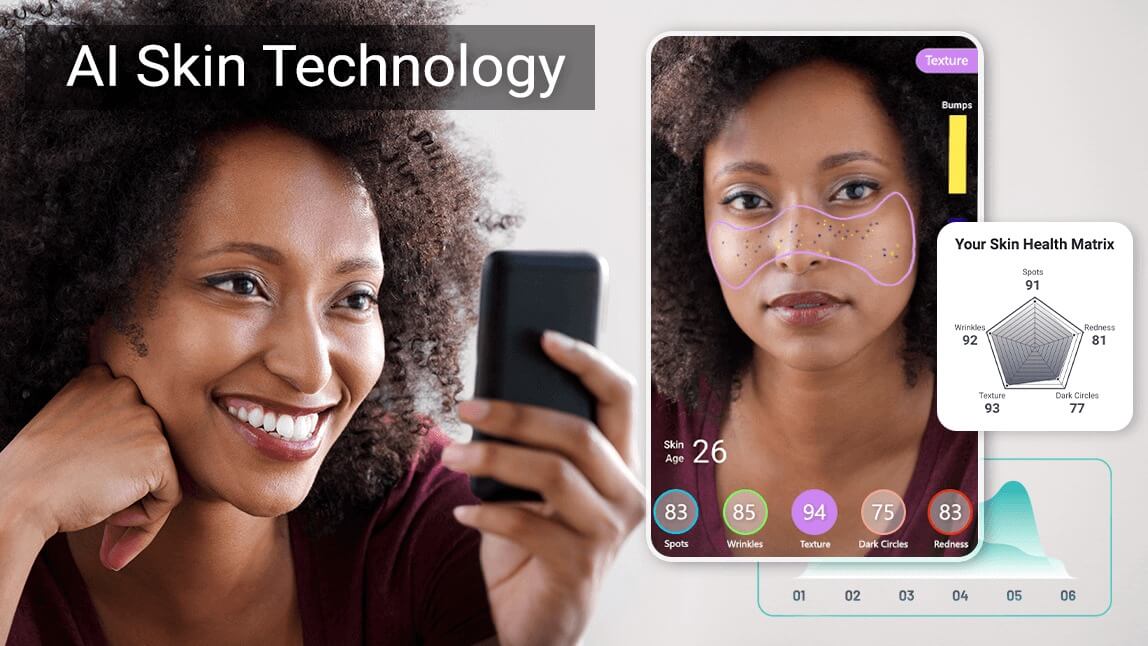
| AI Skin Analysis | Skincare brands and retailers that sell through consultations | Which skin concerns are detected and how results map to products | Consultation-to-purchase rate and basket size |
Our verdict: If color cosmetics drive most of your revenue, start with makeup virtual try-on on your product pages. It is the use case with the clearest measured results in this article, and the try-on data it produces feeds the personalization work that brands like Belcorp describe.
What ROI looks like in these examples
The numbers worth tracking come straight from these brands: NARS counted over 50,000 consumers using its try-on tool in the first two months, with shoppers trying an average of 27 lip shades. Sally Hansen measured a 100% increase in time on product pages and a 110% increase in add-to-basket rate after launching AR nail try-on. Before you launch, benchmark the same metrics on your own product pages so you can compare like for like.
Digital Transformation Strategy: Bringing Beauty Tech to the Next Level
The insights and digital learnings that can be mined from a highly engaged consumer base are a win-win for beauty brands and customers alike. Beauty tech is enabling brands to provide optimized experiences, and consumers are able to make informed decisions about products that serve as important expressions of their own personalities and identities.
As the world moves more into the digital realm—whether that be in the Metaverse or on emerging gaming platforms—beauty tech will play a key role as it seizes on the opportunities provided in those spaces. The foundations being laid through virtual try-on and other AR and AI deployments have immense potential to translate to these digital environments in compelling and unique ways.
While there will be newfound challenges in these spaces—from privacy and security to digital identity and equity—beauty tech can serve as a catalyst for innovation as digital transformation strategy continues to evolve and impact more and more of our daily lives.
What Has Changed Since 2022
When this article was first published in 2022, virtual try-on was mostly a response to closed stores. In 2027 it is a standard part of the beauty buying journey: shoppers expect to try shades on product pages, inside retailer apps, and on social and search platforms such as Snapchat, YouTube and Google Search. AI skin analysis has followed the same path from novelty to an expected step before a skincare purchase. The lesson from NARS, Coty and Belcorp still holds: start with the moment where shoppers hesitate most, measure it, and reuse the data across channels.
Frequently Asked Questions
What is a digital transformation strategy in beauty retail?
It is a plan for moving the parts of beauty shopping that used to need a store, like testing shades or getting skin advice, into digital channels with AI and AR, and then using the resulting data to personalize marketing and product recommendations.
Which AI and AR tools do beauty brands start with?
Most start with makeup virtual try-on on product pages because it targets the biggest purchase hesitation in color cosmetics. Nail brands use AR nail try-on such as AgileHand™, and skincare brands add AI skin analysis to recreate an in-store consultation online.
How do you measure ROI from virtual try-on?
Compare try-on users with your site average on conversion rate, add-to-basket rate and time on product page. Those are the metrics NARS and Sally Hansen reported, which makes them a practical baseline for your own business case.
Can virtual try-on run across web, app and social channels?
Yes. Perfect Corp's try-on runs through a Web Module/SDK and a Mobile App SDK, and it also supports AR for Shopify and try-on experiences on Snapchat, YouTube and Google Search, so one shade library can serve several channels.
Shared Materials by Strapi
*Adjust the size of images ONLY. Please go to Strapi to edit the materials info.
If you are building a digital transformation strategy for a beauty brand or retailer and want to see where virtual try-on or AI skin analysis would pay off first in your channels, talk to our sales team. Perfect Corp's AI and AR beauty tech is trusted by 800+ brands globally.
Shared Materials by Strapi
*Adjust the size of images ONLY. Please go to Strapi to edit the materials info.
Read our complete guide to beauty tech to see how virtual try-on promotes brand success.