 Author: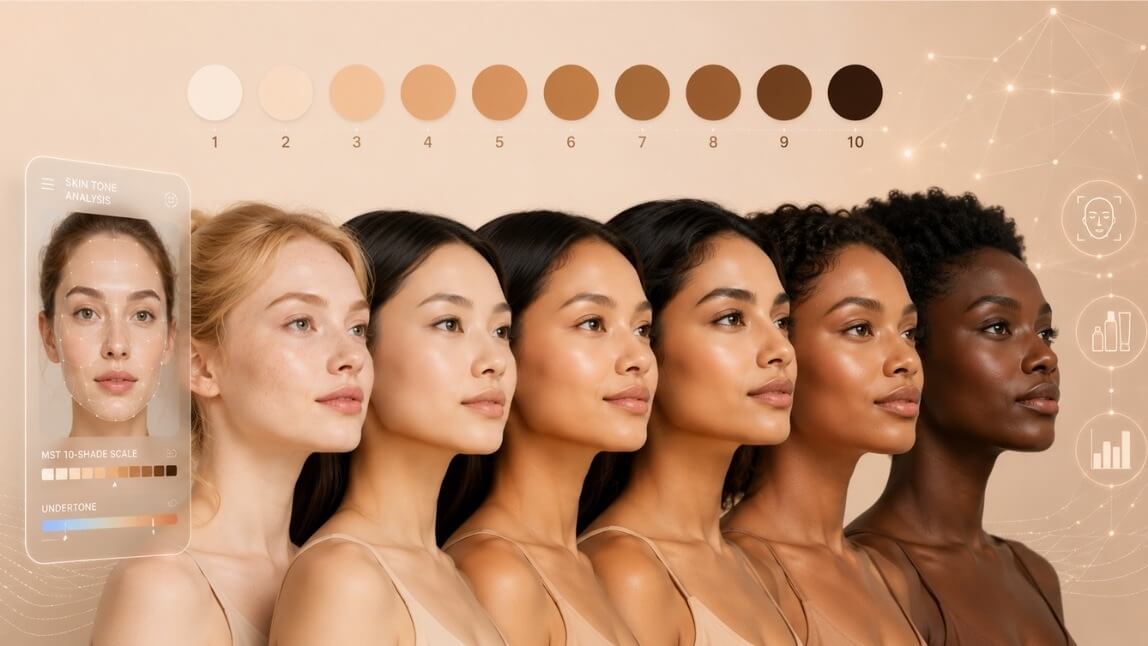
A skin tone chart is more than a color swatch—it's the backbone of inclusive product development, AI model training, and personalized beauty. Here's what every brand needs to know about Fitzpatrick, Monk, and the AI tools rewriting the rules.
What Is a Skin Tone Chart?
A skin tone chart is a standardized visual reference system that categorizes human skin color along a spectrum—from lightest to deepest—often paired with undertone classifications (warm, cool, or neutral). For consumers, charts answer the age-old question: what foundation shade matches me? Today, AI-powered tools like Perfect Corp's AI Shade Finder answer that question instantly—replacing guesswork with real-time skin tone detection and personalized recommendations.
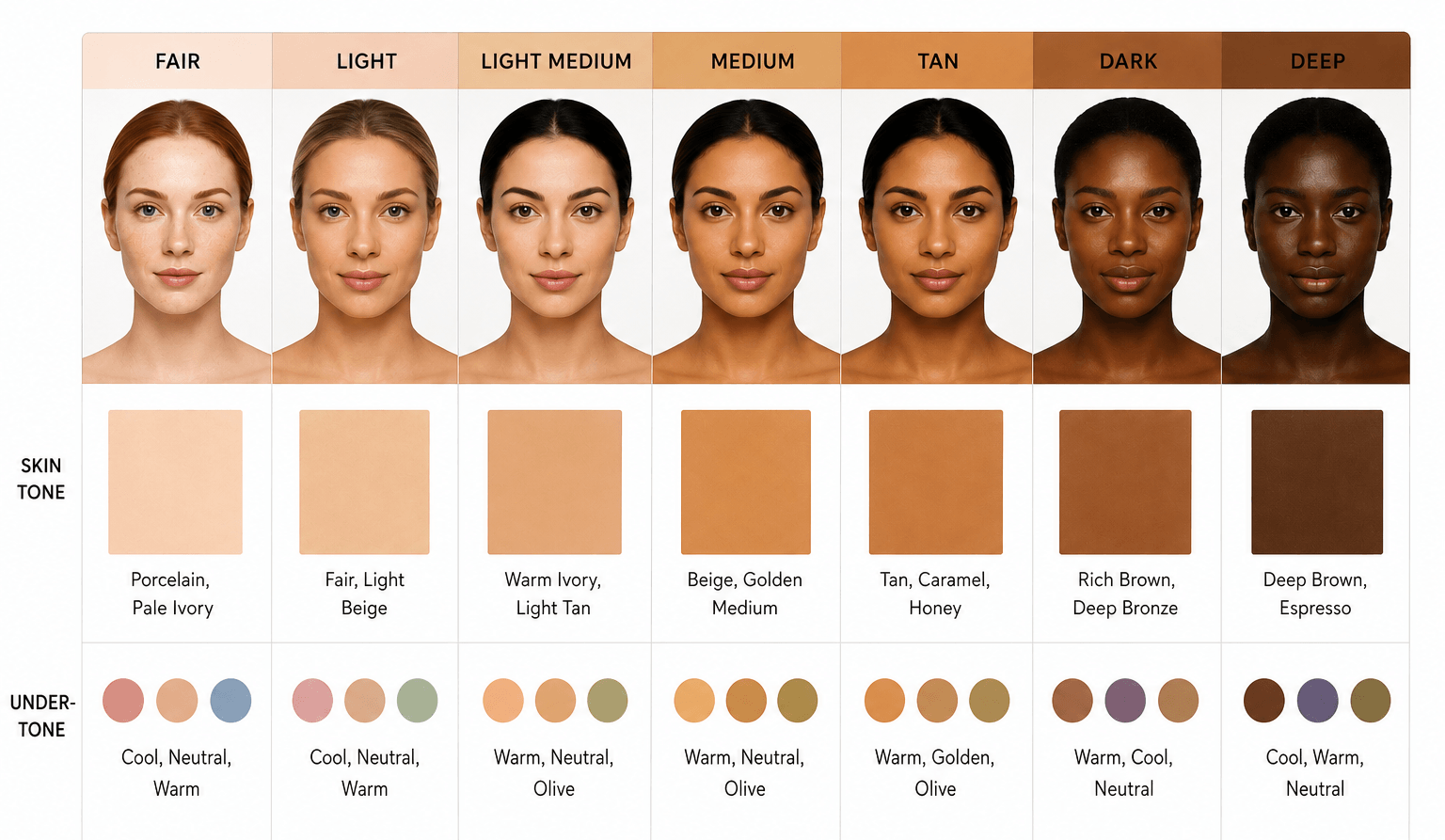
Two major classification systems dominate the industry today: the Fitzpatrick Scale (the 1975 gold standard) and the Monk Skin Tone (MST) Scale (the 2022 challenger built for AI). Understanding both is essential for any brand deploying AI skin analysis in 2026.
The Major Skin Tone Classification Systems Compared
Not all skin tone charts are created equal. Each system was built with a different purpose—and those origins matter when you're choosing a foundation for AI model training or inclusive product design.
The Fitzpatrick Scale (Types I–VI): Dermatology's Legacy Standard
Developed by American dermatologist Thomas B. Fitzpatrick in 1975, the Fitzpatrick Scale was originally designed to estimate UV sensitivity—not skin tone diversity. It classifies skin into six phototypes based on how skin reacts to sun exposure:
| Fitzpatrick Type | Skin Description | Sun Reaction | Example Populations |
|---|---|---|---|
| Type I | Very fair, porcelain, often freckled | Always burns, never tans | Northern European, Scandinavian |
| Type II | Fair, light beige | Burns easily, tans minimally | Northern European, Caucasian |
| Type III | Medium, sometimes burns | Gradually tans to olive | Southern European, Mediterranean |
| Type IV | Olive to light brown | Rarely burns, tans easily | Mediterranean, Hispanic, Indian |
| Type V | Brown to dark brown | Very rarely burns | East Indian, African, Hispanic |
| Type VI | Very dark brown to black | Never burns | African, Aboriginal Australian |

The Fitzpatrick Scale remains the most widely used skin phototype assessment tool in clinical and research settings. However, its Eurocentric origins show: Types V and VI were added as an afterthought to the original four categories, focused exclusively on white skin. For AI training purposes, this skew creates measurable representation gaps—particularly for the billions of consumers whose skin tones fall within the "brown" and "dark" range that Fitzpatrick treats as a single, undifferentiated category.
The Monk Skin Tone (MST) Scale: The AI-Era Standard
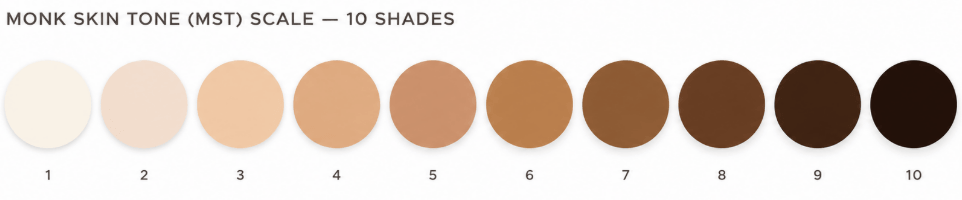
In 2022, Google partnered with Harvard sociologist Dr. Ellis Monk to release an open-source, 10-shade skin tone scale explicitly designed to address Fitzpatrick's shortcomings. The Monk Skin Tone Scale:
- Spans 10 distinct shades (vs. Fitzpatrick's 6), providing finer granularity across darker skin tones
- Decouples skin tone from UV sensitivity and race—measuring perceived pigmentation, not photoreactivity
- Has been adopted by the National Institutes of Health (NIH), incorporated into Google AI products, and validated across 21,000+ images under 15 different lighting conditions
- Is openly licensed (CC BY 4.0)—any brand or researcher can use it without licensing fees
A peer-reviewed study in the Journal of the American Academy of Dermatology confirmed that MST more closely aligns with spectrophotometric measurements for darker skin tones than either self-reported or clinician-estimated Fitzpatrick scores. For beauty brands deploying AI, this isn't just a diversity statement—it's a performance issue. AI models trained on Fitzpatrick-labeled data systematically underperform on deeper skin tones.
The Von Luschan Scale and PERLA: Niche but Notable
The von Luschan chromatic scale (36 categories) and PERLA (a colorimetric system developed for clinical dermatology) offer high granularity but are rarely used in commercial beauty tech—their complexity makes consistent data annotation nearly impossible at scale. For most brands, the practical choice in 2026 is Fitzpatrick for clinical/regulatory work and Monk for AI and inclusive product development.
Skin Tone vs. Undertone: Why Both Matter for Product Matching
A skin tone chart tells you how deep or light someone's complexion appears on the surface. But undertone—the subtle hue beneath that surface—is often the decisive factor in whether a foundation, concealer, or skincare product looks natural on a given customer.
The Three Undertone Categories
- Cool: Pink, red, or bluish hues beneath the surface. Silver jewelry tends to complement. Veins appear blue or purple.
- Warm: Golden, peachy, or yellow hues. Gold jewelry flatters. Veins appear green.
- Neutral/Olive: A balanced mix of cool and warm. Both silver and gold can work. Olive complexions may show greenish or grayish undertones that don't fit neatly into either category.
Classic DIY methods for undertone detection—the vein test, the jewelry test, the white paper test—are useful but unreliable. Poor lighting, product residue, or naturally ambiguous undertones can all skew results. This is precisely where AI has proven its value: by analyzing thousands of color data points from a single selfie, AI undertone detection eliminates guesswork and produces consistent, actionable recommendations at scale.
Explore Perfect Corp's AI Foundation Shade Finder →How AI Is Replacing Static Skin Tone Charts
Static skin tone charts—whether on a brand's website or printed at a beauty counter—share a fundamental limitation: they require self-assessment. Customers squint at color swatches under fluorescent store lighting, guess which hex code matches their wrist, and frequently get it wrong. Return rates on mismatched foundation purchases remain one of the most expensive problems in cosmetics retail.
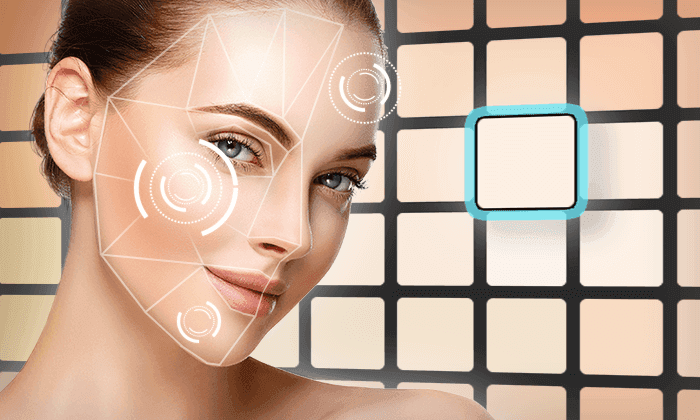
AI-powered skin tone detection changes this equation entirely. Using a smartphone camera or live video feed, modern AI systems can:
- Detect skin tone across the full Fitzpatrick or Monk scale in under one second
- Identify undertones (cool, warm, neutral) with greater consistency than manual assessment
- Map 89,969+ unique skin tone variations to product SKUs in real time
- Perform 180° facial mapping to account for tone variation across different facial zones
- Maintain consistent accuracy across ethnicities, ages, and genders—even in varying lighting conditions
The business case is clear. Perfect Corp's AI Foundation Shade Finder drove a 200% increase in customer engagement for M·A·C Cosmetics within the first month of deployment—by replacing the friction of manual shade matching with instant, AI-confirmed recommendations.
What AI Skin Tone Detection Looks Like in Practice
A customer visits a brand's website or app. They tap "Find My Shade." The camera activates. Within one second, the AI has analyzed their skin, identified their Fitzpatrick type, detected their undertone, and surfaced the three closest foundation matches—complete with virtual try-on. No chart. No quiz. No return. Perfect Corp's AI Shade Finder delivers exactly this experience—deployable as an e-commerce web module, mobile SDK, or in-store kiosk, with no additional hardware required.
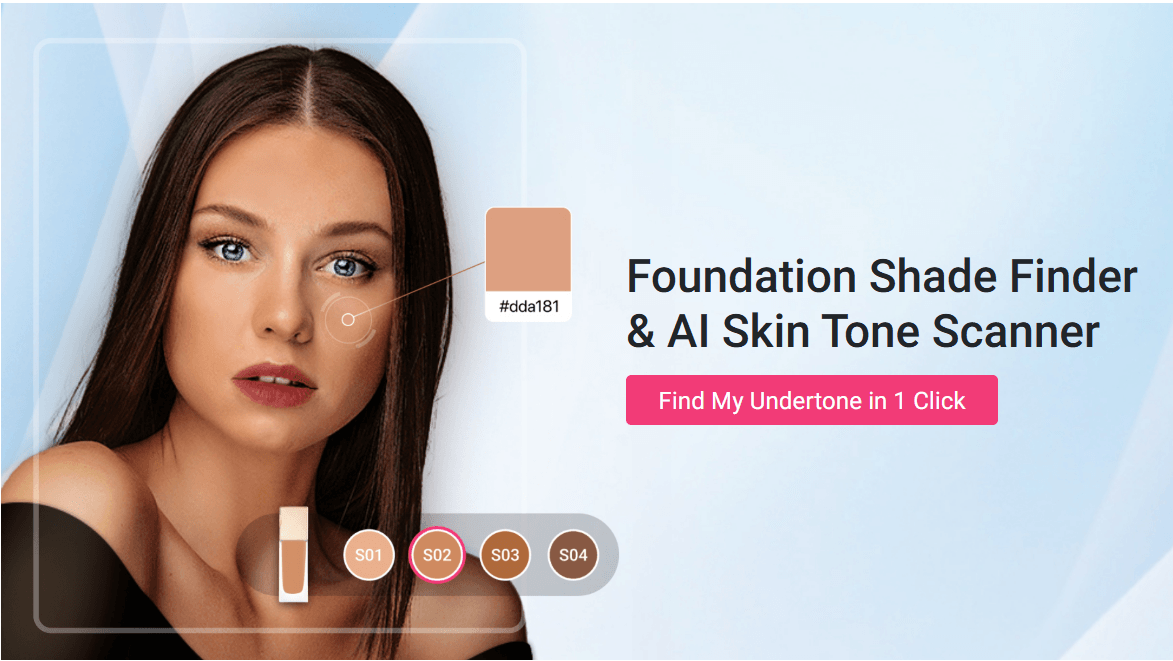
For brands, the backend is equally powerful: every analysis generates skin tone distribution data across the customer base, enabling inventory planning, product development decisions, and personalization campaigns grounded in actual customer demographics rather than assumed ones.
The Inclusive Skin Tone Chart: Why Representation Is a Business Requirement
The beauty industry's historical failure to represent deeper skin tones isn't just an ethical problem—it's a market opportunity. The inclusive shade-matching segment was valued at approximately USD 163 million in 2025, driven by brands that expanded beyond the mid-tone-focused legacy product lines that dominated for decades.
For AI-powered beauty tech, inclusivity starts with training data. A model trained primarily on lighter skin tones will produce systematically worse recommendations for customers with deeper complexions—leading to lower conversion, higher returns, and measurable brand damage among exactly the demographic driving category growth.
The shift toward the Monk Skin Tone Scale in AI development is a direct response to this challenge. By providing more granular representation of darker skin tones, the MST enables AI models to make finer distinctions in the range where Fitzpatrick's Types V and VI collapsed everything into two categories. For a brand serving a global customer base, the difference between a model that performs at 95% accuracy across all skin tones versus one that works well only for lighter complexions is the difference between a scalable personalization engine and an expensive liability.
Skin Tone Charts in Global Markets
Different markets bring different skin tone distribution profiles—and different consumer expectations. A skin tone classification system calibrated for North American or European populations will underperform in South Asian, East Asian, African, or Latin American markets. Brands entering these markets need AI models trained on locally representative data, not a one-size-fits-all chart retrofitted from Fitzpatrick's 1975 baseline.
Building Your Brand's Skin Tone Strategy: A B2B Framework
For beauty brands, skincare companies, and aesthetic clinics deploying AI skin analysis, a coherent skin tone strategy involves three interconnected decisions:
1. Choose Your Classification Standard
For most brands in 2026, the practical answer is to support both Fitzpatrick and Monk. Fitzpatrick remains essential for any clinical or regulatory context (sunscreen SPF recommendations, photosensitivity guidance, dermatological referrals). Monk is the better choice for AI training data, shade matching, and inclusive product development. These aren't competing standards—they measure different things, and best-in-class platforms support both.
2. Train AI on Diverse, Labeled Datasets
The quality of your AI skin tone detection is only as good as your training data. Models trained on fewer than 10,000 images, or on datasets skewed toward lighter skin tones, will underperform for a significant portion of your customer base. Look for AI providers that disclose their training dataset diversity, validation methodology, and cross-demographic accuracy benchmarks.
Perfect Corp's AI Skin Analysis is trained on over 70,000 medical-grade images and achieves a 95% test-retest reliability rate across diverse skin tones, types, ages, and genders—backed by clinical validation with over 80% correlation with physician evaluations.
3. Integrate Skin Tone Data Across Your Product Stack
A skin tone detection event generates more than a foundation recommendation. It creates a data point that should flow into your CRM, inventory system, recommendation engine, and personalization logic. Brands that treat skin tone analysis as a one-time customer service feature leave the most valuable part—ongoing personalization and retention—on the table.
Try the Skin Analysis API in Our AI Playground →Skin Tone Chart Applications: From Foundation to Skincare
Skin tone classification isn't limited to foundation shade matching. Across beauty and aesthetics categories, accurate skin tone detection unlocks a range of commercially valuable applications:
| Application | How Skin Tone Data Is Used | Business Value |
|---|---|---|
| Foundation Shade Matching | Map tone + undertone to SKU catalog | Reduces returns, increases AOV |
| SPF Recommendation | Fitzpatrick type guides SPF level and formula | Trust, compliance, repeat purchase |
| Skincare Personalization | Tone correlates with melanin levels, hyperpigmentation risk | Relevant product recommendations |
| MedSpa Consultations | Pre-treatment tone classification for laser, chemical peel protocols | Safety, liability reduction, efficiency |
| Hair Color Advisory | Warm/cool undertone guides complementary hair tones | Cross-category recommendations |
| Lip & Blush Matching | Surface tone + undertone drives color family selection | Basket expansion, discovery |
| Product R&D | Aggregate tone distribution data informs shade range expansion | Data-driven NPD decisions |
How Perfect Corp's AI Handles Skin Tone Classification
Perfect Corp's AI Foundation Shade Finder works in three steps: instant skin tone detection, personalized foundation recommendations, and virtual try-on—all triggered by a single face scan from a smartphone camera.
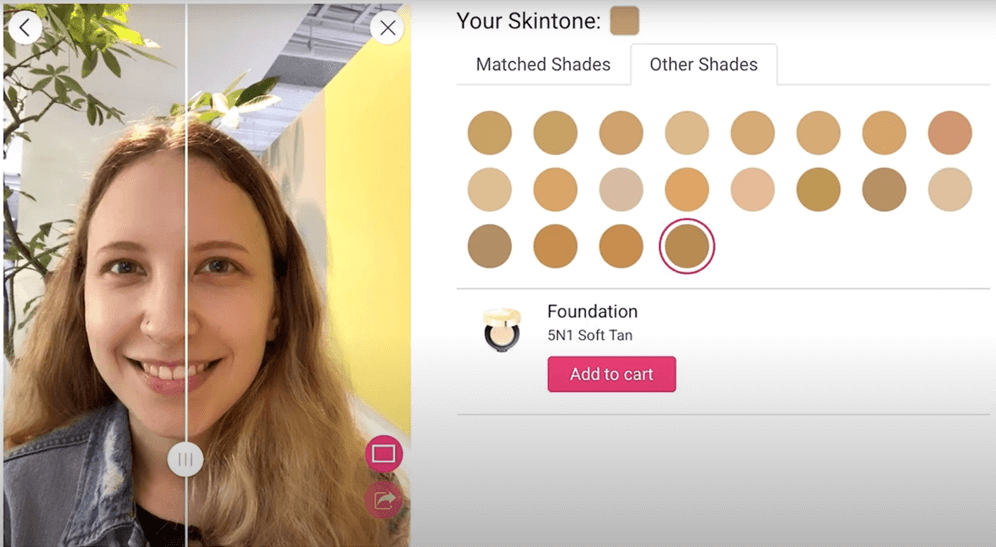
At the detection stage, the AI deep learning algorithm analyzes the full spectrum of human skin tones across a database of 89,969 shades, with unlimited gradations from light to deep and true undertones from warm to cool. To ensure accuracy, the system includes an auto lighting detection algorithm that alerts users when environmental lighting is too bright or dim, and a face alignment check that confirms optimal camera distance and frontal position—minimizing shadows that would otherwise skew tone readings.
Once the skin tone is detected, the AI maps it to brand-specific product catalogs and surfaces the closest foundation matches in real time. Customers can then virtually try on their matched shade—plus warmer and cooler alternatives based on their undertone—directly on their face and neck. Coverage intensity is adjustable, and the AR effect supports both matte and glowy foundation textures.
The result is a personalized shade experience that removes the guesswork from foundation shopping. The solution is deployable as an e-commerce web module, mobile SDK, WeChat mini-program, or in-store consultation tool—making it accessible across every major retail touchpoint.
FAQ: Skin Tone Charts
What are the 4 basic skin tones?
The four categories most commonly used in consumer beauty contexts are fair, light, medium, and deep (or dark). These correspond roughly to Fitzpatrick Types I–II (fair), III (light to medium), IV (medium to tan), and V–VI (deep to very deep). In practice, professional-grade AI systems work with far more granular classifications—the Monk Scale alone spans 10 distinct shades—to enable accurate product matching across the full spectrum of human complexion.
What is the Fitzpatrick Scale used for?
The Fitzpatrick Scale was originally developed to guide dosing of UV light therapy in dermatology. Today, it is used in sunscreen recommendations, clinical research, laser treatment protocols, and as a baseline for AI skin tone classification. Its six-point system, while widely recognized, has been criticized for Eurocentric bias and insufficient granularity for darker skin tones.
What is the Monk Skin Tone Scale?
The Monk Skin Tone (MST) Scale is a 10-shade, open-source skin tone classification system developed by Harvard sociologist Dr. Ellis Monk and released by Google in 2022. It is designed to represent the full global spectrum of human skin tones with greater equity than Fitzpatrick, and has been adopted by the NIH, incorporated into Google AI products, and validated in peer-reviewed dermatology research as performing better than Fitzpatrick for annotating diverse skin tone datasets.
How do I determine my skin undertone?
The most reliable DIY methods are the vein test (blue/purple veins suggest cool undertones; green veins suggest warm) and the jewelry test (silver flatters cool undertones; gold flatters warm). However, both methods are sensitive to lighting conditions and subjective interpretation. AI-powered undertone detection—analyzing thousands of color data points from a live or uploaded photo—produces consistently more accurate results than any manual self-assessment method.
What skin tone scale do AI beauty tools use?
Leading AI beauty platforms typically support Fitzpatrick scale classification for clinical contexts and increasingly incorporate the Monk Skin Tone Scale for training data labeling and inclusive AI development. Best-in-class systems like Perfect Corp's AI Skin Analysis detect over 89,000 unique skin tone variations, mapping them to both standardized classification systems and brand-specific product catalogs in real time.
How accurate is AI skin tone detection?
Accuracy varies significantly by platform and training dataset quality. Perfect Corp's clinical validation study demonstrates a 95% test-retest reliability rate across diverse skin tones, with over 80% correlation with physician evaluations. For brands selecting an AI skin tone tool, key validation metrics to request include cross-demographic accuracy breakdowns, training dataset diversity disclosures, and test-retest reliability under varying lighting conditions.
Can skin tone change over time?
Surface skin tone can shift with sun exposure, seasonal changes, tanning, and certain skincare treatments. Undertone, by contrast, remains relatively stable throughout life as it is determined by melanin distribution patterns at a deeper skin layer. AI skin analysis designed for ongoing consumer engagement should account for this distinction—tracking surface tone changes while anchoring personalization logic to the more stable undertone signal.