


AI Oily Skin Test
Measure oiliness separately for the T zone, the U zone and the whole face from one selfie.
The AI Oily Skin Test returns an oiliness score, a zone-by-zone skin type classification, and the pore and acne readings that travel with it, so a shiny forehead on otherwise dry cheeks is routed as combination skin rather than oily skin. It is part of 28 skin diagnostics across 16 skin concerns, dermatologist-verified, GDPR and HIPAA-compliant, deploying to web, app, retail counter or clinic kiosk from a single integration.
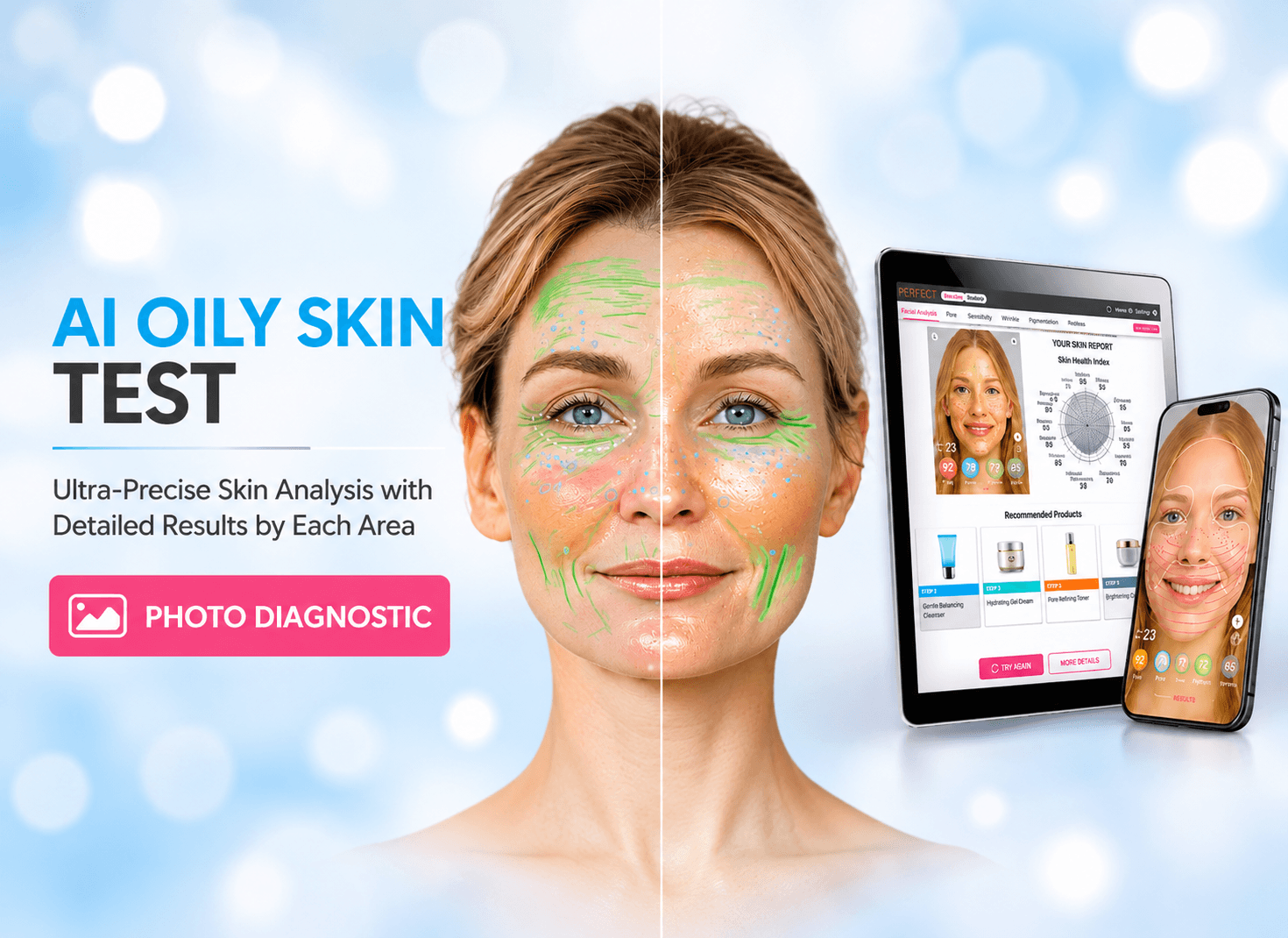
An AI oily skin test estimates sebum related shine and skin type from a photograph and returns a score from 1 to 100, where a higher score means less excess oil. The YouCam test scores the T zone and the U zone separately as well as the whole face, which is what lets a combination skin customer be told apart from a uniformly oily one and sent to a different product. It is a cosmetic assessment, not a medical diagnosis.
What the Oily Skin Test Returns
Most online oily skin quizzes ask the customer how their face feels four hours after cleansing and then classify them from the answer. This test measures the face instead, and it measures it in three places.
| Output | What it covers | Why it matters at the shelf |
|---|---|---|
| Oiliness score | Shine and sebum related surface appearance, 1 to 100 | The headline number the customer sees and remembers |
| Skin type, whole face | Oily, dry, normal or combination overall | Sets the cleanser and moisturiser tier |
| Skin type, T zone | Forehead, nose and chin read on their own | The zone that drives most oily skin complaints |
| Skin type, U zone | Cheeks and jawline read on their own | Catches the dryness that oily customers over treat |
| Pore, by region | Forehead, nose, cheek and whole face | Pore visibility rises and falls with oil, so it belongs in the same basket |
| Acne | Blemish related surface change | Decides whether the routine needs an active or just a mattifier |
| Texture | Surface smoothness and irregularity | Separates rough congestion from plain shine |
| Moisture | Surface hydration | The reading that proves dehydrated oily skin is real |
Every value arrives in the same response, so a routine builder does not need a second scan to find out whether the oil is coming with congestion, with dryness or on its own.
Why T Zone and U Zone Scoring Changes the Recommendation
A single overall face oiliness number is the reason so many skincare recommendations miss. Two customers can return the same overall score and need opposite routines.
| T zone | U zone | What the customer actually is | What to route to |
|---|---|---|---|
| Oily | Oily | Uniformly oily skin | Full mattifying routine, gel cleanser, lightweight fluid |
| Oily | Normal | Classic combination skin | Zone treatment, mattifier on the T zone only |
| Oily | Dry | Combination with a compromised barrier | Barrier repair first, oil control second, never a stripping cleanser |
| Normal | Normal | Balanced, shine is situational | Maintenance, blotting rather than treatment |
| Normal | Oily | Unusual pattern, often product or humidity driven | Review current routine before recommending anything new |
The third row is the one that costs money when it is missed. A customer whose cheeks are dry and whose forehead is oily, sold a full-strength oil control routine on the strength of a whole-face score, strips the barrier, gets more oil in response, and returns the product. Zone-level reading prevents that specific mistake, and it is the single clearest argument for measuring instead of asking.
How the Oily Skin Test Works in 3 Steps
Capture
The customer takes a selfie on their own phone, in a browser or in your app, with no download and no special lighting rig. The capture flow enforces face size, lighting and framing before the image is accepted, which is what keeps results consistent between a bathroom at night and a store under retail lighting.

Analyze
The image is scored for oiliness, skin type by zone, pore by region, acne, texture and moisture in the same pass. Results come back in seconds, with optional detection mask overlays as PNG images so the customer can see which areas drove the reading rather than being handed a bare number.
Route and re-scan at 30 days
Scores map to product tiers, and the customer is invited back to re-scan. Oil control is one of the few skincare categories where a visible change can appear within a month, which makes a 30-day re-scan an unusually strong retention mechanic compared with the ninety days that wrinkle or firmness programmes need.
Understanding the Oiliness Score, 0 to 100
The most common misread in this category is treating oil as the opposite of dryness. It is not. Surface hydration and sebum production are separate, which is why the same face can score low on oiliness and low on moisture at once.
| Oiliness score | Moisture score | Pattern | What goes wrong without the second reading |
|---|---|---|---|
| Low | High | Genuinely oily, barrier intact | Nothing. Standard oil control works |
| Low | Low | Dehydrated oily skin | Oil control alone makes it worse, oil production rises |
| High | Low | Dry or dehydrated, not oily | Customer self identifies as oily from occasional shine and buys the wrong tier |
| High | High | Balanced | Nothing. Maintenance routine |
Returning both values in the same response removes the guesswork. It also gives your merchandising team a defensible reason to recommend a hydrating serum to a customer who arrived convinced they needed a clay mask.
Who Uses an AI Oily Skin Test?
| Team | Where it sits | What they measure it by |
|---|---|---|
| Skincare brands | Product finder on the site and in the app | Conversion rate, average order value, return rate on oil control lines |
| Beauty retailers | Counter tablet and store kiosk | Attach rate, basket size, repeat visits |
| Acne and blemish brands | Pre purchase triage before an active is recommended | Routine completion, adverse reaction complaints |
| Clinics and medspas | Intake and treatment progress tracking | Consultation to booking, re-scan rate |
| Makeup brands | Foundation and primer finish matching | Shade and finish return rate |
| Men's grooming | Entry point for a category with low routine literacy | First purchase rate, subscription signup |
The makeup row is often overlooked. Finish selection, matte against dewy, is an oiliness decision more than a shade decision, and a measured T zone reading predicts foundation wear better than a customer's own description of their skin type.
AI Software vs Traditional Skin Analysis Hardware
| Factor | Hardware analyser | AI software |
|---|---|---|
| Upfront cost | Typically five figures per unit | No hardware spend |
| Where it works | One physical location, one customer at a time | Every device your customer already owns |
| Time to first result | Appointment, seating, capture | Seconds, self serve |
| Reach | Store footfall only | Site, app, social, email, counter and kiosk |
| Re-scan behaviour | Requires a return visit | Push notification, done at home |
| Maintenance | Calibration, servicing, replacement | Updated server side, no downtime |
| Data capture | Stays in the store system | Flows into your CRM with consent |
Hardware still has a place in a clinical setting where a controlled capture environment is part of the service. For a brand that wants every visitor measured, the economics are not close.
Scientifically Validated, Medically Trusted
The underlying analysis engine reaches 95% test to retest reliability and over 80% correlation with professional physician assessment across its diagnostics, and it is dermatologist verified. For an oiliness programme the test to retest figure is the number that matters most, because the whole proposition rests on a customer trusting that a lower score next month reflects their skin and not the lighting in their bathroom.
Self-reported skin type has been questioned in the dermatology literature for years, with reported agreement between self-assessment and instrumental measurement often falling well below what a product recommendation needs.
Pore visibility and surface oiliness move together closely enough that treating them as one customer concern is usually correct, and large scale facial phenotype work has repeatedly found pore and texture related measures among the strongest contributors to how skin quality is judged.
Does It Work Across Skin Tones?
Does It Work Across Skin Tones?
Yes, and this is a question worth pressing any vendor on. The engine is validated across the Fitzpatrick range, and the oiliness and pore readings are built on surface reflectance and texture characteristics rather than on absolute brightness, which is the design choice that keeps a dark skinned face from being scored as shinier simply because of how light behaves on it. Ask every vendor you evaluate to state which tones were represented in their validation set, and treat a non answer as an answer.
Oily Skin Test FAQs
What does the oily skin test return?

An oiliness score from 1 to 100, a skin type classification for the whole face, the T zone, and the U zone separately, plus pore readings by region and acne, texture, and moisture values in the same response.
Why score the T zone and U zone separately?
Combination skin is the most common pattern, and an average face hides it. The difference between the two zones is what tells you whether to recommend a full mattifying routine or to treat one area and protect the other.
How accurate is it?
The engine reaches 95% test-retest reliability and over 80% correlation with professional physician assessment, and it is dermatologist-verified. It is a cosmetic assessment rather than a clinical sebum measurement.
Is this the same as a sebum meter reading?
No. A sebum meter measures lipids directly from a contact strip at one point on the face. This test infers oiliness from the image across whole zones. It is more repeatable at scale and far more practical for a customer at home, but it is not a laboratory instrument and should not be described as one.
Does makeup affect the score?
Yes, significantly. Powder and mattifying primers suppress the reading, while highlighter and dewy finishes inflate it. Prompt for a bare face in the capture flow and state the reason, since customers comply more readily when they understand why.
Does time of day affect the score?
Yes. Sebum output varies through the day and with season and temperature. For a re-scan programme to mean anything, prompt the customer to scan at a similar time of day each time.
Can it tell dehydrated oily skin from plain oily skin?
That is what the moisture reading is for. A low oiliness score alongside a low moisture score indicates a dehydrated barrier producing excess oil, which needs hydration before oil control, rather than instead of it.
What re-scan interval should we set?
30 days. Oil control routines can show measurable change within a month, which is shorter than the 90-day window that wrinkle or firmness programmes need, and makes it one of the best diagnostics for building a re-scan habit.
How much does it cost?
Pricing scales with volume and deployment model, and there is no hardware spend. The comparison worth running is against the per-unit cost of a counter analyser plus its servicing, and a software cost that covers every customer on your site at once.
Can we white label it and connect it to our CRM?
Yes. Branding is fully configurable, and scores can flow into your CRM with customer consent, which is what turns a one-off result into a segment you can email.
Does it work on darker skin?
Yes. The engine is validated across the Fitzpatrick range, and the oiliness and pore readings are based on surface characteristics rather than absolute brightness.
Is this a medical diagnosis?
No. It is a cosmetic skin assessment intended to guide product selection and track visible change. Acne, seborrheic conditions, and anything persistent or painful belong with a clinician.
How do we evaluate it before committing?
Run the hosted experience on a campaign page or a single store for a month, measure conversion and basket size against your existing finder, and check the 30-day re-scan rate. That is enough signal to decide.
Learn More About Related Resources
- Full skin analysis: All 28 diagnostics across 16 concerns in one scan
- Live skincare demo: See the customer facing flow end to end
- Skin analysis machine comparison: Hardware against software, in detail
- Skin analysis app: Native deployment for mobile first brands


