 Author: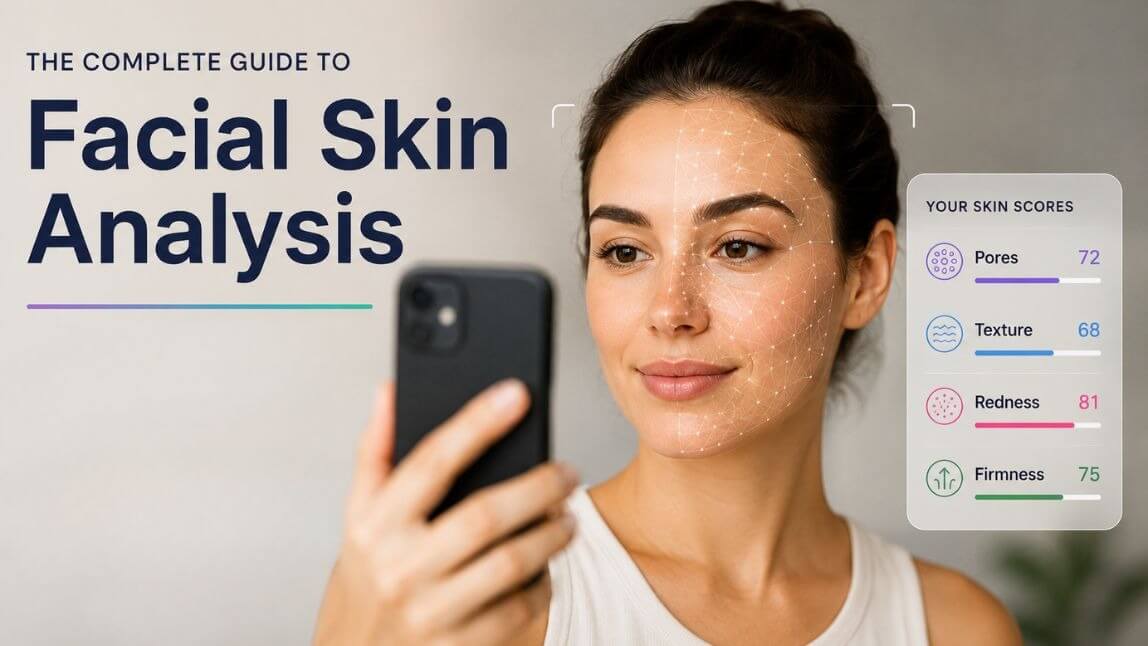
The most common question beauty brands ask before they switch on a skin scanner is not "how does the AI work." It is this: why did two customers with visibly similar skin get different pore scores?
Nine times out of ten the answer has nothing to do with their skin. One took the photo by a window at ten in the morning. The other took it under a bathroom vanity light at eleven at night. Facial skin analysis reads an image, and an image is only as honest as the light that made it.
That is the thing most guides skip, and it is exactly the thing that decides whether the technology earns trust or quietly loses it. This guide covers what facial skin analysis measures, how the scoring actually works, how accurate it is when you press on the numbers, and what to check before you put it in front of customers.
What is facial skin analysis?
Facial skin analysis is the process of evaluating visible skin characteristics of the face, such as pores, wrinkles, texture, pigmentation, redness, oiliness and moisture, and converting them into structured scores that can be compared over time. AI-based systems do this from a single photo or a live camera feed, using computer vision instead of specialised optical hardware.
Two words in that definition do a lot of work. Visible, because a camera reads surface appearance, not what is happening under the skin. And structured, because the whole point is turning a subjective read into numbers you can track, compare and act on.
What does facial skin analysis measure?
Perfect Corp.'s AI Skin Analysis reports up to 16 skin concerns from one scan, plus a skin type classification across 8 types and an estimated skin age. Those concerns fall into four practical groups.
| Group | What it covers | What it tells you |
|---|---|---|
| Surface | Texture, pores, spots, acne | How even and clear the skin surface reads |
| Tone | Pigmentation, redness, radiance, dark circles | Colour evenness and brightness |
| Condition | Moisture, oiliness, eye bags | Hydration and sebum balance right now |
| Structure | Wrinkles, fine lines, firmness, droopy eyelids | Visible signs associated with ageing |
Skin type sits on top of these. Moisture, oiliness and pore scores read together are what separate oily from combination from dry, which is why a skin type test and a full skin scan are really the same engine pointed at different questions.
One caution worth putting in writing on any customer-facing screen: visible redness, texture change or spots can overlap with medical conditions. A cosmetic score is not a diagnosis of acne, rosacea or melasma, and it should never be presented as one.
How does AI facial skin analysis work?
1. Capture and quality gate
The user takes a selfie or opens the live camera. Before anything is scored, the system checks the image is usable: is the face fully in frame, is there enough light, is the shot in focus, is there a heavy beauty filter flattening the texture. Weak systems skip this step and score the photo anyway. That is where wildly inconsistent results come from.
2. Face detection and region mapping
Facial detection locates the face and divides it into regions, because a pore score across the T zone means something different from a pore score on the cheeks. Wide angle detection extends the read toward the sides of the face rather than stopping at the front plane.
3. Concern detection and scoring
Each concern is evaluated by models trained on labelled dermatological imagery, then expressed on a 0 to 100 severity scale. Detected areas can be returned as a heatmap or a binary mask, which is what powers the AR overlay customers see highlighting exactly where the system found something.
4. The recommendation layer
Scores on their own are trivia. The commercial value shows up when those scores map to a product catalogue or a treatment menu, which is what an AI skincare routine builder does with the output.
What do the scores mean?
Each concern comes back on a 0 to 100 scale. Read them as relative, not absolute. A pore score of 64 does not mean the pores are 64 units wide. It means the system placed this face at that point on a distribution built from its training data.
Three rules keep interpretation honest:
- A score describes the image that was analysed, not a physical measurement of skin.
- Camera quality, distance, angle and lighting all move the number. Compare scans taken under similar conditions, not scans taken six months apart in different rooms.
- The trend matters more than any single reading. A customer who moves from 58 to 66 on texture over eight weeks has a story. A customer with one score of 62 has a data point.
How accurate is facial skin analysis?
This is where vendor marketing gets vague, so here are the numbers with the methodology attached.
Perfect Corp.'s engine is trained on over 70,000 high definition, medical grade images covering all six Fitzpatrick skin types, which is what keeps performance from degrading on deeper skin tones. In professional medical testing it demonstrated 95% test-retest reliability, meaning the same face scanned twice under the same conditions returns the same result. Against physician assessments and industry standard imaging devices, correlation exceeded 80% for specific concerns. The models were validated in studies run with board certified dermatologists.
For context, hardware benchmarks are not perfectly stable either. Published reproducibility work on the VISIA Complexion Analysis system found roughly 3% deviation on absolute wrinkle scores between repeat captures, rising to around 9% when percentile comparisons were used. Controlled optics reduce variance. They do not remove it.
When you are comparing vendors, four questions separate real validation from a press release:
- What is your test-retest reliability, and who measured it? Internal claims with no methodology are marketing.
- What does your training set look like across skin tones? Ask for Fitzpatrick coverage specifically, not a vague statement about diversity.
- What do you compare against? Dermatologist labelling and established imaging devices are the two credible reference points.
- What happens on a bad photo? A system that refuses to score a poor capture is more trustworthy than one that always returns a number.
For a deeper breakdown of how the different measurement approaches compare, our guide to skin analysis equipment walks through the hardware and software categories side by side.
Camera-based analysis or a skin analysis machine?
Both exist for good reasons. They solve different problems.
| AI camera-based analysis | Hardware skin analysis machine | |
|---|---|---|
| Equipment | Phone, tablet, laptop or web browser | Dedicated imaging station with multi-spectral optics |
| Typical cost | Subscription or API usage, scales with traffic | Roughly $3,500 for entry level, past $40,000 for 3D clinical systems |
| Where it runs | Website, app, in-store tablet, kiosk, third party platform | One physical location per unit |
| Depth | Surface and visible characteristics | Adds subsurface reads via UV and polarised light |
| Best for | E-commerce, retail, at-scale consultation, multi-market rollout | Clinical assessment in a controlled room |
The honest summary: if your use case is a dermatology clinic documenting subsurface change, hardware still wins. If your use case is putting a diagnostic in front of every visitor on your product pages in nine markets, a hardware box cannot get there and no amount of budget fixes that. Our roundups of skin scanner features and prices and the top face analysis machine suppliers go through the specific models.
Where do businesses actually deploy it?
Five patterns cover almost everything we see:
- Product pages. A scan on the PDP replaces a shade or formula guess with a recommendation. One partner reported close to a 14x uplift in sales when shoppers engaged with their Perfect Corp. powered pore analysis tool.
- Brand apps. Repeat scanning turns a one-off purchase into a tracked routine, which is the only way most skincare brands ever see longitudinal data on their own customers.
- In-store tablets and kiosks. Staff use the scan to open a consultation instead of asking what the customer is looking for today.
- Clinics and med spas. The scan becomes the before image, and the follow-up scan becomes the case for the next treatment.
- Direct API integration. Teams building their own product skip the front end entirely and call the skin analysis API from their own stack. Our walkthrough on how to use a skin analysis API covers the integration path.
If you want to see the output before you commit to anything, the live skincare showcase runs the full scan in a browser.
What about privacy and consent?
Facial imagery is sensitive data in most jurisdictions, and this is the part that stalls deployments after the technology has already been approved. Get it settled early.
- Compliance posture. Perfect Corp.'s skin analysis is built to HIPAA and GDPR standards. Ask any vendor to state theirs in writing, not on a slide.
- Retention. Decide whether images are stored at all, and for how long. "We do not retain the image after scoring" is a very different product from "we keep it indefinitely for model training."
- Consent language. Several US states, Illinois and Texas among them, regulate biometric identifiers specifically. Have your counsel review the consent flow before launch, not after.
- Cosmetic framing. Keep customer-facing copy in cosmetic language. The moment the interface implies diagnosis, your regulatory exposure changes.
How do you get consistent results?
Whether you are training retail staff or writing on-screen guidance for shoppers, this is the whole list that matters:
- Face the camera straight on.
- Use soft, even light. Daylight from a window is the easiest reliable source.
- Avoid harsh overhead light and strong side shadows.
- Turn off beauty filters and skin smoothing camera modes.
- Pull hair back from the forehead and cheeks.
- Keep a neutral expression, since a smile changes the fine line read around the eyes.
- Remove makeup, or at minimum note that makeup was worn.
- Hold the camera at a consistent distance each time.
- Clean the lens. It sounds trivial. It is not.
Retailers who standardise lighting at the scanning station get far cleaner before and after comparisons than those who let staff scan wherever there is space. That single operational decision does more for perceived accuracy than any model upgrade.
What should you do with the results?
Pick one or two concerns to act on, not fifteen. A customer handed a full grid of scores usually does nothing with it. A customer told "your texture and pore scores are the two worth working on, here is a routine for that" converts.
On the business side, the scan data is worth more than the individual consultation. Aggregate concern distribution across your customer base tells you which products to feature, which markets skew oily against dry, and which claims your catalogue is not yet covering. Most brands take a year to notice that second use case.
Ready to see it on real faces? Explore Perfect Corp.'s AI Skin Diagnostic, or contact our team for a demo built around your channel mix.
Frequently asked questions
What is facial skin analysis?
Facial skin analysis evaluates visible skin characteristics of the face, including pores, wrinkles, texture, pigmentation, redness, oiliness and moisture, and converts them into structured scores that can be reviewed and compared over time.
What does an AI face scan measure?
An AI face scan measures visible, image-derived characteristics only. Perfect Corp.'s system reports up to 15 skin concerns, classifies skin across 8 types, and estimates skin age from a single scan.
How accurate is AI facial skin analysis?
Accuracy depends on the model, the training data and the quality of the photo. Perfect Corp.'s engine has demonstrated 95% test-retest reliability in professional medical testing, with over 80% correlation to physician assessments and industry standard imaging devices for specific concerns.
Is facial skin analysis a medical diagnosis?
No. It provides cosmetic and educational estimates based on image analysis. It does not diagnose skin disease and it does not assess moles or skin cancer. Medical concerns belong with a qualified clinician.
Can facial skin analysis identify my skin type?
Yes, within limits. Moisture, oiliness and pore scores read together indicate whether skin currently presents as oily, dry, combination or balanced. That reading shifts with season, products, time of day and photo conditions.
Does facial skin analysis work on all skin tones?
It depends entirely on the training data. Models trained on narrow datasets lose accuracy on deeper skin tones. Perfect Corp.'s training set spans all six Fitzpatrick skin types for this reason, and it is a fair question to put to any vendor.
Do you need a skin analysis machine, or is a phone enough?
For cosmetic assessment, recommendation and progress tracking, a phone camera with a validated AI model is enough. For subsurface imaging in a clinical setting, dedicated hardware still has capabilities a standard camera does not.
Can facial skin analysis be added to an existing app or website?
Yes. It can run as an embedded web module, inside a mobile app, on an in-store device, or through a direct API call from your own stack. The API route gives the most control over the interface and the recommendation logic.
Keep reading
See the technology in action
- AI Skin Diagnostic solution
- Live skincare showcase
- Online face scanner
- Free skin type test
- AI skincare routine builder
Comparing systems and hardware
- Skin analysis equipment: how to choose a system
- Top face analysis machine suppliers
- Best skin analysis machines and AI skin analyzers
- Skin scanners in 2026: price and features
Building it yourself
Related metrics
Perfect Corp.'s AI Skin Analysis is intended for cosmetic and educational use. It does not diagnose any medical condition. For concerning skin changes, consult a qualified dermatologist.