 Author:
Prior to the global shift toward digital-first consumer engagement, skincare brands and aesthetic providers were already under pressure to better understand how customers interact with products, consultations, and treatment recommendations across digital channels. As retail skincare, med spas, and dermatology clinics continue adopting AI-assisted consultation workflows, technologies such as artificial intelligence (AI), augmented reality (AR), and machine learning are playing a growing operational role in customer assessment, product matching, and treatment planning.
In particular, the latest AI skin scanner technologies are reshaping how brands deliver skin analysis at scale. Modern skin scanners can evaluate multiple skin concerns with greater consistency across mobile devices, in-store kiosks, and consultation environments, helping skincare brands improve personalization while reducing reliance on subjective manual assessments. As consumer demand for data-driven skincare recommendations continues to rise, AI skincare scanners are becoming an increasingly important component of the digital skincare ecosystem for retailers, med spas, and aesthetic businesses alike.
As skincare consultations increasingly move across ecommerce, mobile apps, retail counters, and virtual channels, brands are under pressure to maintain consultation consistency at scale.

Why Skin Scanner Technology Is Becoming Central to Modern Skincare Consultations
The role of the skin scanner has evolved significantly beyond basic complexion analysis. In today’s skincare market, skin scanner technology is increasingly being used as a consultation infrastructure tool — helping beauty retailers, med spas, dermatology clinics, and skincare brands deliver more consistent, data-supported customer experiences across both online and in-person environments.
One of the primary drivers behind this shift is the growing consumer expectation for personalization. Customers are no longer satisfied with generalized skincare recommendations or traditional counter consultations based solely on visual observation. Instead, they expect tailored product suggestions, progress tracking, and treatment recommendations supported by measurable skin analysis data. This change in consumer behavior has accelerated demand for digital skin scanner systems capable of evaluating concerns such as wrinkles, texture, pores, redness, hydration, and pigmentation in a more standardized way.
At the operational level, skincare consultation workflows have also become more complex. Med spas and aesthetic clinics are managing higher consultation volumes while facing increasing pressure to improve conversion rates, treatment confidence, and client retention. At the same time, beauty retailers are looking for scalable ways to provide guided skincare experiences without relying entirely on highly trained in-store specialists. In both cases, skin scanner technology helps reduce consultation variability and creates a more structured framework for skincare assessments and product recommendations.
The adoption of skin scanners is also closely tied to broader digital skincare trends. Hybrid consultation models — where consumers move between mobile apps, virtual consultations, in-store devices, and ecommerce channels — are becoming more common across the beauty industry. As a result, brands are investing in skin scanner platforms that can support omnichannel skincare journeys while maintaining consistency in skin analysis results and recommendation logic.
Another important factor is the increasing commercial focus on measurable skincare outcomes. Consumers today frequently document their skincare progress through selfies, social media content, and recurring treatment visits, creating stronger demand for visible before-and-after tracking. This has made skin scanner technology particularly valuable for clinics and skincare providers seeking to improve treatment transparency, customer trust, and long-term engagement.
From an industry perspective, the modern skin scanner is no longer viewed solely as a diagnostic device. It is becoming part of a larger digital consultation ecosystem that supports skincare analysis, treatment planning, personalized product recommendations, and customer relationship management. For beauty brands and aesthetic businesses navigating rising consumer expectations and operational efficiency demands, skin scanner technology is increasingly becoming a practical necessity rather than a novelty.
For many skincare brands, the challenge is no longer access to skin analysis technology itself, but maintaining consistent consultation quality across fragmented customer touchpoints.
3 Steps AI Skincare Scanner Takes to Do a Skin Analysis & What to Expect
An AI Skincare Scanner is a digital skin analysis tool designed to evaluate visible skin conditions through computer vision and machine learning models trained on large-scale facial image datasets. Modern skin scanner systems are increasingly used across skincare retail, med spas, dermatology clinics, and ecommerce consultation workflows to improve consultation consistency and support more personalized skincare recommendations.
This AI Skincare Scanner analyzes up to 15 different skin concerns using deep-learning models trained on more than 70,000 medical-grade facial images across varying skin tones, age groups, and lighting environments. Dataset quality plays a critical role in skin scanner accuracy, particularly when evaluating concerns such as redness, texture, pores, pigmentation, and wrinkles across diverse users. The system has also been validated with input from skincare professionals to improve reliability in real-world consultation settings.
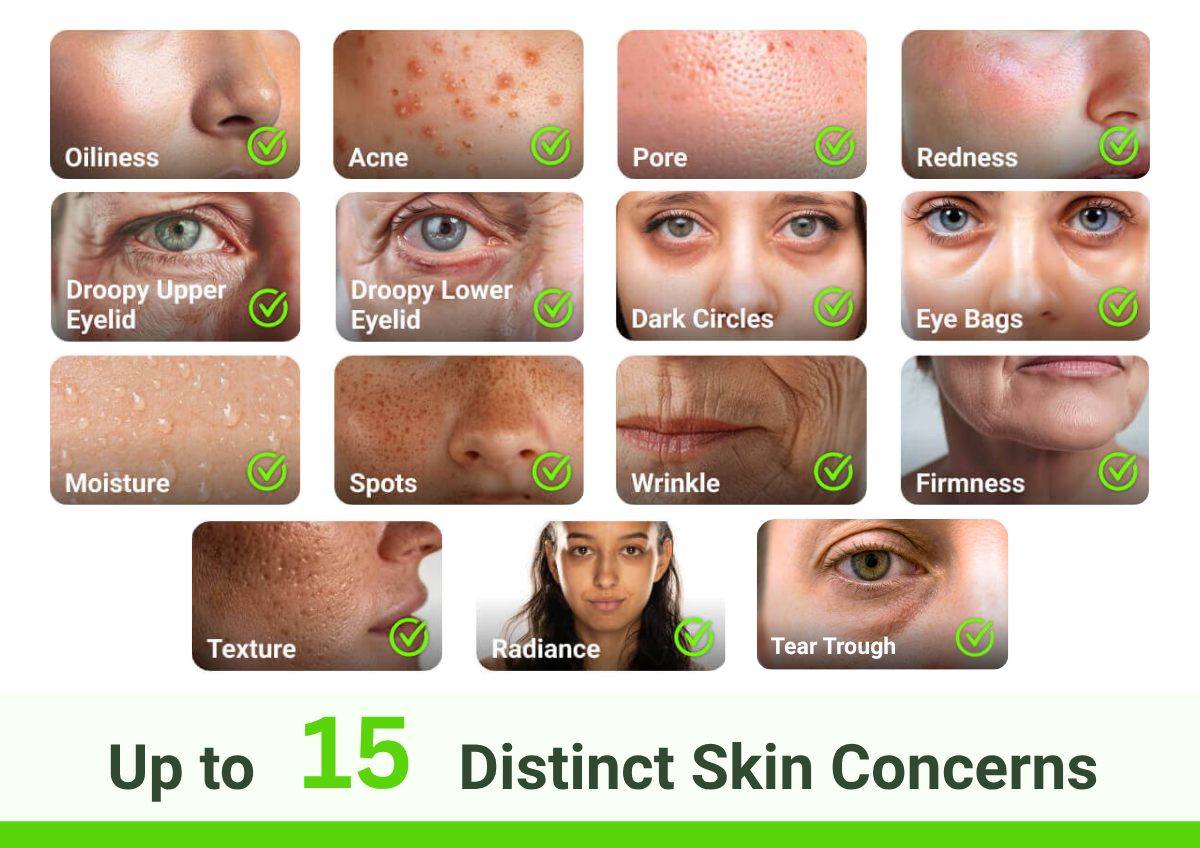
Like most computer vision-based skin scanner technologies, results can still be influenced by external variables such as camera quality, facial positioning, makeup coverage, and inconsistent lighting conditions. For this reason, many skincare brands and aesthetic providers implement standardized capture workflows to improve analysis consistency across devices and consultation environments.
Most commercial skin scanner systems evaluate visible skin patterns rather than underlying dermatological conditions, which is why many providers position the technology as a consultation support tool instead of a medical diagnostic system.
Performing a skin analysis with the AI Skincare Scanner typically involves three streamlined steps:
Step 1: Activate the Camera
The user opens the skin scanner through a mobile device, tablet, kiosk, or web browser. Many brands integrate this step directly into ecommerce journeys, digital consultations, or in-store skincare assessment workflows.
Step 2: Capture a Photo or Use Live Camera Mode
The skin scanner captures a facial image using either a still photo or live-camera analysis mode. To improve detection quality, users are generally instructed to maintain neutral facial expressions and position themselves under balanced lighting conditions with minimal visual obstructions.
Step 3: AI Skin Analysis Generates Results Within Seconds
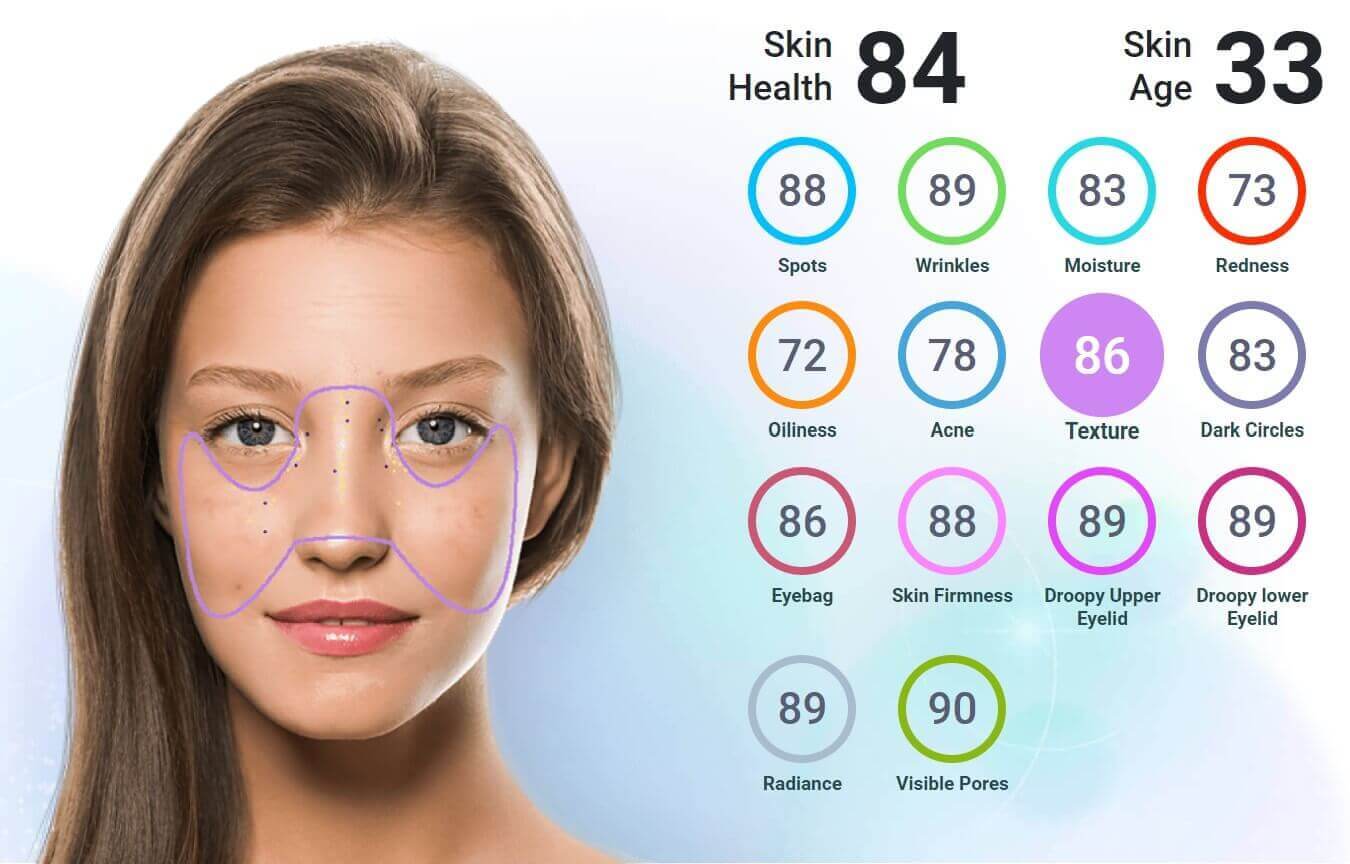
The system processes the facial image using computer vision algorithms that evaluate multiple visible skin attributes simultaneously. The skin scanner then generates a skin analysis report within seconds, allowing brands or skincare professionals to support consultations with more structured and standardized assessment data.
The Latest Capability
Current AI skin scanner technology is capable of detecting a broad range of visible skin concerns, including:
- pigmentation-related concerns
- wrinkles
- texture-related concerns
- dark circles
- redness
- oiliness
- hydration-related concerns
- acne
- eye bag
- skin firmness
- skin radiance
- upper droopy eyelids
- lower droopy eyelids
- visible pores
- tear trough
As skin scanner technology continues to mature, many providers are focusing not only on detection breadth, but also on improving consistency across different devices, skin tones, and real-world consultation conditions. Scalability has become particularly important for beauty retailers and global skincare brands deploying skin analysis across ecommerce platforms, mobile apps, and in-store consultation environments simultaneously.
Product Recommendations
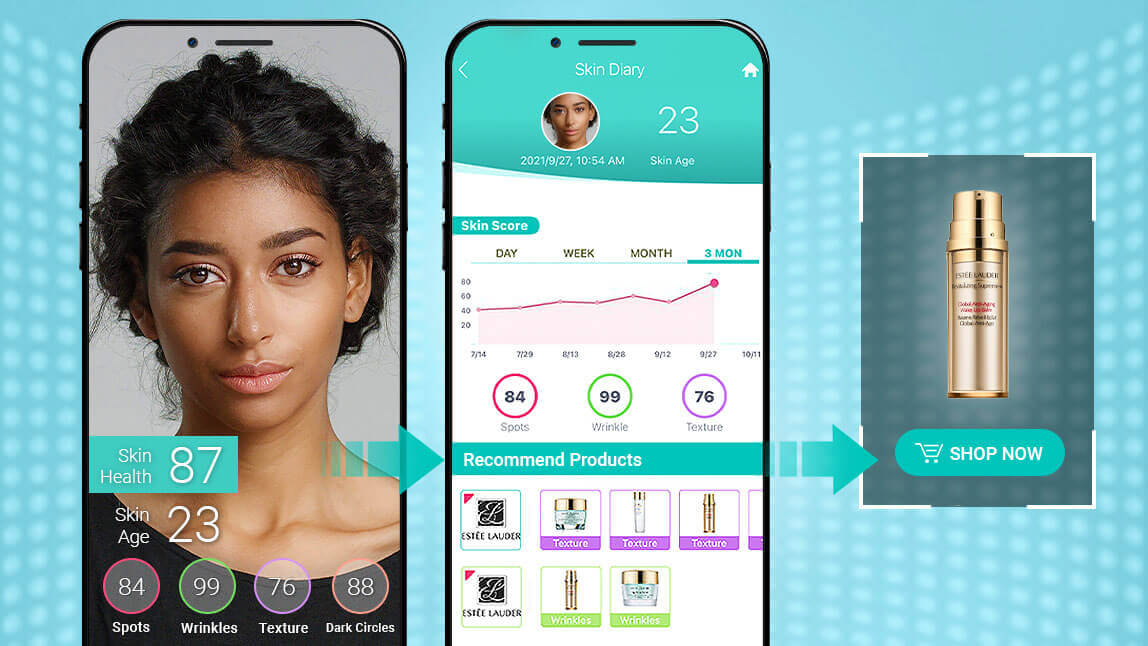
Beyond skin concern detection, skin scanner platforms are increasingly being integrated with personalized skincare recommendation engines. Based on the analysis results, brands can connect detected skin concerns with relevant skincare products, treatment protocols, or consultation pathways.
From an operational standpoint, this helps standardize recommendation logic across retail associates, estheticians, and digital channels while reducing reliance on purely subjective consultations. In ecommerce environments, AI skin scanner workflows are also being used to improve product discovery, increase engagement time, and support conversion optimization through more tailored skincare recommendations.
In enterprise skincare environments, recommendation consistency is often critical for maintaining brand trust across multiple consultants, retail locations, and digital channels.

Visualize the Possible Improvements
Some advanced skin scanner technologies also support skin simulation and skin emulation capabilities. These features generate visual projections that demonstrate how certain skin concerns may improve over time with consistent product usage or skincare treatments.
In practice, these simulations are commonly used to support consultation discussions, treatment planning, and customer progress tracking rather than serving as definitive predictive outcomes. Since actual skincare results vary based on product usage, treatment adherence, lifestyle factors, and skin condition severity, most professional implementations position skin simulations as educational visualization tools rather than guaranteed outcome forecasts.

A Personalized Skin Care Experience Accessible Anywhere, Anytime
Skin Scanner technology is increasingly becoming part of how skincare brands deliver scalable personalization across ecommerce, mobile apps, virtual consultations, and in-store advisory services. As consumers become more selective about skincare purchases, many brands are using digital skin scanner workflows to support product recommendations with visible skin analysis data rather than relying solely on generalized skincare quizzes or manual consultations.
From a commercial perspective, this helps address a common challenge in skincare retail: customer uncertainty. Many consumers struggle to confidently identify their own skin concerns, especially when shopping online without access to an esthetician or in-store advisor. By incorporating a skin scanner into the consultation journey, brands can provide more structured skincare guidance that improves recommendation transparency and increases customer confidence during product selection.
Many consumers now expect skincare recommendations to feel evidence-based rather than purely sales-driven, particularly when purchasing products online without in-person guidance.
Skin scanner platforms also help improve consultation consistency across different channels and staff experience levels. In retail and med spa environments, skincare recommendations can vary significantly depending on the consultant’s training, product familiarity, or assessment approach. A digital skin scanner creates a more standardized baseline for evaluating visible concerns such as wrinkles, redness, texture, pores, or oiliness, helping support more aligned skincare recommendations across teams and locations.
Another important shift is the growing demand for remote skincare consultations. Consumers are increasingly comfortable completing skincare assessments from home, particularly through mobile-first experiences that fit naturally into ecommerce browsing and social-driven shopping behavior. As a result, skincare brands are adopting skin scanner technology not only as a diagnostic feature, but also as a customer engagement tool that encourages repeat interaction, progress tracking, and ongoing skincare routine optimization over time.
Compatible with iPhone & iPad
Advancements in mobile camera technology have significantly expanded the accessibility of skin scanner applications. Modern iPhone and iPad cameras are now capable of capturing facial detail at a level sufficient for many consumer-facing skin analysis workflows, reducing the need for dedicated hardware in certain retail and ecommerce use cases.
This operational flexibility is particularly valuable for brands scaling digital skincare services across multiple regions or channels. Instead of requiring specialized diagnostic equipment at every consultation point, businesses can deploy mobile-compatible skin scanner experiences through existing consumer devices, kiosks, tablets, or web-based interfaces.
At the same time, commercially realistic implementations still account for practical limitations. Factors such as ambient lighting, makeup coverage, image resolution, and camera angle can influence skin scanner accuracy and analysis consistency. For this reason, many brands implement guided capture instructions and standardized imaging workflows to improve reliability across different user environments.
For consumers, the convenience factor is equally important. A mobile-compatible skin scanner lowers the friction associated with skincare consultations by allowing users to complete assessments instantly during ecommerce browsing or virtual consultations. This creates more opportunities for brands to introduce personalized product recommendations at key decision-making moments, particularly for first-time shoppers who may otherwise hesitate to purchase skincare products online.
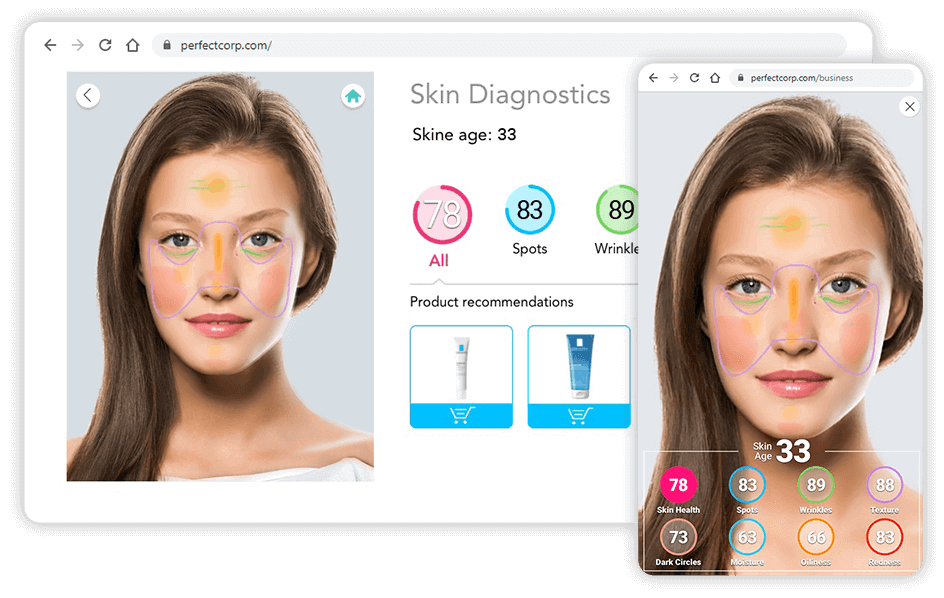
The rise of digital skin scanner technology also reflects broader changes in skincare shopping behavior. Consumers increasingly expect skincare consultations to be available across online and offline touchpoints, with consistent recommendations regardless of whether the interaction begins through a website, mobile device, in-store consultation, or virtual skincare service.
Rather than replacing skincare professionals, many brands are using skin scanner systems to support consultation workflows by combining visible skin analysis with professional guidance and product expertise. In practice, this hybrid approach often helps improve customer trust by making recommendations feel more data-supported while still maintaining the human element that remains important in skincare consultations.
How Skin Scanner Technology Is Changing Med Spa and Beauty Retail Workflows
Skin scanner technology is increasingly being integrated into med spa and beauty retail operations as a structured layer within the consultation workflow, rather than as a standalone diagnostic tool. In practice, its value is less about replacing professional judgment and more about standardizing the starting point of skincare assessments across high-volume, multi-staff environments.
In med spa settings, a typical consultation often begins with subjective visual evaluation followed by a treatment recommendation—such as chemical peels, laser treatments, or skincare regimens. However, this process can vary significantly depending on practitioner experience, time constraints, and client communication quality. A skin scanner introduces a more consistent intake layer by capturing and quantifying visible concerns such as texture irregularities, pigmentation, redness, and fine lines before the consultation progresses. This allows practitioners to anchor their recommendations in a structured skin analysis output, helping reduce variability between consultations while still leaving room for clinical judgment.
From an operational standpoint, this is particularly relevant in multi-provider med spas where consistency across practitioners directly impacts both treatment planning and client trust. When skin scanner outputs are used as a shared reference point, clinics can better align on baseline assessments, improve documentation quality, and support more standardized consultation outcomes across different locations or teams.
In beauty retail environments, skin scanner systems are often deployed at the beginning of the customer journey—either through in-store kiosks, tablet-based advisor tools, or QR-linked mobile experiences. Retail associates can use the scan results to guide product discovery more efficiently, narrowing down recommendations based on detected concerns such as dryness, acne tendencies, or visible pores. This reduces reliance on broad product explanations and helps shift consultations toward more targeted skincare routines, especially in high-traffic store environments where time per customer is limited.
Scalability is a key driver behind adoption. As beauty brands expand across regions and retail formats, maintaining consistent consultation quality becomes increasingly difficult. Skin scanner technology helps address this by providing a unified analysis layer that can be deployed across ecommerce platforms, physical stores, and virtual consultation channels. This creates a more consistent foundation for personalization workflows, where product recommendations are generated based on standardized skin assessment outputs rather than individual interpretation alone.
Another important operational consideration is data continuity across touchpoints. Many brands are beginning to connect skin scanner results with customer profiles, allowing repeat customers to track changes in skin conditions over time. In med spa workflows, this can support treatment progress discussions and revisit planning. In retail contexts, it can improve re-engagement strategies by enabling more relevant follow-ups based on previous skin analysis results and evolving skincare needs.
Ultimately, skin scanner technology is reshaping how skincare consultations are structured across both med spas and beauty retail by introducing a more repeatable and scalable framework for skin assessment, while still relying on human expertise for final recommendation and treatment decisions.
Limitations and Operational Considerations of Skin Scanner Technology
While skin scanner technology has become increasingly sophisticated, real-world implementation still comes with practical limitations that skincare brands, med spas, and beauty retailers must carefully manage. In commercial environments, the effectiveness of a skin scanner often depends as much on workflow design and operational consistency as on the underlying computer vision model itself.
Brands with clearly defined consultation workflows typically see stronger adoption outcomes than businesses deploying skin scanner technology without operational alignment.
One of the most common challenges involves lighting inconsistency. Variations in ambient lighting, shadows, camera positioning, and image quality can significantly affect how visible skin concerns are detected and interpreted. Concerns such as redness, pigmentation, texture, and oiliness are particularly sensitive to environmental conditions. As a result, many professional deployments introduce guided image-capture instructions, controlled lighting setups, or standardized consultation stations to improve analysis consistency across users and locations.
Dataset quality and representation also remain important considerations. A skin scanner trained on limited demographic or environmental datasets may perform inconsistently across different skin tones, age groups, acne conditions, or regional usage behaviors. In practice, commercial-grade skin scanner systems require ongoing model refinement and dataset expansion to maintain reliable performance across diverse customer populations. For global skincare brands operating across multiple markets, scalability is closely tied to how well the system generalizes under real-world conditions rather than controlled testing environments alone.
Another operational challenge involves customer perception and trust. While many consumers appreciate data-supported skincare recommendations, some remain skeptical of fully automated skin analysis results, particularly for more sensitive skin concerns. In med spa and professional skincare settings, customers often still expect human validation before committing to treatments or purchasing higher-priced skincare products. For this reason, many successful implementations position the skin scanner as a consultation support tool rather than a replacement for professional expertise.
Workflow adaptation can also be more complex than expected. Integrating a skin scanner into existing consultation processes may require staff training, updated consultation scripts, CRM integration, and changes to how skincare recommendations are documented or delivered. In beauty retail environments, associates must learn how to interpret skin analysis outputs in a way that feels consultative rather than overly technical or sales-driven. In med spas, practitioners may need to balance standardized scan results with individualized clinical observations and treatment planning.
There are also limitations to AI-only skincare consultations. While skin scanner technology can effectively evaluate many visible surface-level concerns, it cannot fully account for factors such as hormonal conditions, allergies, medication use, lifestyle habits, or underlying dermatological issues that may influence skin health. As a result, skin scanner outputs are generally most effective when combined with professional consultation, customer history, and broader skincare context.
From a commercial standpoint, brands that approach skin scanner deployment realistically tend to see stronger long-term adoption. Rather than treating the technology as a standalone solution, many successful skincare businesses integrate skin scanners as one component within a broader personalization, consultation, and customer engagement strategy. This balanced approach often improves customer trust while making implementation more operationally sustainable over time.
What Businesses Should Evaluate Before Choosing a Skin Scanner Platform
As skin scanner adoption continues to expand across skincare retail, med spas, dermatology clinics, and ecommerce platforms, businesses are becoming more selective about how these systems fit into broader operational and customer engagement strategies. Enterprise brands also increasingly evaluate how customer skin analysis data is stored, managed, and integrated across broader customer engagement systems. Choosing a skin scanner platform is no longer just a technology decision — it increasingly affects consultation workflows, personalization infrastructure, customer data management, and long-term scalability.
One of the first areas businesses typically evaluate is dataset quality and model reliability. Since skin scanner performance is heavily influenced by the training data behind the computer vision system, companies should assess whether the platform has been trained across diverse skin tones, age groups, lighting conditions, and regional demographics. A platform that performs well in controlled demonstrations may still face consistency challenges in real-world retail or clinic environments where image quality and user behavior vary significantly.
API flexibility is another important consideration, particularly for businesses building custom skincare journeys or integrating skin analysis into existing digital ecosystems. Many enterprise brands prefer skin scanner platforms that can connect directly with ecommerce systems, mobile apps, consultation tools, loyalty programs, or personalized recommendation engines through APIs rather than relying solely on standalone interfaces. This allows brands to incorporate skin analysis into broader personalization workflows while maintaining control over the customer experience and recommendation logic.

Consultation workflow integration is equally critical. In practice, even technically strong skin scanner systems can face adoption challenges if they interrupt existing operational processes. Med spas may require integration with intake forms, treatment documentation systems, or practitioner consultation flows, while beauty retailers often prioritize quick onboarding and minimal friction during in-store interactions. Businesses evaluating skin scanner platforms typically look beyond detection accuracy alone and assess how naturally the technology fits into real consultation environments.
CRM and customer data integration are becoming increasingly important as skincare brands focus more heavily on retention and lifecycle engagement. When skin scanner results can be connected to customer profiles, brands gain the ability to support progress tracking, repeat consultation workflows, personalized follow-ups, and more targeted skincare recommendations over time. This is particularly valuable for subscription skincare models, treatment programs, and loyalty-driven retail strategies where ongoing engagement matters as much as the initial consultation.
Scalability is another major enterprise consideration. A skin scanner platform may function effectively in a single retail pilot or flagship clinic, but large-scale deployment introduces additional operational requirements such as multi-location consistency, localization support, infrastructure stability, staff training, and cross-device compatibility. Businesses expanding internationally also need to consider how the platform performs across different consumer behaviors, imaging conditions, and regulatory environments.
Implementation complexity should not be underestimated either. Deploying a skin scanner often requires coordination across technical teams, ecommerce operations, retail training, marketing, and customer experience departments. Brands may need to redesign consultation flows, establish image-capture guidelines, refine recommendation frameworks, and define how scan results are communicated to customers in ways that feel informative rather than overly clinical or transactional.
From a commercial perspective, the most effective skin scanner platforms are typically those that support operational adaptability rather than forcing businesses into rigid workflows. As digital skincare experiences continue evolving, many brands are prioritizing systems that can integrate into existing consultation strategies while remaining flexible enough to support future personalization, omnichannel engagement, and evolving customer expectations.
How Brands Leverage Online Skincare Scanner Technology
Case Study: Neutrogena
Skincare brands such as Neutrogena have already explored using AI skin scanner technology to help their online customers understand their skin conditions better by guiding them through an AI online assessment tool. The online assessment is easy to use and works on any camera-enabled device, making it extremely convenient for online shoppers.
A great benefit of the skincare scanner technology is its ability to convey information in a highly visual way right on the customer's face, helping them to see the problematic skin areas by providing an objective score for each skin condition. This skin innovation is extremely intuitive and helps customers understand the results much better.
These implementations illustrate how skin scanner technology is increasingly being used not only for engagement, but also to reduce friction in digital skincare consultations and improve recommendation confidence during ecommerce purchasing journeys.
Case Study: La Roche-Posay
Another leading skincare brand, La Roche-Posay, has taken it one step further, spearheading the development of the advanced skin tracking necessary for the analysis of the most common skin concern—acne; a concern that affects more than 40 million individuals in the US every year.
The La Roche-Posay Acne Spot Scan tool delivers an immediate acne spot reading and personalized product recommendations for treatment, directly through a mobile device. This type of advanced skin tech helps to instantly educate and inform the consumer of their skin health, helping to track various areas of concern and allowing brands to recommend the appropriate products to meet individual customer needs.
Acne-focused skin scanner workflows are particularly valuable because acne consultations often involve recurring engagement, treatment monitoring, and longitudinal skincare management rather than one-time product discovery.
The Future of AI Skincare Scanner Technology
Visually assessing multiple skin concerns remains a highly complex challenge, particularly across varying skin tones, lighting environments, camera qualities, and real-world user behaviors. However, ongoing improvements in computer vision models, dataset diversity, and image-processing capabilities are steadily improving how skin scanner platforms interpret visible skin conditions in commercial environments. The industry is also moving beyond isolated diagnostic outputs toward more connected skincare ecosystems where skin analysis supports product recommendations, treatment planning, customer retention strategies, and longitudinal progress tracking.
Looking ahead, one of the most important shifts will likely involve the evolution of consultation workflows themselves. Rather than replacing skincare professionals, skin scanner technology is increasingly being positioned as a decision-support layer that helps practitioners, retail associates, and digital platforms deliver more structured and personalized skincare guidance at scale. This collaborative model — where AI-assisted analysis supports human expertise — is becoming more commercially realistic than fully automated consultation experiences.
The next generation of skin scanner systems is also expected to move beyond static image analysis toward more dynamic and continuous interaction models. Real-time video-based skin analysis, multi-session skin tracking, and deeper integration with customer profiles may allow skincare brands and aesthetic providers to create more adaptive consultation journeys over time. At the enterprise level, scalability will remain a defining factor, particularly for businesses managing omnichannel skincare experiences across ecommerce, mobile applications, retail locations, and professional treatment environments.
As digital skincare infrastructure matures, the competitive focus is shifting from simply offering skin analysis to delivering operationally reliable, clinically credible, and commercially sustainable consultation experiences. In that context, the future of skin scanner technology will likely be defined less by standalone AI capabilities and more by how effectively these systems integrate into broader personalization, customer engagement, and skincare workflow strategies.
As the skincare industry becomes more data-driven, the competitive advantage will likely shift from offering skin analysis itself to delivering operationally integrated consultation ecosystems built around personalization, continuity, and customer trust.
▶ Related Readings: 5 Reasons Brands Are Serious about Skincare Technology
Get expert advice from Perfect Corp. and be part of the beauty tech trend. Contact us for details on beauty tech solutions trusted by 600+ brands globally.
Shared Materials by Strapi
*Adjust the size of images ONLY. Please go to Strapi to edit the materials info.
Read our “Beauty Tech: The Complete Guide” to unlock powerful ROI secrets.
Skincare Scanner FAQs
What is a facial skin scan?

A facial skin scan is used for online skin analysis to provide information on a user's skin health. The technology provides users a real-time online analysis of their skin health across 15 skin concerns, and also differentiates skin conditions at different stages in their lifecycle and then highlights the results through an interactive AR overlay.
How do you perform a skin analysis?
AI technology makes it easy and accurate. By enabling the camera from a laptop or mobile phone, the skin analyzer will automatically detect your facial skin and provide a scanning result within a few seconds.
What is the purpose of skin analysis?
For customers, a regular skin analysis helps them to better understand their daily skin conditions, and apply products accordingly. For brands, the skin analysis helps them to provide truly customized skincare products to the users. Many brands have seen the increase in both sales and customer engagement with the help of AI skin analysis.