 Author: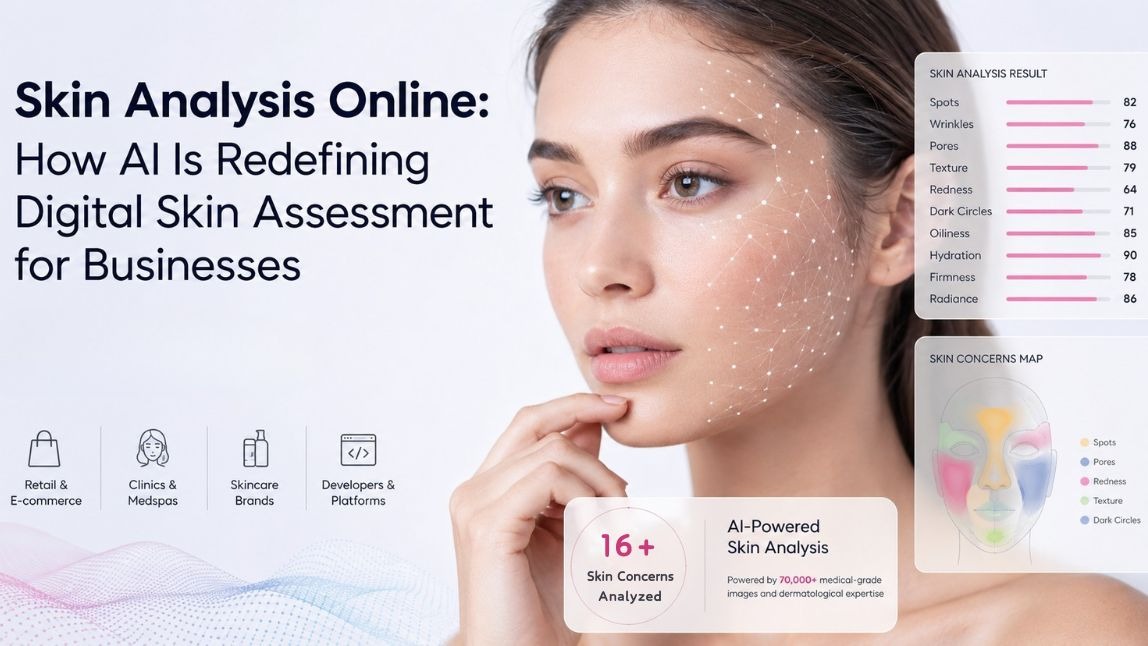
Online skin analysis has moved beyond a consumer-facing beauty quiz. For skincare brands, retailers, clinics, and medspas, image-based skin assessment is becoming a practical way to collect structured skin insights, personalize recommendations, and create a more measurable customer journey.
What Is Skin Analysis Online?
Skin analysis online refers to assessing visible skin characteristics through a digital interface, typically using a smartphone or computer camera. Instead of relying only on a questionnaire or a customer's own description of their skin, an AI-based system can examine an uploaded photograph or live camera image and identify visible characteristics such as spots, wrinkles, pores, redness, texture, acne, dark circles, oiliness, hydration, firmness, and radiance.
For businesses, the key distinction isn't simply whether an online skin analysis is fast. The more meaningful question is whether the technology can convert an image into structured, repeatable information that can be used in a real customer experience.
This changes the role of skin analysis from a one-time diagnostic-style interaction into a potential digital service layer. A skincare retailer can use it to guide product discovery. A clinic can use it to support consultations and progress tracking. A beauty platform can embed it directly into a web or mobile journey. Perfect Corp. explores this shift in greater detail in its article Beyond Skin Quizzes: How AI Skin Analysis Is Changing the Way We Understand Our Skin.
Why Online Skin Analysis Matters to Beauty and Skincare Businesses
Traditional skin consultations have an obvious limitation: they depend heavily on time, staff availability, equipment, and the consistency of individual assessments. Digital skin analysis does not necessarily replace professional judgment, but it can provide a standardized starting point before a human consultation or product recommendation.
For e-commerce, this is particularly valuable. A customer who arrives at a product page often knows what they want to buy but may not know which product is appropriate for their skin. A digital assessment can introduce an evidence-based layer between browsing and purchasing. For a deeper look at how this can work in digital commerce, see AI Skin Analysis for E-Commerce Beauty Brands: A 2026 Operator's Guide.
For physical retail and medspas, the same technology can extend the consultation beyond the store. Customers can complete an assessment online, return for follow-up assessments, and compare changes over time. This creates opportunities for personalization, retention, and more meaningful conversations around skincare routines.
How AI Skin Analysis Online Works
A professional online skin analysis system generally follows three stages.
- Image capture: The user takes a selfie or uploads an existing image. Image quality, lighting, and face positioning are important because inconsistent inputs can affect the reliability of visual analysis.
- Computer vision and AI analysis: The system detects facial regions and evaluates multiple visible skin characteristics. More sophisticated solutions can map concerns to specific areas of the face rather than producing a single generalized score.
- Structured results: The analysis is returned as scores, classifications, visual overlays, or other structured data. An API-based implementation can then pass these results into a website, mobile application, CRM, recommendation engine, or consultation workflow.
Perfect Corp.'s AI Skin Analysis technology, for example, analyzes more than 16 skin concerns and can return structured results for integration into digital experiences. Its technology is built using more than 70,000 medical-grade facial images and reports a 95% test-retest reliability rate in a dermatology-related study. Learn more about Perfect Corp.'s AI Skin Analysis API.
What Makes a Professional Skin Analysis Solution Different?
Not every online skin scanner should be evaluated in the same way. A simple consumer quiz can be useful for engagement, but businesses considering an AI skin analysis solution need to look deeper.
1. Validation and consistency
Accuracy claims should be supported by more than marketing language. Businesses should ask how the model was trained, what type of images were used, whether dermatologists or other qualified professionals were involved, and whether the system has been evaluated for consistency.
Perfect Corp. states that its AI skin analysis technology was developed using more than 70,000 medical-grade images and verified with dermatological expertise, with a reported 95% test-retest reliability rate. Its skin imaging research also reports more than 80% correlation with physician and professional-device assessments across specific skin concerns. See the research and skin imaging methodology.
2. Coverage across skin types and tones
A model intended for global use should be evaluated across different ages, skin tones, and skin types. This is not simply a technical consideration. It is part of building a responsible customer experience and avoiding a system that performs unevenly across different populations.
Perfect Corp. reports training its skin analysis technology on diverse facial images covering different ages, ethnicities, skin tones, and skin types. Businesses should nevertheless conduct their own validation against the populations they serve before deployment.
3. Privacy and data governance
Facial images are sensitive customer data. Any business deploying online skin analysis should understand where images are processed, how data is protected, how long information is retained, and which privacy requirements apply to its markets.
Perfect Corp.'s AI Skin Analysis API is designed with HIPAA and GDPR compliance in mind. For businesses operating in regulated markets, privacy should be reviewed as part of the technical and legal implementation process rather than treated as an afterthought.
4. Integration flexibility
A strong skin analysis engine is only useful if it can fit into the existing customer journey. An API-based solution can allow a business to build its own interface while using the underlying computer vision capability. This makes it possible to integrate analysis into websites, mobile apps, e-commerce flows, consultation tools, or internal platforms without developing the computer vision model from scratch.
From Skin Score to Business Value
The real commercial value of online skin analysis does not come from producing another number on a screen. It comes from what the business does with the result.
For example, a skincare brand can connect detected concerns with its product catalog and provide recommendations based on the customer's assessed needs. An online retailer can use the assessment as an interactive product-discovery step. A medspa can use standardized assessments to support consultations and document changes between visits. A beauty platform can combine skin analysis with personalized content, routine recommendations, and progress tracking. For a broader look at these business applications, see The Skincare AI Tool Built for Beauty Businesses.
This is where structured AI output becomes particularly important. If the system returns machine-readable results rather than a static report, developers can build business logic around those results. The same analysis can therefore support different experiences across web, mobile, retail, and professional environments.
Online Skin Analysis Should Support, Not Overstate, Professional Care
There is an important distinction between assessing visible skin characteristics and making a medical diagnosis. A responsible digital skin analysis experience should communicate what the technology can and cannot determine.
The World Health Organization has emphasized that AI used in health-related contexts should be developed and deployed with safety, ethics, equity, governance, and accountability in mind. These principles are relevant to businesses introducing AI-based skin assessment because the technology operates at the intersection of personal data, health-related information, and consumer decision-making. WHO: Ethics and Governance of Artificial Intelligence for Health.
For this reason, businesses should position online skin analysis appropriately: as a tool for skin assessment, personalization, education, monitoring, or consultation support, depending on the specific product and regulatory context. Clear communication is part of product quality.
Choosing an Online Skin Analysis Technology: A B2B Checklist
Before selecting a provider, decision-makers should evaluate the technology against the complete business workflow rather than comparing feature counts alone.
- Does the solution identify the skin concerns relevant to your customer base?
- Is the technology supported by dermatological or professional validation?
- Has the model been developed using sufficiently diverse data?
- Can the solution handle both uploaded images and camera-based experiences?
- Can results be returned as structured data through an API?
- Does the provider offer appropriate privacy and security controls?
- Can the results be connected to product recommendations or business rules?
- Can the experience scale across web, mobile, retail, and professional channels?
- Does the provider offer a testing environment so developers can evaluate the technology before committing to a full implementation?
These questions help separate a visually impressive skin scanner from a technology that can actually become part of a scalable digital product.
Why API-Based Skin Analysis Is Becoming More Practical
Building a computer vision model for skin analysis internally requires far more than training an image classifier. A production-ready system needs data, model development, image-quality controls, face detection, testing, infrastructure, privacy considerations, ongoing maintenance, and a reliable interface for developers.
An API approach allows businesses to focus their engineering resources on the customer experience and business logic. The company can design its own interface, recommendation system, commerce flow, or consultation workflow while using a specialized skin analysis engine underneath. Perfect Corp. also discusses the API-first approach in Skin Reader: How AI Skin Analysis Transforms Skincare for Businesses.
Perfect Corp.'s AI Skin Analysis API follows this model: developers can capture or upload an image, send it for analysis, and receive structured results that can be rendered inside their own applications. The API is available through a hands-on playground, allowing teams to evaluate the workflow before building a production integration.

The Future of Skin Analysis Online Is Personalization
The next stage of digital skin analysis is unlikely to be defined simply by detecting more concerns. The greater opportunity lies in connecting reliable skin insights with meaningful actions.
For brands, that may mean more relevant product recommendations. For retailers, it may mean a more useful path from discovery to purchase. For clinics and medspas, it may mean more consistent consultation support and measurable progress tracking. For developers, it means having access to structured skin intelligence that can become part of a broader digital product.
In other words, the value of online skin analysis is not the scan itself. It is the infrastructure that the scan enables.
Build an Online Skin Analysis Experience with Perfect Corp.
Perfect Corp. provides AI-based skin analysis technology for businesses that want to bring personalized skin assessment into digital, retail, and professional experiences. Its AI Skin Analysis technology supports analysis of 16+ visible skin concerns, is built on a large medical-grade image dataset, and is available as an API for custom applications.
Whether the goal is to improve skincare discovery, build a personalized recommendation engine, support consultations, or create a new digital beauty product, the right architecture starts with reliable analysis and a clear business use case.