Author:


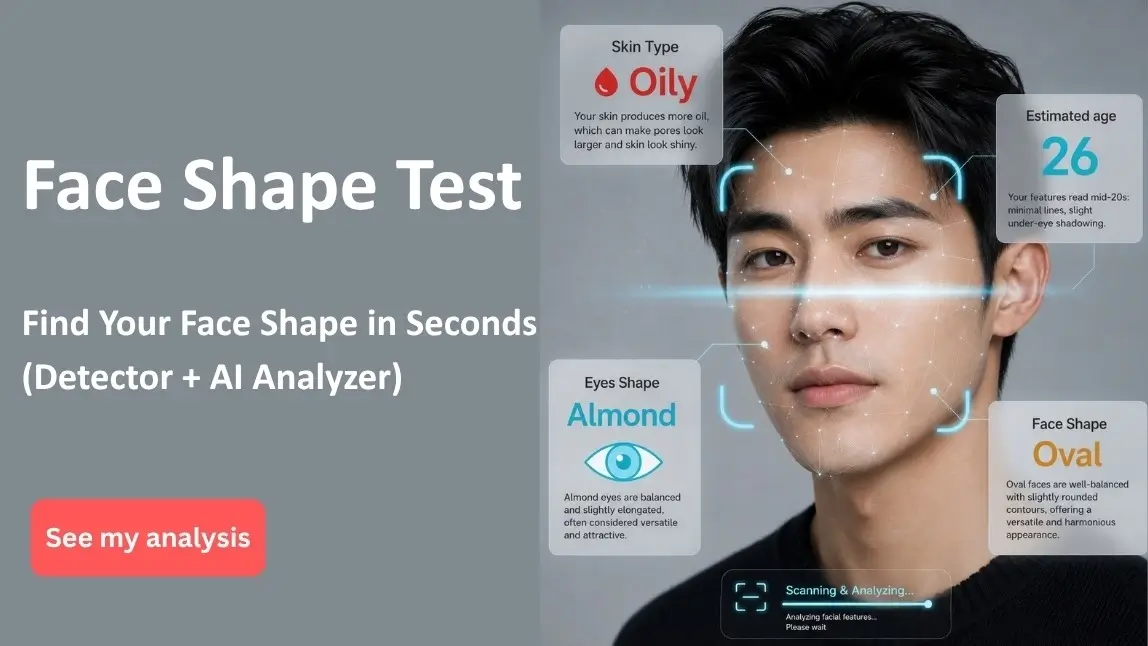
A face shape test helps you compare visible facial proportions with common categories, including oval, round, square, heart, diamond, oblong, and triangle. You can start with a quick self-assessment or use an AI face shape analyzer to explore your result from a photo.
This guide explains both options. Take the four-question face shape quiz below if you prefer a no-photo approach, or try the AI Face Analyzer for a photo-based assessment of visible facial proportions and feature relationships.

What Is a Face Shape Test?
A face shape test (sometimes called a face shape quiz, face type detector, or face shape meter) evaluates the proportional relationship between four dimensions:
- Forehead width — measured across the widest point of your brow
- Cheekbone width — from the sharpest point of one cheekbone to the other
- Jaw width — across the widest part of your jawline
- Face length — from the center of your hairline to the tip of your chin
How these four numbers relate to each other determines your category. Length noticeably greater than width? You're likely oval or oblong. Width and length roughly equal with a soft jaw? Probably round. Strong, angular jaw matching your forehead width? Square territory.
Traditional tests rely on a mirror, a ruler, and a fair amount of squinting. Modern tests use AI to map facial features and compute the ratios automatically—which is why searches for "face shape detector online" and "what is my face shape upload photo" keep climbing.
Take the 60-Second Face Shape Quiz (No Photo Needed)
Pull your hair back, face a mirror straight-on, and answer these four questions:
Question 1: What's the widest part of your face?
- A. Forehead
- B. Cheekbones
- C. Jawline
- D. Everything looks about equal
Question 2: How would you describe your jawline?
- A. Softly rounded
- B. Sharp and angular
- C. Narrow, tapering to a point
- D. Wide and flat at the bottom
Question 3: Is your face longer than it is wide?
- A. Yes, clearly longer
- B. Slightly longer
- C. About equal
Question 4: What shape is your chin?
- A. Pointed
- B. Rounded
- C. Flat or squared
Scoring Your Answers
| Your Pattern | Likely Face Shape |
|---|---|
| Balanced proportions, slightly longer than wide, rounded chin | Oval |
| Equal width and length, full cheeks, soft jaw | Round |
| Equal widths across forehead/cheeks/jaw, angular jaw, flat chin | Square |
| Wide forehead, narrow jaw, pointed chin | Heart |
| Widest at cheekbones, narrow forehead and jaw | Diamond |
| Clearly longer than wide, similar widths top to bottom | Oblong |
| Jaw wider than forehead | Triangle |

Landed between two shapes? That's completely normal—most faces blend at least two categories. This is exactly where an AI test earns its keep: it returns confidence scores across all categories instead of forcing a single label.
Ready for a precise answer? Try the free AI Face Analyzer—upload a photo and get your face shape, symmetry score, and 70+ feature breakdown in seconds.
The 7 Face Shapes Explained

Most face shape tests classify results into seven categories. Here's what defines each one:
Oval Face Shape
Face length is about 1.5x the width, cheekbones sit slightly wider than the forehead, and the jaw curves softly toward a rounded chin. Oval is the most versatile shape—nearly every hairstyle, frame, and makeup technique works with minimal adjustment. It's also the most common result returned by AI detectors.
Round Face Shape
Width and length are nearly equal, cheeks are full, and the jawline is soft with no hard angles. Styling for round faces usually aims to add visual length: height on top, longer layers, and angular glasses.
Square Face Shape
Forehead, cheekbones, and jaw share roughly the same width, and the jawline is strong and angular. Square faces read as structured and confident; styling focuses on softening or celebrating the angles rather than creating new ones.
Heart Face Shape
A broad forehead and prominent cheekbones taper down to a narrow jaw and pointed chin. The styling goal is lower-face balance—chin-length bobs, wider frames at the bottom, and beard volume for men.
Diamond Face Shape
The rarest shape: narrow forehead, narrow jaw, and dramatically wide cheekbones. Diamond faces are highly sensitive to hair length and side volume—small changes create big visual shifts.
Oblong (Rectangular) Face Shape
Clearly longer than wide, with forehead, cheeks, and jaw at similar widths. Visual shortening is the priority: side-swept fringes, horizontal lines, and width-adding frames. If this sounds like you, our full oblong face shape style guide covers haircuts, glasses, and makeup in detail.
Triangle Face Shape
The jawline is the widest part of the face, tapering upward to a narrower forehead. Many "6-shape" tests skip this category entirely, which is why blend-y results often get mislabeled as square or round. Styling adds width and volume up top to rebalance proportions.
Want celebrity examples for every category? See our visual breakdown of the 7 main types of face shapes—and men can find beard-specific guidance in the men's face shape guide.
How Does an AI Face Shape Test Work?
An AI face shape analyzer follows a consistent four-step pipeline:
- Facial features detection. The model maps dozens of reference points across your face—hairline, temples, cheekbones, jaw angles, chin, eyes, nose, and mouth. Perfect Corp.'s engine tracks 70+ facial feature points.
- Normalization. The algorithm corrects for head tilt, camera distance, and rotation, so a slightly angled selfie doesn't skew the result.
- Ratio calculation. It computes the proportional relationships between forehead, cheekbone, and jaw widths against face length.
- Classification. Your ratios are matched against face type clusters trained on large, diverse datasets, returning your shape—often with confidence scores for adjacent categories.
The whole process takes under two seconds. For a deeper technical walkthrough of manual vs. AI methods, read Face Shape Detector 101.
Face Shape Test vs. AI Analyzer: Which Option Should You Choose?
| Factor | Manual Quiz / Ruler Method | AI Face Shape Test |
|---|---|---|
| Time required | 5–10 minutes | Under 2 seconds |
| Equipment | Mirror, measuring tape, patience | One front-facing photo |
| Method | Based on self-observation | Based on visible proportions in a photo |
| Result | A broad self-assessment | A photo-based category assessment; results may share traits across categories |
| Extra insights | None | May provide additional visible feature insights, depending on the tool |
A manual face shape test is a useful starting point when you want a no-photo self-assessment. A photo-based AI analyzer can offer another point of reference when you prefer not to estimate measurements yourself. Results from either approach should be treated as guidance, since photo conditions and natural variation between categories can affect the result.
How to Take the Perfect Photo for a Face Shape Test
Even the best AI can't fix a bad input. For the most accurate result:
- Pull your hair completely back. Bangs and side pieces hide your hairline and jaw—the two most important boundaries.
- Face the camera straight-on at eye level. Even a slight downward angle exaggerates your forehead.
- Use even, natural lighting. Harsh side shadows distort the perceived width of your jaw.
- Keep a neutral expression. Smiling raises your cheeks and rounds out your lower face.
- Step back from the lens. Arm's length minimum—more on why below.
Why Guessing Your Face Shape Usually Fails
Three culprits explain why the same person gets "round" from one mirror session and "square" from another:
1. Wide-angle lens distortion. Front-facing phone cameras use short focal lengths. Held close, they exaggerate whatever is nearest the lens—usually your nose and mid-face—while compressing your jaw and ears backward. Research on focal length and facial perception shows that close-range selfies can measurably distort perceived facial proportions. This is the single biggest reason selfie-based guesses go wrong.
2. Soft-tissue camouflage. Beards, facial fat, and even masseter muscle development can visually widen a jaw that's structurally narrow. Manual tests measure what they see, not the underlying structure.
3. Head tilt. A few degrees of tilt shortens your visible face length and can flip an oblong reading into a round one. AI normalizes for this; your bathroom mirror does not.
Is There a "Most Attractive" Face Shape?
Short answer: no. Research on facial attractiveness consistently points to proportional harmony, symmetry, and averageness—not any single category—as the drivers of perceived attractiveness. An oval face with poor proportion balance can read less harmonious than a well-balanced square or triangle face.
That's why the useful question isn't "which shape is best?" but "how balanced are my proportions within my shape?"—something a symmetry and ratio analysis answers far better than a category label. And remember: your result isn't necessarily permanent. Weight changes, aging, and fat distribution all shift perceived shape over time, as we cover in Can Face Shape Change?
What to Do With Your Face Shape Result
Your face shape is a decision-making shortcut for:
- Haircuts: Add height for round faces, width for oblong, softness for square.
- Glasses: Contrast is the rule—angular frames for soft faces, rounded frames for angular ones.
- Makeup and contouring: Face shape determines where shadow and highlight look natural, rather than painted-on.
- Beard styling: A beard is the most powerful face-shape modifier available without surgery—it can visually lengthen, widen, or sharpen the lower face.
If your result came back wider than expected, our wide face styling guide breaks down slimming hairstyles, contour maps, and frame choices.
Face Shape Tests for Business: Beyond the Selfie
Face shape detection isn't just a consumer curiosity—it's become core infrastructure for beauty, eyewear, and aesthetics businesses. Perfect Corp.'s face analysis technology, trusted by 800+ brand partners worldwide, powers use cases like:
- Eyewear retail: Automatically recommend frames that balance each shopper's detected shape, then let them try frames on in AR—reducing returns and lifting conversion.
- Hair salons and hair-tech apps: Suggest cuts and styles matched to face proportions before a single snip.
- Beauty brands: Serve shape-specific contour and blush placement tutorials tied to shoppable products.
- Medical aesthetics: Provide ratio-level facial analysis (jaw proportion, eye distance, philtrum length) for consultation and simulation workflows.
Developers can integrate the same detection engine—facial features mapping, ratio analysis, GDPR-compliant photo handling—with a few API calls via the YouCam AI API platform. Enterprises can contact Perfect Corp. for a demo to see the technology in action.
Frequently Asked Questions
Is there a free face shape test?
Yes. The manual quiz in this article is free, and Perfect Corp.'s AI Face Analyzer offers free photo-based face shape detection online—no sign-up required for the demo experience.
How accurate is an AI face shape test?
A photo-based AI face shape test assesses visible facial proportions and feature relationships to compare them with common face-shape categories. Results can vary with photo angle, lighting, hair, expression, image quality, and the natural overlap between categories, so treat the result as useful guidance rather than a fixed label.
What are the 7 face shapes?
Oval, round, square, heart, diamond, oblong (rectangular), and triangle. Some tests use six categories and omit the triangle, which can mislabel jaw-dominant faces.
Can my face shape change over time?
Your bone structure is fixed after skeletal maturity, but perceived face shape shifts with weight changes, age-related fat pad migration, muscle development, and styling. Retesting every year or two is reasonable.
What is the most attractive face shape?
There isn't one. Attractiveness research points to symmetry, proportion, and averageness—qualities that exist within every shape category—rather than the category itself.
Can I test my face shape without measuring?
Yes. You can use a front-facing photo with an AI face shape analyzer to receive a photo-based assessment of visible facial proportions. For a clearer result, use even lighting and keep hair away from the hairline and jawline.
Do face shape tests work the same for men and women?
The classification logic is identical—the same seven categories and ratios apply. Styling recommendations differ, particularly around beards, hairlines, and frame proportions.