 Author:



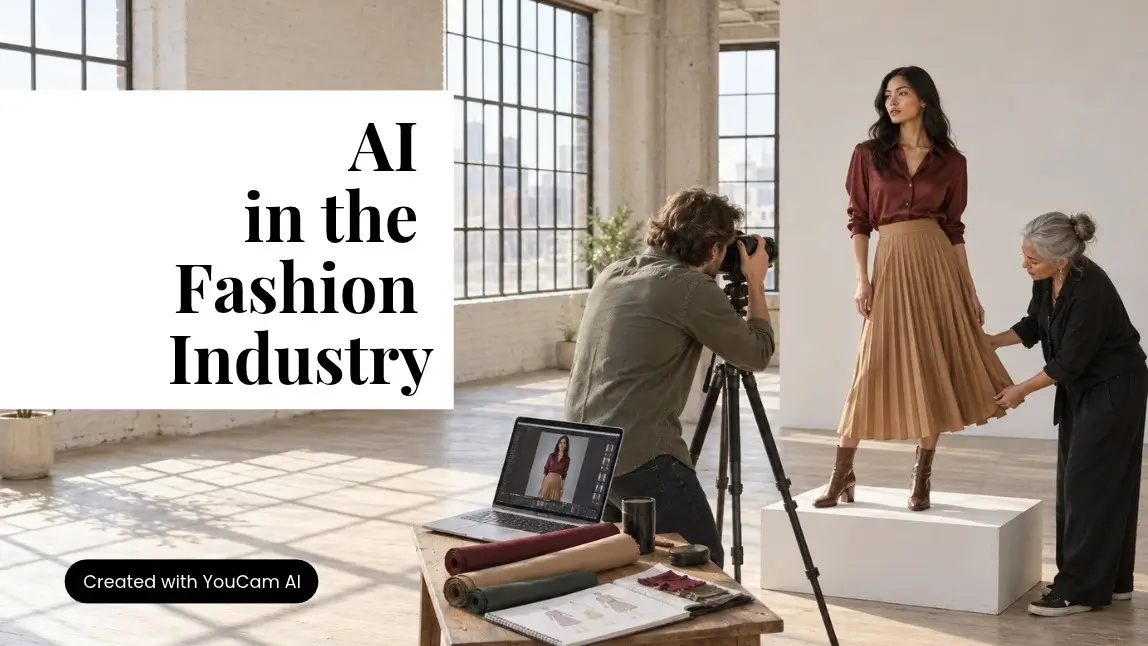
AI in the fashion industry is now part of everyday work, not a side experiment. Brands and retailers use it to sketch and test designs, forecast demand, plan assortments, produce product imagery, let shoppers try items on, answer customer questions and run resale programs. In The State of Fashion 2026, McKinsey and The Business of Fashion report that more than 35% of fashion executives already use generative AI in areas such as customer service, image creation, copywriting and product discovery.
This guide maps the eight areas where AI is used across the fashion value chain, explains what each one does in practice, and shows where to start. Two of those areas, product imagery and virtual try-on, are where Perfect Corp.'s fashion APIs fit: they place clothes, shoes, bags, scarves and hats onto photos of real people, so brands can build try-on and on-model imagery into their own sites and apps.

Table of Contents
- Where AI Fits in the Fashion Value Chain
- 1. AI in Fashion Design and Product Development
- 2. Trend and Demand Forecasting
- 3. Merchandising, Inventory and Pricing
- 4. Product Imagery and Campaign Content
- 5. Virtual Try-On for Clothes, Shoes and Accessories
- 6. AI in Fashion Retail: Search, Discovery and Service
- 7. Supply Chain and Operations
- 8. Resale, Rental and Circular Fashion
- Challenges of AI in the Fashion Industry
- How to Start Using AI in Your Fashion Business
- FAQ
- Conclusion
Where AI Fits in the Fashion Value Chain
AI in fashion is not one tool. Each stage of the value chain uses a different kind of AI: generative models for images and copy, predictive models for demand and pricing, computer vision for quality checks and image tagging, and conversational AI for shopping help. The table below gives the quick overview; the sections after it go stage by stage.
| Stage | What AI does | Main users | Type of AI |
|---|---|---|---|
| Design and product development | Mood boards, concept sketches, colorway and print variations, early sampling decisions | Designers, product developers | Generative AI |
| Trend and demand forecasting | Spots emerging styles in social, search and sales data; estimates demand by product and region | Trend, planning and buying teams | Predictive models, image recognition |
| Merchandising, inventory and pricing | Assortment planning, store allocation, replenishment, markdown timing | Merchandisers, planners | Predictive and optimization models |
| Product imagery and content | On-model photos, campaign variations, product descriptions, translations | Ecommerce, content and marketing teams | Generative AI |
| Virtual try-on | Shows garments and accessories on a shopper's or model's photo | Ecommerce and app teams | Generative AI, computer vision |
| Search, discovery and service | Conversational shopping assistants, visual search, recommendations, customer support | Ecommerce, CRM and service teams | Large language models, recommendation systems |
| Supply chain and operations | Sourcing scenarios, fabric defect detection, warehouse automation | Sourcing, production and logistics teams | Computer vision, optimization, robotics |
| Resale, rental and circularity | Authentication, item grading, listing creation, pricing used items | Resale and rental operators | Computer vision, generative AI |
Adoption is uneven across these stages. In the State of Fashion 2026 executive survey, leaders named scaling AI and digital capabilities as the single biggest opportunity for the industry in 2026, but most uses so far are siloed tasks such as copywriting, image generation and customer service. That is why content, imagery and customer-facing tools are where many brands see results first.
1. AI in Fashion Design and Product Development
AI in fashion design mostly speeds up the early, exploratory part of a collection. Designers use generative image tools to build mood boards, try silhouettes, test colorways and prints, and visualize variations of a garment before anything is cut or sewn. That means fewer physical prototypes and faster decisions about which ideas go to sampling.
Product development teams also use AI on the technical side: drafting product specifications, checking material options against cost targets, and keeping product data consistent from design to production. McKinsey's 2023 analysis Generative AI: Unlocking the future of fashion estimated that generative AI could add $150 billion to $275 billion to the operating profits of the apparel, fashion and luxury sectors within three to five years, with design and product development among the main sources of value.
Creative direction stays human. AI produces options quickly, but deciding what fits the brand, the season and the customer is still the designer's job.
2. Trend and Demand Forecasting
AI trend forecasting in fashion analyzes far more signals than a team could read by hand: runway and street-style images, social posts, search behavior and the brand's own sales data. Image recognition picks out recurring details such as a print, a color or a sleeve shape, and models estimate whether a signal is a short spike or a lasting trend.
Demand forecasting then turns those signals into numbers: how many units of each style, color and size to buy, and where to send them. Better forecasts mean fewer markdowns and less unsold stock, which matters more as margins tighten. Forecasting still needs people: buyers decide how much risk to take on a new trend, and that call depends on the brand's customer and positioning.
3. Merchandising, Inventory and Pricing
Merchandising is where forecasts become decisions. AI tools help planners build assortments by store and region, allocate stock across stores and warehouses, trigger replenishment, and time markdowns so that products sell through without heavy discounts.
A typical example: a mid-size apparel brand launching a few hundred new styles a season uses AI to decide which stores get which colors and sizes, based on local sales history and the space each store has. Planners review the recommendations and adjust them, and the system learns from what actually sells. The value comes from faster, more consistent decisions across thousands of products, not from removing the planner.
4. Product Imagery and Campaign Content
AI-powered marketing in fashion starts with content. Every product needs photos, descriptions and often versions for different markets and channels, and that volume is hard to keep up with through traditional shoots alone. Generative AI now helps with on-model images, background and campaign variations, product copy and translations. The State of Fashion 2026 report describes marketing teams moving from producing content to curating and directing it, and notes that Zalando cut its image production time from six to eight weeks to three to four days with generative AI.
For product imagery, the most practical use is turning existing product photos into on-model images. Instead of booking a full shoot for every color and style, a brand photographs the garment once and places it on its own model photos. Our guide to AI on-model product photography covers that workflow, and the clothing photography guide compares flat lay, ghost mannequin and on-model shots.
AI-generated models vs. your own model photos
Many of the most-searched questions about AI in fashion are about AI models: whether brands use them and whether shoppers can tell. There are two different approaches. Some brands generate synthetic people or create "digital twins" of real models. H&M, for example, released its first images featuring digital twins of real models in July 2025, co-created with the photographer and models involved.
The other approach keeps real people in the picture: the brand uses its own model photos and AI places the actual product onto them. Shoppers see a real person wearing the real item, and the brand controls who appears in its imagery. Whichever approach a brand chooses, being clear with shoppers about AI-generated imagery protects trust.
Where Perfect Corp.'s fashion APIs fit in imagery
Perfect Corp.'s fashion APIs work on the second approach. Perfect Corp. does not supply AI models; brands use their own model photos, and the API Playground includes sample model photos for testing. Brands own the images they upload and the results they generate.
- Clothes: the AI Clothes Changer API places a garment from a standard product image onto a full-body or half-body photo, adjusting for body shape, proportions and lighting. It covers tops, bottoms, dresses, swimwear and full outfits, and can add jackets, coats and vests as an outer layer. No 3D garment models are needed.
- Shoes: the AI Shoes Virtual Try-On API takes a photo of a person with their shoes visible plus a shoe image, and returns the same photo wearing the new pair, keeping the shoe's color, pattern and finish.
- Bags, scarves and hats: the bag, scarf and hat APIs take a person photo and a product image and generate a styled look of that person with the accessory, with a coordinated outfit and background in a style preset the brand chooses. They suit campaign and lookbook imagery.
5. Virtual Try-On for Clothes, Shoes and Accessories
Virtual try-on lets shoppers see how a product looks on a person before they buy. There are two main technologies, and they suit different jobs:
| Photo-based AI try-on | Live AR try-on | |
|---|---|---|
| How it works | Generative AI places the product onto a photo | 3D product models follow the shopper in the live camera view |
| What brands need | Standard product photos | 3D models of the products |
| Best for | Garments, catalog-wide try-on, on-model imagery | Shoes and accessories in an interactive camera experience |
| Perfect Corp. solution | Fashion APIs (clothes, shoes, bags, scarves, hats) | Enterprise AR solutions, such as AR Shoes Virtual Try-On |

Actual results from Perfect Corp.'s AI clothes virtual try-on tool.
Try-on matters most where shoppers hesitate because they can't picture the item on a person. Size and fit is one of the main reasons fashion items are returned, and the industry addresses it with separate size-recommendation tools that use body and product measurements. Virtual try-on works on a different question: how the style, color and overall look come across when worn. It shows how a garment looks, not which size to buy.
That makes try-on a good fit for "looks different than expected" returns and for helping shoppers choose between colors or styles. Our guide on how to reduce returns in fashion ecommerce matches each return reason to the fix that works for it, and the product page optimization checklist shows where try-on sits on a product page.

Actual result from Perfect Corp.'s AI shoes virtual try-on.
Your product photos, real results
Upload a garment and a model photo in the API Playground and check the result before you integrate.
6. AI in Fashion Retail: Search, Discovery and Service
AI in fashion retail is changing how shoppers find products. Instead of typing a keyword and scrolling, shoppers can describe what they need, such as an outfit for a winter wedding, and get a curated answer. Retailers now build this into their own apps as conversational shopping assistants, and shoppers also ask general AI assistants for product advice before they ever visit a store's site.

McKinsey's State of Fashion 2026 analysis describes this shift directly: customers use large language models to search, compare and get recommendations, and some use AI agents as style advisers. In the report's words, a brand's presence in AI chatbot responses is becoming "the new SEO." For brands, that means product data has to be complete and structured, and content has to be reachable by AI systems through APIs, not only visible on a web page.
Behind the scenes, retailers use AI for customer service (answering order and return questions, drafting replies), for visual search (finding similar items from a photo), and for personalized recommendations across the site, email and app.
For developers building these experiences, Perfect Corp.'s fashion APIs are standard REST APIs with JSON responses and code examples in JavaScript, Java, Python, PHP, Node.js and cURL. The shoes try-on is also available as a tool on Perfect Corp.'s MCP server, so AI agents and assistants can call it directly.
7. Supply Chain and Operations
Fashion supply chains deal with long lead times, many suppliers and changing trade conditions. AI helps sourcing teams model scenarios, such as moving production to another region or rerouting shipments, and estimate the cost and timing of each option. In factories, computer vision inspects fabric and finished garments for defects faster than manual checks, and optimization software plans fabric cutting to reduce waste.
In warehouses and fulfillment, AI-driven robots and routing systems handle picking and packing, and forecasting helps put stock closer to where it will sell. These uses are less visible to shoppers, but they are where cost and waste are often reduced most directly.
8. Resale, Rental and Circular Fashion
Resale is one of the fastest-growing parts of fashion: McKinsey's State of Fashion 2026 analysis forecasts that the secondhand fashion and luxury market will grow two to three times faster than the firsthand market through 2027. AI makes resale more workable at scale by helping authenticate items, grade their condition, write listings and suggest prices.
Imagery is a particular challenge in resale and rental, because every item is unique and often photographed flat or on a hanger. Showing those items on a person helps shoppers judge them. We cover this in detail in virtual try-on for resale and secondhand marketplaces, and the guide to starting a clothing rental business explains where try-on fits in a rental model.
Challenges of AI in the Fashion Industry
Most fashion companies are past the question of whether to use AI. The harder part is making it work well and responsibly.
Scaling past pilots
Many companies run AI pilots that never reach full rollout. The State of Fashion 2026 report notes that, across industries, 92% of companies say they will increase their investment in generative AI, but only 1% say their deployment has reached maturity. The usual blockers are scattered product data, old workflows and teams that weren't involved in designing the new process.
Authenticity and trust
AI imagery only helps if shoppers trust it. If a generated image shows a garment differently from the real product, the brand pays for it in returns and reviews. Working from real product photos, reviewing results before publishing and labeling AI-generated imagery clearly all reduce that risk.
Bias, intellectual property and ethics
AI models learn from existing data, so they can repeat its gaps, for example by showing a narrow range of body types or skin tones. Fashion brands address bias in AI tools by testing outputs across diverse people, setting clear rules for imagery and keeping human review in the process. Brands also need to know where training data and generated designs come from, protect their own designs and models' likenesses, and agree consent and pay with the people whose images they use.
The role of human creativity
AI changes jobs more than it replaces them. Repetitive tasks such as resizing images, tagging products and drafting descriptions shrink, while judgment, taste and brand direction become more important. The brands getting the most from AI treat it as a production tool that their creative and commercial teams direct.
How to Start Using AI in Your Fashion Business
The most useful AI projects start from a specific business problem, not from the technology. A simple sequence works for most brands and retailers:
- Pick one constraint. For example, product imagery that can't keep up with new arrivals, high return rates in one category, or slow markdown decisions.
- Check your data and assets. Clean product data and a consistent set of product photos make almost every AI use case easier.
- Run a focused pilot. Test on a limited set of products or one channel, with a clear comparison against your current process.
- Measure the result. Track the metric you set out to change, such as production time per image, return rate for the target reason or conversion on product pages.
- Scale what works. Build the winning workflow into your systems and train the teams who will use it.
Getting started with Perfect Corp.'s fashion APIs
If imagery or try-on is your starting point, you can test Perfect Corp.'s fashion APIs on your own products before involving engineering:
- Create an account in the API Console to get your API key.
- Test in the API Playground with a few product photos and model photos to see the results for your catalog.
- Read the API documentation for authentication, requests and image requirements.
- Compare API pricing: plans are pay-per-use.
Perfect Corp. has more than 10 years of AI and AR development behind it, and its technology has been used by more than 800 global brands.
FAQ
How is AI used in the fashion industry?
AI is used across the whole fashion value chain: generating design concepts, forecasting trends and demand, planning assortments and prices, producing product imagery and copy, letting shoppers try items on virtually, powering shopping assistants and customer service, inspecting quality in production, and authenticating and pricing items for resale.
Which fashion brands are using AI?
Many large brands and retailers now use AI publicly. A few documented examples: Ralph Lauren launched Ask Ralph, a conversational AI stylist in its app, in September 2025. Zalando rolled out its AI assistant to all of its markets in October 2024, alongside a trend tool built on its own data. H&M released images featuring AI digital twins of real models in 2025. And at Fashion Forward Week in February 2026, Nicole Miller worked with Perfect Corp. on an AI virtual fitting room that let attendees try on looks from the designer's archival collections.
Are fashion brands using AI models?
Some are. Brands use AI in two main ways for model imagery: generating synthetic models or digital twins of real models, or placing real products onto photos of real models. Brands that use AI-generated people usually disclose it, because shoppers want to know whether what they see is real.
Will AI replace fashion designers?
No. AI speeds up parts of the design process, such as mood boards, variations and technical documents, but deciding what a collection should say and who it is for remains a human, creative decision. Designers who use AI well spend less time on repetitive work and more on direction.
How is AI used in fashion retail?
In fashion retail, AI powers product search and recommendations, conversational shopping assistants, virtual try-on, customer service, pricing and markdowns, and store and warehouse planning. A growing share of shoppers also use general AI assistants to research products, so retailers are making their product data easier for AI systems to read.
Does virtual try-on tell shoppers their size?
No. Virtual try-on shows how a garment or accessory looks on a person: its style, color and overall look. Choosing a size is a separate step, usually supported by size charts and dedicated size-recommendation tools.
Conclusion
AI in the fashion industry now runs from the first sketch to the resale listing. The areas with the clearest early results are the ones with high volume and repeatable work: content and imagery, shopping discovery, forecasting and planning. The brands that benefit most pick one problem, build on clean data and real product photos, measure the result and keep people in charge of the creative and commercial decisions.
If product imagery or virtual try-on is on your list, Perfect Corp.'s fashion APIs let you bring clothes, shoes, bags, scarves and hats onto photos of real people inside your own site or app.
Fashion APIs for your site or app
Sign up in the API Console and start testing clothes, shoes and accessory try-on.
This article was edited and reviewed by the Perfect Corp. editorial team. Welcome to contact us or give us more suggestions.