 Author:



Images generated by AI
A blind pimple is the one that hurts out of all proportion to how it looks. There is no head, often barely a visible mark, just a deep tender lump that announces itself every time you touch your face. The frustration is that the instincts it triggers, squeeze it, scrub it, dry it out, are all wrong, and that the window where you can still influence how it ends lasts about two days. That makes early recognition the whole game, which is why acne scoring in a skin analysis API is worth more as an early signal across the face than as a verdict on one lump.
What this guide covers
What Is a Blind Pimple?
A blind pimple is an inflamed spot that forms deep under the skin and never breaks the surface. The clinical term is a closed nodule or a papule, depending on size and depth. Where an ordinary whitehead sits near the surface with a visible opening, a blind pimple develops far enough down that there is no path out, so the contents stay trapped and the surrounding tissue inflames around them.
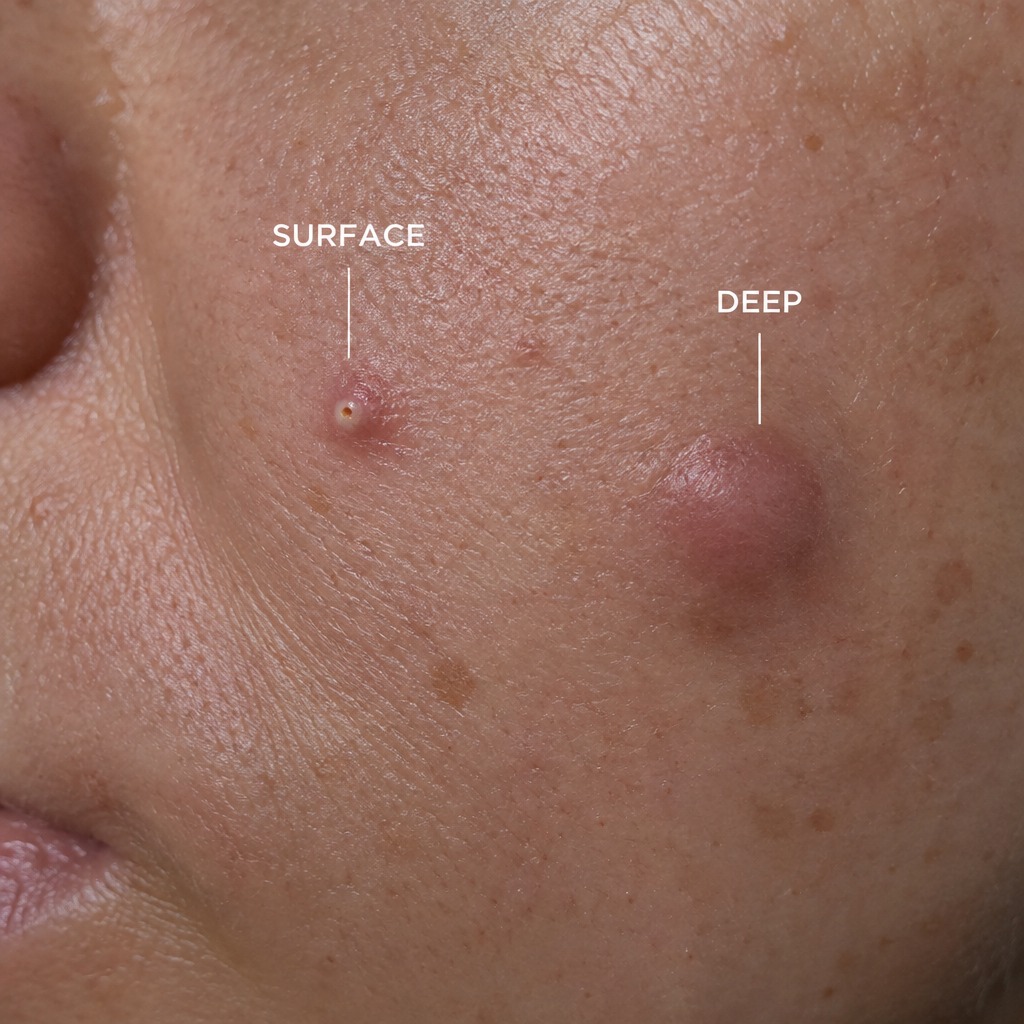
What you feel is a firm, deep, tender lump. What you see is often very little, sometimes a slight raised area or mild redness, sometimes nothing at all until it has been there a few days. That gap between how much it hurts and how little it shows is the defining characteristic and the source of most of the frustration.
Why Does a Blind Pimple Hurt So Much?
Because of pressure and location. The inflammation develops inside a confined space with nowhere to expand, so it presses outward against surrounding tissue. That tissue is rich in nerve endings, particularly on the chin, jawline and nose, which is why a lump of the same size hurts more in some places than others.
A surface whitehead has an escape route and relieves its own pressure. A blind pimple does not, so the pressure builds until your immune system resolves the contents from the inside, which takes days to weeks. The soreness tracks the pressure, which is why these spots typically hurt most around day two or three and then ease even though the lump is still clearly there.
The pain is also a useful diagnostic. Deep tenderness means active inflammation, which means your skin is actively working on it. A deep lump that does not hurt at all is usually something else, and the next section covers what.
How Is a Blind Pimple Different From a Cyst, a Boil or Milia?
These get confused constantly, and the treatment for each is different enough that the confusion matters.
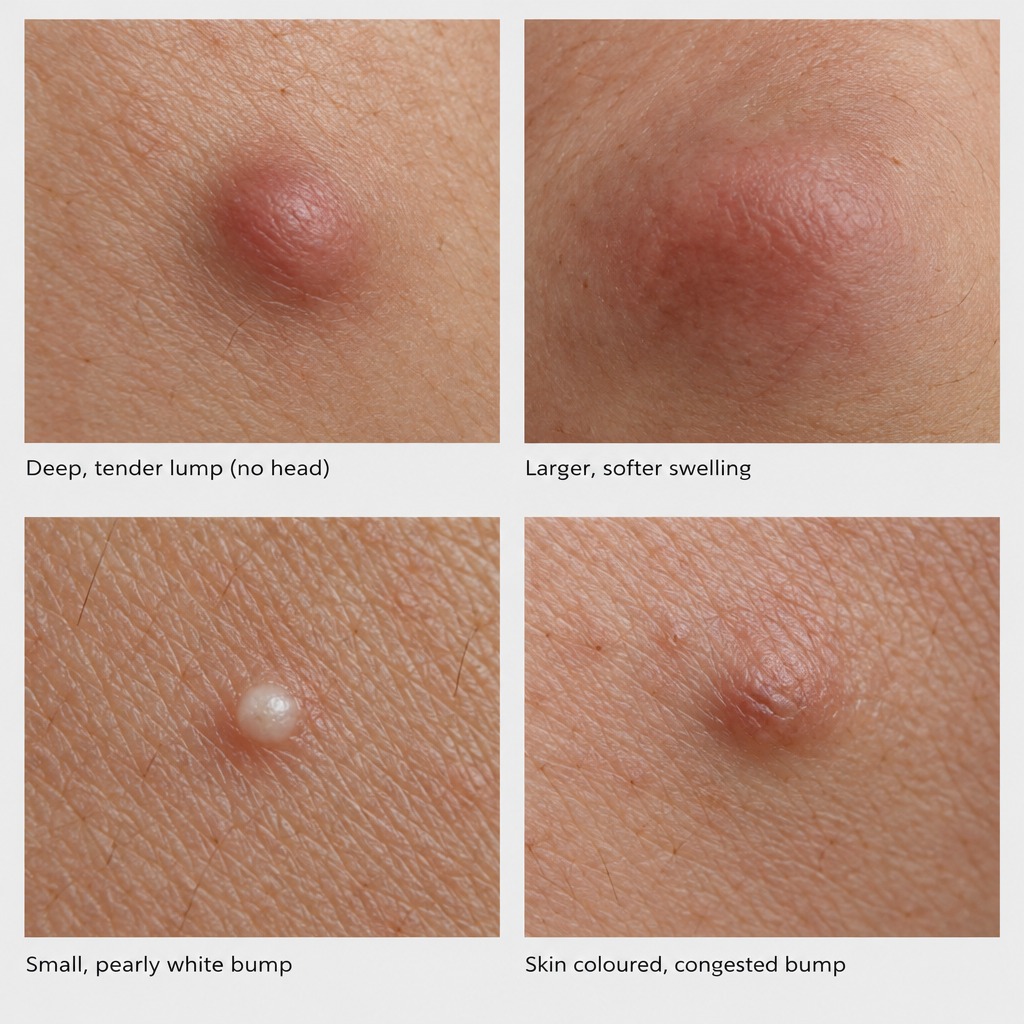
| What it is | How it feels | What it looks like | What to do |
|---|---|---|---|
| Blind pimple | Firm, deep, tender, sore to the touch | Little or no visible head, mild redness at most | Warm compress, leave it alone, topical treatment |
| Cystic acne lesion | Larger, softer, deeper, often very painful | A noticeable swelling, sometimes several centimetres | Dermatologist. These scar reliably if untreated |
| Boil | Very painful, warm to the touch, grows fast over days | Red and swollen, may develop a yellow centre | Medical attention. A bacterial infection, not acne |
| Milia | Firm, completely painless | Small white or pearly bumps just under the surface | Not a pimple. Needs removal, not acne treatment |
| Closed comedone | Small, firm, not painful | A skin coloured bump, surface slightly uneven | Salicylic acid or a retinoid, patience |
| Ingrown hair | Tender, often itchy | Redness around a hair follicle, sometimes a visible hair | Stop removing hair in that area, warm compress |
The quickest sorting question is whether it hurts. Painless deep bumps are almost never blind pimples, and acne spot treatments do nothing for milia or closed comedones while irritating the surrounding skin.
What Causes Blind Pimples?
The same process that causes all acne, happening deeper than usual. A follicle becomes blocked with sebum and dead cells, bacteria that normally live there multiply in the trapped material, and the immune system responds with inflammation. When that blockage is close to the surface you get a whitehead. When it is deeper, you get a blind pimple.
| Contributing factor | How it drives deep lesions |
|---|---|
| Hormonal fluctuation | Raises sebum production. Explains the monthly jaw and chin pattern many people recognise |
| Stress | Raises cortisol, which raises sebum and slows healing at the same time |
| Friction and pressure | Phones, helmet straps, masks, hands resting on the chin. Blocks follicles mechanically |
| Heavy or occlusive products | Thick creams and some oils block follicles in people already prone to it |
| Over exfoliation | A damaged barrier inflames more readily, so blockages escalate faster |
| Picking and squeezing | Pushes contents deeper and spreads inflammation sideways |
| Sweat left on the skin | Particularly under clothing or equipment after exercise |
Over exfoliation deserves a note because it is counterintuitive. People with deep breakouts often respond by scrubbing harder, which damages the barrier, which increases inflammation, which makes the next blockage escalate into a deeper lesion rather than a surface one. If your skin stings after cleansing, that loop is probably running.
What Does the Location Tell You?
Not as much as face mapping charts claim, but the physical explanations are real and useful.
- Chin and jawline. The most common site for deep painful spots, and the one most associated with hormonal cycling. Also where hands rest and where phones make contact.
- Nose. Large sebaceous glands and dense nerve supply, which is why a nose lesion hurts disproportionately.
- Forehead and hairline. Often linked to hair products, hats and headbands, and to sweat that sits after exercise.
- Cheeks. Frequently friction related. Phone screens, pillowcases and hands.
- Back and shoulders. Sweat plus pressure from bags and clothing. Deep lesions here scar more readily than facial ones.
Location is a hint about behaviour rather than about internal organs. The useful question is what touches that part of your face regularly.
Can You Pop a Blind Pimple?
No, and this is the single most consequential thing on this page.
There is nothing to pop. A blind pimple has no opening and no collected contents sitting near the surface, so squeezing does not release anything. What it does do is rupture the follicle wall below the skin, which spreads inflammatory material sideways into surrounding tissue. A lump that would have resolved in a week becomes a larger lesion lasting three, and the deeper the original spot, the higher the chance it leaves a permanent mark.
Three specific consequences, in order of how often they happen:
| What squeezing causes | How likely | How long it lasts |
|---|---|---|
| A larger, more inflamed lesion | Very likely | 2 to 4 weeks instead of 1 |
| A post inflammatory mark | Likely, especially on deeper skin tones | 3 to 12 months |
| A permanent indented scar | Possible with deep lesions | Permanent without treatment |
The distinction between a temporary mark and a permanent scar matters when you are deciding how worried to be, and our guide to telling acne scars from acne marks explains how to tell which one you are looking at.
How Do You Treat a Blind Pimple?
The goal is to reduce inflammation and either help it resolve internally or help it come to the surface on its own. Nothing here works in an hour, which is worth knowing before you start.
| Approach | How to do it | Timeline |
|---|---|---|
| Warm compress | Clean warm cloth, 10 to 15 minutes, 3 times daily. The most effective home step | Eases pain within hours, helps resolution over days |
| Benzoyl peroxide, 2.5 to 5 percent | A thin layer on the spot only, once daily to start | 3 to 7 days |
| Salicylic acid spot treatment | Targeted application. Less effective on deep lesions than on surface ones | 5 to 10 days |
| A topical retinoid | Across the area rather than the spot. Prevention more than treatment | Weeks, and it reduces future lesions |
| Hydrocolloid patch | Only once a head has formed. Useless on a sealed lesion | Overnight, after it surfaces |
| Ice, briefly | A few minutes wrapped in cloth for pain and swelling | Symptom relief only |
| Cortisone injection | In clinic, for a large or important lesion | 24 to 48 hours. The only genuinely fast option |
Two things to avoid. Drying the spot aggressively with alcohol or strong acids inflames the surrounding skin without reaching the lesion, and it is a common route into a damaged barrier. And toothpaste, which appears in every list of home remedies, irritates skin and treats nothing.
How Long Does a Blind Pimple Last?
| Scenario | Typical duration | What usually happens |
|---|---|---|
| Left alone, treated with warm compresses | 1 to 2 weeks | Resolves internally or surfaces and drains on its own |
| Treated with benzoyl peroxide early | 5 to 10 days | Inflammation settles faster, lower chance of marking |
| Squeezed | 3 to 6 weeks | Larger lesion, high chance of a lasting mark |
| Repeatedly picked | Months | Scarring becomes likely rather than possible |
| Cortisone injection | 1 to 2 days | Fastest route, requires a clinic visit |
The spread between the first row and the third is entirely under your control, and it is the reason the advice to leave it alone is not just caution. Doing nothing is an active treatment choice with a measurably better outcome.
How Does a Skin Analysis API Handle Blind Pimples?
Carefully, and with its limits stated, because this is a case where overclaiming would be obvious to the user.
The AI acne analysis runs as part of a system returning 28 skin diagnostics across 16 skin concerns from a single selfie, dermatologist verified. Acne is scored from visible signs, which means a lesion with no surface presentation is at the edge of what any camera based system can see. A blind pimple that is raising the skin slightly or showing redness will register. One that is purely subsurface may not.
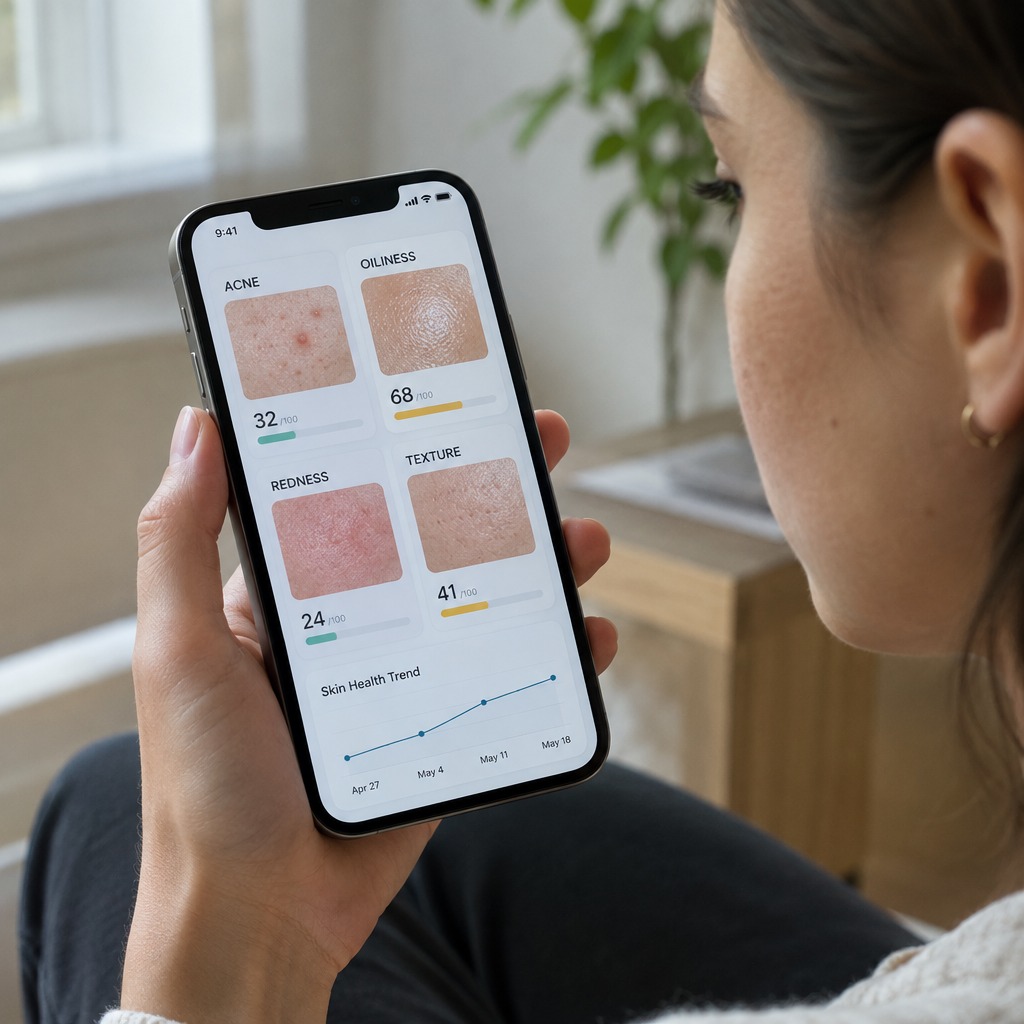
That limit is less restrictive than it sounds, because the useful question is rarely about one lump.
| Scored concern | What it contributes | Why it matters for deep lesions |
|---|---|---|
| Acne | Count and distribution of visible inflammatory lesions | Establishes whether this is one spot or a pattern |
| Oiliness | Sebum level across zones | High oiliness with recurring deep lesions points to prevention, not spot treatment |
| Redness | Inflammation and barrier stress | Separates an inflammatory pattern from a purely congestive one |
| Texture | Surface irregularity and congestion | Picks up the clogging that precedes deep lesions |
A single scan tells you the state of the face. A scan repeated every few weeks tells you the trend, and the trend is where the value is. Someone whose acne and oiliness scores climb together across a month is heading for more deep lesions, and that is an actionable prediction in a way that a verdict on today's lump is not.
Two limits stated plainly. These are estimates from visible signs, not a diagnosis, and a lesion with no visible surface change may be missed entirely. Anything suspected to be a boil or a true cyst belongs with a clinician rather than with an app.
How Do You Prevent Blind Pimples?
Prevention works considerably better than treatment here, because by the time you can feel one, most of the outcome is already determined.
- Use a topical retinoid consistently. The single most effective preventive measure for deep lesions, because it stops follicles blocking in the first place. Allow eight to twelve weeks.
- Remove the friction. Clean your phone, change pillowcases weekly, keep hands off your chin, loosen anything that presses on your face.
- Cleanse after sweating rather than hours later, particularly where clothing or equipment traps it.
- Do not over cleanse or over exfoliate. A damaged barrier produces deeper lesions, not fewer.
- Check your products for heavy occlusives if deep lesions started after a routine change.
- Treat recurring hormonal patterns as a pattern. Monthly jaw and chin lesions respond better to a preventive routine timed ahead of them than to spot treatment after.
When Should You See a Dermatologist?
Sooner than most people do. Deep lesions are the type that scar, and scarring is far easier to prevent than to treat.
- Lesions that recur in the same place, which suggests an underlying structure rather than a one off blockage.
- Anything larger than about a centimetre, or that keeps growing after three days.
- Pain severe enough to disturb sleep, or warmth and spreading redness, which may indicate infection rather than acne.
- Any lesion that has already left an indented mark, since that pattern tends to repeat.
- Several deep lesions at once, which is usually a treatable condition rather than bad luck.
- No improvement after six to eight weeks of consistent over the counter treatment.
A cortisone injection resolves a single important lesion in a day or two, and oral treatment changes the trajectory for recurring deep acne in a way that no topical does. Both require a clinician, and waiting the problem out is how a treatable pattern becomes a permanent one.
How Do Teams Use Acne Scoring in an API?
Deep painful lesions are a high intent moment. The person scanning is uncomfortable, motivated and about to make a decision, which makes the honesty of the response unusually valuable.
| Acne score | Oiliness | Redness | Route the customer to |
|---|---|---|---|
| Low, isolated lesion | Normal | Normal | Spot care and aftercare guidance. Do not sell a routine overhaul |
| Moderate, recurring | High | Normal | Preventive routine. Retinoid and salicylic acid, framed over 8 to 12 weeks |
| Moderate | Normal | Elevated | Barrier support first. Aggressive acne actives will backfire here |
| High, deep lesions described | Any | Any | Refer to a professional. Say so plainly and keep the trust |
| Low acne, high texture | Normal | Normal | Congestion rather than inflammation. Different products entirely |
Three implementation notes. Never return an empty result when a user reports a painful lump the camera cannot see, because the absence of a detection is not the absence of a problem and a blank screen destroys confidence. Build the referral path properly, since recommending a dermatologist at the right moment is the cheapest trust you will ever buy. And track the trend across scans, because the preventive recommendation is worth more than the reactive one and only repeat scanning surfaces it.
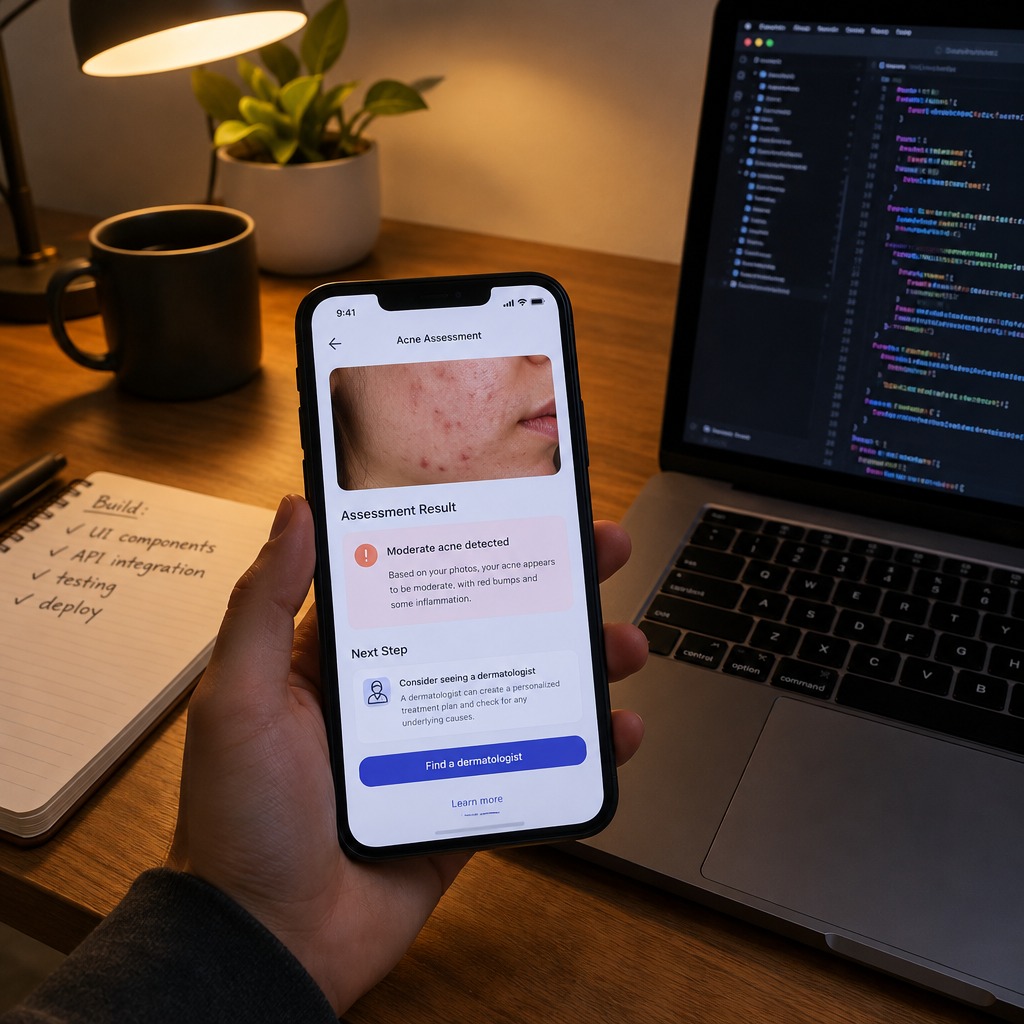
You can test the per concern scoring against real images in the YouCam AI API Playground, and see how brands have built similar flows in the Perfect Corp skin analysis showcase. Perfect Corp works with 800+ brand partners on experiences of this kind.
Blind Pimple FAQ
What is a blind pimple?
An inflamed spot that forms deep under the skin without breaking the surface. There is no head to see, which is where the name comes from, but it is tender to the touch and often visible only as a slight raised area or faint redness.
How do you get rid of a blind pimple overnight?
You usually cannot. A warm compress and a thin layer of benzoyl peroxide will reduce pain and speed things up, but deep lesions take days. The only reliably fast option is a cortisone injection from a clinician, which works within a day or two.
Should you pop a blind pimple?
No. There is no opening and nothing near the surface to release, so squeezing ruptures the follicle below the skin and spreads the inflammation. It reliably turns a one week problem into a three week one and raises the chance of a permanent scar.
How do you bring a blind pimple to a head?
A warm compress for ten to fifteen minutes, three times a day. It increases local circulation and encourages the contents to move toward the surface naturally. Once an actual head forms, a hydrocolloid patch becomes useful, and it does nothing before that.
How long does a blind pimple last?
One to two weeks if left alone and treated with warm compresses, often five to ten days with early benzoyl peroxide. Three to six weeks if it has been squeezed, and longer if it has been picked repeatedly.
Why is my blind pimple so painful?
Because the inflammation is trapped in a confined space with nowhere to expand, so it presses on surrounding tissue that is rich in nerve endings. Pain usually peaks around day two or three and then eases, even while the lump is still there.
What is the difference between a blind pimple and a cyst?
Size, depth and softness. Cysts are larger, deeper, softer and more painful, and they scar far more reliably. A cyst is a reason to see a dermatologist, while a blind pimple can usually be managed at home.
Can stress cause blind pimples?
It contributes. Stress raises cortisol, which increases sebum production and slows healing, so both the formation and the duration of deep lesions get worse. It is rarely the only cause but it reliably makes an existing tendency worse.
Can a skin analysis API detect a blind pimple?
It detects visible inflammatory lesions among 28 diagnostics across 16 concerns, so a blind pimple raising or reddening the skin will usually register while a purely subsurface one may not. The real value is in tracking the acne, oiliness and texture pattern over time rather than in judging a single lump.
Does toothpaste work on a blind pimple?
No. It irritates the surrounding skin without reaching a lesion that sits well below the surface, and the irritation can leave a mark of its own. A warm compress does far more and costs nothing.
The Best Treatment Is the One You Do Not Do
Blind pimples resolve on their own in one to two weeks, and almost everything that extends that timeline is something you did to them. Warm compresses three times a day, a thin layer of benzoyl peroxide, and otherwise leaving it alone produces the best realistic outcome for most people. The prevention work matters more than the treatment work, and a consistent retinoid plus removing whatever presses against your face addresses more deep lesions than any spot treatment will.
For teams building acne features, the honest position is the valuable one. Say what the camera can and cannot see, track the pattern rather than the lump, and refer out when it is warranted. Test the skin analysis API in the YouCam AI Playground, or contact Perfect Corp for a demo to see how per concern scoring fits your customer flow.