 Author:
Images generated by AI
Dull is the vaguest word in skincare and the one the entire brightening category is built on. It is also, usefully, a physics problem rather than a mystery: skin looks radiant when its surface is smooth enough to reflect light in one direction, and flat when the surface scatters that light in every direction. That means dullness has causes you can separate and fix in a specific order, and it means a skin analysis API can score it honestly, because radiance is not one measurement but a combination of texture, moisture and evenness.
What this guide covers
What Causes Dull Skin?
Four things, usually together: a build up of dead surface cells that roughens the skin, dehydration that flattens the surface further, uneven tone from pigment or sallowness, and reduced blood flow from poor sleep, smoking or stress. Sun damage sits underneath all of them, because it degrades both surface quality and evenness over years.
None of those is a pigment problem in the way the brightening aisle implies, which is why so many people buy a vitamin C serum for dullness and feel nothing has changed.
Why Is Dullness a Light Problem Rather Than a Colour Problem?
Because glow is a reflection. A smooth, well hydrated surface bounces light back coherently, which your eye reads as a highlight along the cheekbone and a sense of luminosity. A rough or dry surface scatters the same light in every direction, so no highlight forms and the skin reads as flat, grey and tired even when its actual colour has not changed at all.
This is worth internalising because it reorders your priorities. Anything that smooths the surface or holds water in it increases radiance immediately. Anything that only changes pigment changes radiance slowly, and only if pigment was your problem in the first place.
It also explains two everyday observations. Why your skin looks brighter straight after a shower, which is a hydration effect lasting minutes. And why a hydrating serum can produce a visible glow in two days while a brightening serum takes three months.
What Are the Three Kinds of Dullness?
| Type | What is happening | How to spot it | What fixes it |
|---|---|---|---|
| Surface dullness | Dead cell build up, dehydration, rough texture, damaged barrier | Skin feels rough or tight. Dullness is uniform across the face. Improves visibly right after moisturiser | Hydration, gentle exfoliation, barrier repair, a retinoid over time |
| Tone dullness | Uneven pigment, sun damage, post-acne marks, a sallow or grey cast | Skin is smooth to the touch but patchy or yellowish in colour. Looks worse in photographs than in person | Vitamin C, niacinamide, azelaic acid, daily SPF, time |
| Fatigue dullness | Reduced microcirculation from poor sleep, smoking, dehydration, stress | Comes and goes with your week. Worst on bad sleep, with under eye shadowing alongside | Sleep, stopping smoking, exercise, fluids. No product substitutes for these |
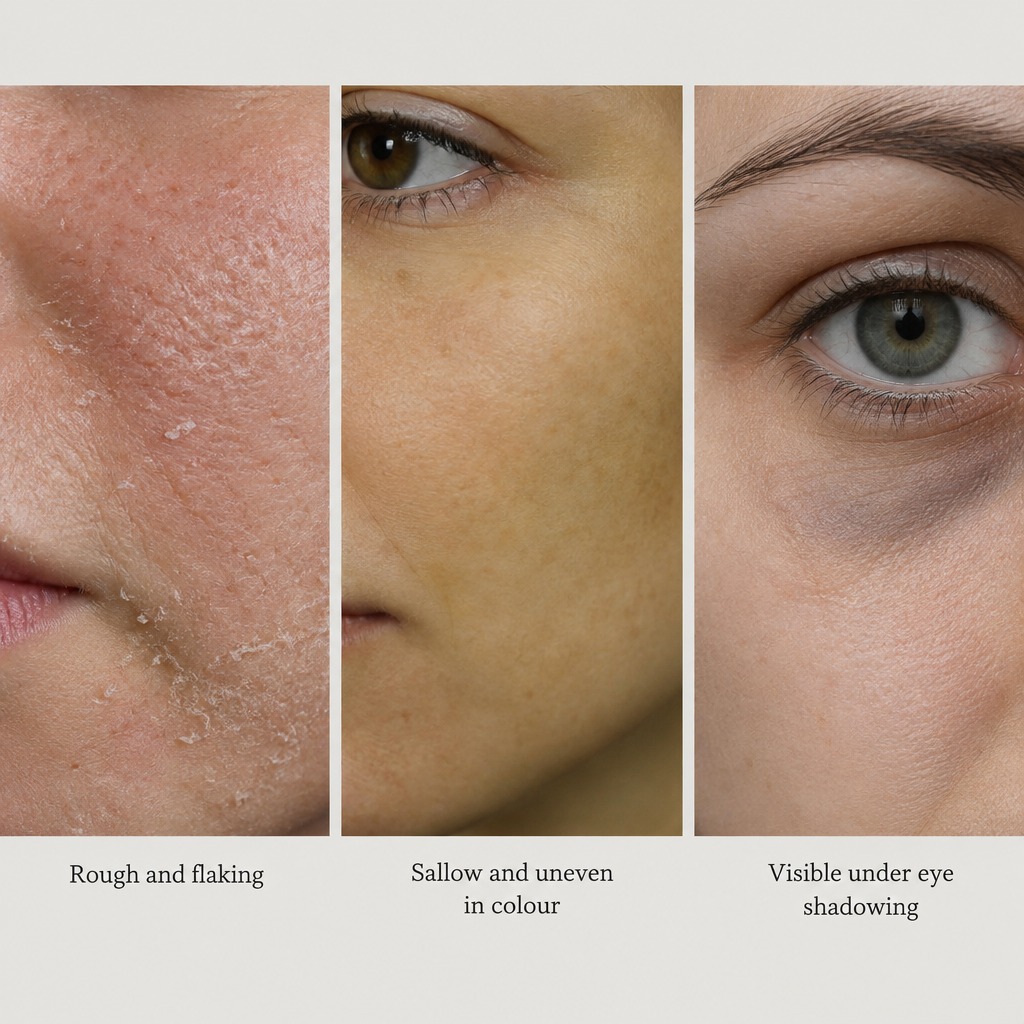
Most people have a dominant one and a secondary one. Fixing the dominant one is what produces the change people actually notice.
How Do You Work Out Which One You Have?
The single light test
Stand beside a window with light coming from one side, no overhead lights, no filters, and photograph yourself at eye level. Look for a highlight along the cheekbone. A clear highlight means your surface is reflecting properly and your dullness is tone or fatigue. No highlight, or a broken patchy one, means surface dullness.
The moisturiser test
Apply a plain moisturiser to one cheek only and wait ten minutes, then compare the two sides in the same light. If the treated side looks visibly brighter, a meaningful part of your dullness is dehydration and surface roughness, and it will improve quickly.
The week test
Note how your skin looks after a bad night versus a good one. Dullness that swings with sleep is the fatigue type and will not be solved by anything you apply.
| Observation | Points to |
|---|---|
| No cheekbone highlight under side light | Surface dullness |
| Brighter after moisturiser within minutes | Surface dullness, dehydration component |
| Smooth to the touch but patchy in colour | Tone dullness |
| Worse in photographs than in the mirror | Tone dullness |
| Swings with sleep and stress | Fatigue dullness |
| Under eye shadowing alongside | Fatigue dullness |
How Does a Skin Analysis API Score Radiance?
As a composite, because that is what radiance honestly is. There is no single substance called glow to detect, so a system that returns one unexplained radiance number is hiding its reasoning.
The YouCam AI Skin Analysis API runs 28 skin diagnostics across 16 skin concerns from a single selfie, dermatologist verified, each returned as its own scored value. Four of them combine into the radiance picture:
| Scored concern | Contribution to dullness | Which type it indicates |
|---|---|---|
| Texture | Surface roughness that scatters light | Surface dullness |
| Moisture | Hydration, scored separately from oil | Surface dullness, and the fastest to move |
| Spots and tone evenness | Pigment unevenness that reads as a dirty or sallow cast | Tone dullness |
| Dark circles and redness | Under eye shadowing and vascular appearance | Fatigue dullness |
Routing on the combination is what makes the recommendation useful. High texture with low moisture is a two week win and you should promise it. Normal texture with high spot unevenness is a three month project and promising two weeks there loses the customer. Elevated dark circles with everything else normal is a lifestyle conversation, and the honest version of that conversation builds more trust than a serum would.
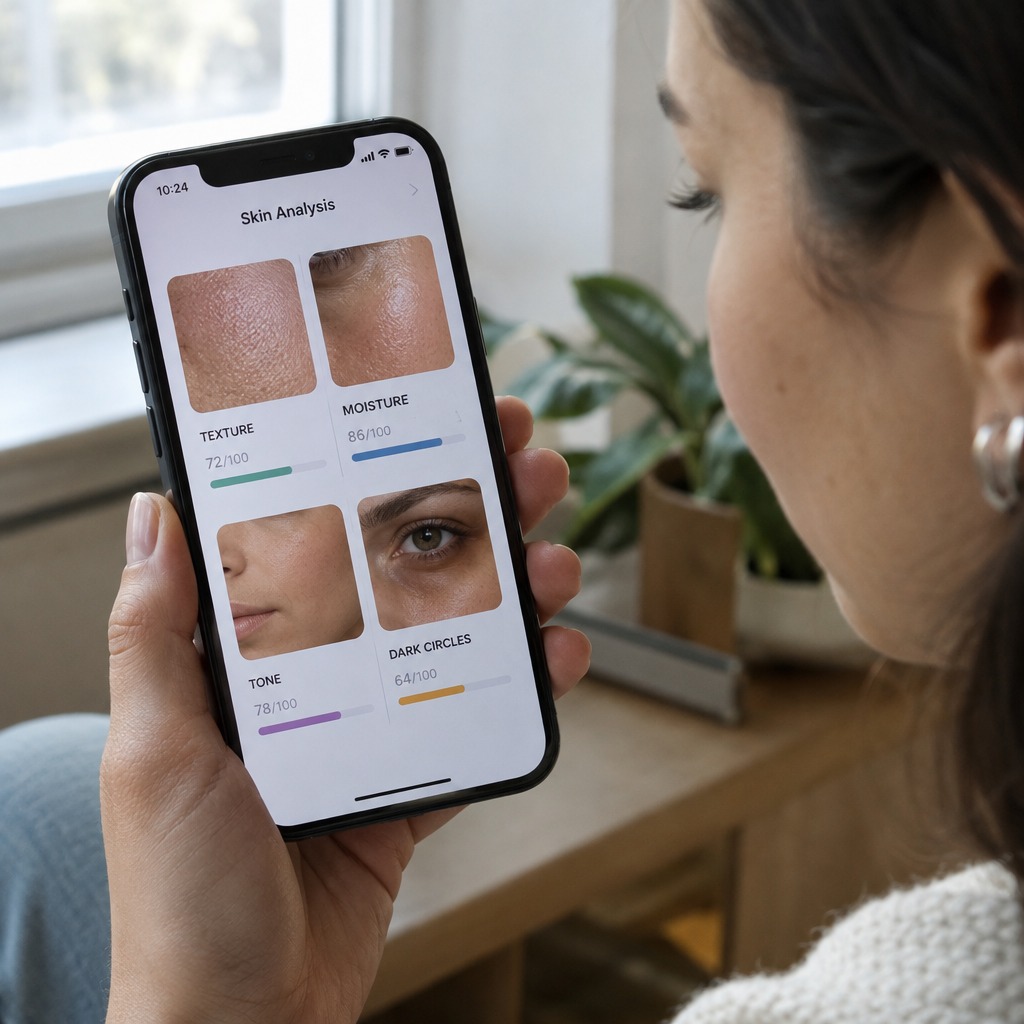
Two limits, stated plainly. These are estimates from visible signs rather than measurements of the tissue. And radiance scoring is unusually sensitive to capture, because a highlight depends entirely on light direction: the same face scores very differently under a ring light and a window. Lock the conditions or the number is noise.
How Do You Fix Surface Dullness?
This is the fast one, and it is where most people should start regardless, because it is also the cheapest to test.
| Step | What it does | Timeline |
|---|---|---|
| Hydrate properly, humectant under an occlusive | Plumps the surface so it reflects rather than scatters | Immediate to 3 days |
| Repair the barrier if products sting | A compromised barrier guarantees dullness | 1 to 2 weeks |
| Gentle chemical exfoliation, lactic or mandelic acid | Clears dead cell build up | 1 to 3 weeks |
| A retinoid, built up slowly | Improves turnover and surface quality structurally | 8 to 12 weeks |
| Stop over-cleansing | Removes the cause in a surprising number of cases | 1 to 2 weeks |
One warning. The instinct when skin looks dull is to exfoliate harder, and over-exfoliation produces a damaged barrier, which produces dullness. If your skin is dull and stings, exfoliating is the wrong move and barrier repair is the right one.
How Do You Fix Tone Dullness?
| Ingredient | What it addresses | Timeline |
|---|---|---|
| Daily broad spectrum SPF | Stops the cause. Without it nothing else holds | Preventive |
| Vitamin C | Antioxidant support and pigment evenness | 8 to 12 weeks |
| Niacinamide | Tone evenness and barrier support | 4 to 8 weeks |
| Azelaic acid | Pigment and redness together | 8 to 12 weeks |
| Retinoid | Turnover, which clears pigmented cells faster | 12 weeks and beyond |
If your unevenness is patchy and symmetrical rather than scattered, read our guide to telling melasma from other hyperpigmentation before escalating, because that specific pattern punishes aggressive treatment.
How Do You Fix Fatigue Dullness?
- Sleep. The most reliable intervention on this entire page, and the one no product replaces. Visible improvement usually within a week of consistent sleep.
- Stop smoking. It reduces microcirculation and degrades collagen simultaneously.
- Move. Regular exercise improves circulation, and the post-exercise flush is a real short term radiance effect.
- Hydrate and moderate alcohol. Both show up in the face within a day.
- Manage the under eye separately. Shadowing there drags the whole face down perceptually. Our dark circle guide covers that properly.
Why Do Brightening Products Often Do Nothing?
Because most of them target pigment, and most dullness is surface. If your problem is a rough, dehydrated surface scattering light, a tyrosinase inhibitor has nothing to work on. The product is not failing, it is aimed at a different mechanism.
Three specific mismatches worth knowing:
| What you bought | What it treats | When it will disappoint |
|---|---|---|
| Vitamin C serum | Pigment evenness, antioxidant protection | When your dullness is texture or dehydration |
| Strong exfoliating acid | Dead cell build up | When your barrier is already compromised. It makes things worse |
| Illuminating primer or drops | Optical highlight, cosmetically | Never, honestly, as long as you know it washes off |
The third row deserves its defence. A cosmetic highlight is an entirely legitimate way to look radiant today while a slower routine works on the underlying cause.
How Long Until Skin Looks Brighter?
| What you are fixing | First visible change | Full effect |
|---|---|---|
| Dehydration | Hours to 3 days | 1 to 2 weeks |
| Dead cell build up | 3 to 14 days | 4 weeks |
| Damaged barrier | 1 week | 2 to 4 weeks |
| Sleep debt | 3 to 7 nights | 2 weeks |
| Tone unevenness | 8 to 12 weeks | 3 to 6 months |
| Sun damage accumulated over years | Months | Partially, with sustained protection |
The spread across that table is the reason dullness feels unsolvable. Two of the rows pay out within a fortnight and two take half a year, and people routinely start with the slow ones.
How Do Teams Build Radiance Scoring with an API?
Radiance is a strong engagement hook and a weak standalone metric, so the implementation question is how to make it specific enough to act on.
| Texture | Moisture | Tone evenness | Route the customer to |
|---|---|---|---|
| High | Low | Normal | Hydration and barrier. Promise a visible change in days, which is the easiest win in skincare |
| High | Normal | Normal | Gentle exfoliation and a retinoid. Promise 2 to 4 weeks |
| Normal | Normal | Low evenness | Tone path. Vitamin C, niacinamide, SPF. Promise 8 to 12 weeks and say so clearly |
| High | Low | Low evenness | Sequence it. Surface first because it pays out fast, tone second |
| Normal | Normal | Normal, dark circles elevated | Lifestyle content, not a product. This is where trust gets built |
Three implementation notes. Never return a bare radiance score with no breakdown, because the customer cannot act on it and will not believe it. Lock capture lighting hard, since a highlight is a function of light direction and a ring light will manufacture radiance that a window will not. And sequence recommendations by payout speed: lead with the surface fix that shows in days, which buys you the patience for the tone work that takes months.
You can test the scoring against real images in the YouCam AI API Playground before writing integration code. Perfect Corp works with 800+ brand partners on flows of this kind.
Dull Skin FAQ
What causes dull skin?
Dead surface cell build up, dehydration, a damaged barrier, uneven pigment, and reduced circulation from poor sleep or smoking, with sun damage underlying most of it. The first three are surface problems and improve fastest.
Why does my skin look dull but feel smooth?
That points to tone rather than surface. Smooth skin that still reads flat usually has uneven pigment or a sallow cast, which responds to vitamin C, niacinamide and sunscreen over a few months rather than to exfoliation.
How can I get glowing skin fast?
Hydrate the surface. A humectant under an occlusive produces a visible change within hours to three days, because glow is a reflection and a plumped surface reflects better. It is temporary unless you keep it up, and it is real.
Does exfoliating help dull skin?
When there is genuine dead cell build up, yes, within one to three weeks. When the dullness comes from a damaged barrier, exfoliating makes it worse. If your products sting, repair before you exfoliate.
Why does my skin look brighter after a shower?
Short term hydration smooths the surface so it reflects light coherently, plus a brief circulation flush. Both fade within the hour, which is a neat demonstration that radiance is a surface and blood flow effect rather than a colour one.
Does drinking water help dull skin?
Adequate hydration supports normal skin function, but surface dehydration is a barrier issue and responds far more to what you apply and to ambient humidity than to intake. Topical humectants outperform extra glasses.
Why does my skin look worse in photos than in the mirror?
Cameras flatten and compress, and flash lighting removes the directional highlight that reads as glow in person. Tone unevenness also shows more in a photograph than it does to the eye at conversational distance.
Does lack of sleep really make skin look dull?
Yes, through reduced microcirculation, slower overnight repair and under eye shadowing. It is one of the faster reversible causes, usually visible within a week of consistent sleep.
Can a skin analysis API measure radiance?
It scores the components that produce radiance, texture, moisture, tone evenness and under eye appearance, among 28 diagnostics across 16 concerns, rather than detecting glow as a single substance. A breakdown is more honest and far more actionable than a bare radiance number.
How often should I re-scan for dullness?
Every two to four weeks, under identical lighting conditions. Radiance scoring is the most lighting-sensitive concern there is, so a scan taken under different light tells you about the room rather than the skin.
Smooth It Before You Brighten It
Glow is light bouncing off a smooth, hydrated surface, which means the fastest route to looking brighter has nothing to do with pigment. Hydrate, repair the barrier, clear genuine build up, and a large share of dullness lifts within a fortnight. Then, if colour unevenness is still there underneath, work on tone with the understanding that it takes months. Start in that order and the whole concern becomes tractable. For teams building the recommendation, score the components rather than returning a mystery number, and sequence the advice by how fast each part pays out.
Test the skin analysis API in the YouCam AI Playground, or contact Perfect Corp for a demo to see how per-concern scoring fits your customer flow.