 Author:
Choosing the right skin analysis machine is rarely a straightforward purchasing decision. For clinic operators, beauty brand managers, and retail buyers, it involves balancing diagnostic accuracy, workflow fit, device footprint, and total cost of ownership — none of which are captured in a spec sheet alone.
The market has matured considerably over the past few years. What were once expensive, fixed imaging stations used only in dermatology clinics are now competing with software-based AI systems that run on an iPad or integrate directly into a brand's website. That shift has broadened the buyer pool, but it has also made comparisons more complex.
This article breaks down the five most widely evaluated skin analysis tools in 2026 — covering hardware-based systems like VISIA and DermaScan, integrated devices like the OBSERV 520x and Cobbawe MJ-W-21-5, and AI software platforms like Perfect Corp.'s skin analysis engine. For each, we examine key features, pricing tiers, physical footprint where applicable, and the business contexts where each solution is likely to perform best.
Whether you're equipping a med spa, launching a skincare product line, or building a branded digital consultation experience, understanding these tools operationally — not just technically — is what drives a sound investment.
5 Popular Skin Scanners & AI Skin Analysis Tools
There are several categories of skin imaging and diagnostic systems available to beauty businesses today — from clinical-grade hardware to software-only platforms that run on a standard tablet. The five tools below represent the most commonly evaluated options across retail, med spa, and enterprise skincare contexts.
- Perfect Corp. — Advanced AI Skin Analysis Machine
- VISIA — Skincare Machine
- DermaScan — Ultrasound Skin Scanner
- OBSERV 520x — Multi-Mode Skin Analysis Machine
- Cobbawe MJ-W-21-5 — Integrated Facial Imaging System
1. Perfect Corp. - Advanced AI Skin Analysis Machine
Perfect Corp.'s AI Skin Analysis platform is a software-based diagnostic system built for scale and integration flexibility. Rather than requiring a dedicated hardware station, it runs on standard devices — smartphones, tablets, web browsers, and third-party platforms — making it operationally practical across a wider range of business environments than traditional imaging hardware.
Before investing, you can experience a live AI skin diagnostic demo to see how the system performs in real time.
Features
Detects 15 skin concerns, 8 skin types, and estimates skin age.
The 15 tracked concerns include: moisture levels, spots, wrinkles, dark circles, oiliness, texture, redness, acne, eye bags, skin firmness, droopy upper eyelid, droopy lower eyelid, tear trough, radiance, and visible pores. Skin types span normal, oily, dry, redness, dry & redness, oily & redness, combination, and combination & redness.
The breadth of concern detection is meaningful for retail and consultation contexts — more data points give practitioners and recommendation engines more to work with when personalizing product or treatment suggestions. The system also includes an AI Skin Simulation feature that visualizes potential skin improvement outcomes, which is useful for treatment planning conversations.
The platform is trained on 70,000+ medical-grade images and reports 95% test-retest reliability across its concern detection framework.
Price
From $5/month. Perfect Corp. operates on a usage-based pricing model, making it accessible to businesses at different scales — from a single-location clinic running occasional analyses to an enterprise brand processing high volumes across multiple digital touchpoints. API access is available for brands integrating the engine into their own infrastructure. Pricing scales with usage rather than a flat per-seat fee, which matters for businesses with variable consultation volumes.
Integrations:
The platform supports deployment across mobile apps, iPads, web pages, in-store consultation stations, and third-party platforms including Taobao, WeChat, and TikTok mini-programs. A full Skin Analysis API is available for brands building custom digital experiences.

For businesses that need mobility without a hardware commitment, the Skincare Pro app offers a tablet-based deployment designed for practitioners and small businesses. For enterprise-level integration, the API connects the analysis engine to recommendation systems, CRM platforms, and loyalty programs — where the commercial value of the data compounds over time.
Recommended for: Enterprise beauty brands, skincare e-commerce, multi-location clinics, and businesses that need API-level customization or multi-channel deployment.

2. VISIA - Skincare Machine
VISIA, developed by Canfield Scientific, is one of the most established hardware-based skin imaging systems in clinical use. It uses a controlled multi-spectral lighting environment — combining standard, UV, and cross-polarized illumination — to capture both surface and subsurface skin conditions that a standard camera cannot detect. This makes it a reference-grade tool in dermatology and medical aesthetics, where diagnostic depth matters more than deployment flexibility.

Price
VISIA units typically range from $7,000 to $20,000 depending on model and configuration. In 2025, some units appeared on third-party marketplaces (Alibaba, Dr. Toy Store) at significantly lower price points — under $535 in some cases — but buyers should evaluate the specific model carefully, as older or refurbished units may lack current software capabilities or calibration standards. Per-session analysis at clinics typically runs $50–$200, with many providers offering it complimentarily alongside booked treatments.
Features
- Detects 8 skin concerns: spots, wrinkles, texture, pores, UV spots, brown spots, red areas, and porphyrins
- Estimates skin age
- Includes skin simulation features, including aging projection and injection visualization
The narrower concern set compared to AI software platforms reflects VISIA's clinical positioning — it prioritizes precision in a defined diagnostic scope over breadth. For dermatologists and medical aestheticians, that trade-off is often appropriate. For retail or high-volume consultation environments, the limited concern range and hardware dependency can be limiting.
Size
Approximately 24" H × 19" W × 18" D, though dimensions vary by model. Requires a dedicated, stable setup with consistent ambient lighting conditions for reliable results. Not portable between locations.
3. DermaScan - Ultrasound Skin Scanner
DermaScan, developed by Cortex Technology, takes a different technical approach from optical imaging systems. It uses high-frequency ultrasound to assess structural skin properties — thickness, density, hydration, and elasticity — rather than capturing surface images. This gives it a distinct diagnostic profile: useful where subsurface structural data is clinically relevant, less applicable for visible surface concern assessment.

Image Source: Cortex
Features
Analyzes 8 skin observation parameters, including texture, irregularities in skin tone, redness, deep texture (wrinkles), oiliness, and skin dehydration.
The ultrasound methodology is particularly relevant in research and clinical settings where longitudinal tracking of structural skin changes matters — monitoring the effects of a topical treatment on dermal thickness, for example. For retail or general consultation use cases, the clinical nature of the output and the requirement for trained operation make it less suited compared to optical or AI-based systems.
Size
Approximately 7–8" L × 4–5" W × 3–4" H — handheld and portable, which is a genuine operational advantage for practitioners who need to move the device between treatment areas. However, the handheld form factor requires trained staff to ensure consistent positioning and gel application for accurate readings.
4. OBSERV 520x Skin Analysis Machine
The OBSERV 520x is a clinical-grade skin analysis system designed for in-depth visual assessment across multiple lighting conditions. It occupies a practical middle ground in the market: more accessible than a full VISIA setup in terms of size and price, while offering multi-spectrum imaging capabilities that go beyond what standard cameras or AI-only software can achieve.
Features
The OBSERV 520x operates across multiple observation modes — daylight, UV, and polarized light — allowing practitioners to assess both surface conditions and underlying skin concerns in a single session. The system produces high-resolution imaging with 3D visualization, which is particularly useful for client-facing consultations where visual impact matters alongside diagnostic accuracy.
The touchscreen interface is designed to be operable without specialist technical training, and the relatively compact form factor makes it more flexible than larger dedicated imaging booths.
In practice, OBSERV 520x is commonly used in aesthetic clinics and dermatology-adjacent settings where detailed visual documentation supports treatment planning and client progress tracking. Its multi-mode capability makes it more versatile than single-spectrum alternatives, though it still requires a stable setup and consistent lighting control for reliable cross-session comparisons.
Size
Approximately 20" × 20" × 12" — compact relative to full imaging booth systems, but still requires a dedicated consultation space. Not designed for mobile or multi-location deployment without additional setup investment.
5. Cobbawe MJ-W-21-5 — Integrated Facial Imaging System
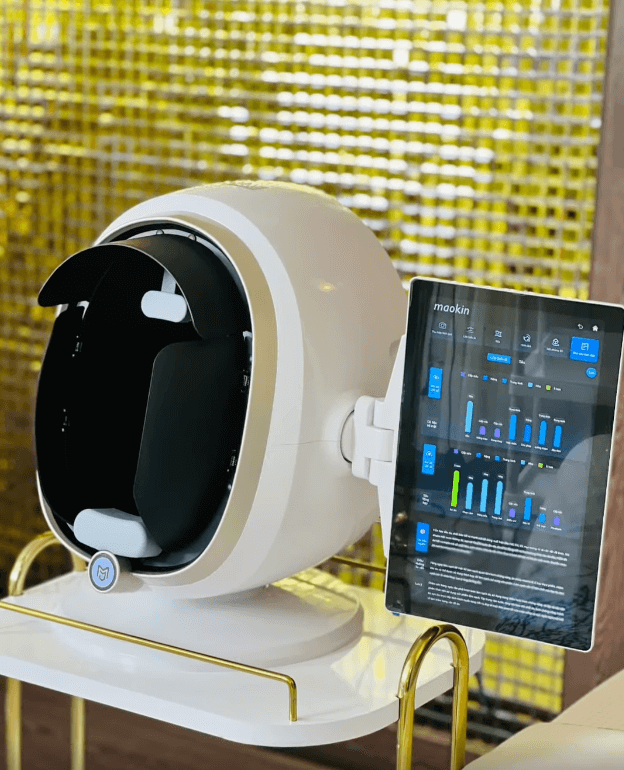
The Cobbawe MJ-W-21-5 is a mid-tier hardware system commonly available through e-commerce platforms including Amazon. It combines a physical facial imaging hood with an integrated tablet display, offering an all-in-one setup that doesn't require a separate computer or external monitor. It appeals to clinics and aestheticians looking for a tangible hardware presence at a more accessible price point than clinical-grade alternatives.
Price
Typically $1,500 to $2,800 per unit on Amazon. This positions it below VISIA-tier hardware, though buyers should factor in shipping costs, potential import duties, and — importantly — the long-term software update trajectory. Hardware at this price point from third-party manufacturers may not receive the same level of ongoing software support as dedicated clinical platforms.
Features
- Multi-spectrum imaging: RGB visible light, UV, and polarized light (PL) capture for both surface and underlying skin conditions
- Comprehensive concern assessment: evaluates pore size, sebum secretion, wrinkles, pigmentation, acne, and moisture levels
- Integrated 21.5" touchscreen display: allows practitioners to show side-by-side visual comparisons directly on the device without needing an external screen
The multi-spectrum capability is meaningful at this price tier — UV and polarized imaging add diagnostic depth beyond what a standard camera provides. The integrated display is a practical advantage in consultation settings, allowing the practitioner and client to review results together without rotating between devices.
Size
The 21.5" display and enclosed facial imaging hood make this a relatively bulky unit that requires a dedicated, stable consultation desk. It is not designed for portable use, and the footprint should be factored into clinic layout planning before purchase.
A practical note for buyers: the Cobbawe ecosystem is less mature than established clinical brands. Before purchasing, confirm what software updates are included, whether the analysis model receives ongoing training improvements, and what warranty and support options are available. These factors affect long-term value more than the hardware spec sheet.
Why Beauty Businesses Are Adopting Skin Analysis Technology
The right system depends on how the analysis fits into your broader business workflow — not just on feature comparison.
1. Does your AI Skin Analysis Tool need customization?
For brands with specific diagnostic requirements or existing digital infrastructure, API-based access is the more flexible path. Perfect Corp.'s AI Skin Analysis platform supports full API integration alongside web modules, mobile SDKs, and mini-programs for Taobao, WeChat, and TikTok — allowing brands to connect skin analysis outputs to their recommendation engines, CRM systems, and loyalty platforms. The commercial value compounds when analysis data flows into downstream systems rather than sitting in a standalone report.
You don't need to over-specify concern detection. If your use case only requires hydration and texture analysis, for example, the cost and integration complexity will be proportionally lower.
Recommended for: Brands with customized needs, brands seeking website or app integration, enterprise retailers.

2. Do you need a portable, practitioner-friendly solution?
Skincare Pro is an app-based AI skin analysis tool built for practitioners who need professional-grade analysis without a hardware station. It runs on smartphones and tablets, is operable by non-technical staff, and fits naturally into existing consultation workflows — at intake, in the treatment room, or on the retail floor.
For small businesses and independent clinics, this deployment model eliminates the upfront hardware cost, removes maintenance obligations, and allows the tool to move with the practitioner rather than anchoring the consultation to a fixed location.
Recommended for: Med spas, aesthetic clinics, independent beauty professionals, small skincare retailers.

How Different Businesses Are Using Skin Analysis in Practice
Med Spa & Aesthetic Clinic Consultations
In a med spa setting, skin analysis typically operates at the front of the consultation workflow — before the practitioner enters the room. Staff run the analysis as part of intake, and the report is reviewed with the client during the consultation itself.
This works particularly well for clinics offering treatment packages. A visual skin concern map — showing UV damage, texture irregularities, or early signs of volume loss — gives the practitioner a structured way to walk through treatment rationale without starting from scratch every session. It also creates a documented baseline for tracking outcomes over time, which clients increasingly expect.

For high-volume clinics, throughput matters. Hardware systems with a dedicated room setup work well for scheduled appointments but create bottlenecks during walk-in periods. App-based systems like Skincare Pro address this by allowing any staff member with a tablet to run an analysis in any space.
In-Store Skincare Retail
Skin analysis creates a genuine in-store differentiator — an experience that can't be replicated online — and a reason for customers to visit rather than reorder from a brand's website.
The most effective in-store implementations integrate the analysis directly into the point-of-sale conversation. A beauty advisor runs the scan, reviews results with the customer, and walks through product recommendations tied to specific concerns. When the recommendation is grounded in data the customer can see, the conversion path is shorter.
Retailers should plan for lighting variability. Overhead fluorescent lighting and window glare both affect image capture quality in AI-based systems. Some brands address this with dedicated analysis stations with controlled ambient lighting — an investment that pays off in result consistency.
E-Commerce & Digital Brand Experiences
For brands selling online, embedded skin analysis tools recreate the consultation experience without a human advisor. The typical flow: selfie capture, 15–30 second analysis, results page mapping detected concerns to recommended products.
When done well, this performs meaningfully better than generic "find your routine" quizzes. The risk is in execution — an analysis that generates a report and dumps the customer into a generic product catalog loses most of its personalization value. The analysis needs to connect directly to a curated, concern-specific recommendation layer. API-based integrations allow brands to build this connection within their existing infrastructure.
Skincare Brand Product Development
Enterprise brands with access to aggregated, consented skin analysis data are beginning to use it for product planning — understanding the distribution of skin concerns by geography, season, or demographic provides a signal that sales history alone cannot. This is an emerging use case that requires robust data governance infrastructure, but for brands that have built that foundation, it represents a meaningful competitive advantage.
Hardware Machines vs. AI Software: A Practical Buying Guide
Businesses evaluating skin analysis technology are effectively choosing between two different operational models. Understanding where each performs well matters more than comparing spec sheets.
| Factor | Hardware-Based Systems (VISIA, OBSERV, Cobbawe) | AI Software Systems (Perfect Corp.) |
| Diagnostic depth | Higher — multi-spectrum imaging detects subsurface conditions | Surface to mid-depth; strong for visible concerns |
| Upfront cost | $1,500 – $20,000+ per unit | From $5/month; API pricing scales with usage |
| Physical footprint | Dedicated space required; not portable | Runs on smartphone, tablet, or web browser |
| Setup complexity | Significant — installation, calibration, training | Low — most deployments operational within days |
| Scalability | Linear with hardware units | Near-unlimited across locations and channels |
| Consistency | High within controlled environment | Variable by lighting; best with quality gating |
| Integration flexibility | Limited; typically standalone | High — API, SDK, web module, mini-program |
| Best for | Clinical dermatology, medical aesthetics, high-end spa | Retail brands, e-commerce, multi-location clinics, SMBs |
On total cost of ownership: Hardware systems carry ongoing maintenance, calibration, and software update costs that are often not included in the purchase price. Over three years, TCO can run two to three times the initial unit price. Software-based systems shift this to a predictable recurring service fee — easier to budget and easier to adjust as business needs evolve.
The choice isn't always binary. Some enterprise brands run hardware systems in flagship locations for high-touch clinical consultations, while deploying a software API across their digital channels and wholesale partner integrations.
What Skin Analysis Tools Don't Tell You: Known Limitations
No skin analysis system operates without constraints, and understanding those constraints upfront prevents poor deployment decisions.
Lighting and image quality are the most common sources of inconsistency in AI-based systems. An analysis under controlled studio conditions will outperform one taken on a customer's phone in a dim bathroom. This is inherent to camera-based imaging, not a flaw unique to any vendor. Businesses deploying in retail environments should invest in standardized capture conditions.
Dataset representation affects accuracy across skin tones. Models trained predominantly on lighter complexions have documented limitations in detecting certain conditions — particularly pigmentation concerns — on darker skin tones. The field has improved, but buyers should ask vendors directly about training data diversity and validation across Fitzpatrick scale categories.
Customer skepticism is a real adoption hurdle in some segments. Not all customers are comfortable with facial scanning, particularly around data privacy. Clear consent processes, transparent data policies, and user control over how facial data is stored are baseline requirements for responsible deployment — and legal requirements in GDPR and CCPA-regulated markets.
Workflow integration is frequently underestimated in implementation planning. A tool that generates a report but doesn't connect to booking systems, CRM platforms, or product inventory creates more work rather than less. Integration cost — in time and technical resources — should be factored into any procurement evaluation.
Over-reliance on AI outputs is a subtler risk in clinical settings. AI analysis is a decision-support tool, not a replacement for practitioner judgment. Positioning it that way — with staff and clients — protects the business from liability and preserves the consultation relationship that drives long-term retention.
Where the Industry Is Heading: Observations for 2026 and Beyond
The skincare industry is undergoing a structural shift that goes beyond technology adoption. Consumers increasingly expect businesses to know them — their specific concerns, their skin history, their past responses to treatments — in the way a trusted aesthetician would after years of working with them. AI skin analysis is one mechanism for delivering that continuity at scale, but only when the data layer behind it is sophisticated enough to act on.
What separates leading implementations from superficial ones is not the technology itself, but the intelligence built around it. A skin scan that generates a report is a feature. A skin scan that connects to a personalized treatment journey — triggering follow-up communications, adjusting product recommendations seasonally, flagging changes in skin condition over time — is a retention system. The businesses investing in that fuller architecture are building something competitors cannot easily replicate, because the value compounds with data history.
Several operational shifts are worth tracking:
AI skin analysis is becoming a baseline expectation in premium skincare. Much as digital booking and mobile loyalty programs moved from differentiators to standard features, AI skin assessment is following the same trajectory. Brands without it are increasingly at a disadvantage in premium channels.
The personalization gap between in-store and online is closing. Software-based skin analysis tools allow e-commerce brands to deliver consultation-quality personalization at the point of digital purchase — particularly significant for brands relying heavily on direct-to-consumer channels.

Data governance is becoming a competitive variable. As consumers become more aware of how biometric data is used, brands with trustworthy data practices will see higher consent rates — and therefore better data quality to act on.
Integration depth matters more than feature breadth. The next wave of differentiation in beauty tech will come not from which system detects the most skin concerns, but from which platform connects those insights most effectively to product recommendation, treatment planning, and long-term customer relationship management.
Matching the Right Solution to Your Business Model
For businesses at different stages of evaluation, the practical starting point is matching deployment model to operational reality — not simply identifying the most technically sophisticated system available.
Perfect Corp. AI Skin Analysis — Enterprise & API Integration
Perfect Corp.'s platform detects 15 skin concerns and 8 skin types, operating across web, mobile, in-store tablet, and third-party platform deployments. Pricing starts at $5/month on a usage-based model, with API access for brands integrating the engine into existing digital infrastructure.
The API approach is particularly well-suited for brands managing multiple digital touchpoints — skin analysis results feed directly into recommendation engines, CRM systems, and loyalty platforms without a separate product layer. Validated on 70,000+ medical-grade images with 95% test-retest reliability.
Recommended for: Enterprise beauty brands, skincare e-commerce, multi-channel retail, API-level customization.

Skincare Pro — App-Based Solution for Clinics & Small Businesses
For practitioners and small businesses that need professional-grade analysis without API integration overhead, Skincare Pro runs on tablets and smartphones. Designed to be operable by non-technical staff, it fits naturally into existing consultation workflows — at intake, in the treatment room, or on the retail floor — without tying the analysis to a fixed hardware station.
Recommended for: Med spas, aesthetic clinics, independent beauty professionals, small skincare retailers.

Safety & Privacy Considerations
Face-based skin scanning requires consent — not as a legal formality, but as a trust foundation. The most effective implementations treat the consent moment as an opportunity to explain the value exchange: the customer provides a scan and receives a personalized analysis that is meaningfully more useful than a generic skin quiz.
Data minimization — collecting only what is needed for the analysis, not retaining facial images beyond the session without explicit consent — is the operational standard that responsible platforms have adopted. For businesses in regulated markets, GDPR and CCPA compliance should be confirmed with vendors before deployment.
The same standard Apple applied to Face ID for consumer hardware — secure, purpose-limited biometric processing — should be expected of third-party skin analysis platforms. Asking vendors directly about data retention policies, server locations, and third-party data sharing is not optional due diligence. It is a baseline requirement.

Shared Materials by Strapi
*Adjust the size of images ONLY. Please go to Strapi to edit the materials info.
Choosing the Right Skin Analysis Solution: Final Summary
For clinical depth and subsurface diagnostics, hardware systems like VISIA or OBSERV 520x remain the reference standard — at a price and footprint appropriate for dedicated clinical environments.
For scalability, integration flexibility, and multi-channel deployment, AI software platforms are the more operationally practical choice. The diagnostic gap for surface-level concerns has narrowed considerably, and the flexibility advantage is substantial.
For businesses unsure where to start, a free trial of an AI-based system is the lower-risk entry point — allowing operators to test the consultation workflow, evaluate staff adoption, and measure early customer response before committing to a larger integration.
Get expert advice from Perfect Corp. and be part of the beauty tech trend. Contact us for details on beauty tech solutions trusted by 600+ brands globally.

Skin Analysis Machine & Scanner FAQ
What is a skin scanner and how does it work?

A skin scanner uses AI or multi-spectrum imaging to assess the skin's surface and, in some systems, subsurface layers. AI-based systems use a camera capture and deep learning model to identify concerns like acne, dark circles, and texture irregularities, generating a detailed report in seconds. Hardware-based systems add controlled lighting environments to detect UV damage and vascular conditions invisible to a standard camera.
How do you perform skin analysis with Perfect Corp.?
- Step 1: Open Perfect Corp's AI Skin Analysis on your mobile device
- Step 2: Choose between Selfie or Live mode
- Step 3: The AI Skin Analyzer will test and analyze up to 15 different skin conditions, detect skin types, and determine skin age
- Step 4: Receive your personalized skin analysis report.
What equipment is used for skin analysis?
A variety of equipment is used for skin analysis, including devices such as digital skin analyzers, UV cameras, and magnifying lamps. These tools help professionals assess skin conditions like hydration levels, pigmentation, and texture, allowing them to provide personalized skincare recommendations.
How much does a Canfield VISIA skin analysis cost?
VISIA hardware units typically range from $7,000 to $20,000. Per-session costs at clinics generally run $50–$200, with many providers offering it complimentarily alongside booked treatments. Third-party marketplace listings exist at lower price points, but buyers should evaluate model specifics carefully.
Are skin analysis machines accurate?
For surface-level concerns, well-trained AI systems achieve high consistency. Perfect Corp.'s platform reports 95% test-retest reliability across its 15-concern framework, trained on 70,000+ medical-grade images. Accuracy for any system is affected by image quality and lighting conditions at capture.
What equipment is used for skin analysis?
Options range from handheld ultrasound devices (DermaScan) and multi-spectrum imaging booths (VISIA, OBSERV) to software-based AI systems that run on standard smartphones and tablets (Perfect Corp., Skincare Pro). The right choice depends on diagnostic requirements, budget, and operational context.
What is the 1% rule in skincare?
Ingredients at concentrations above 1% must be listed in descending order on a product label. Ingredients below 1% can be listed in any order. This helps consumers evaluate the effective concentration of active ingredients in a formulation.
How can I do skin analysis at home?
Visit Perfect Corp.'s Skin Demo page, take a selfie, and receive an instant skin report with personalized recommendations. No account or hardware required.
Do skin analysis machines work?
Yes. Professional-grade systems — whether hardware or AI-based — assess skin conditions that are difficult to evaluate visually, including deep-set pigmentation, pore size, hydration levels, and UV damage, providing an objective baseline for treatment or product decisions.
What age is skin analysis appropriate for?
Skin analysis is generally appropriate for any adult age group. Most clinical and AI-based systems are designed for adult skin assessment. Specific clinical applications may have their own age considerations.
Where to test skincare?
Before applying a new skincare product to your entire face, you should perform a "patch test" on a discreet area of skin. The most recommended spots are the inner arm, along the edge of your jawline, or behind the ear. Apply a small amount of the product and wait 24-48 hours to check for any signs of an allergic reaction, such as redness, itching, or irritation.
Do skin analysis machines work?
Yes, skin analysis machines are effective. Professional-grade devices use advanced imaging technology (like AI, multispectral scanning) to accurately measure skin conditions invisible to the naked eye, such as deep-set spots, wrinkle severity, pores, hydration levels, and UV damage, providing an objective assessment of your skin's health.
What does the skin analyzer machine do?
A skin analyzer machine captures a detailed, high-resolution image of your skin and then uses an AI algorithm to analyze it for multiple metrics, including spots, wrinkles, texture, pores, UV spots, and moisture. Based on this data, it generates a comprehensive report on your skin's condition and often recommends personalized skincare products or treatments.
What is the app that tells you how good something is for your skin?
Yes, there are several types of apps, often called "ingredient checkers" or "skincare scanners," that do this. These apps allow you to scan a product's ingredient list to identify potentially irritating or comedogenic ingredients and help you understand the function of each ingredient to determine if a product is a good fit for your skin.
What face scanner tells you what skin type you have?
An AI-powered skin analysis app or online tool can act as a face scanner to tell you your skin type. By using your phone's camera, it can analyze key metrics of your skin (like oiliness and hydration) to provide an accurate assessment of whether you have oily, dry, combination, or normal skin.