 Author:


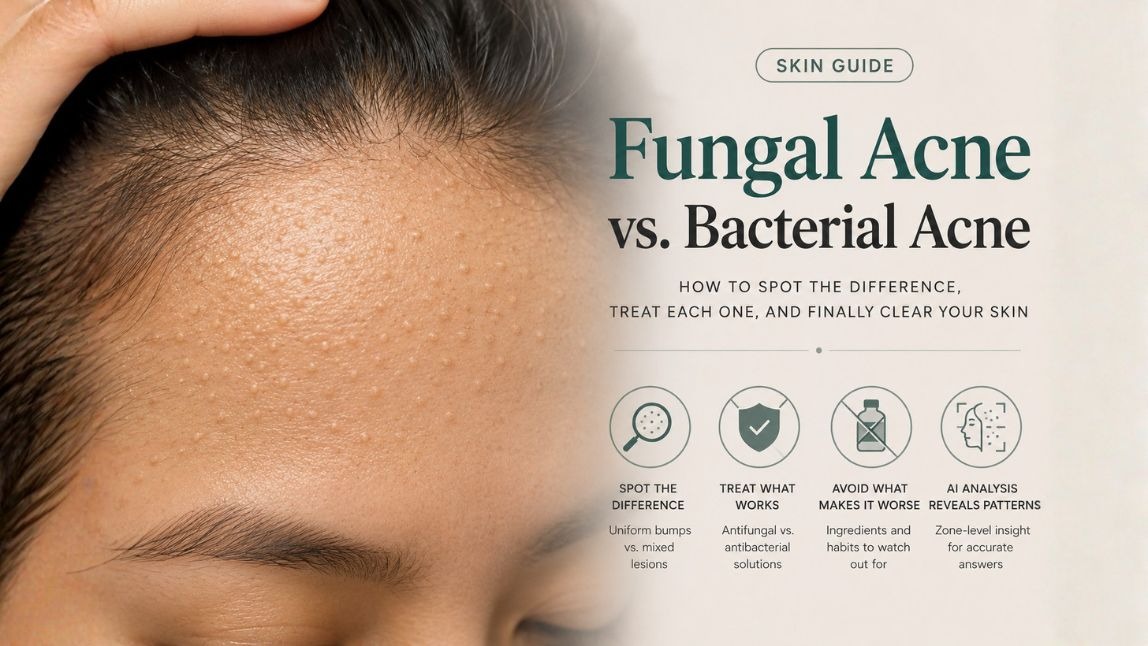
Some acne does not respond to acne treatment. You have been consistent for three months with benzoyl peroxide, maybe an antibiotic, possibly both. The jawline cysts improved. The tiny bumps across your forehead and hairline did not, and if anything they multiplied. There is a good chance those bumps are not acne at all. Malassezia folliculitis, known online as fungal acne, is caused by a yeast rather than a bacterium, and antibacterial treatment does nothing to it. This guide covers how to tell the two apart, why so many people have both at once, what works for each, and how zone-level skin analysis makes the pattern obvious.
Table of Contents
- What is fungal acne, and is it really acne?
- How do you tell fungal acne from bacterial acne?
- Why do so many people have both at the same time?
- What causes Malassezia to overgrow?
- How do you treat each one?
- Which products make fungal acne worse?
- How does AI skin analysis reveal the pattern?
- Fungal acne FAQ
What is fungal acne, and is it really acne?
Fungal acne is a nickname, and an unhelpful one. The condition is Malassezia folliculitis, sometimes called Pityrosporum folliculitis, and it is a yeast overgrowth inside hair follicles. It is not acne, it has no relationship to clogged pores, and it responds to a completely different class of treatment.
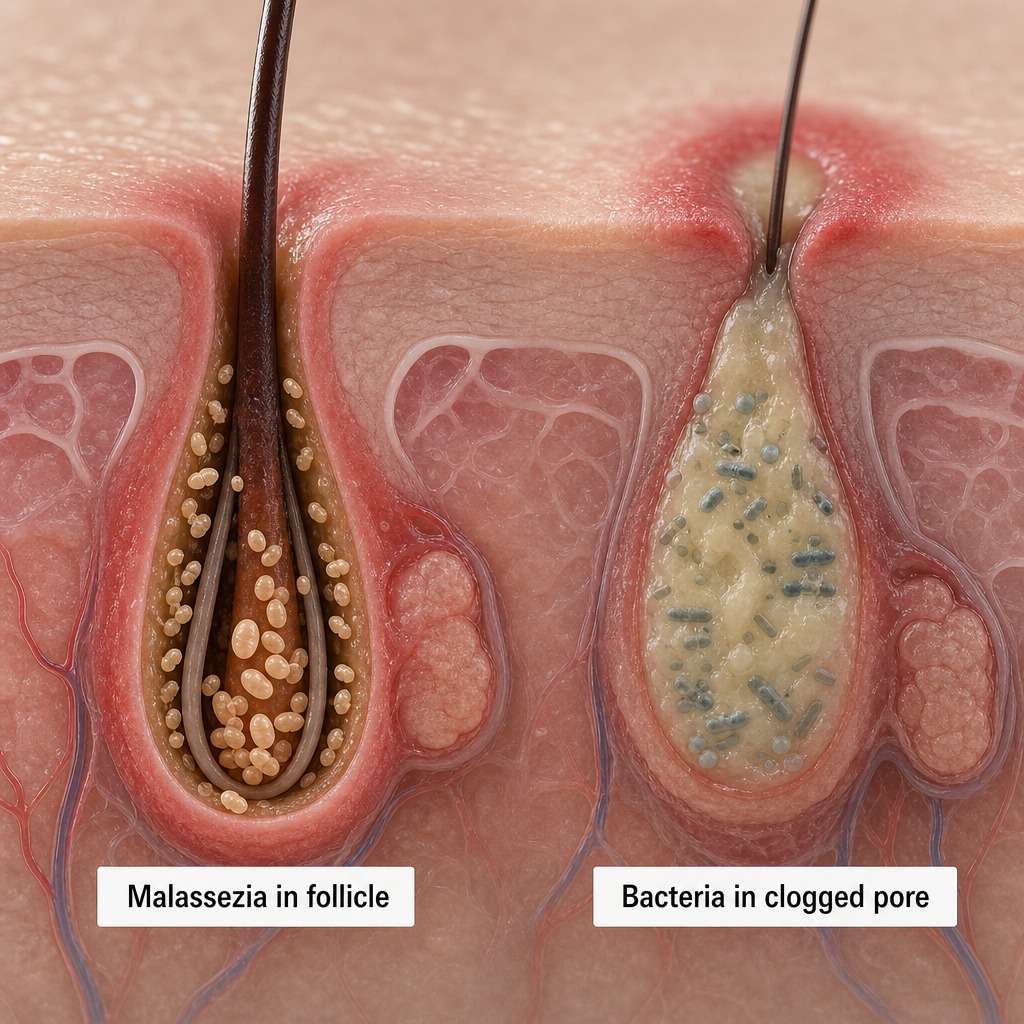
Malassezia lives on everyone's skin as a normal part of the microbiome. It feeds on the fatty acids in sebum. When conditions favor it, heat, humidity, occlusion, excess oil, or a course of antibiotics that removed its bacterial competition, it multiplies inside the follicle and triggers an immune response. The visible result is a crop of small, remarkably uniform bumps.
Bacterial acne, properly acne vulgaris, starts somewhere else entirely. A pore becomes plugged with sebum and dead skin cells, Cutibacterium acnes colonizes the trapped environment, and inflammation follows. The pore is the problem. In fungal acne, the follicle is fine and the organism is the problem.
That is why the treatments do not cross over. Antibacterial ingredients do not kill yeast, and antifungal ingredients do not address a plugged pore.
How do you tell fungal acne from bacterial acne?
| Signal | Fungal (Malassezia folliculitis) | Bacterial (acne vulgaris) |
|---|---|---|
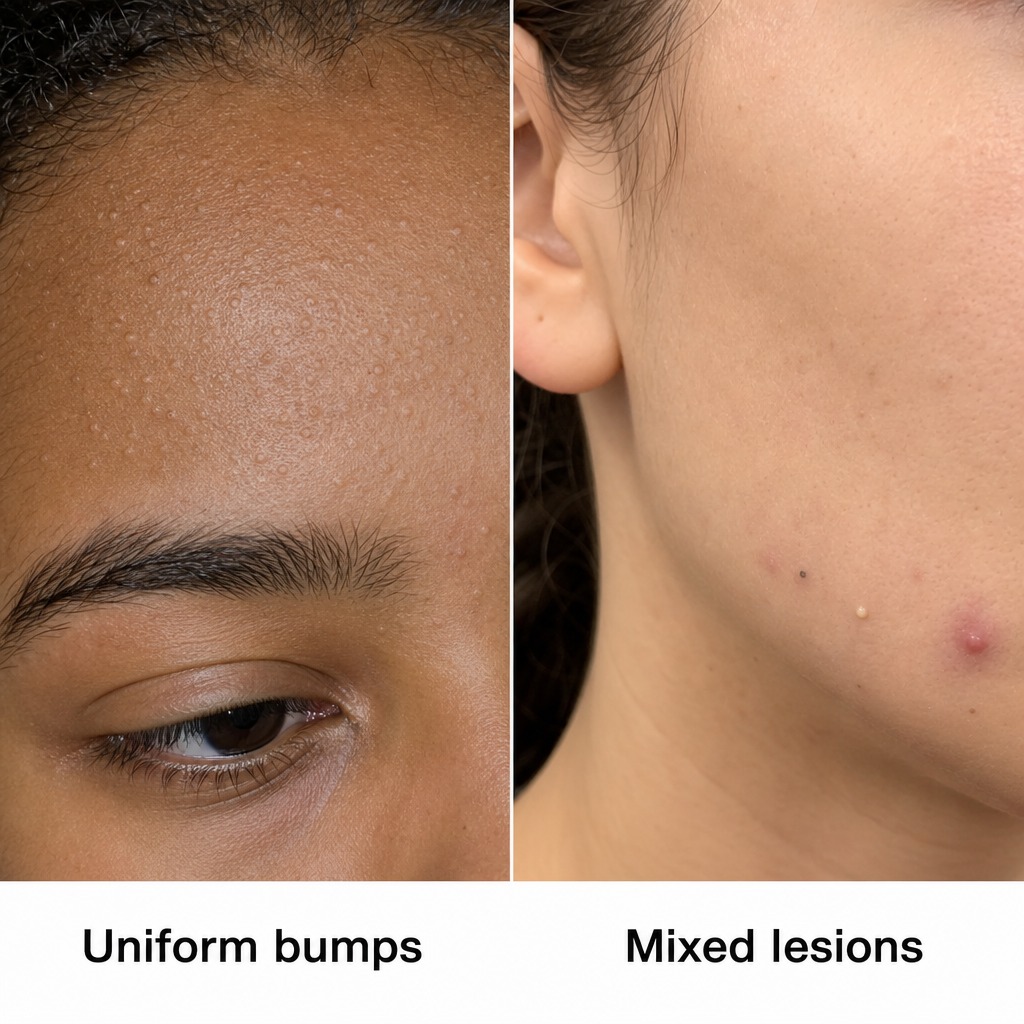
| Uniformity | Strikingly consistent, roughly 1 to 2mm each | Mixed sizes and types in the same area |
| Itch | Often itchy, worse when hot or sweaty | Does not itch |
| Comedones | No true blackheads or whiteheads | Blackheads and whiteheads are characteristic |
| Location | Forehead, temples, hairline, chest, upper back, shoulders | Anywhere, with hormonal patterns favoring chin and jawline |
| Triggers | Heat, humidity, sweat left on the skin, occlusive products | Hormonal cycles, stress, pore-clogging ingredients |
| Response to acne treatment | None, or worsening | Gradual improvement over 8 to 12 weeks |
Uniformity and itch carry the most weight. Bacterial acne almost never produces forty bumps of identical size, and it almost never itches. If both of those are true at once, fungal is the leading hypothesis regardless of what else is going on.
The treatment-response test
The most decisive evidence is retrospective. Genuinely treatment-resistant acne that has not moved after three months of a well-executed antibacterial routine should prompt reconsideration of the diagnosis rather than escalation of the same approach. Persistent monomorphous bumps that ignore antibiotics are a textbook prompt to consider Malassezia in the differential.
Why do so many people have both at the same time?
This is the part most articles miss, and it explains why the question feels unanswerable to so many people. The two conditions are not mutually exclusive, and one particular combination is extremely common in adult women: uniform itchy bumps across the forehead and temples, plus deeper hormonal cysts along the chin and jawline.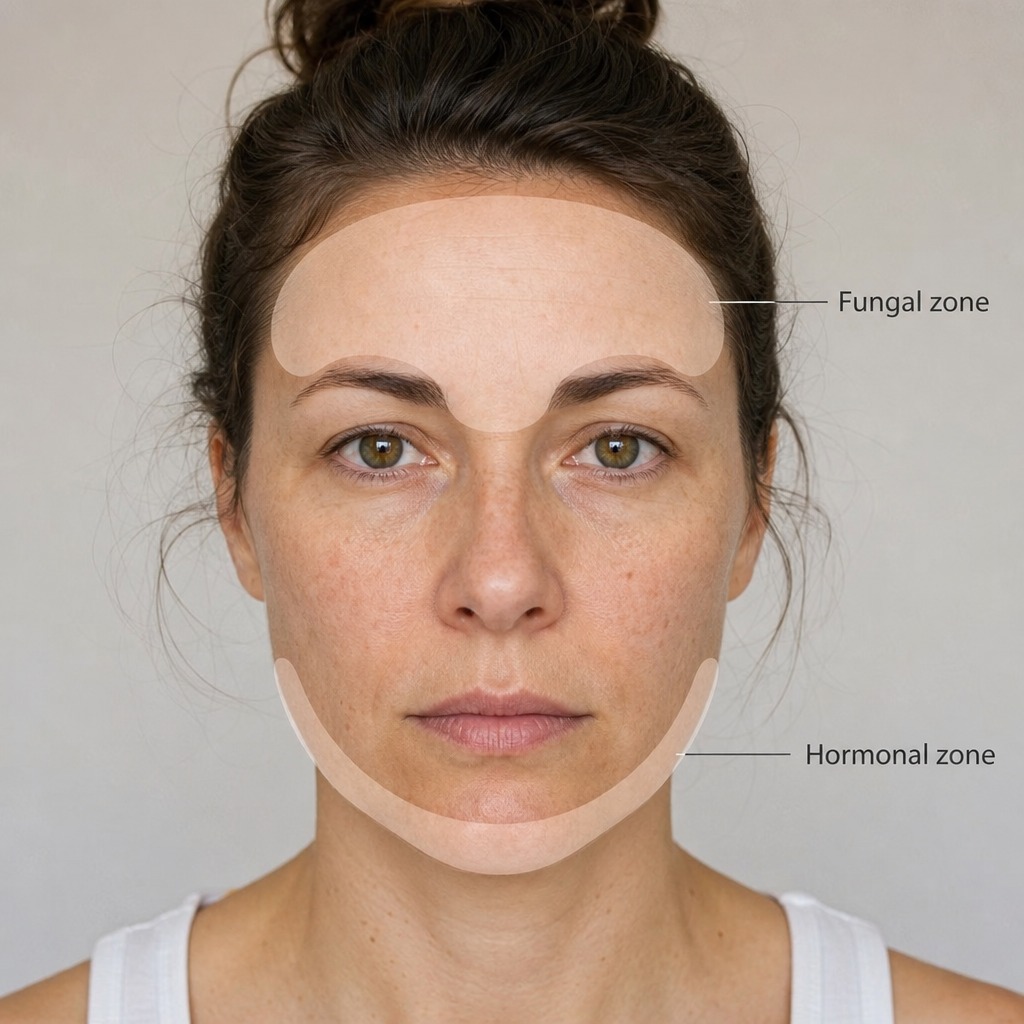
What causes Malassezia to overgrow?
- Heat and humidity. Malassezia thrives in warm moist conditions, which is why flares cluster in summer and in tropical climates.
- Sweat left on the skin. The problem is not sweating, it is staying in damp clothing afterwards. Occlusion plus moisture is the ideal environment.
- Oil-rich products. Malassezia metabolizes specific fatty acids, so many facial oils, esters, and rich creams are direct food sources.
- Recent antibiotic courses. Removing bacterial competition gives the yeast room.
- Naturally oily skin and elevated androgens. More sebum means more fuel.
- Occlusive clothing and equipment. Helmets, headbands, tight synthetic fabrics, and hats trap heat against the skin.
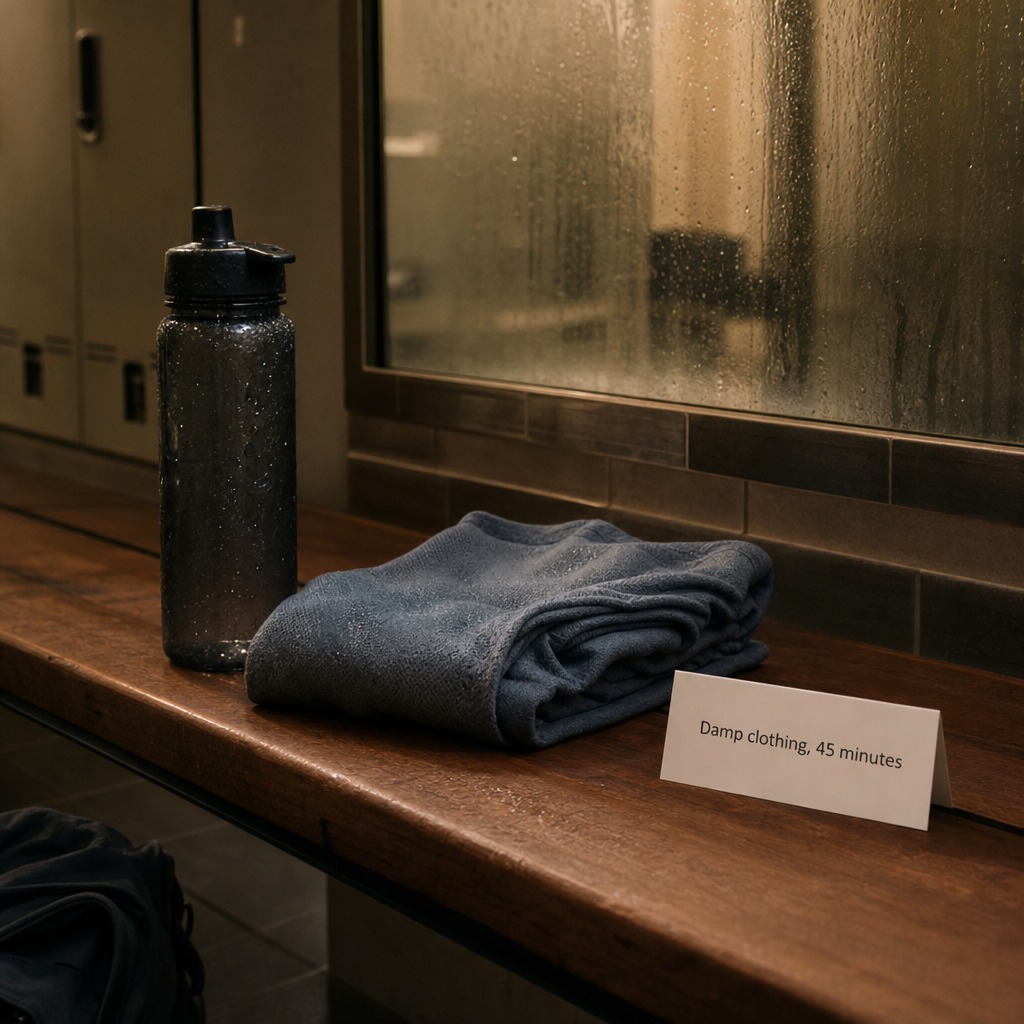
The overlap with dandruff and seborrheic dermatitis is not a coincidence. All three involve the same yeast family, which is why someone dealing with persistent flaking on the scalp and uniform bumps on the hairline is usually looking at one underlying issue rather than two.
How do you treat each one?
| Condition | First-line approach | How it is typically used | Time to visible change |
|---|---|---|---|
| Fungal (Malassezia) | Topical antifungal, commonly ketoconazole or zinc pyrithione | Often an antifungal shampoo used as a short-contact mask on affected areas | 2 to 4 weeks |
| Fungal, persistent | Oral antifungal, prescribed | Short course under medical supervision | 1 to 3 weeks |
| Bacterial, non-inflammatory | Retinoid plus salicylic acid | Nightly retinoid, BHA a few times weekly | 8 to 12 weeks |
| Bacterial, inflammatory | Benzoyl peroxide, sometimes with a topical antibiotic | Daily, applied to affected zones | 6 to 12 weeks |
| Hormonal pattern | Hormonal evaluation, sometimes systemic treatment | Assessed by a clinician | 3 to 6 months |
If you have both, treat by zone rather than treating the whole face with one product. Antifungal where the uniform itchy bumps are, standard acne treatment where the mixed lesions are, and a simple non-feeding moisturizer everywhere.
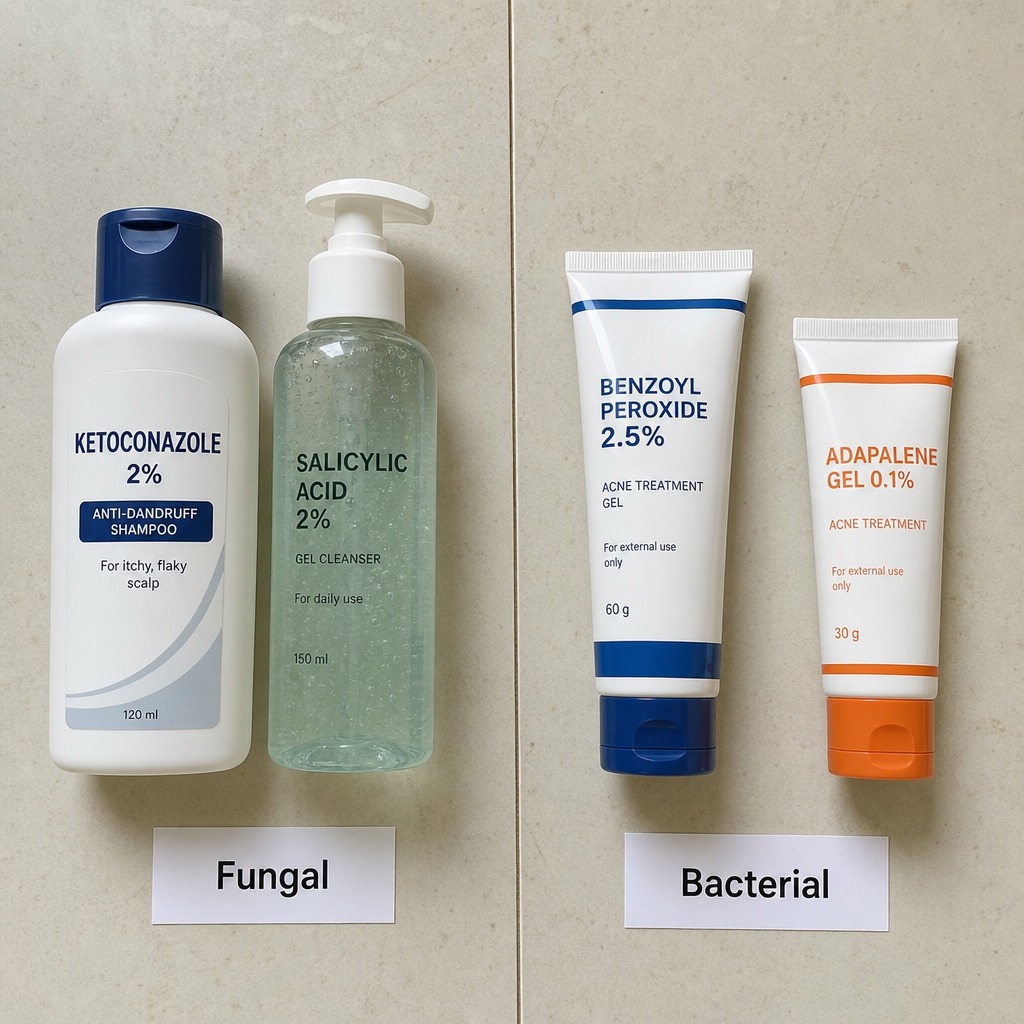
A clinician can also confirm the fungal component directly. A Wood's lamp examination or a simple skin scraping removes the guesswork entirely, and given how long people spend cycling through the wrong products, that appointment usually pays for itself.
Which products make fungal acne worse?
Malassezia feeds on fatty acids of a particular chain length, so ingredient choice matters more here than in almost any other skin condition. The categories to watch:
- Most plant oils, including coconut, olive, and many facial oil blends
- Many esters, commonly those with names ending in ate paired with a fatty alcohol root
- Polysorbates and certain emulsifiers
- Fermented ingredients such as galactomyces
- Rich occlusive balms used over affected areas
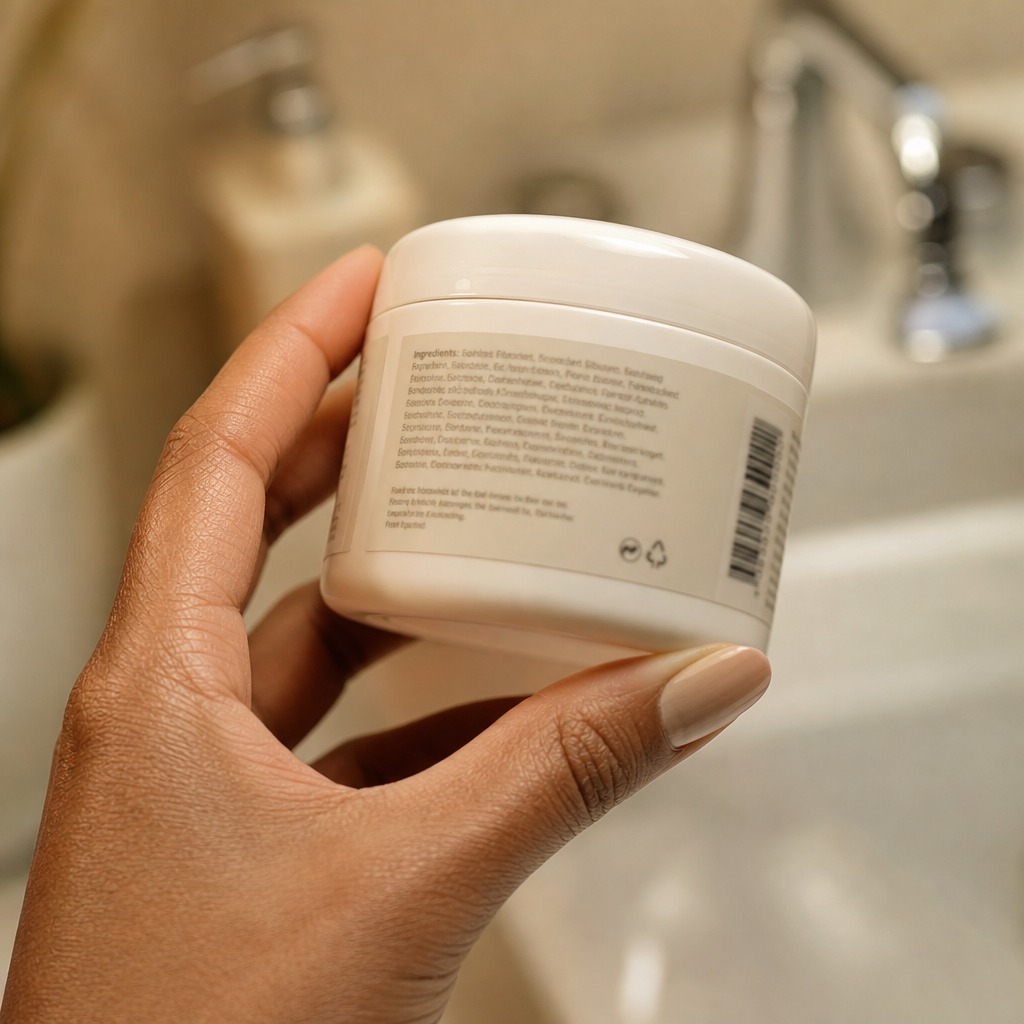
Squalane, mineral oil, glycerin, and most simple humectants are generally considered safe, which means a genuinely fungal-friendly routine does not have to be a bare one. Hydration is still necessary. It just has to come from ingredients the yeast cannot metabolize.
Note the trap: someone who suspects fungal acne often reaches for a gentler, richer moisturizer to calm the irritation, and that richer moisturizer is frequently the thing feeding it.
How does AI skin analysis reveal the pattern?
Distribution is the strongest available signal, and it is the one people are least able to assess on themselves. Looking in a mirror gives you an impression of severity. It does not give you a reliable read on whether the forehead is genuinely denser than the jaw, or whether the pattern has shifted over six weeks.
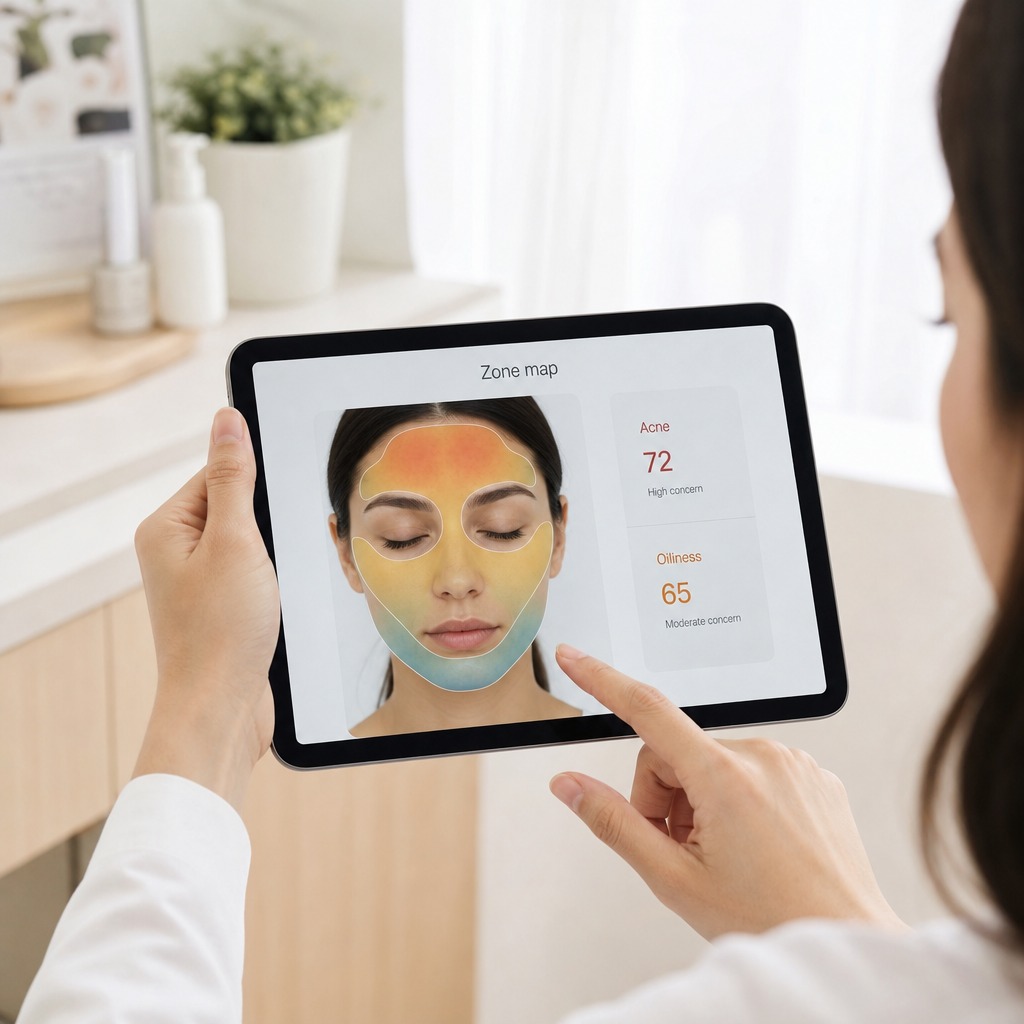
Perfect Corp's AI Skin Analysis scores 15 concerns from a single photo, including acne and oiliness, and maps them across facial zones using a 180 degree analysis. It draws on a database of more than 70,000 medical-grade images spanning a range of skin tones and ages, with a clinical study reporting 95% test-retest reliability.
An important boundary first. AI skin analysis scores concerns, it does not diagnose an infection. It cannot identify Malassezia, and a definitive answer belongs to a clinician. What it does well is make the pattern legible:
- Zone-level density. A forehead-dominant distribution alongside a separate jawline cluster is exactly the dual-condition pattern described earlier, and it is far easier to see on a scored map than in a mirror.
- Oiliness scored independently. High sebum plus a forehead-dominant pattern raises the fungal hypothesis substantially.
- Trend across sessions. If a zone is flat after eight weeks of antibacterial treatment while another zone is improving, you have objective evidence that one area is not the same condition as the other.
That last point is the most useful. The single most common story in this category is months lost to a treatment that was never going to work, and the earliest reliable signal that something is wrong is a zone that will not move while its neighbors do.
You can run the full 15-concern scan in a browser through the free AI skin analysis demo, and the enterprise version sits in AI Skin Analysis.
What this changes for clinics and brands
For a clinic, a client arriving with a scored zone map turns the consultation into a confirmation exercise rather than an interview. For a brand, it prevents the worst outcome in the category: recommending an acne regimen to someone whose primary issue is fungal, then absorbing the review that says the product made things worse. It did.
More than 800 brand partners now run AI skin assessment inside the consultation flow, and Beekman 1802 reported a 50% engagement lift after adding an AI skin experience. Teams building this into an existing product can test the scoring output in the API Playground first.
Fungal acne FAQ
How do I know if I have fungal acne?
Three signals together: bumps that are strikingly uniform in size, itching, and no response to standard acne treatment after several weeks. Location on the forehead, hairline, chest, or upper back strengthens the case. Confirmation requires a clinician.
Does fungal acne itch?
Frequently, and this is the fastest distinguishing feature, though not everyone experiences it. Bacterial acne essentially never itches. Itch alone is not proof, but its presence moves the odds significantly.
Will benzoyl peroxide help fungal acne?
Not meaningfully. Benzoyl peroxide is antibacterial, and Malassezia is a yeast. Some people report mild improvement from the drying effect, but it does not address the cause and the bumps return.
Can you have fungal acne and regular acne at once?
Yes, and it is common. The classic pattern is uniform itchy bumps on the forehead and temples alongside hormonal cysts on the chin and jaw. Treating by zone works better than treating the whole face with one product.
How long does fungal acne take to clear?
With a suitable topical antifungal, most people see change within two to four weeks. Oral antifungals prescribed for stubborn cases can work faster. Preventing recurrence is the longer project, since the triggers are environmental and behavioral.
Does fungal acne go away on its own?
Sometimes, if the trigger disappears. A flare caused by a humid holiday may resolve once you are home. A flare driven by an ongoing routine, climate, or exercise pattern generally will not.
What ingredients feed fungal acne?
Most plant oils, many fatty acid esters, polysorbates, and certain fermented ingredients. Squalane, mineral oil, and glycerin are generally considered safe. Ingredient lists matter more for this condition than for almost anything else.
Is fungal acne contagious?
No. Malassezia is already present on everyone's skin. The condition is an overgrowth of something you already have, not something you catch from another person.
The takeaway
Uniform, itchy, treatment-resistant bumps on the forehead and hairline are not behaving like acne because they usually are not acne. The most useful mental shift is to stop asking which condition you have and start asking which condition is where, since having both at once is common and it is the reason single-product plans keep failing. Map the distribution, treat by zone, and confirm with a clinician before committing to a long course of anything.