 Author:


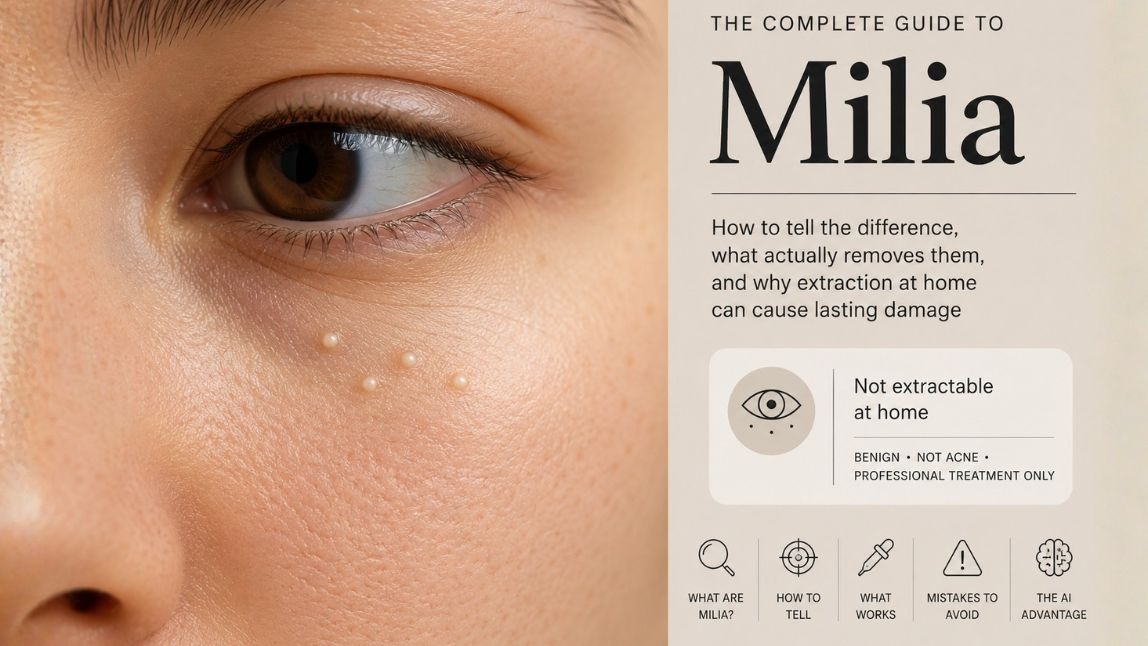
There is a small white dot under your eye. It has been there for two months. It has not grown, it has not become red, and no amount of pressure will move it. You have tried the salicylic acid you keep for breakouts and it did precisely nothing. That is because it is almost certainly not a breakout. Milia are keratin cysts, not clogged pores, and none of the acne ingredients in your bathroom cabinet will touch them. This guide covers how to tell milia from whiteheads, why the difference dictates completely different treatment, what actually removes them, and why the under-eye area is where most of the damage from getting it wrong happens.
Table of Contents
- What are milia?
- How do you tell milia from whiteheads?
- What causes milia?
- How do you get rid of milia?
- Why you should not extract milia at home
- Can you prevent milia?
- How does AI skin analysis help with identification?
- Milia FAQ
What are milia?
A milium is a tiny cyst filled with keratin, the structural protein that makes up the outer layer of skin. It forms when keratin becomes trapped beneath the surface with no route out, and the body encloses it in a small sac.
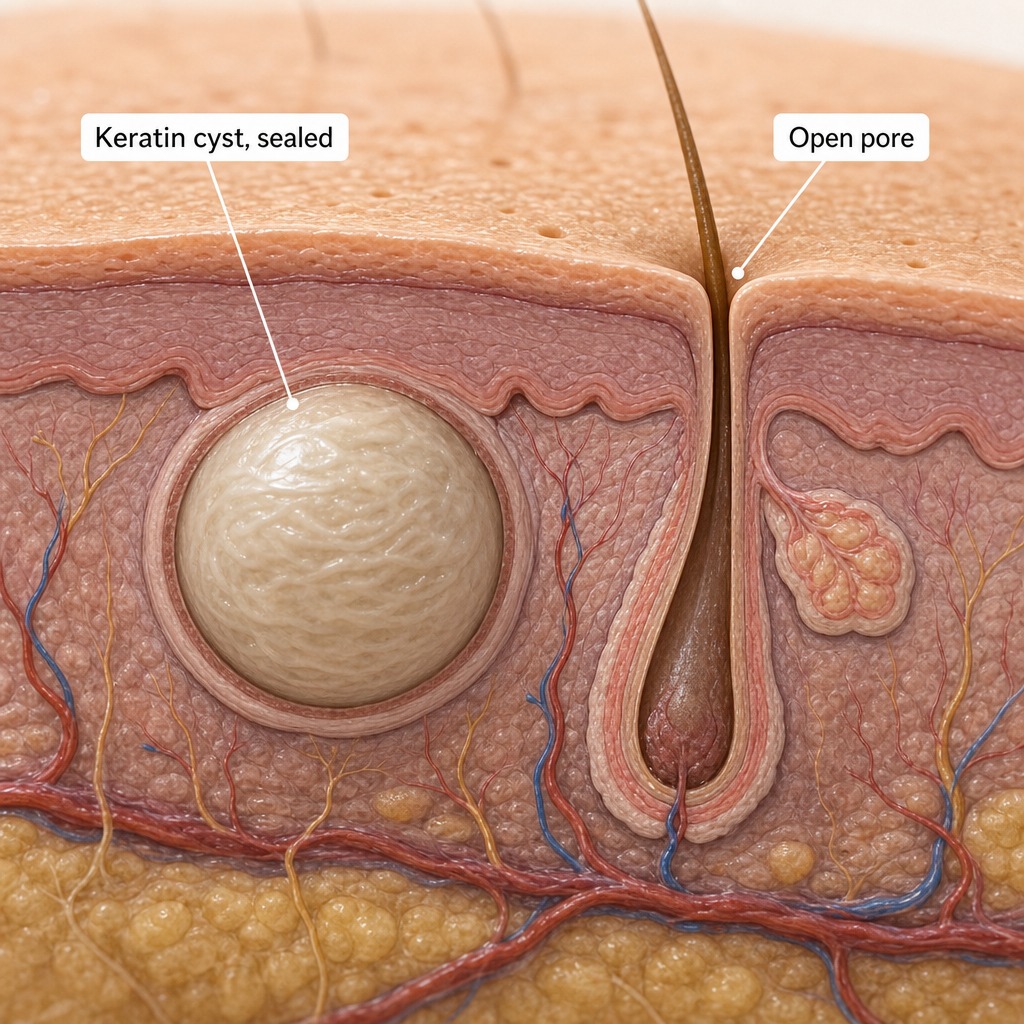
The critical detail is that a milium has no opening. It is not connected to a pore or a follicle. This is the entire reason acne treatments fail against it: salicylic acid works by entering the pore and dissolving what is inside, and there is no pore to enter. The keratin is walled off.
Milia are also completely benign. They are not an infection, they do not spread, and they cause no symptoms beyond their appearance. They favor thin-skinned areas, which is why they gravitate to the under-eye, the upper cheek, the eyelid, the temple, and occasionally the nose and forehead. Newborns get them frequently, which is one of the few contexts where they reliably resolve on their own.
How do you tell milia from whiteheads?
| Characteristic | Milia | Whitehead (pustule) |
|---|---|---|
| Feel | Hard, firm, does not move under the skin | Soft, gives slightly under pressure |
| Color | White or pearly, clearly defined edges | White or yellow center on a red base |
| Inflammation | None. No redness at all | Redness around the base is characteristic |
| Duration | Weeks to months without changing | Days to two weeks, then resolves |
| Location | Under eyes, eyelids, upper cheeks, temples | Oily zones: chin, nose, forehead, jawline |
| Under pressure | Nothing emerges. It does not budge | Contents can be expressed, though you should not |
| Response to acne actives | None | Improves over days to weeks |
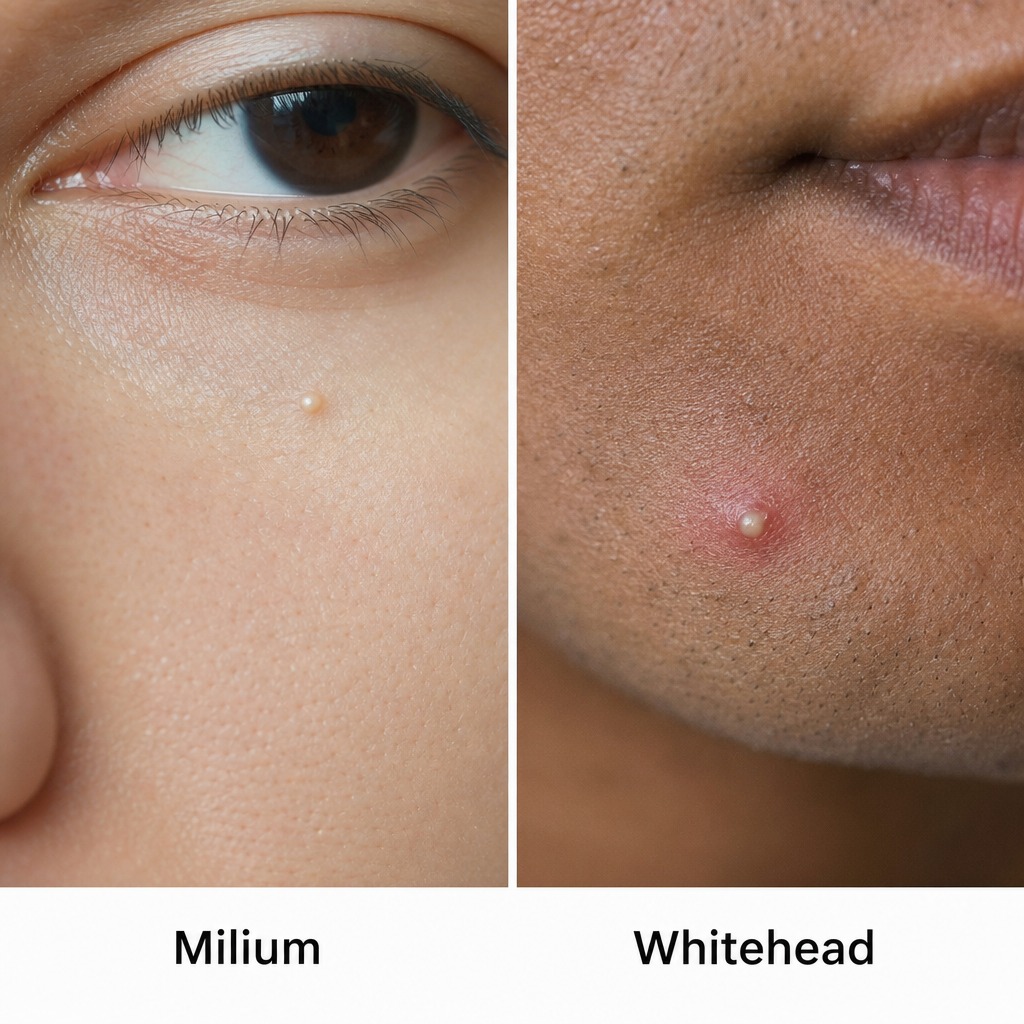
Duration is the fastest test that requires no touching. A whitehead has a lifecycle. It forms, comes to a head, and resolves within a couple of weeks whether you intervene or not. A milium simply stays. Anything that has looked identical for a month is not a pustule.
What about closed comedones?
Closed comedones are the third member of this group and the one most often confused with milia. Both are flesh-colored or white, both are non-inflamed, and both persist. The differences: closed comedones sit in the oily zones rather than the thin-skinned ones, they appear in clusters rather than as isolated dots, they feel softer, and unlike milia they respond well to retinoids and salicylic acid.
If you have twenty small bumps across your forehead, those are closed comedones. If you have three hard white dots under one eye, those are milia. The distribution tells you almost everything.
What causes milia?
Milia divide into two types, and the distinction matters for what you can do about them.
Primary milia arise spontaneously. Keratin becomes trapped without any obvious trigger. This is the type most adults have, and it is also the type newborns are born with. There is a genetic component, and some people simply form them more readily than others.
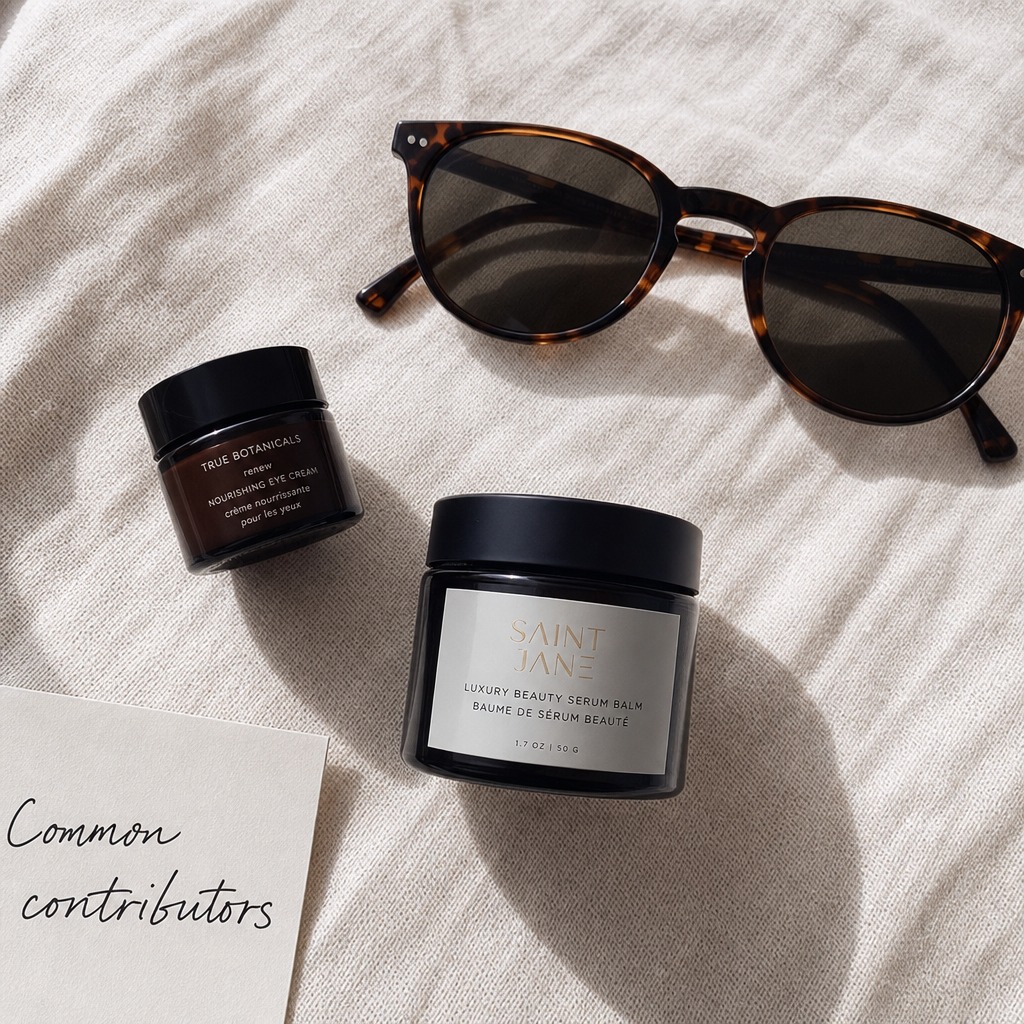
Secondary milia follow damage or occlusion. Common contributors include:
- Heavy occlusive products used repeatedly in thin-skinned areas, particularly rich eye creams
- Sun damage accumulated over years, which thickens the outer layer and impedes natural shedding
- Burns, blistering, or trauma to the skin, including some laser and resurfacing procedures
- Long-term topical steroid use
- Reduced natural exfoliation, which becomes more common with age
The eye cream connection is worth dwelling on because it is so common and so avoidable. Under-eye skin is thinner and sheds less efficiently than the rest of the face, so a formula that sits comfortably on the cheek can be too occlusive there. Milia appearing exclusively under one or both eyes, in someone who recently switched eye products, has an obvious first suspect.
How do you get rid of milia?
Honest answer first: professional extraction is the only reliable route, and it is a quick, minor procedure.
| Approach | How it works | Effectiveness | Notes |
|---|---|---|---|
| Professional extraction | A sterile lancet creates a tiny opening, the keratin pearl is lifted out | Definitive | Takes seconds per milium, minimal downtime |
| Topical retinoid | Increases turnover so trapped keratin sheds more readily | Modest, mostly preventive | Best for reducing new formation over months |
| Chemical exfoliation | Thins the overlying layer over time | Limited on established milia | Useful as maintenance, not as removal |
| Waiting | Some resolve spontaneously | Reliable in infants, unpredictable in adults | Adult milia often persist for months or years |
| Home extraction | Attempting to force the cyst open | Ineffective and risky | See below |
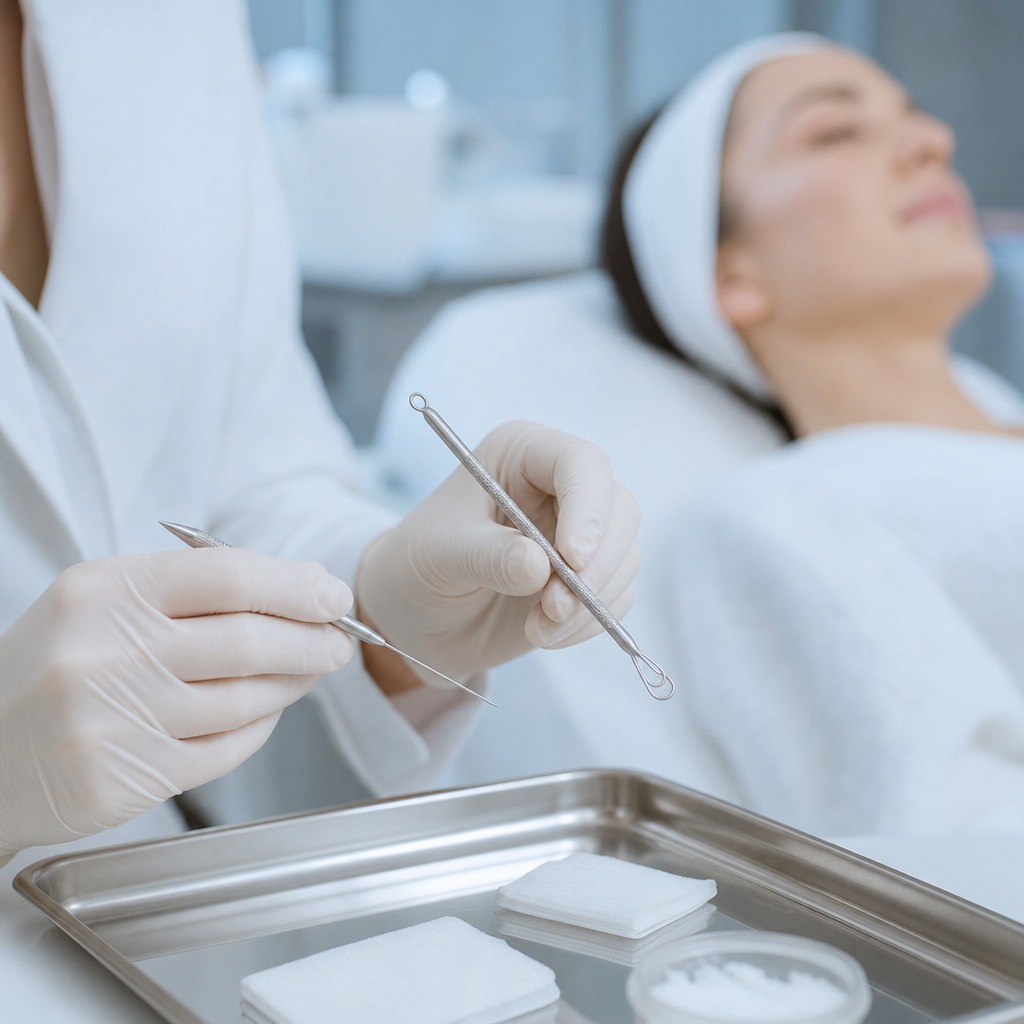
Retinoids deserve a fair hearing here. They will not remove an existing milium quickly, but consistent use over three to six months genuinely reduces how many new ones form, particularly for people who get them repeatedly. For a recurring problem, that is the more valuable intervention. For the three dots under your eye right now, it is not the answer.
Why you should not extract milia at home
Milia have no opening, which means removal requires creating one. That is a small incision, and doing it yourself in the most delicate skin on your face carries real consequences.
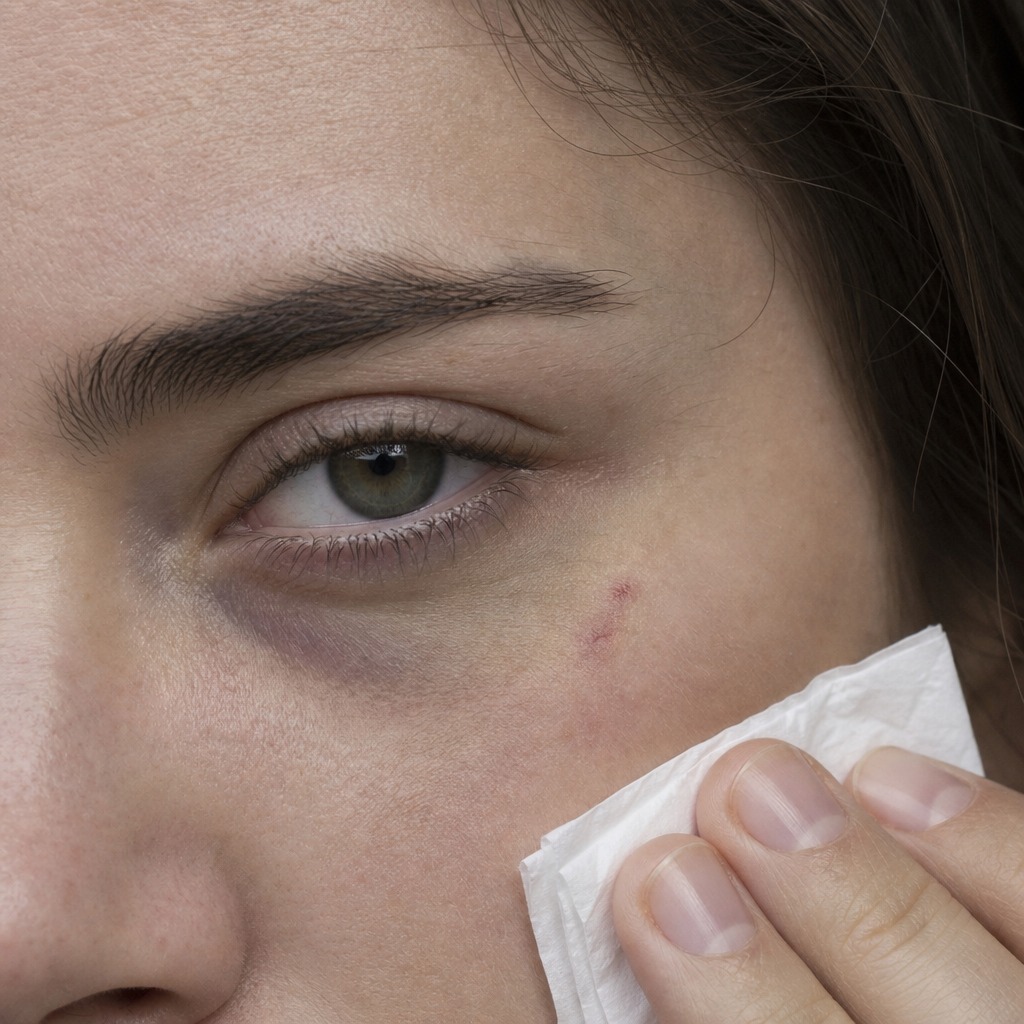
Squeezing without an opening does nothing to the cyst and everything to the surrounding tissue. Under-eye skin bruises easily and heals slowly, so people typically end up with a bruise that lasts a fortnight and a milium that is entirely unchanged. When someone escalates to a needle without sterile technique, the risks become infection, a permanent scar, or hyperpigmentation in an area where marks are especially visible.
The arithmetic is unfavorable. A practitioner removes several milia in a few minutes with sterile tools and appropriate lighting. The home version has a low chance of success and a meaningful chance of leaving something more noticeable than the original.
Can you prevent milia?
Partially, and mostly by removing contributors rather than by adding anything.
- Lighten the eye area. Switch heavy balms and rich creams for a lighter gel or serum around the eyes. This is the single highest-yield change for anyone with recurring under-eye milia.
- Sun protection. Cumulative UV damage thickens the outer layer and slows natural shedding, which is a documented contributor to secondary milia.
- Gentle, consistent exfoliation. Regular mild chemical exfoliation supports normal shedding. Aggressive scrubbing does not, and can create the trauma that causes secondary milia in the first place.
- A retinoid, if you are prone. The preventive case is much stronger than the removal case.
- Cleanse thoroughly at night. Particularly if you wear long-wear makeup or heavy sunscreen around the eyes.
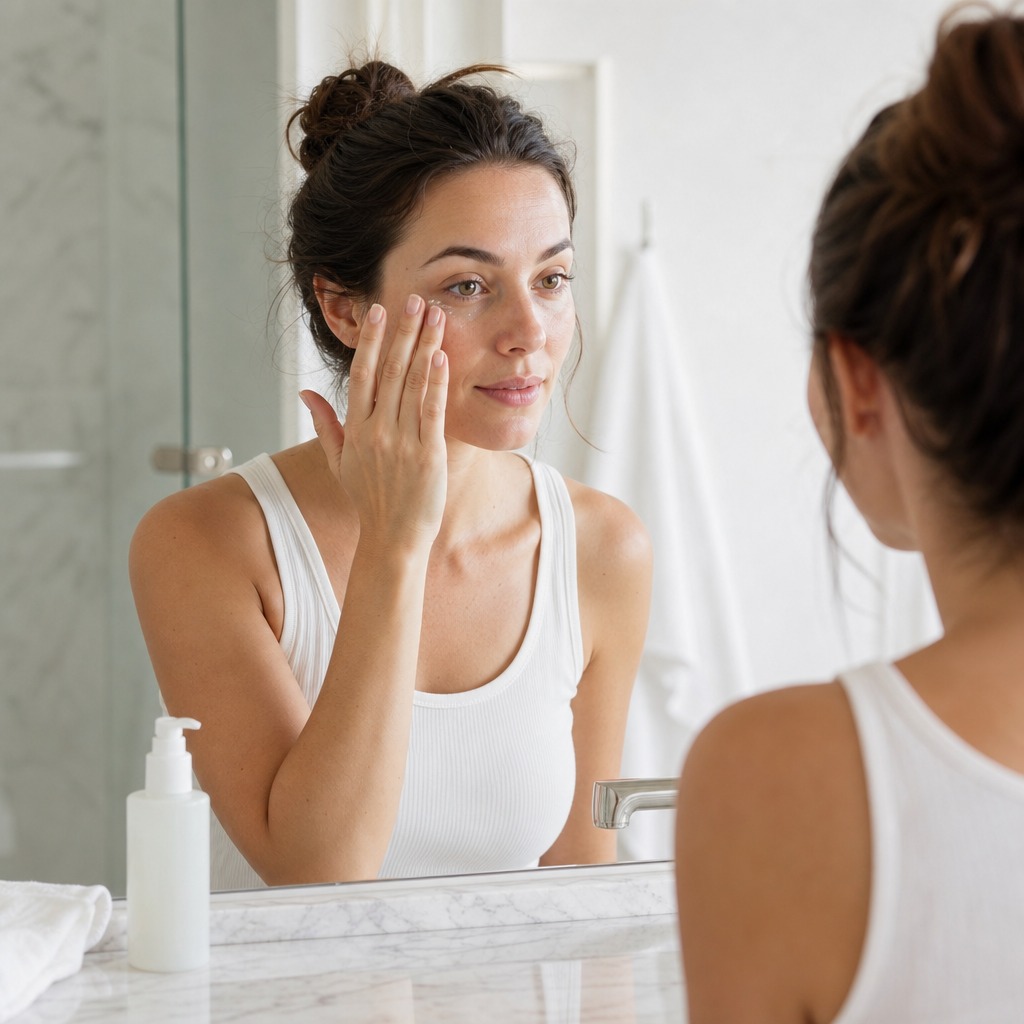
None of this guarantees you will never form another one, especially with primary milia where genetics play a large role. It does reliably reduce the rate.
How does AI skin analysis help with identification?
The identification step here is a visual judgment made in poor conditions on the least accessible part of your own face. Under-eye skin is difficult to photograph, difficult to see clearly in a mirror, and highly sensitive to lighting angle.
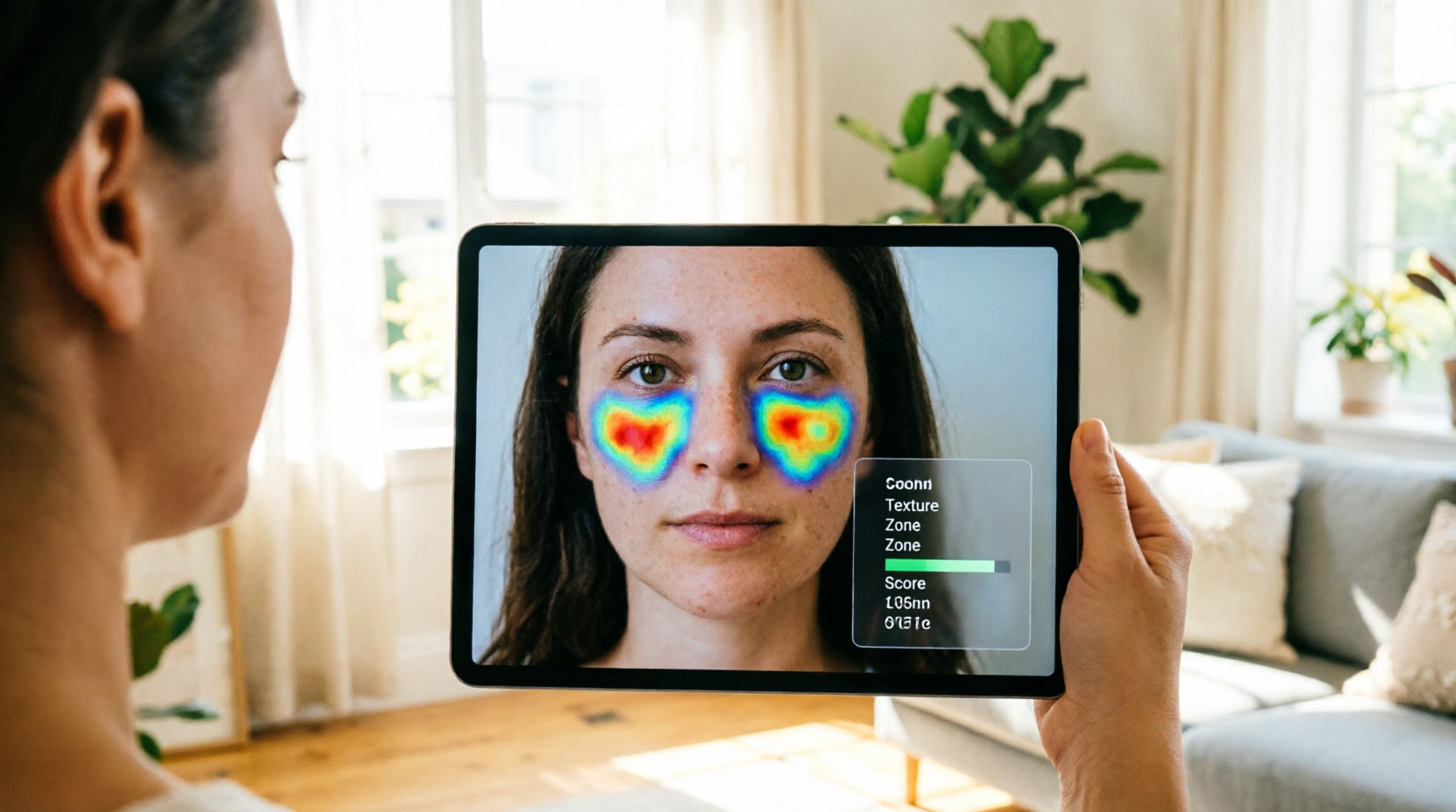
A boundary first: AI skin analysis scores concerns, it does not diagnose. It cannot label a bump as a milium, and a definitive answer belongs to a dermatologist or a licensed practitioner. What it does contribute is objective, repeatable information about the surrounding context, which is often what actually decides the question.
Perfect Corp's AI Skin Analysis scores 15 concerns from a single photo, texture among them, and maps distribution across facial zones. It is built on a database of more than 70,000 medical-grade images across a range of skin tones and ages, with a clinical study reporting 95% test-retest reliability.
Three ways that helps with this specific question:
- Distribution over description. Milia are isolated and sit in thin-skinned zones. Closed comedones cluster in oily zones. A scored facial map separates those two patterns instantly, and pattern is the most reliable non-clinical signal available.
- Oiliness scored separately. A dry under-eye zone with isolated bumps points away from comedonal acne, which needs sebum to form.
- Stability across sessions. Milia do not change. Comedones and pustules do. Two scans four weeks apart make that difference measurable rather than remembered.
You can run the full scan in a browser through the free AI skin analysis demo, and the related question of whether a bump is comedonal is covered in more depth in our guide to AI skin analysis.
What this means for clinics and brands
Milia are a small revenue line and a large trust opportunity. A client who is told plainly that their under-eye bumps will not respond to the serum they were about to buy, and that a five minute in-clinic extraction will resolve them, remembers that conversation. The alternative is selling a product that was never going to work.
More than 800 brand partners have integrated AI skin assessment into consultation and recommendation flows for this reason: the fastest way to lose a customer is to recommend something for the wrong condition. Beekman 1802 reported a 50% engagement lift after adding an AI skin experience, and Kanebo's COFFRET D'OR saw a 2.48x increase in time on page. Development teams can test the underlying concern scoring in the API Playground before integrating.
Milia FAQ
Are milia the same as whiteheads?
No. Milia are keratin cysts with no opening and no inflammation. Whiteheads in common usage are inflamed pustules with a visible center. They form differently, look different up close, and respond to entirely different treatment.
Do milia go away on their own?
In newborns, almost always, usually within weeks. In adults, often not. Adult milia frequently persist for months or years unless removed.
Can I pop a milium?
You cannot, because there is no opening to pop. Pressure only bruises the surrounding skin, and the under-eye area bruises particularly easily. Removal requires a small sterile incision performed by a practitioner.
What causes milia under the eyes?
Under-eye skin is thin and sheds less efficiently, so it is the most common site. Heavy eye creams, cumulative sun damage, and slower natural exfoliation with age are the usual contributors. A recent switch to a richer eye product is the first thing to check.
Does retinol get rid of milia?
Not quickly, and not reliably for existing ones. Retinoids are far more useful as prevention, meaningfully reducing how many new milia form over three to six months of consistent use. For the ones already there, extraction is the answer.
Will salicylic acid work on milia?
No. Salicylic acid works by entering a pore and dissolving its contents. A milium is a sealed cyst with no pore, so there is nothing for the acid to enter.
How much does milia removal cost?
It varies by location and provider, and it is usually charged as a short in-clinic procedure or added to a facial. It is one of the quicker treatments available, since each milium takes seconds once the area is prepared.
Can milia be prevented?
Partly. Lighter products around the eyes, daily sun protection, gentle regular exfoliation, and a retinoid if you are prone will all reduce the rate. Primary milia have a genetic component, so prevention lowers frequency rather than eliminating it.
The takeaway
Milia are the clearest example in skincare of a problem that punishes the wrong diagnosis. They are harmless, they are permanent until removed, and they ignore every active ingredient people reach for. Hard, white, unchanging, in thin-skinned areas, with no redness. If that describes what you are looking at, stop buying products for it and book five minutes with a practitioner instead.