 Author: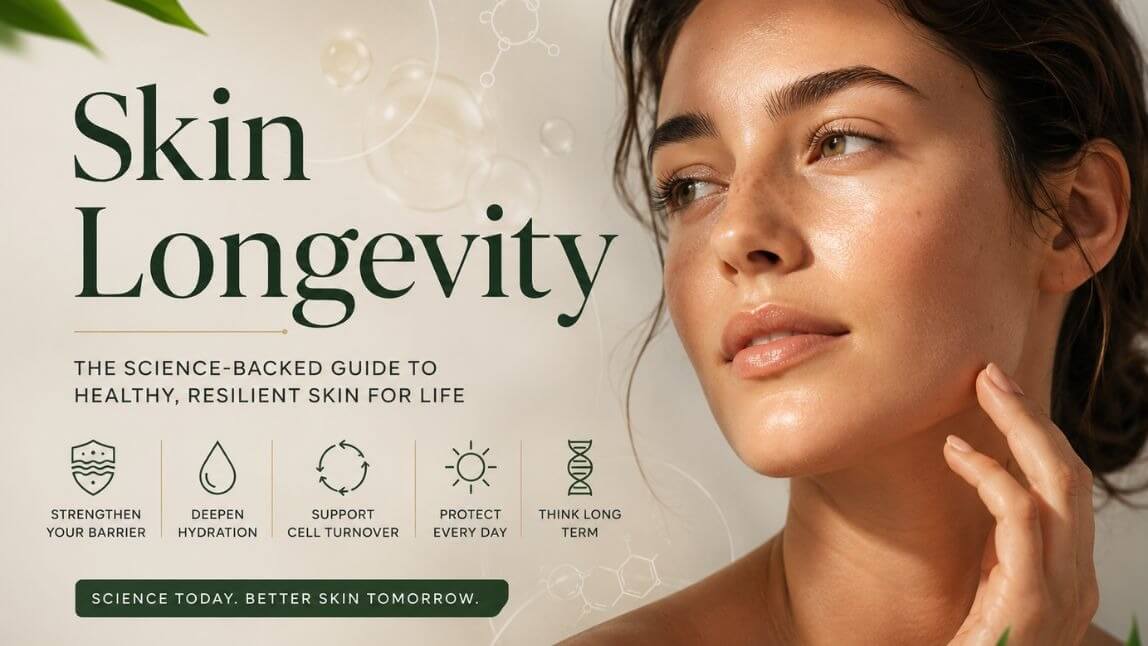
Ask ten skincare brands to define "anti-aging" and you will get ten different answers, most of them built around erasing wrinkles that have not even shown up yet. Skin longevity throws that premise out. It is not about beating a clock. It is about keeping skin functioning well for longer, and being able to prove it, the same way researchers measure health span in any other organ.
Skin longevity is your skin's ability to maintain barrier function, hydration, and healthy cell turnover over time, rather than simply masking visible signs of aging after they appear. The goal shifts from correction to prevention, and from a fixed endpoint like "fewer wrinkles" to an ongoing process: skin that keeps doing its job well into your 40s, 60s, and beyond.
This guide breaks down what the science actually says, which ingredients are backed by real data versus marketing copy, and, unlike most articles on this topic, how to actually check whether your routine is doing anything at all.
What Is Skin Longevity, Really?
Skin longevity borrows its name from the broader longevity movement, the one built around health span rather than lifespan. Applied to skin, the idea is simple: instead of asking "how do I look younger," you ask "how do I keep my skin working well for longer." That distinction matters more than it sounds.
Traditional anti-aging is reactive. A wrinkle appears, a serum promises to soften it. Skin longevity is proactive. It treats the skin as a living, functioning organ, not a surface to be corrected after the fact. The concept has moved from niche dermatology talk to a full industry pivot in just a couple of years. Estee Lauder built an entire platform around it, drawing on 15 years of internal longevity research and a partnership with the Stanford Center on Longevity. When a legacy prestige brand reroutes its whole R&D narrative around a concept, that is usually a sign the science underneath it has matured, not just the marketing.
Skin Longevity vs. Traditional Anti-Aging: What Actually Changes
| Dimension | Traditional Anti-Aging | Skin Longevity |
|---|---|---|
| Core goal | Erase visible signs after they appear | Preserve function before decline becomes visible |
| Timing | Reactive, usually starts once lines or spots show up | Proactive, often starts in your 20s or earlier |
| Success metric | Fewer wrinkles, tighter appearance | Barrier strength, hydration, consistent turnover, resilience |
| Mindset | Skin as a flaw to correct | Skin as a system to support |
The Biology Behind Why Skin Ages in the First Place
You cannot support a system you do not understand, so here is the short version of what is actually happening under the surface.
- Collagen production slows. Collagen is the structural protein that keeps skin firm. Output declines gradually starting in your mid to late 20s, and the drop accelerates around menopause for many women.
- Elastin degrades. Elastin is what lets skin snap back into place. Once it breaks down, it does not regenerate the way collagen partially can.
- Cell turnover slows down. Skin cells regenerate roughly every 28 days in your 20s. By your 50s, that cycle can stretch to 45 to 60 days, which is a big part of why texture and dullness become more noticeable with age.
- Oxidative stress accumulates. UV exposure, pollution, and everyday metabolic activity generate free radicals that damage collagen and cellular DNA. This damage is cumulative, which is why prevention beats correction almost every time.
- Cellular senescence sets in. Some skin cells stop dividing but stay metabolically active, releasing low-grade inflammatory signals that quietly speed up collagen breakdown nearby. Researchers sometimes call this "inflammaging," a slow-burn inflammation that compounds over decades.
None of this is exotic knowledge. What is new is the framing: instead of treating each symptom in isolation, a skin longevity approach addresses the mechanisms that produce all of them at once.
The Five Pillars of a Skin Longevity Routine
Strip away the branding and every credible skin longevity protocol comes down to the same five pillars. Skip one and the other four work harder than they should.
| Pillar | What It Does | How to Support It |
|---|---|---|
| Barrier integrity | Keeps moisture in and irritants out | Ceramide-rich moisturizers, gentle non-stripping cleansers |
| Hydration | Plumps the skin and softens the look of fine lines | Hyaluronic acid, glycerin, humectant layering |
| Cell turnover | Clears dull, old cells and encourages fresh ones | Retinoids, mild chemical exfoliation |
| Oxidative defense | Neutralizes free radical damage before it accumulates | Vitamin C, niacinamide, antioxidant serums |
| Sun protection | Blocks the single largest driver of visible aging | Broad-spectrum SPF, applied daily, no exceptions |
That last pillar deserves extra weight. A widely cited figure in dermatology circles holds that sun exposure is responsible for the majority of visible facial aging, and outlets covering skin longevity routinely put that share at up to 80 percent. If your routine has a weak point, it is probably here, not in the newest serum you have not tried yet.
Which Ingredients Are Actually Backed by Evidence?
The skin longevity conversation has attracted its share of hype, especially around oral supplements. Here is a grounded ranking based on how much clinical evidence actually exists for each category, not how well it markets.
| Ingredient | Primary Role | Evidence Level |
|---|---|---|
| Broad-spectrum SPF | Prevents UV-driven collagen breakdown | Very high, decades of clinical consensus |
| Retinoids (retinol, retinal, tretinoin) | Cell turnover, collagen stimulation | Very high, the most researched anti-aging class available |
| Niacinamide | Barrier support, hydration, pigmentation, mild collagen support | High, validated across multiple randomized controlled trials |
| Vitamin C | Antioxidant defense, brightening | High, a well-established topical antioxidant |
| Peptides | Cell signaling, structural support | Moderate, promising but less robust than retinoids |
| Oral NAD+ precursors and longevity supplements | Cellular energy support | Early stage, real mechanism but limited skin-specific outcome data |
On that last row: the pitch that swallowing an NAD+ precursor will visibly change your skin is seductive, and the underlying cellular biology is genuinely interesting. But when the outcome is measured specifically at the skin, the evidence for oral compounds trails far behind what is documented for topical retinoids, niacinamide, and daily SPF. If you have a limited budget, spend it on your face, not your medicine cabinet.
Skincare researchers at QIMA Life Sciences describe this shift plainly: the industry is moving away from short-term aesthetic fixes and toward formulations designed to keep skin resilient and functional over years, not weeks. That is a fundamentally different design brief for a product, and it shows in how ingredient lists have changed over the past few product cycles.
It Is Not Just Skincare: The Lifestyle Side of Skin Longevity
No serum outruns a bad routine outside the bathroom. Sleep, diet, and stress all leave a visible trace on skin, and the mechanism is usually the same one driving the rest of this article: oxidative stress and inflammation.
- Sleep is when skin does most of its repair work, including collagen synthesis. Chronic short sleep shows up as dullness and slower recovery from irritation.
- Diet heavy in refined sugar accelerates a process called glycation, where sugar molecules bind to collagen and make it stiffer and more brittle over time.
- Stress raises cortisol, which can break down collagen and impair barrier repair, which is why skin often looks visibly worse during high-stress stretches, not just tired.
None of this replaces a topical routine. It just means the topical routine is working against a headwind if the basics elsewhere are ignored.
The Part Almost Nobody Talks About: How Do You Know If It Is Working?
Here is the gap in most skin longevity content: it tells you what to apply and almost never tells you how to check whether it is doing anything. Skin longevity is, by definition, a slow process. Visible change lags behind biological change by weeks or months, which makes it easy to quit a good routine too early, or stick with a bad one far too long, simply because nothing looks different yet.
This is where objective measurement earns its place next to any serum. Instead of guessing from the mirror, an AI skin analysis tool can score specific, trackable indicators such as hydration, texture, pore visibility, and estimated skin age from a single photo, then let you compare that score against a scan from weeks or months earlier. Perfect Corp's own skin diagnostic technology, trained on 70,000-plus clinical images, has been benchmarked at a 95 percent test-retest reliability rate and an 80 percent correlation with professional physician assessments, which means the score you get today is a reasonably faithful baseline for the score you get in three months, not just a random number.
That kind of measurement turns skin longevity from a vague aspiration into something you can actually track, the same way you would track a fitness or sleep metric. If your barrier score improves after eight weeks of ceramide-led products, you know the routine is earning its shelf space. If it does not, you know before you have wasted a full season on the wrong formula.

For Brands: Turning the Skin Longevity Trend Into a Retail Advantage
If you sell skincare rather than just use it, skin longevity is less a content trend and more a customer education problem. Shoppers increasingly ask why a product works, not just what it promises, and a routine built around vague anti-aging language is a harder sell than one backed by a visible, trackable metric.
Brands including Cetaphil, Decorte, and Bakel have leaned into this by putting AI-powered skin diagnostics directly into the shopping journey, letting customers see their own baseline numbers before a product recommendation is even made. That single step reframes the conversation from "trust us" to "here is your data, here is what it suggests." It is a small UX change with an outsized effect on both conversion and long-term trust, since the recommendation now traces back to something the customer can see for themselves.
Contact Perfect Corp for a demo to see how AI skin diagnostics can plug into your own site or in-store experience.

Frequently Asked Questions
What is skin longevity?
Skin longevity is the practice of maintaining skin's barrier function, hydration, and healthy cell turnover over time, rather than only addressing visible signs of aging after they have already appeared. It treats skin as a functioning system to be supported, not a surface to be corrected.
How is skin longevity different from anti-aging?
Traditional anti-aging is reactive: a wrinkle or spot appears, and a product targets it. Skin longevity is proactive and preventive, focused on preserving collagen, barrier strength, and cell turnover before visible decline sets in.
What ingredients actually support skin longevity?
Broad-spectrum sunscreen, retinoids, niacinamide, and vitamin C have the strongest clinical backing. Peptides show promise for cell signaling and structural support, though the evidence base is thinner than for retinoids.
Do oral longevity supplements help skin as much as topical ingredients do?
Not based on current evidence. Compounds like NAD+ precursors have real cellular mechanisms, but skin-specific outcome data for oral supplements is still limited compared to the decades of clinical research behind topical retinoids, niacinamide, and daily SPF.
When should I start a skin longevity routine?
Since collagen decline typically begins in the mid to late 20s, that is a reasonable starting point for a preventive routine. That said, benefits from improved barrier health and consistent sun protection exist at any age.
Can lifestyle habits really affect how my skin ages?
Yes. Poor sleep limits overnight collagen repair, high-sugar diets accelerate a stiffening process called glycation, and chronic stress raises cortisol in ways that can break down collagen and slow barrier repair.
How can I tell if my skin longevity routine is actually working?
Because changes happen gradually, mirror checks are unreliable. Scoring trackable indicators like hydration, texture, and estimated skin age with a tool such as Perfect Corp's beauty tech research and comparing scans over weeks or months gives a more objective read than visual judgment alone.
What role does AI play in skin longevity skincare?
AI-powered skin analysis can quantify specific skin metrics from a photo and track how they change over time, turning a vague, slow-moving goal into something measurable. It also helps brands move from generic recommendations to ones grounded in an individual customer's actual skin data.