 Author:



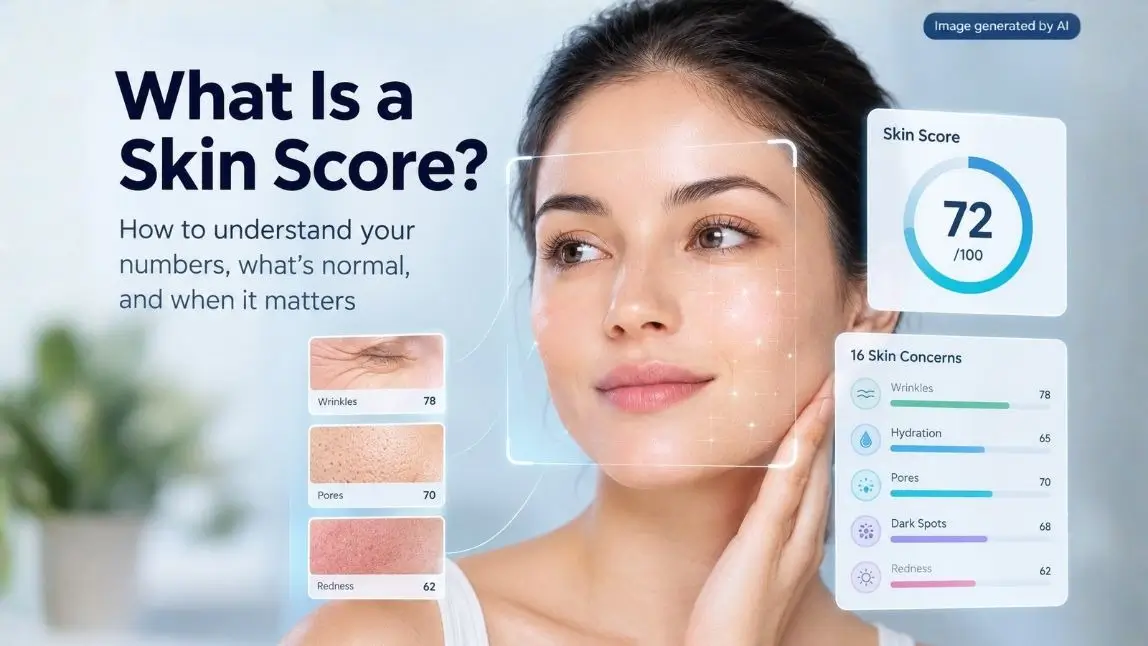
Images generated by AI
You run a scan, a number comes back, and the obvious question has no obvious answer. Is 72 good? Is 58 a problem? The honest reply is that a skin score is meaningless in isolation and highly useful in context, and knowing which context makes the difference between a number that changes your routine and a number that just makes you anxious.
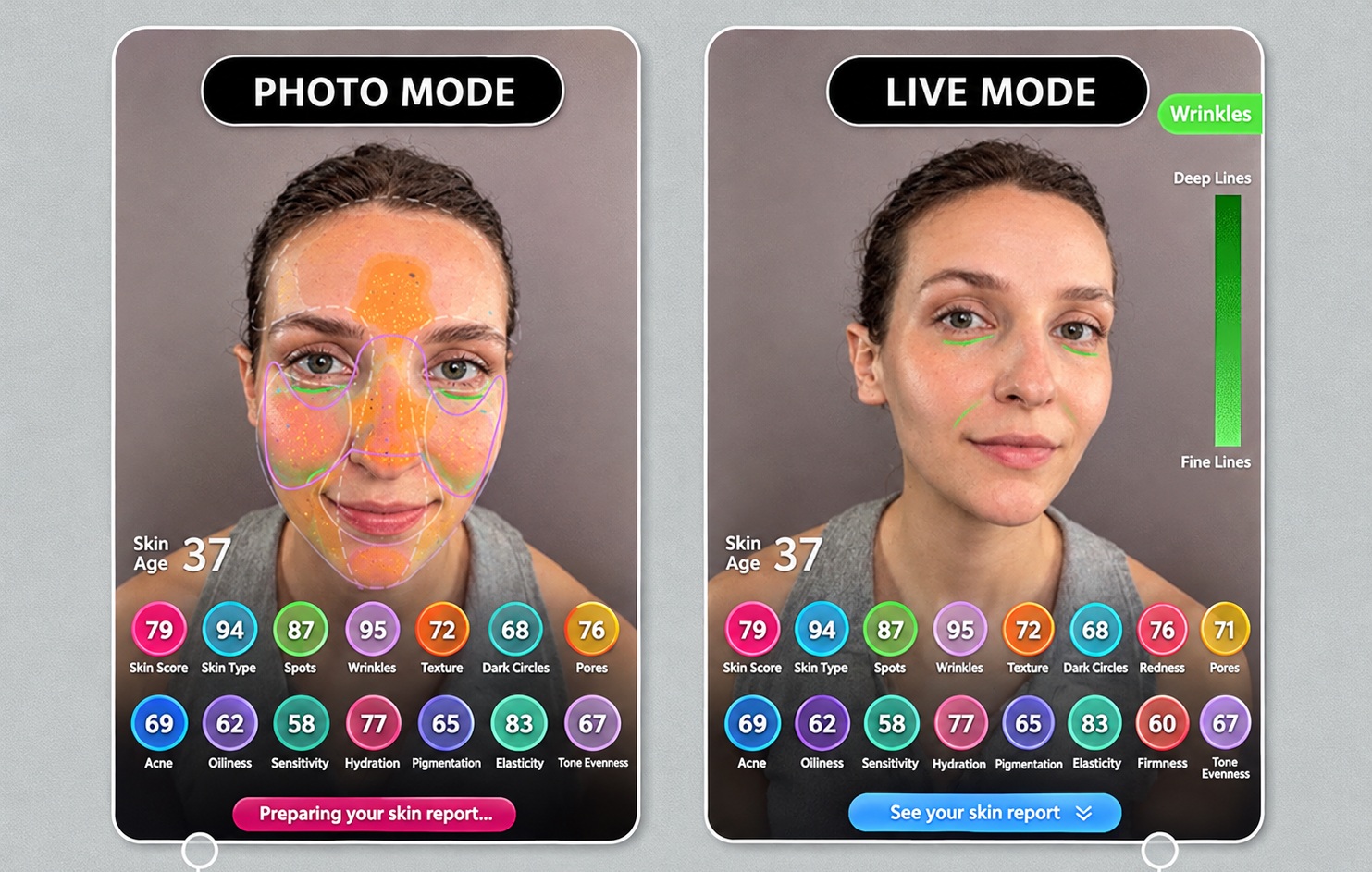
This guide covers what a skin score is actually measuring, what a good number looks like for each concern, why yours moves between scans, and how to read a report properly. You can follow along with a real one in the AI skin analysis demo, which scores 28 skin diagnostics across 16 skin concerns from a single photo and returns them grouped rather than blended into one verdict, which is the format the rest of this article assumes.

What this guide covers
What Is a Skin Score?
A skin score is a numeric estimate of how a particular visible skin characteristic presents in a photograph, placed on a scale. In most consumer facing systems that scale runs from 1 to 100 and higher means healthier looking, so a high wrinkle score means fewer visible wrinkles rather than more. That direction catches almost everyone out on a first read, and a system that does not label it clearly is creating confusion it could have prevented.
What a score is not is a measurement of your skin. It is an estimate derived from visible signs in an image, which is a meaningfully different thing from a reading taken off the tissue with a probe. The distinction matters because it explains both the strengths of these tools, which are speed, repeatability and coverage, and their limits, which are sensitivity to lighting and an inability to see anything that does not show up on the surface.
Is There a Universal Good Skin Score?
No, and anyone who tells you 80 is good is quietly assuming a scale they have not named.
There is no cross industry standard for skin scoring. Different vendors measure different concerns, calibrate against different references, and apply different adjustments before a number reaches the screen. A 70 from one system and a 70 from another are not the same statement about your face. Within one system the numbers are comparable; across systems they are not, in the same way that two unrelated exams both marked out of 100 do not produce interchangeable grades.
It is worth knowing that this is not a failing unique to software. Human expert grading of skin has its own reliability ceiling. A 2025 systematic review and meta-analysis in the British Journal of Dermatology, which assessed how well image based AI evaluates inflammatory skin disease severity across 45 studies, reported a pooled reliability coefficient of 78 percent and noted that performance varied substantially by condition, from around 92 percent sensitivity for atopic dermatitis down to about 72 percent for psoriasis.
Performance in skin severity grading is condition dependent rather than a single headline figure, and the authors specifically called for more transparent data reporting and prospective studies using objective reference standards.Cai ZR et al., Assessing the performance of artificial intelligence models in evaluating inflammatory skin disease severity: a systematic review and meta-analysis, British Journal of Dermatology, 2025;193(5):847 to 855
The practical takeaway is that a good skin score is one you can compare to something. Everything that follows is about establishing what that something should be.
How Does Clinical Dermatology Score Skin?
With scales that are narrow, validated and deliberately unambitious about what they cover. This is useful background, because it shows what a defensible score looks like.
| Scale type | What it does | What it does not do |
|---|---|---|
| Investigator Global Assessment | A short ordinal severity rating, often 0 to 4, for one named condition | Does not describe skin generally, and is condition specific |
| Severity indices such as EASI | Combines extent and intensity into a composite score for one disease | Not transferable between conditions |
| Photonumeric scales | Grade one feature, such as forehead lines, against reference photographs | One feature per scale. Not a whole face number |
| Fitzpatrick skin type | Classifies response to sun exposure, I to VI | Not a quality score, and often self reported incorrectly |
| Instrument readings | Measures a physical property such as hydration with a probe | Measures a point, not a face, and needs a controlled room |
Notice what is missing from that list. There is no validated clinical scale that produces a single overall skin quality number for a whole face, because dermatology does not treat skin as one thing. Every rigorous scale in use grades one feature or one condition at a time.

That is the strongest argument for reading a skin analysis report the way a clinician reads a chart, concern by concern, rather than looking for one headline figure. It is also why the better consumer tools return grouped per concern results. The skin analysis demo organises its output into acne and texture, aging and firmness, and tone and pigmentation, which maps closely onto how the concerns are actually assessed rather than onto how they are marketed.
What Does a Skin Analysis Score Actually Measure?
Per concern, and in more detail than most people realise. The 16 concern names expand into 28 scored diagnostics once region level sub scores are included, because several concerns are not single values at all.
| Group | What is scored | Why it is grouped this way |
|---|---|---|
| Acne and texture | Pores by facial region, texture, acne, oiliness | These move together and respond to the same interventions |
| Aging and firmness | Wrinkles by type and region, moisture, eye bags, tear trough, firmness, droopy eyelids | Structural and hydration signals that change on a slow timeline |
| Tone and pigmentation | Spots, dark circles, radiance, redness, skin type across full face, T zone and U zone | Colour signals, which split into vascular and pigment causes |
| Classification | Skin condition, Fitzpatrick skin type, estimated skin age | Context for interpreting everything above, not quality scores |
Two implementation details worth knowing as a reader. Several systems return both a raw score and an adjusted score for display, and they are not the same number, so if you are tracking change over time you want the raw one. And concerns like wrinkles and pores are returned per region, which means a single wrinkle bar in an interface is hiding several separate readings that may be telling different stories.
What Is a Good Score for Each Concern?
Treating each concern on its own terms, here is what the ranges generally mean and, more usefully, what each one implies about timeline. The bands below are a reading guide for scales where higher means healthier, not a clinical threshold.
| Concern | A strong score suggests | A low score suggests | How fast it can move |
|---|---|---|---|
| Moisture | Surface hydration well maintained | Dehydration, tightness, more visible fine lines | Days. The fastest score on the report |
| Texture | Smooth surface, light reflecting evenly | Build up, roughness, congestion | 2 to 4 weeks |
| Oiliness | Balanced sebum for your skin type | High sebum, or stripped skin overcompensating | 2 to 6 weeks |
| Redness | Low vascular visibility, calm skin | Irritation, barrier damage or a vascular condition | 1 to 4 weeks, and it is the most volatile score |
| Acne | Few visible inflammatory lesions | Active breakouts, and often congestion underneath | 6 to 12 weeks for a real change |
| Pores | Low visible pore prominence in that region | Congestion or structurally larger pores | 4 to 8 weeks for appearance, structure does not change |
| Radiance | Even tone and a surface that reflects well | Dullness, which is usually surface rather than colour | Days to weeks if surface, months if pigment |
| Spots | Even pigment distribution | Sun damage, melasma or post inflammatory marks | 3 to 6 months, minimum |
| Wrinkles | Few established lines in that region | Static lines, which differ from expression lines | 12 weeks for fine lines, longer for set ones |
| Firmness | Good structural support | Laxity, which is collagen and elastin related | Months, and partially |
| Dark circles | Even under eye tone | Pigment, vascular shadowing or structural hollowing | Depends entirely on which of the three it is |
| Eye bags and tear trough | Smooth under eye contour | Fluid, fat pad prominence or volume loss | Structural ones do not respond to skincare |
The timeline column is the part worth acting on. A report with low moisture and low spots scores is describing two problems on completely different clocks, and judging a pigment routine after four weeks is how people conclude that nothing works.
Why Does Your Score Change Between Scans?
Usually because something about the photograph changed, not because something about your face did. This is the single most common reason people lose trust in these tools, and it is almost entirely preventable.
| Variable | Effect on your scores | What to do |
|---|---|---|
| Light direction | Large. Radiance and texture depend on how light hits the surface | Same window, same time of day, every scan |
| Flash or ring light | Large. Flattens texture and can manufacture apparent radiance | Pick one lighting setup and never change it |
| Time of day | Moderate. Oiliness and redness both drift across a day | Morning, before anything is applied, is the cleanest baseline |
| Recent activity | Large on redness. Exercise, heat and alcohol all show | Wait an hour after anything that warms you |
| Makeup or skincare | Large. Anything on the surface is what gets scored | Bare skin, and let it settle after cleansing |
| Camera distance and angle | Moderate. Changes which regions are measured and how | Use the framing guide, hold at eye level |
| Resolution | Moderate on fine detail such as pores and texture | Use the same device each time |
Independent validation of this category has focused less on a single accuracy figure and more on repeatability, with test to retest reliability reported above an intraclass correlation of 0.90 in a dermatologist led review of the technology, which is the property that makes progress tracking meaningful at all.Report by Steven R. Feldman, MD, PhD, Professor of Dermatology, Wake Forest School of Medicine, 2022, alongside peer reviewed validation in Initial validation of a new device for facial skin analysis, Journal of Dermatological Treatment, 2022;33(8)
A useful rule: if two scans were taken under conditions you cannot describe identically, the difference between them is not evidence of anything. Lock the conditions first, then start tracking.
What Is a Good Skin Age Score?
An estimated skin age close to your actual age is a normal result, and the number is more interesting as a direction than as a verdict. A skin age several years below your chronological age suggests the visible aging signals the system reads, chiefly wrinkles, firmness, spots and texture, are presenting younger than typical for your age group. Several years above suggests the opposite.
Three things worth holding in mind. Skin age is a derived figure built from other scores rather than a measurement of its own, so it moves when its components move. It is estimated relative to a population, which means the comparison group matters and is rarely disclosed in detail. And it is heavily influenced by the same capture conditions as everything else, so a dramatic skin age shift between two scans almost always means the lighting changed.
Used sensibly it is a good motivational metric and a poor diagnostic one. If the number moves two years in a month, suspect the photograph.

What Should You Compare Your Score Against?
Three comparisons are valid and one that everyone makes is not.
| Comparison | Valid? | Why |
|---|---|---|
| Your own score, same system, same conditions, over time | Yes. This is the most useful one by a wide margin | Everything except your skin is held constant |
| Your scores against each other, within one scan | Yes. Tells you what to prioritise | Relative ranking is reliable even when absolute values are not |
| Your score against the system's own age reference | Partly. Useful as context, not as a target | The reference population is rarely disclosed in full |
| Your score against someone else's score | No | Different face, different capture, and usually a different scale |
Reference populations matter more than they are usually credited. Work published in Science Advances using a curated, biopsy confirmed image set spanning Fitzpatrick I to VI found that dermatology algorithms performed unevenly across skin tones, and that the gap narrowed only once the models were tuned on more diverse data.Daneshjou R, Vodrahalli K, Novoa RA, Ko J, Swetter SM, Zou J, Chiou A, et al., Disparities in dermatology AI performance on a diverse, curated clinical image set, Science Advances, 2022, doi:10.1126/sciadv.abq6147
The second row is underrated. Even if you distrust the absolute numbers entirely, the ordering within a single scan is informative: the concern scoring lowest relative to your others is a reasonable place to start, and that conclusion survives most of the uncertainty in the absolute values.
What Is a Good Overall Score?
If a system gives you one, treat it as a summary headline rather than a result. An overall score is an average across concerns that move on different timelines and respond to different treatments, so it is the figure least able to tell you what to do next.
It has one legitimate use, which is tracking a general direction over a long period under locked conditions. It has one common misuse, which is becoming the number people optimise for, because the fastest way to raise a composite is to improve whichever component moves quickest, usually hydration, which can leave a slow but important problem untouched while the headline figure improves.
As a practical answer to the question in this section's title: for most adults an overall score in the middle of the range is unremarkable and tells you nothing worrying. What matters is which individual concerns sit well below your personal average, and whether they are moving in the right direction over several scans.

How Do You Turn a Score into a Change?
Read the combination, not the lowest number. Several common patterns have a clear reading.
| Pattern | What it usually means | Where to start |
|---|---|---|
| Low moisture, normal everything else | Simple dehydration | Humectant under an occlusive. Visible in days |
| Low moisture and low texture | Surface build up plus dehydration | Hydrate first, then gentle exfoliation |
| Low redness score with low moisture | Likely a compromised barrier | Stop all actives. Repair for 2 to 4 weeks |
| Low spots, everything else normal | Pigment, mostly sun accumulated | Daily SPF plus vitamin C or niacinamide. Months |
| Low acne and low oiliness scores together | Active congestion with high sebum | Salicylic acid, and a retinoid for prevention |
| Low radiance, normal texture and spots | Often hydration or fatigue rather than tone | Hydration and sleep before any brightening product |
| Low firmness and low wrinkle scores | Structural aging signals | Retinoid, sun protection, and realistic expectations |
If you want to see this working on an actual face rather than in a table, the skin analysis demo returns the full grouped breakdown with a recommended routine attached, which makes the relationship between a pattern and a recommendation concrete in a way that reading about it does not.

When Does a Score Mean See a Professional?
A consumer skin score is a screening and tracking tool, not a diagnostic one, and no number on it should be treated as a medical finding. That said, some patterns are worth escalating.
- A persistently low redness score alongside symptoms such as stinging, burning or flushing that does not fully settle.
- An acne score that does not improve after eight to twelve weeks of consistent over the counter treatment, particularly with deep or painful lesions.
- Any individual spot or patch that is changing in size, shape, colour or border. No cosmetic scoring system is designed to assess this, and it needs a clinician.
- Symmetrical pigment patches that darken despite diligent sun protection.
- Scores that drop sharply across several concerns at once without an obvious cause.
For context on where image based AI sits against clinicians, a systematic review and meta analysis in npj Digital Medicine covering 53 comparative studies found AI outperformed generalists by a wide margin, while the difference against expert dermatologists was statistically significant but small in practical terms. The authors noted that 94 percent of the studies were retrospective.Systematic review and meta analysis of artificial intelligence versus clinicians for skin cancer diagnosis, npj Digital Medicine, 2024
The third point is the important one. These tools are built for cosmetic concerns, and the fact that something appears in a report does not mean the report is capable of assessing it.
How Should Teams Present Scores to Customers?
If you are building the experience rather than reading it, score presentation is where most of the trust is won or lost.
| Do this | Instead of this | Why |
|---|---|---|
| Label the direction explicitly | Assuming users know higher is better | Roughly half will read it the other way on first sight |
| Show concerns grouped | One overall number | A composite cannot be acted on. A breakdown can |
| State a timeline with every recommendation | Recommending a product with no horizon | Pigment judged on a hydration timeline reads as failure |
| Lead with the fastest moving concern | Leading with the lowest score | An early visible win buys patience for the slow work |
| Enforce capture conditions, and say why | Accepting any photo silently | Inconsistent capture destroys the progress feature |
| Store raw scores for comparison | Storing only the displayed value | Display values are adjusted and make poor deltas |
| Say plainly what the tool cannot assess | Implying completeness | Honesty about limits is the cheapest credibility available |
You can test the per concern output against real images in the YouCam API Playground, or run the full consumer flow end to end in the skin analysis demo to see how the grouping, the skin age estimate and the routine recommendation fit together before you design your own. Perfect Corp works with 800+ brand partners on experiences of this kind.
Good Skin Score FAQ
What is a good skin score out of 100?
There is no universal answer, because there is no cross industry standard scale. Within one system, a score in the middle of the range is unremarkable for most adults, and what matters is which individual concerns sit well below your own average and which direction they are moving.
Does a higher skin score mean better skin?
On most consumer scales, yes. Higher generally means healthier looking for that concern, so a high wrinkle score means fewer visible wrinkles. Always check the labelling, because the direction is not standardised and it is the most common misreading.
Why is my skin score different every time I scan?
Usually the photograph changed rather than your skin. Light direction, flash, time of day, recent exercise, makeup and camera distance all move the numbers. Scan in the same light, at the same time of day, on bare skin, with the same device.
Can I compare my skin score with someone else's?
No. Different faces, different capture conditions and often different underlying scales make the comparison meaningless. The only comparison that holds is your own score against your own score under matched conditions.
What is a good skin age score?
Close to your actual age is a normal result. Skin age is derived from other scores rather than measured directly and is estimated against a population, so treat it as a direction of travel rather than a verdict. A large change in a month usually means the lighting changed.
What does an overall skin score tell me?
Less than the breakdown does. An overall score averages concerns that move on different timelines, so it is the number least able to tell you what to do next. Use it for long term direction and use the per concern scores for decisions.
How often should I check my skin score?
Every two to four weeks under identical conditions. More often than that and you are mostly measuring daily variation, particularly in redness and oiliness, which are the two most volatile scores on any report.
Are skin scores accurate?
They are consistent estimates from visible signs rather than measurements of the tissue, and consistency is what makes them useful for tracking. Published work on AI severity grading reports good but condition dependent performance, so treat any single headline accuracy figure with caution.
What score should I worry about?
None on its own. Scores are cosmetic screening outputs, not diagnoses. Escalate on symptoms and on change: anything painful, anything that is altering in size, shape or colour, and anything that has not improved after a consistent twelve week effort.
Which skin score should I try to improve first?
Whichever one both sits low for you and moves fastest, which is usually moisture or texture. An early visible result makes the slower pigment and firmness work far easier to stick with, and it also confirms that your capture conditions are consistent enough to detect real change.
A Number Is Only as Good as Its Comparison
The question of what counts as a good skin score has no absolute answer, and chasing one is the fastest route to misreading your own report. What a score can tell you is reliable and genuinely useful: which of your concerns is relatively worst today, whether it is moving in the right direction, and how long the thing you are trying is supposed to take. Lock your capture conditions, read the breakdown rather than the headline, compare yourself only to yourself, and give each concern the timeline it actually needs.
Run a scan in the skin analysis demo to see a full per concern breakdown, test the scoring in the YouCam AI Playground, or contact Perfect Corp to discuss how per concern scoring fits your customer experience.