


 Author:


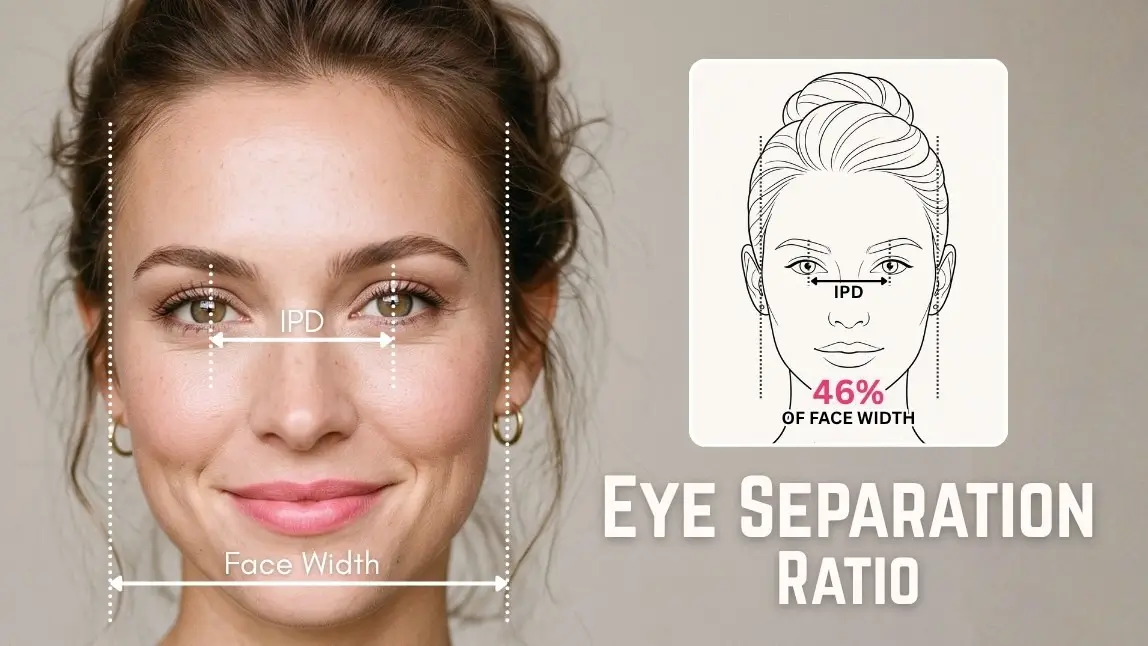
Type "eye separation ratio" into Google and you'll fall down a rabbit hole fast, facial-ratio forums,
TikTok "beauty math" explainers, and a lot of confident numbers with very little context. Somewhere in that noise is a real, peer-reviewed finding about facial proportion and perception.
This guide separates the two: what the eye separation ratio actually is, where the famous "0.46" figure comes from, why it's a much softer science than the internet makes it sound, and how modern AI facial analysis measures it with actual precision.
What Is the Eye Separation Ratio?
The eye separation ratio (often shortened to ESR or "ES ratio") is a proportion used in facial-aesthetics research to describe how far apart the eyes sit relative to the width of the face.

It's calculated by dividing interpupillary distance (IPD) — the distance between the centers of the pupils — by bizygomatic width, which is the distance between the two widest points of the cheekbones.

It's a ratio rather than a raw measurement for a simple reason: eye distance alone doesn't mean much without context. A 6.2 cm IPD looks completely different on a narrow face than on a wide one.
The Formula: How the Eye Separation Ratio Is Calculated
The formula itself is simple:
ES Ratio = Interpupillary Distance (IPD) ÷ Bizygomatic Width
Both measurements need to be taken in the same unit (millimeters work well) and ideally from a straight-on, neutral-expression photo to avoid distortion from head tilt or camera angle.
Manual measurement with a ruler or calipers is possible, but small errors in locating the exact pupil center or the widest point of the cheekbone can shift the result meaningfully — which is one reason automated, AI measurement has become the more reliable standard.

Where Does the "0.46" Number Actually Come From?
The most frequently cited figure is 0.46, and it traces back to real academic research rather than internet folklore.

A study by researchers at UC San Diego and the University of Toronto tested how attractiveness ratings changed as they digitally adjusted the horizontal distance between the eyes on the same base face. Accordingly to the research, they claim that attractiveness peaked when that distance sat at roughly 46% of the face's width.
That's the origin of the idea that 0.46 is "ideal": it isn't an arbitrary aesthetic decree, it's close to the population average, and human perception tends to favor averageness in facial proportions.
Is There Really One "Perfect" Eye Separation Ratio?
This is where a lot of online content oversimplifies. The 0.46 figure came from a specific study population, and follow-up research complicates the idea of one universal number.
A study examining 3D facial attractiveness in a Hong Kong Chinese population found that many of the "ideal" ratios and angles proposed in Western-centric literature, including several classic facial proportion benchmarks, did not correlate strongly with attractiveness ratings in that population.
In practice, that means: averageness matters more than hitting an exact digit, ideal ranges vary somewhat by the population studied, and a dozen other factors: symmetry, skin quality, facial harmony as a whole, expression, and simple personal preference, affect perceived attractiveness far more than any single ratio in isolation. Treating 0.46 as a pass/fail threshold misreads what the research actually shows.
How to Measure Your Own Eye Separation Ratio
Manual measurement
To estimate ES ratio by hand, you'll need a clear, front-facing photo taken at eye level with no head tilt. Measure the distance between pupil centers, then measure the distance between the outer edges of the cheekbones at their widest point, and divide the first number by the second.
This works as a rough estimate, but hand-measurement from a 2D photo introduces perspective distortion and landmark-placement error that can shift the result by several percentage points.
AI-powered measurement
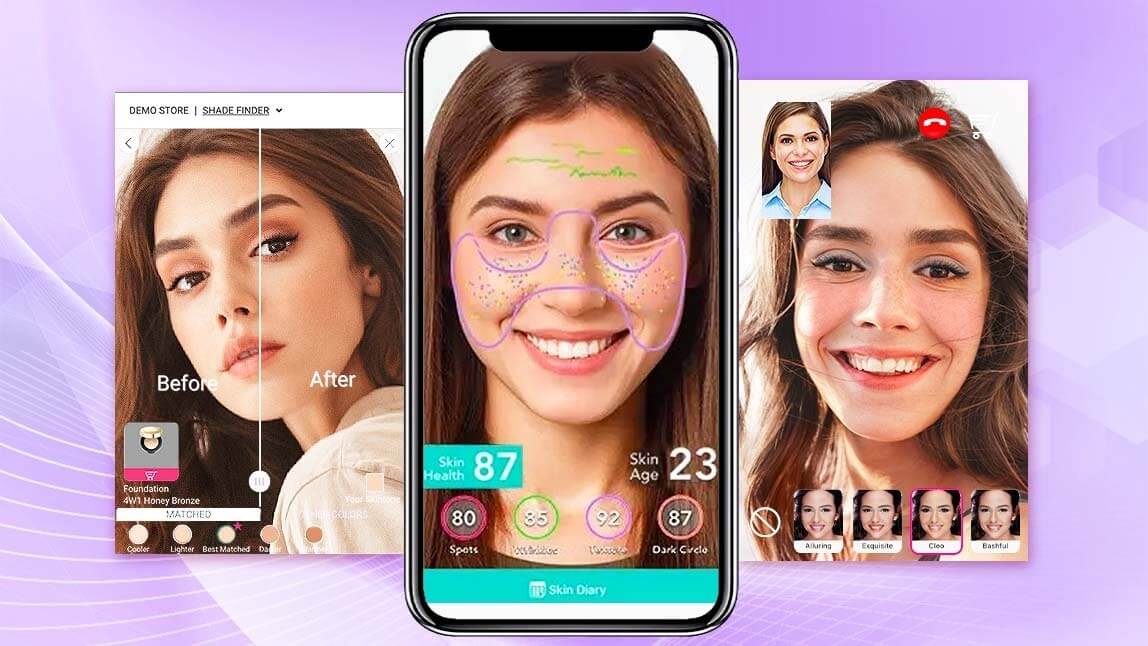
Facial analysis APIs solve the precision problem by detecting dozens of facial analysis automatically and computing geometric ratios from them rather than relying on a ruler and a guess. Perfect Corp's AI Face Analyzer analyzes 70+ facial attributes and calculates proportions like the eye separation ratio, the golden ratio score, and overall facial symmetry in seconds from a single photo, with far greater consistency than manual measurement.

Eye Separation Ratio Ranges: What They Actually Describe
Rather than a strict "good vs. bad" scale, ES ratio sits on a spectrum. Here's roughly how the research-cited ranges break down:
| ES Ratio Range | General Description | Visual Character |
|---|---|---|
| Below ~0.44 | Narrower-set eyes | Closer-set gaze; often paired with a more angular or elongated central face |
| ~0.45 – 0.47 | Average / commonly cited "ideal" range | Close to population average proportions; frequently associated with perceived balance |
| Above ~0.48 | Wider-set eyes | More open, wide-eyed impression; common in many well-known, widely considered attractive faces |
It's worth repeating: these are descriptive bands drawn from averages, not medical or aesthetic cutoffs. Plenty of widely admired faces fall outside the 0.45–0.47 band, because overall facial harmony is the product of dozens of interacting proportions, not one isolated ratio.
How Beauty and Eyewear Brands Use Eye Separation Data
Beyond the curiosity factor, ES ratio and related eye-geometry measurements have real commercial applications:
Makeup personalization
Eyeliner shape, shadow placement, and brow styling that visually balance eye spacing differ significantly between narrower-set and wider-set eyes.

Eyewear and frame matching:
Recommendation engines built on precise facial geometry can suggest frames that are proportionate to an individual's actual measurements rather than face shape alone.

Virtual try-on accuracy:
Any AR try-on experience — glasses, eyeliner, false lashes — depends on knowing exactly where the eyes sit relative to the rest of the face. Imprecise eye-landmark detection is one of the most common causes of try-on results that look slightly "off."
Explore how precise facial detection powers these use cases at Perfect Corp's AI Face Analysis, where brands can test facial analysis endpoints directly.
Can Makeup or Styling Change the Appearance of Eye Separation?
The underlying bone structure that determines ES ratio doesn't change without surgical intervention, but the perceived spacing of the eyes can be visually adjusted with technique:
- For eyes that read as closer-set: Extending eyeliner slightly outward and past the outer corner, concentrating highlighter on the inner corners, and keeping brows slightly farther apart can visually widen the perceived gap.
- For eyes that read as wider-set: Bringing eyeliner and definition slightly toward the inner corner, and shaping brows to start a touch closer to the nose bridge, can visually pull the eyes inward.
Brands offering AI-guided makeup tutorials can use a person's actual measured ES ratio to recommend the correct technique automatically, rather than asking the user to self-diagnose their eye spacing. See how this works with Perfect Corp's AI Face Analyzer showcase.

Frequently Asked Questions About Eye Separation Ratio
What is a good eye separation ratio?
Research most often cites a range of roughly 0.45–0.47 as close to population averages, based on a facial-attractiveness study that found this proportion correlated with higher attractiveness ratings.
That said, "good" is population-dependent and far from an exact science — many attractive, well-proportioned faces fall outside this specific range.
How do you calculate eye separation ratio?
Divide interpupillary distance (the distance between pupil centers) by bizygomatic width (the distance between the widest points of the cheekbones).
Both should be measured in the same unit from a straight-on photo for the most accurate estimate.
What's the difference between IPD and ES ratio?
Interpupillary distance (IPD) is a raw measurement — just the distance between the pupils, commonly used for eyewear fitting.
ES ratio divides that number by face width, turning it into a proportion that can be compared meaningfully across faces of different sizes.
Are wide-set or close-set eyes less attractive?
Not inherently. Ratio research reflects statistical averages and correlations in specific study populations — it isn't a verdict on any individual face.
Symmetry, with other features, expression, and skin quality all play a much larger role in perceived attractiveness than any single ratio.
Can AI accurately measure my eye separation ratio?
Yes. Facial analysis APIs that detect dozens of facial landmarks can calculate ES ratio far more consistently than manual measurement, since they eliminate the guesswork of locating exact pupil centers and cheekbone edges by eye.
How do beauty and eyewear brands use eye separation data?
Brands use precise eye-geometry measurements to power personalized makeup recommendations, match eyewear frames to actual facial proportions, and improve the accuracy of AR virtual try-on experiences for glasses, eyeliner, and lashes.

![AI Face Shape Analyzer for Contour & Makeup [Try It Online]](https://plugins-media.makeupar.com/smb/blog/post/2023-12-19/d5320e41-bbff-4642-9c9e-1aff2186db8c.jpg)