Author:


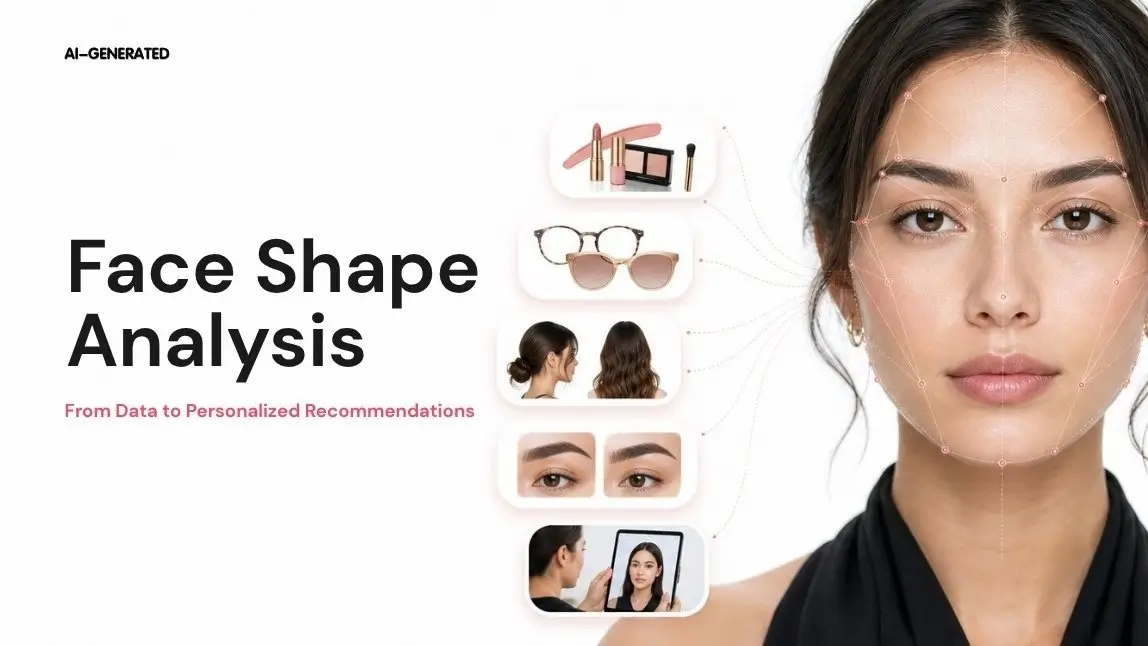
Face shape analysis uses artificial intelligence to evaluate facial structure from an image, including the relationship between the forehead, cheekbones, jawline, chin, and overall face length. For businesses, the outcome is not simply a label such as oval, round, square, heart, diamond, or oblong. It is a set of insights that can support more relevant product discovery, styling guidance, virtual try-on, and consultation experiences.
When connected to a product catalog or service workflow, AI face shape analysis helps beauty, retail, and aesthetic businesses move beyond generic browsing. A customer takes a selfie, receives an understandable result, and is guided toward products, looks, or services that fit their preferences and facial features.
What Does Face Shape Analysis Measure?
Face shape analysis identifies facial landmarks and compares proportional relationships across the face. Rather than depending on a short self-assessment quiz, AI can evaluate a range of visible attributes from a clear, front-facing image.
- Face Outline: the balance of the forehead, cheekbones, jawline, and chin.
- Face Proportions: the relationship between face length, width, and key facial regions.
- Feature Attributes: supporting details such as eye, eyebrow, lip, nose, and cheekbone shape.
- Facial Ratios: measurements such as facial thirds, fifths, and symmetry indicators.
- Personal Color: visible characteristics including skin tone, eye color, hair color, eyebrow color, and lip color.
Perfect Corp.’s AI Face Analyzer brings these elements together in one solution. It can analyze more than 100 facial attributes, including face structure, personal color, and 11 facial proportions, to provide data that businesses can use for personalized beauty and retail experiences.
From Face Shape Data to Useful Recommendations

The value of face shape analysis depends on the next step. AI provides the input, but each business decides how to connect that input to its catalog, services, content, and brand experience.
- Analyze: a customer captures or uploads a clear selfie.
- Interpret: AI identifies face shape, proportions, and optional facial or color attributes.
- Match: the business applies rules that connect those attributes to relevant products, looks, tutorials, or services.
- Guide: the customer receives a personalized recommendation, visual experience, or consultation starting point.
This approach turns a facial-analysis result into an experience with practical value. Instead of seeing a generic “shop all” page, a user can discover a contouring technique, frame shape, hairstyle, brow product, or consultation pathway that is relevant to their result.
Business Use Cases for Face Shape Analysis
Personalized Makeup Discovery

Makeup brands can use face shape analysis to personalize the way shoppers discover contour, blush, brow, eye, and lip products. For example, a round-face result may surface a tutorial focused on lifted blush placement and softly defined contour, while a square-face result may feature techniques intended to soften the visual appearance of angles.
The objective is not to “correct” a person’s face. It is to offer styling options that help users explore looks aligned with their own preferences. Businesses can pair face-shape insights with virtual try-on so customers can preview recommended shades and techniques on their own faces before purchasing.
Eyewear, Hair, and Accessory Guidance

Face shape analysis is also useful beyond makeup. Eyewear retailers can use it to recommend frame families that create visual balance—for example, angular frames for round faces or softer, curved frames for square faces. Hair brands and salons can surface haircut inspiration and styling content, while accessory retailers can guide customers toward earring, neckline, or headwear options.
In each case, the analysis creates a more consultative browsing experience. It gives users a clear reason to engage and gives retailers a structured way to organize recommendations around facial characteristics and style preferences.
Personalized Digital and In-Store Consultations

For consultation-led businesses, face shape analysis can create a visual starting point for a more informed conversation. In a beauty counter, salon, medspa, or aesthetic practice, a consultant can use a customer’s analysis result to discuss style goals, product options, or relevant services in real time.
Facial proportions and symmetry should be used as descriptive references, not as a definition of attractiveness. Perfect symmetry is uncommon, and individual variation is normal. For more context, read Perfect Corp.’s guide to Facial Symmetry and AI Analysis .
Where Face Shape Analysis Fits in the Customer Journey
| Customer Touchpoint | How Face Shape Analysis Can Help |
|---|---|
| Homepage or Campaign Landing Page | Turn a “find your look” campaign into an interactive entry point that starts with a selfie. |
| Product Discovery Flow | Recommend relevant makeup, eyewear, hair, brow, or accessory categories based on the user’s result. |
| Mobile App Onboarding | Create a personalization profile that can inform future product and content recommendations. |
| In-Store Consultation | Give beauty advisors a visual report that supports confident, individualized product education. |
| Post-Purchase Engagement | Send tailored tutorials, makeup looks, styling ideas, and product-replenishment content after a customer opts in. |
What to Consider Before Implementation
A successful face shape analysis experience should be useful, transparent, and inclusive. Before launching, businesses should consider the following:
- Data Quality: choose technology that has been trained and tested across diverse skin tones, ages, genders, and face shapes.
- Photo Guidance: explain how to capture a clear, front-facing, well-lit image so users can achieve reliable results.
- Privacy and Consent: clearly state why a photo is required, how it is processed, and how long it is stored.
- Recommendation Design: connect results to genuinely relevant products, educational content, or services rather than generic output.
- Inclusive Language: frame insights as personalized options and avoid beauty scores, diagnoses, or claims that define an “ideal” face.
Perfect Corp.’s AI Face Analyzer is trained on more than 100,000 diverse face samples and supports face-attribute, personal-color, and ratio analysis across web modules, APIs, mobile SDKs, and in-store consultation experiences.
See Face Shape Analysis From the Customer’s Perspective
The best way to understand face shape analysis is to try the experience yourself. Try Perfect Corp.’s Free AI Face Analyzer Online to see how a quick photo can generate insights into face shape, facial features, personal color, symmetry, and facial proportions, alongside personalized recommendations for hairstyles, eyewear, and makeup.
The same technology can be deployed as a web module, API, mobile SDK, or in-store consultation tool. To explore a face-analysis experience designed around your catalog, customer journey, or service workflow, Contact Perfect Corp.’s Sales Team .
Frequently Asked Questions
What Is Face Shape Analysis?
Face shape analysis uses AI to evaluate facial structure and proportions from a photo. It can identify face-shape categories and related facial attributes that businesses use to deliver personalized product, styling, and consultation recommendations.
How Do Businesses Use AI Face Shape Analysis?
Businesses can connect face-shape results to product catalogs, virtual try-on experiences, educational content, and consultant workflows. Common applications include personalized makeup, eyewear, hairstyle, brow, accessory, and aesthetic-consultation recommendations.
Is Face Shape Analysis the Same as a Beauty Score?
No. Responsible face shape analysis provides facial-structure and styling insights; it should not judge attractiveness or define an ideal face. Its purpose is to support more relevant, inclusive, and useful personalization.