 Author:
Scleral show is when the white part of the eye (the sclera) is visible above or below the iris more than usual, usually because the eyelid sits lowe, or higher, than it should.
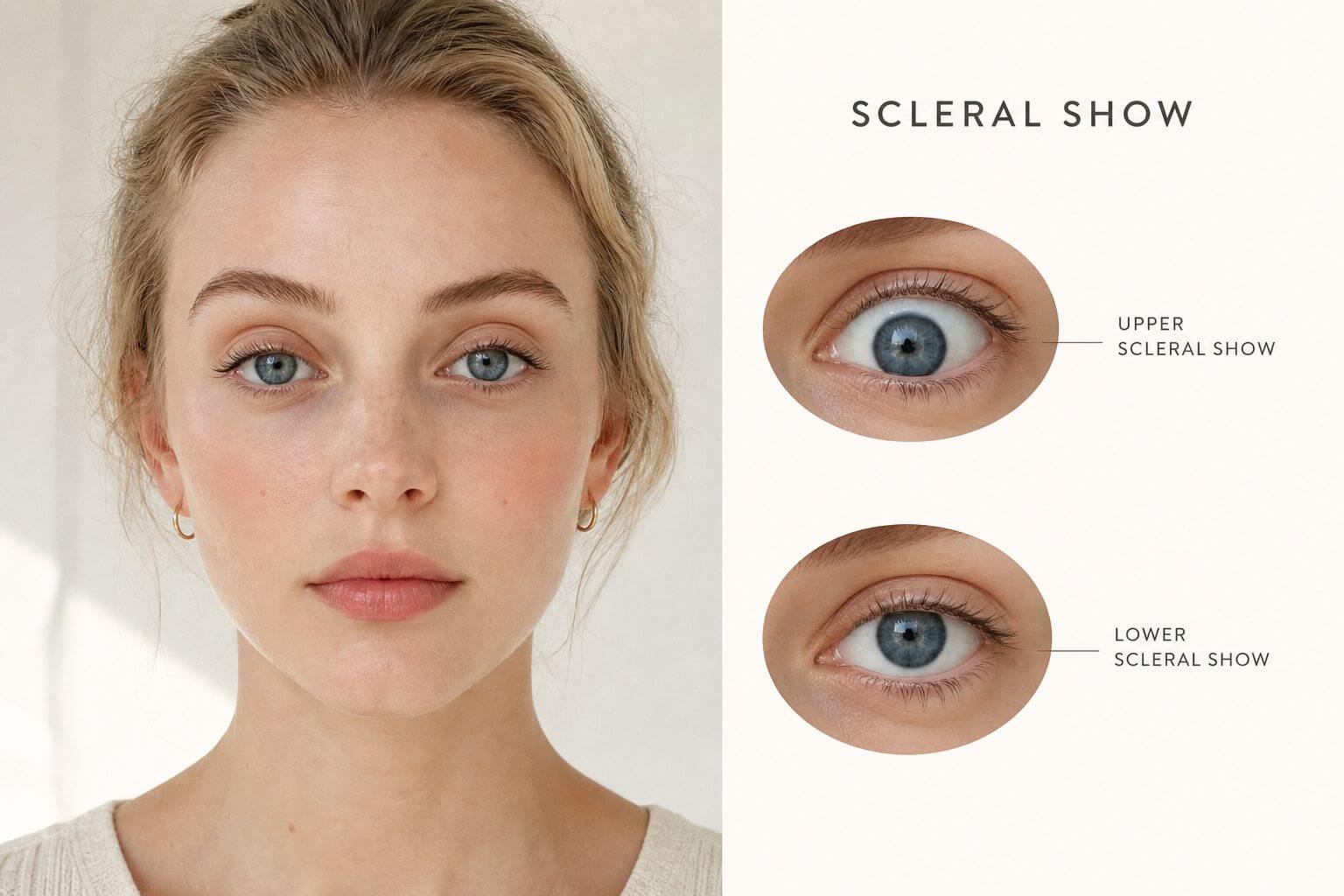
It can be a natural trait, a sign of aging, or a side effect of eyelid surgery. Some people love the wide-eyed look. Others want it gone. Either way, understanding what's actually happening in your eyelid structure is step one.
What Is Scleral Show, Exactly?
Ophthalmologists and plastic surgeons use "scleral show" as a clinical measurement: the visible strip of sclera between the eyelid margin and the edge of the iris (the limbus) when you look straight ahead. It's not a disease. It's a position — the eyelid isn't cradling the eyeball the way a "textbook" eyelid would.
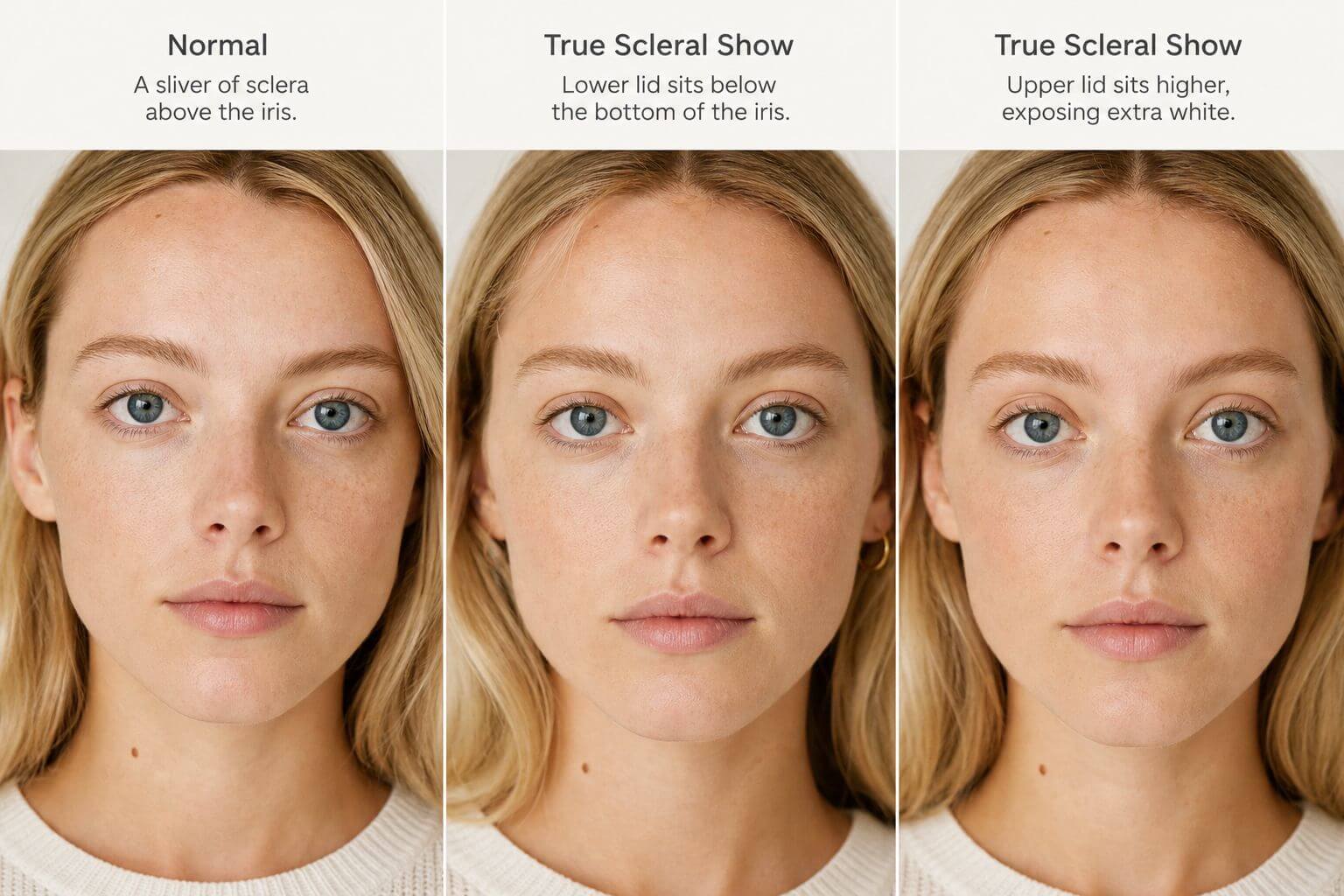
Most people show a sliver of sclera above the iris when they open their eyes wide. That's normal. What clinicians flag as true scleral show is when the lower lid drops below the bottom of the iris, or the upper lid sits noticeably higher than expected, exposing extra white year-round — not just during a wide-eyed expression.
Scleral Show vs. Sanpaku Eyes: Same Thing, Different Lens
You'll see "scleral show" used in medical journals and "sanpaku eyes" used almost everywhere else — TikTok, Pinterest, Japanese physiognomy forums. They describe the identical physical trait: extra sclera visible above or below the iris. The difference is cultural framing, not anatomy.
- Scleral show — the clinical term, used by ophthalmologists and oculoplastic surgeons to describe eyelid position and measure surgical outcomes.
- Sanpaku eyes ("three whites") — a term rooted in Japanese face-reading tradition, where extra visible white is read as a personality or fortune signal. Modern beauty culture has mostly stripped the superstition and kept the aesthetic label.
Neither term implies illness. Whether it reads as "striking" or "tired" depends entirely on the rest of the face and how much sclera is showing.
(img)
Upper vs. Lower Scleral Show: What's the Difference?
| Type | Where the sclera shows |
|---|---|
| Upper scleral show | Above the iris |
| Lower scleral show | Below the iris |
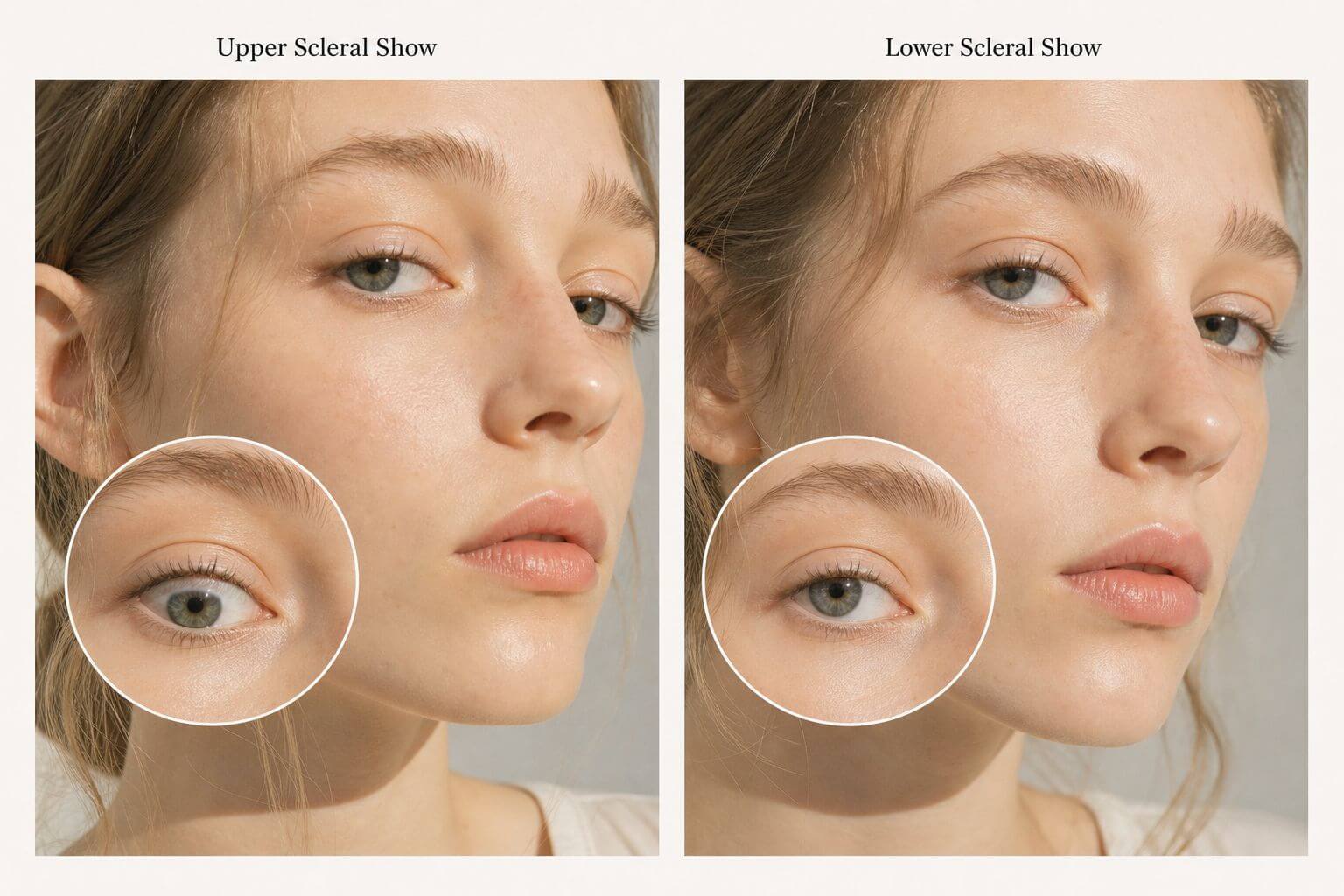
Lower scleral show is the far more common complaint, especially among people who've had — or are considering — eyelid surgery. It's also the type most searched, since it's the one people actively want corrected.
What Causes Scleral Show?
| Cause | How it happens |
|---|---|
| Genetics / natural anatomy | Some people are simply born with a shorter vertical eyelid or a flatter orbital rim, exposing more sclera from birth. |
| Aging | Skin and muscle laxity let the lower lid drift downward; the midface can also descend and pull the lid with it. |
| Blepharoplasty complications | Removing too much skin or fat during eyelid surgery can prevent the lid from fully covering the eyeball afterward — one of the most common revision-surgery complaints. |
| Thyroid eye disease | Graves' disease and related conditions can cause eyelid retraction and a "staring" appearance from upper scleral show. |
| Facial nerve weakness / paralysis | Reduced muscle tone around the eye can stop the lid from closing or sitting properly. |
| Trauma | Scarring or tissue damage near the eyelid can pull it out of position. |
*This is for informational purposes only. For medical advice or diagnosis, consult a professional.
Is Scleral Show Bad for Your Eyes?
Cosmetically, scleral show is neutral — it's a look, not a diagnosis. Functionally, it can matter. When the lid can't fully cover the eyeball, the exposed surface dries out faster. That can lead to:
- Chronic dryness, grittiness, or a burning sensation
- Increased blinking or excessive tearing (a reflex to compensate for dryness)
- Higher risk of irritation or corneal exposure in more severe cases
Mild scleral show usually causes no symptoms at all. If you're noticing dryness or discomfort alongside visible sclera, that's worth a conversation with an eye doctor or oculoplastic surgeon — not just an aesthetic call.
Is Scleral Show Attractive?
This is where the internet splits into two camps. A touch of lower scleral show reads as youthful, wide-eyed, and doll-like, it's part of what makes "doe eyes" so sought-after in makeup and filler trends. Push past a certain threshold, though, and the same trait reads as fatigue, sadness, or an unintentionally startled expression. Where that line sits is subjective, asymmetric between faces, and honestly hard to judge from a mirror.

That subjectivity is exactly why so many people hesitate before booking a consultation, they're not sure if fixing it will look "refreshed" or just look different.
This is where a visual preview earns its keep. Perfect Corp.'s AI-powered eye shape tools already let brands show shoppers how they'd look with different doe eyes–style enhancements — the same underlying tech applies directly to eyelid position simulation.

How Do You Know If You Have Scleral Show?
A simple self-check: look straight ahead into a mirror in neutral lighting, relaxed expression — not wide-eyed, not squinting. If you can see a visible gap of white between your lower lid and the bottom of your iris, you have some degree of lower scleral show.
Clinicians formalize this with a measurement called MRD2 (margin reflex distance 2) — the distance from the light reflex in your pupil to your lower eyelid margin. A larger-than-average MRD2 confirms lower eyelid retraction.
*This is for informational purposes only. For medical advice or diagnosis, consult a professional.
See Before You Commit: How AI Eye Lift Simulators Help
The biggest hesitation with any eyelid procedure isn't the recovery — it's not knowing what you'll actually look like afterward. An AI eye lift simulator solves that by generating a realistic preview of adjusted eyelid position, canthal tilt, and scleral exposure on your own photo, before any filler or scalpel is involved.
Perfect Corp.'s API already models eye-area filler and structural changes across facial zones, giving brands and practices a way to let patients try before they buy — with zero commitment and zero downtime.
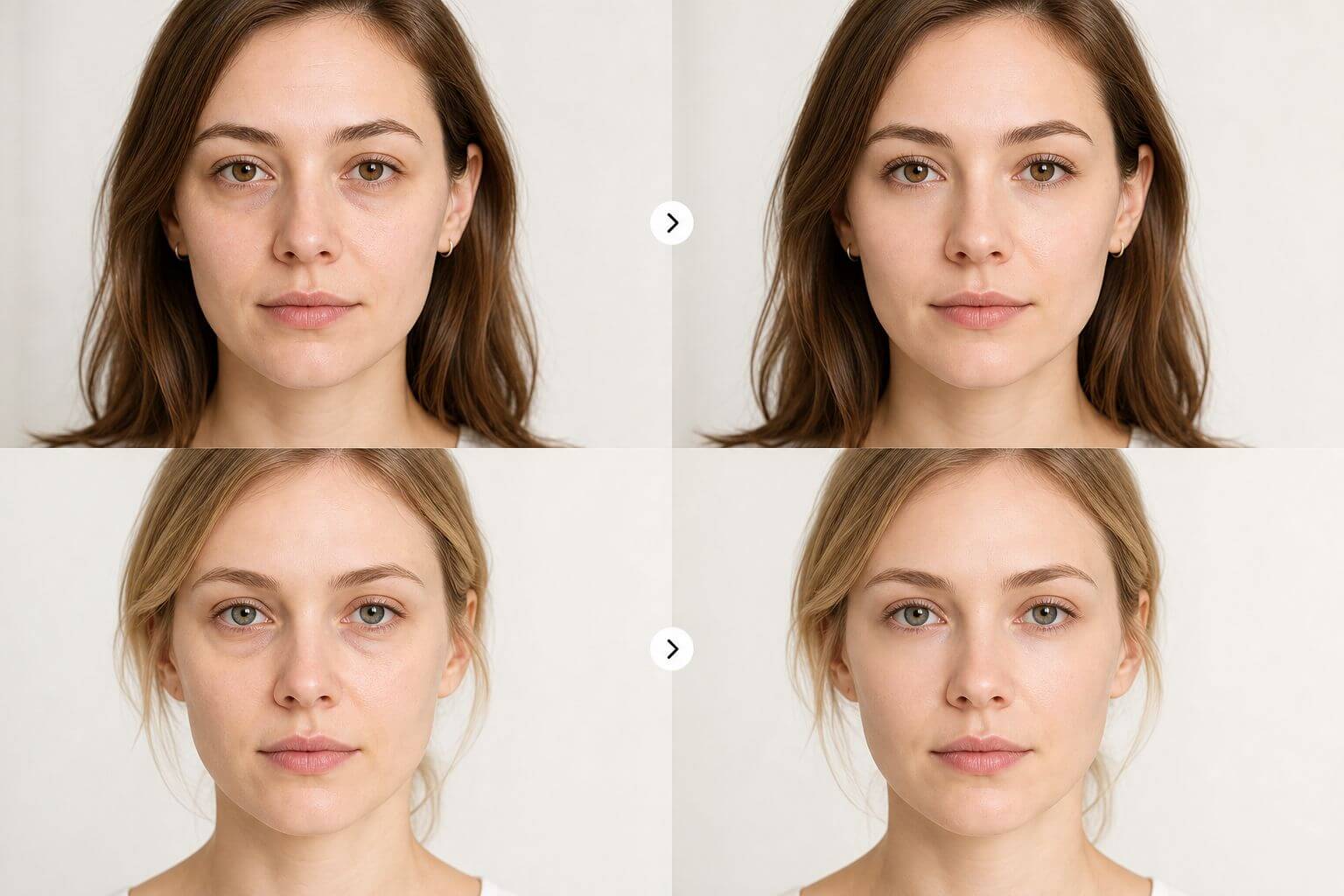
For clinics and medspas, this isn't just a nice-to-have.

Patients who can see a believable "after" convert into consultations at a noticeably higher rate than those relying on verbal description alone
How Is Scleral Show Treated?
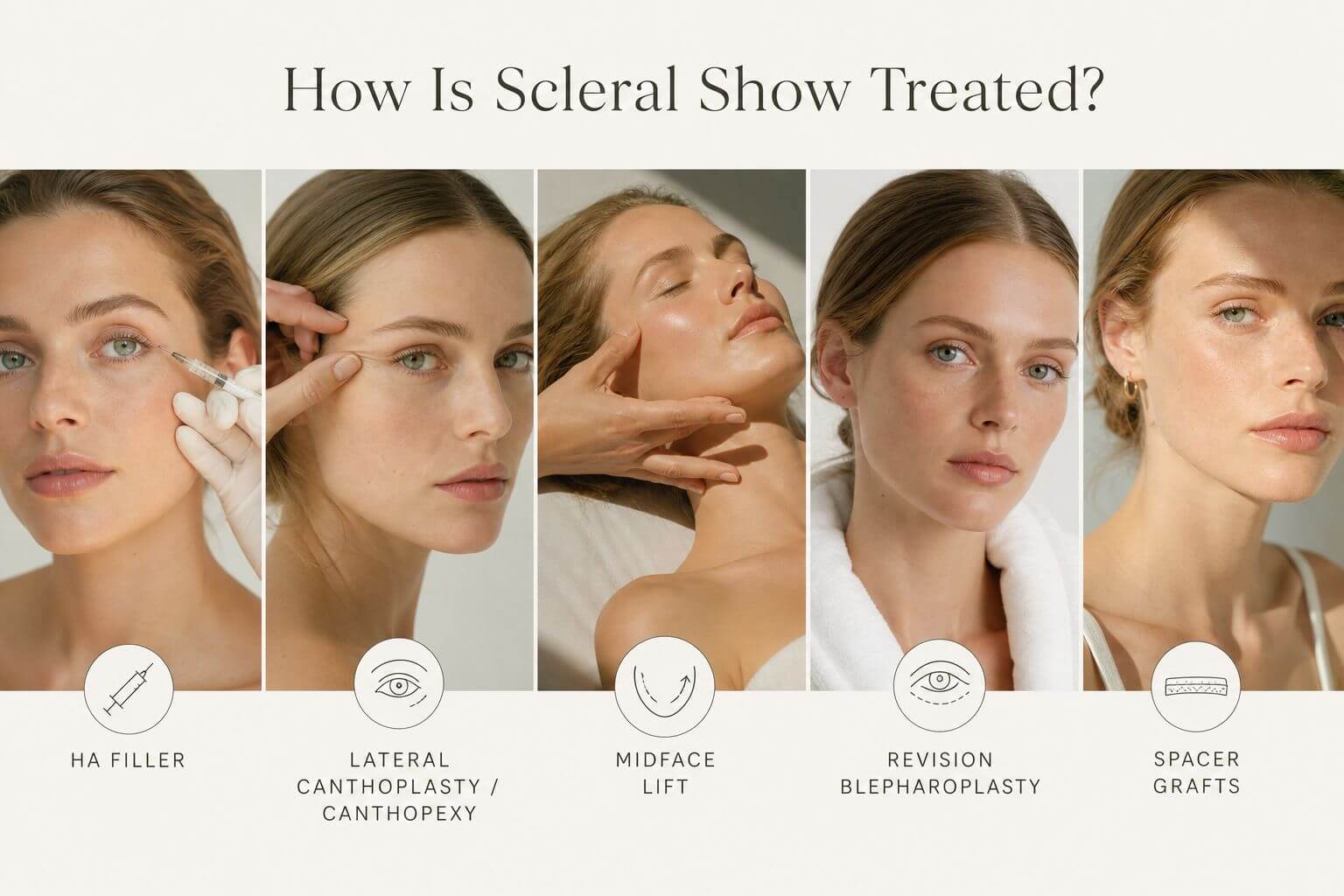
| Approach | Best for | Downtime |
|---|---|---|
| Hyaluronic acid (HA) filler | Mild cases, non-surgical candidates, or as a bridge before surgery | Minimal — bruising possible |
| Lateral canthoplasty / canthopexy | Moderate to severe lower lid retraction | 1–2 weeks |
| Midface lift | Age-related descent pulling the lid down | 2–3 weeks |
| Revision blepharoplasty | Scleral show caused by a previous eyelid surgery | 1–3 weeks, case-dependent |
| Spacer grafts | Severe retraction requiring structural support | 2–4 weeks |
There's no universal fix — the right approach depends on whether the cause is structural, age-related, or surgical. That's exactly why a consultation (and a preview) beats guessing from a search result.
Frequently Asked Questions
Is scleral show the same as sanpaku eyes?
Yes, anatomically. "Scleral show" is the clinical term; "sanpaku eyes" is the cultural/aesthetic term rooted in Japanese physiognomy. Both describe visible sclera above or below the iris.
Can scleral show go away on its own?
Mild, genetic scleral show typically doesn't change without intervention. Scleral show caused by swelling (post-surgery, injury) can improve on its own as inflammation resolves — usually within weeks to a few months.
Can you fix scleral show without surgery?
Yes, in mild-to-moderate cases. Hyaluronic acid filler placed along the lower lid–cheek junction can support the eyelid and reduce visible sclera without an incision. More significant retraction usually needs a surgical approach.
Does scleral show get worse with age?
Often, yes. Skin and muscle laxity plus midface volume loss both tend to pull the lower lid downward over time, which is why lower scleral show becomes more common — and more noticeable — with age.
Is scleral show a sign of a health problem?
Usually not. It's most often anatomical or age-related. In some cases it's linked to thyroid eye disease or facial nerve issues, so new or sudden scleral show — especially with other symptoms — is worth a medical evaluation.
How much does scleral show correction cost?
Non-surgical filler approaches are typically priced per session, similar to other under-eye filler treatments. Surgical correction (canthoplasty, midface lift, revision blepharoplasty) varies widely by complexity and geography — a consultation is the only reliable way to get a number specific to your case.