 Author:



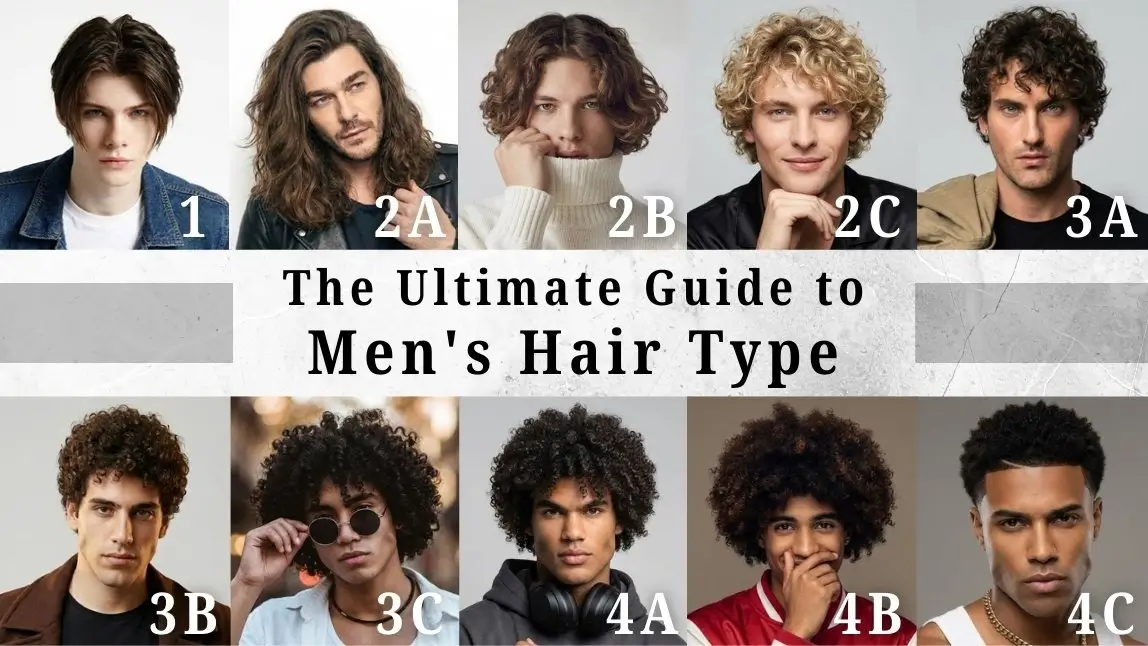
Men's hair falls into four main types: Type 1 (straight), Type 2 (wavy), Type 3 (curly) and Type 4 (coily). Each type splits into A, B and C subtypes based on how fine or tight the pattern is, which gives 12 hair types from 1A to 4C.
This guide covers every men's hair type with a chart and pictures, a quick test to tell wavy from curly hair, and how to find your type at home or with an AI hair type detector.
Table of Contents
- Men's Hair Type Chart (1A to 4C)
- Type 1: Straight Hair (1A, 1B, 1C)
- Type 2: Wavy Hair (2A, 2B, 2C)
- Type 3: Curly Hair (3A, 3B, 3C)
- Type 4: Coily Hair (4A, 4B, 4C)
- Wavy vs. Curly vs. Coily Hair in Men
- How to Find Your Hair Type as a Man
- Hair Type vs. Hair Texture vs. Density
- How AI Hair Type Detection Works
- FAQ
- Conclusion
Men's Hair Type Chart (1A to 4C)
The most widely used hair type chart is based on the Andre Walker Hair Typing System. The number (1 to 4) describes the shape of the strand, from straight to coily. The letter (A to C) describes the width or tightness of the wave, curl or coil within that type.

Use this quick-reference table to compare all 12 men's hair types at a glance:
| Hair type | What it looks like | Main styling need |
|---|---|---|
| 1A | Fine, flat, pin-straight | Volume and lightweight products |
| 1B | Straight with medium thickness and some body | Light hold; holds a side part or quiff |
| 1C | Straight, coarse and thick, may show a slight bend | High-hold clay to control stubborn strands |
| 2A | Loose, stretched-out S waves, flat at the roots | Texture without weight (sea salt spray) |
| 2B | Defined S waves from mid-length | Frizz control at the crown |
| 2C | Thick, deep waves from the root, near-spirals | Moisture and anti-frizz cream |
| 3A | Large, shiny loops | Light cream for definition |
| 3B | Springy ringlets with volume | Hydration and curl definition |
| 3C | Dense, tight corkscrews | Gentle detangling and conditioner |
| 4A | Defined S-shaped coils | Leave-in conditioner and oils |
| 4B | Sharp Z-shaped bends, fluffy look | Protective styling to limit breakage |
| 4C | Tightest coils, little visible pattern, most shrinkage | Intense moisture and gentle handling |
Type 1: Straight Hair (1A, 1B, 1C)
Type 1 hair is straight, with no visible curl pattern. Scalp oil travels easily down a straight strand, so this type can look greasy faster and often lacks volume.

1A Hair Men: Fine and Flat
1A hair is the finest and flattest straight type. It is very soft but struggles to hold a curl or a style, and it is generally considered the rarest hair type. Lightweight volumizing products work better than heavy pomades, which weigh it down.
1B Hair Men: Medium and Versatile
1B hair is straight with medium thickness and a little more body than 1A. It is widely considered the most common hair type. It holds a style relatively well and suits a simple side part or a messy quiff.
1C Hair Men: Coarse and Resistant
1C hair is straight but coarse and thick, and it may show a slight bend. It can be hard to manage and tends to stick out when cut too short. High-hold clays help tame stubborn strands. For cut ideas by straight hair type, see these haircuts for men with straight hair.
Type 2: Wavy Hair (2A, 2B, 2C)
Type 2 hair sits between straight and curly. The strands form an "S" shape but do not close into full loops. Wavy hair gives men natural volume and texture, but it is prone to frizz, especially in 2B and 2C.

2A Hair Men: Loose, Tousled Waves
2A hair is fine, with a loose, stretched-out wave that stays flat at the roots. It is easy to straighten or curl. Sea salt sprays enhance the natural beachy texture without weighing it down.
2B Hair Men: Defined Waves
2B hair has a more defined "S" pattern that starts from mid-length. It can resist styling and tends to frizz at the crown. 2B is still wavy, not curly, because the waves do not form a full loop.
2C Hair Men: The Borderline Curl
2C hair is thick and coarse, with deep waves that start at the root and can almost form loose spirals. It needs moisture and anti-frizz creams to keep the waves defined.
Is your hair 2A, 2B or 2C? Look at where the wave starts. Waves that begin near the ends point to 2A, waves from mid-length point to 2B, and deep waves from the root point to 2C.
Type 3: Curly Hair (3A, 3B, 3C)
Curly hair types in men range from big, loose loops to tight corkscrews. Dryness is the main challenge for Type 3, because scalp oils struggle to travel along the twists of the strand.

3A Hair Men: Loose Curls
3A curls are large and shiny, with loops roughly the width of sidewalk chalk. Light creams define the curl without leaving a stiff, crunchy gel cast.
3B Hair Men: Springy Ringlets
3B hair forms springy ringlets about the width of a marker. This texture has a lot of volume and noticeable shrinkage, so regular hydration is essential.
3C Hair Men: Tight Corkscrews
3C hair is densely packed with tight corkscrews about the width of a pencil. It has a lot of volume and can break if handled roughly, so detangle it wet with plenty of conditioner.
Type 4: Coily Hair (4A, 4B, 4C)
Type 4 hair is most common among men of African descent. It is naturally dry, with a spongy texture that can be soft and fine or coarse and wiry. It shrinks significantly when dry, so it often looks much shorter than its real length.

4A Hair Men: Defined Coils
4A hair shows a defined "S" pattern when stretched, similar to 3C but tighter. It holds moisture better than other Type 4 hair but still needs leave-in conditioners and oils to stay elastic.
4B Hair Men: The "Z" Pattern
4B hair bends in sharp angles like the letter "Z". It looks fluffy and has a less defined pattern than 4A. Protective styles help prevent breakage.
4C Hair Men: The Tightest Texture
4C hair is similar to 4B but more tightly coiled, often without a visible pattern unless viewed up close. It has the most shrinkage of all hair types and needs intense moisture and gentle handling.
Wavy vs. Curly vs. Coily Hair in Men

The boundaries between types cause most of the confusion. These checks help tell them apart:
- Straight vs. wavy (1C vs. 2A): 1C hair may bend slightly, but it does not form a repeating "S". If the bends repeat along the strand, the hair is 2A.
- Wavy vs. curly (2C vs. 3A): wavy hair forms "S" bends that stay open. Curly hair closes into full loops or spirals.
- Curly vs. coily (3C vs. 4A): curly hair keeps a clear spiral with shine. Coily hair forms tighter coils or zigzags, feels drier and shrinks much more.
Short haircuts make this harder, because a pattern needs some length to show. If the sides are faded, check the longest section on top.
How to Find Your Hair Type as a Man
There are two common ways to identify a men's hair type: a manual air-dry test or an AI hair type detector.
1. The Air-Dry Test

- Wash your hair and let it air-dry completely without any product.
- Look at the longest section in a mirror, or check a single shed strand against a white background.
- Compare the pattern with the chart above.
Wet hair stretches waves and curls, and heat styling or heavy products can hide the natural pattern, so always check dry, unstyled hair. Many men also have more than one pattern, for example wavier hair at the crown and straighter hair at the nape. In that case, go by the dominant pattern.
2. AI Hair Type Detector

- Open the AI Hair Type Analyzer and enable the device camera or upload a photo.
- Let the AI scan the hair.
- Get the result, including in-between types such as 1 Straight to 2A Slight Wavy.
The AI analyzes whatever hair is visible in the photo, regardless of gender. For very short cuts, results are most reliable when there is enough length to show the natural pattern.
AI Hair Type Analyzer
Scan a photo or live camera view to identify 10 hair types and the in-between results.
Hair Type vs. Hair Texture vs. Density
Hair type is often confused with other hair traits. Each one describes something different:
- Hair type: the curl pattern of the strand, from straight to coily (1A to 4C).
- Hair texture: the width of a single strand, from fine to medium to coarse.
- Hair density: how many strands grow on an area of the scalp, which can be checked with AI hair density analysis.
Two men with the same curl pattern can still need different products, because fine hair can be dense and coarse hair can be sparse.
How AI Hair Type Detection Works
Quizzes rely on self-assessment, which often leads to guesses between neighboring types. Here is why AI hair type detection is more consistent. A deeper comparison is available in this guide on AI hair analysis vs. hair type quizzes.
7,000+ Training Images for Reliable Hair Type Classification
The AI is trained on over 7,000 diverse images of different hair types, colors and textures. This gives consistent, data-driven results instead of a best guess.
Multi-Texture Detection

Traditional quizzes force users into a single box, while the AI detects multiple textures at once. It classifies hair into 10 hair types, from 1 (straight) to 4C (extremely coily), and returns 9 in-between results, such as 2C to 3A (thick wavy to loose curls). This captures hair that sits between two types, like 3A curls at the root and 3B at the ends, which a multiple-choice quiz would miss.
Instant Results Anywhere
The detector uses computer vision and machine learning to analyze a photo or live scan of real hair. This removes subjectivity and returns consistent results in seconds, online or in-store.
Hair Type AI for Brands and Retailers
For hair care brands, barbershops and retailers, AI Hair Type Analysis turns a photo into personalized product recommendations. Combined with AI Hair Length Detection and AI Hair Frizziness Detection, it supports a complete hair assessment. For example, a brand can recommend a defrizzing serum because the AI detected high frizz on a Type 2A user. More examples are in this guide to custom hair care recommendations with AI, and developers can review the AI Hair API.
Perfect Corp.'s platform and cloud infrastructure are ISO/IEC 27001:2022 certified, and data processing follows GDPR principles. Details are on the compliance page.
FAQ
How do I identify my hair type as a male?
Wash your hair, let it air-dry without products, and compare the pattern on the longest section with a hair type chart. Straight hair is Type 1, "S" waves are Type 2, full loops are Type 3 and tight coils or zigzags are Type 4. An AI hair type detector can confirm the result from a photo.
What is the most common hair type for men?
Type 1B, straight hair with medium thickness, is widely considered the most common hair type.
What is the rarest hair type for men?
Type 1A, very fine and pin-straight hair, is generally considered the rarest hair type.
Is my hair 2A, 2B or 2C?
Check where the waves start. 2A waves are loose and appear near the ends, 2B waves are defined from mid-length, and 2C waves are deep and start at the root.
Can men have more than one hair type?
Yes. Different areas of the head often show different patterns, such as 2C waves on top and 3A curls underneath. Care and styling usually follow the dominant pattern.
Can a man's hair type change?
Yes. Hair type can shift over time with age and hormonal changes, and heat or chemical damage can loosen a natural wave or curl.
What is the most attractive hair type for guys?
No single hair type is the most attractive. A cut that suits the face shape and works with the natural pattern, plus the right products, makes a bigger difference than the type itself.
Conclusion
Hair types in men range from 1A straight to 4C coily, and each one needs different cuts and care. Identifying the exact type, with the air-dry test or an AI detector, is the first step to choosing the right products and styles.

For brands, AI Hair Type Detection analyzes texture, thickness and curl pattern across 10 hair types and 9 in-between results, so every shopper gets recommendations that match their real hair.
Personalized hair care recommendations
Identify 1A to 4C curl patterns and mixed hair types, and recommend the right products online or in-store.
This article was edited and reviewed by the Perfect Corp. editorial team. Welcome to contact us or give us more suggestions.