 Author:



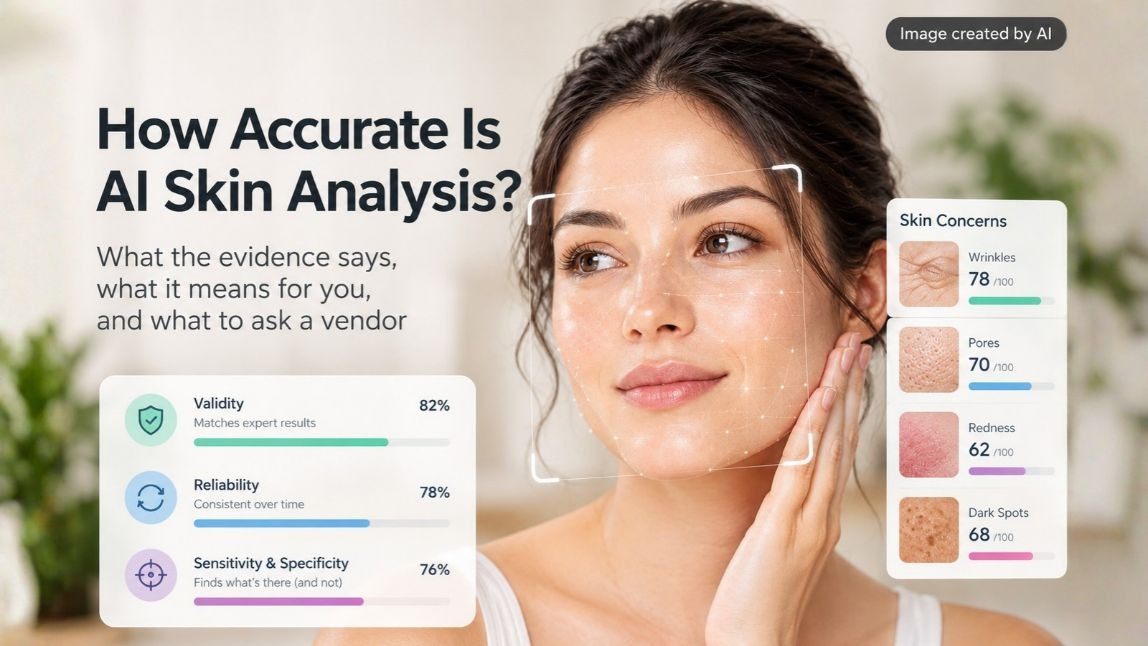
Images generated by AI
Every vendor in this category quotes a percentage, and almost none of them say what it measures. That is the real problem with the question of how accurate AI skin analysis is: accuracy is not one property, the published evidence is more nuanced than any headline figure, and the number that actually determines whether these tools are useful to you is usually not the one on the marketing page.
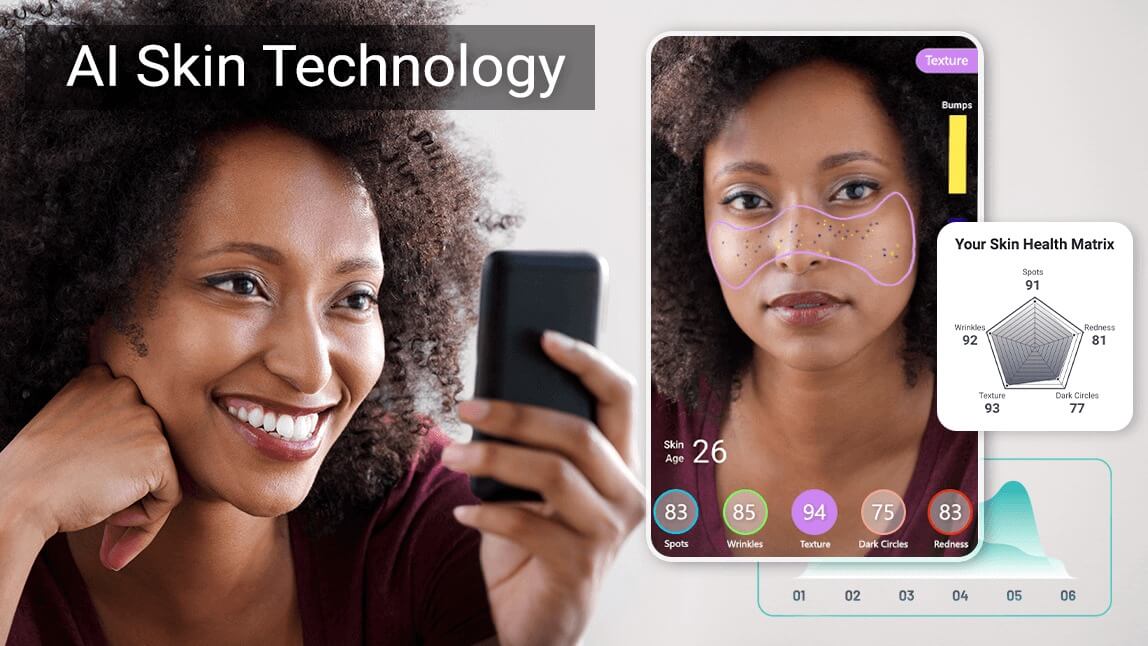
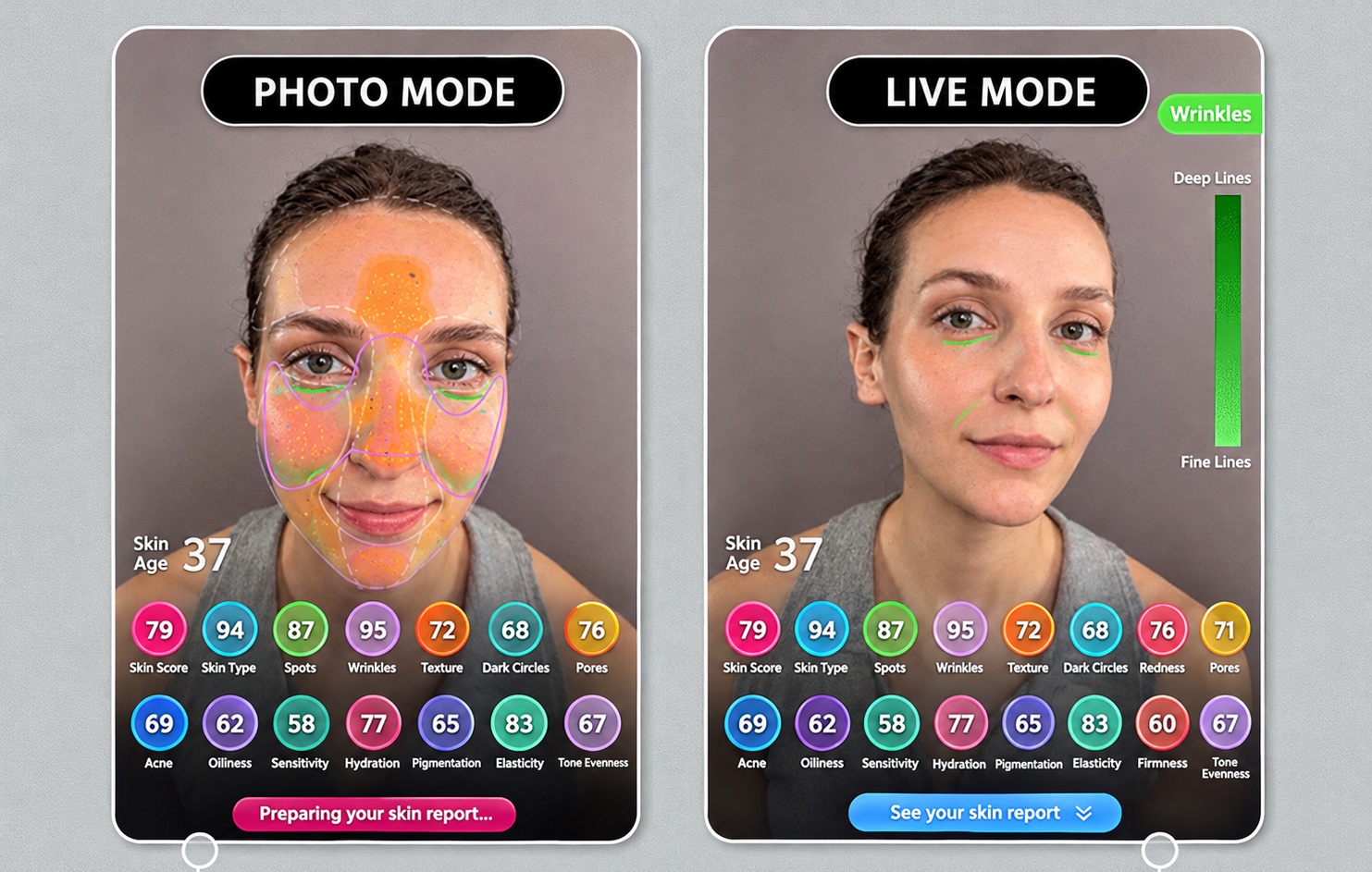
This guide separates the three things people mean by accuracy, reviews what the peer reviewed literature actually reports, covers the skin tone question honestly, and sets out what to ask a vendor. If you want to see what the output looks like before reading about how it is validated, the AI skin analysis demo returns 28 skin diagnostics across 16 skin concerns from a single photo, grouped per concern, which is the format the discussion below assumes.
What this guide covers
What Does Accuracy Actually Mean Here?
Three distinct properties get collapsed into one word, and they answer different questions.
| Property | The question it answers | How it is measured | Why it matters to you |
|---|---|---|---|
| Agreement or validity | Does the system reach the same conclusion as an expert? | Correlation or agreement against clinician grading | Determines whether a single result is trustworthy |
| Reliability or consistency | Does it give the same answer twice on the same skin? | Test to retest, usually an intraclass correlation | Determines whether progress tracking means anything |
| Sensitivity and specificity | Does it catch what is there without flagging what is not? | Against a reference standard, per concern | Matters most for screening style use cases |
For a consumer or retail skin analysis product, reliability usually matters more than agreement, which is the opposite of most people's intuition. A system that reads consistently three points below a dermatologist on every scan is still perfectly capable of telling a customer their texture improved over six weeks. A system that agrees with a dermatologist on average but swings fifteen points between two photographs of the same face cannot do that at all.
So when a vendor quotes one number, the first question is which of these three it is. The second is against what reference, and the third is on whose faces.
What Does the Peer Reviewed Evidence Say?
The strongest recent evidence on image based AI assessing skin severity comes from a 2025 systematic review and meta analysis in the British Journal of Dermatology, which pooled results across 45 studies. It reported pooled sensitivity of 80.5 percent and specificity of 96.2 percent, with a pooled reliability coefficient of 78 percent. Performance varied sharply by condition, from roughly 92 percent sensitivity for atopic dermatitis down to about 72 percent for psoriasis.
Equally important is what the authors said about the quality of the evidence. Thirty five of the 45 studies did not report skin tone at all, only one used a prospective design, and 14 were judged to carry a high risk of bias.
The authors concluded that image based AI can assess severity accurately and reliably, while calling for better transparency in data reporting and for prospective, high quality clinical studies using objective reference standards. They also cautioned that heterogeneity across studies was high enough that the pooled accuracy figures should be generalised carefully.Cai ZR, Kim J, Rezaei SJ, Chen ML, Touma F, Zhu C, Onyeka S, Fonjungo F, Omiye JA, Krakowski I, Nwandu L, Biossonnette R, Ko JM, Linos E. Assessing the performance of artificial intelligence models in evaluating inflammatory skin disease severity: a systematic review and meta-analysis. British Journal of Dermatology, 2025;193(5):847 to 855. doi:10.1093/bjd/ljaf250
One caveat before anyone transfers those numbers across. That review covers inflammatory skin disease severity, which is a clinical task. Cosmetic skin analysis scores concerns like texture, pores and radiance, which are different problems with different reference standards. The literature is useful as a guide to how this class of technology performs and where it is weakest, not as a direct accuracy figure for a consumer scanner.
How Does AI Compare With Dermatologists?
Better than non specialists, and roughly comparable to experts, with heavy caveats about study design.
A systematic review and meta analysis published in npj Digital Medicine, covering 53 comparative studies of AI versus clinicians for skin cancer diagnosis, found pooled sensitivity of 87.0 percent and specificity of 77.1 percent for AI, against 79.8 percent and 73.6 percent for clinicians overall. The gap was widest against generalists, where AI reached 92.5 percent sensitivity compared with 64.6 percent. Against expert dermatologists it narrowed to 86.3 percent versus 84.2 percent sensitivity.
The reviewers concluded that the difference against expert dermatologists, while statistically significant, was minimal in practical terms, and that the most promising direction is collaboration between clinicians and AI rather than replacement. They noted that 94.3 percent of the included studies were retrospective and that datasets frequently lacked diversity in skin types and ethnic groups.A systematic review and meta-analysis of artificial intelligence versus clinicians for skin cancer diagnosis, npj Digital Medicine, 2024
Two translations for anyone applying this to a cosmetic product. First, the realistic claim is that a well built system performs in the region of a trained assessor on the specific visible features it was built to score, not that it replaces a consultation. Second, retrospective studies on curated images set an upper bound. Real performance on a customer's bathroom selfie will be lower than any published figure, for reasons covered further down.
How Accurate Is Human Assessment, for Comparison?
This is the comparison that gets skipped, and it reframes the whole question.
Human grading of skin is itself imperfect and variable. The British Journal of Dermatology meta analysis above reported a pooled reliability coefficient of 78 percent for AI severity grading, which is a reminder that the benchmark being measured against is not a perfect instrument either. Clinical dermatology handles this by using narrow validated scales, reference photographs and trained raters, precisely because unaided human judgement of skin severity drifts.
Consumer self assessment is substantially less reliable again. People routinely misidentify their own skin type, and self reported Fitzpatrick classification is a well documented source of error. That matters because the realistic alternative to an AI scan, in a retail or ecommerce setting, is not a dermatologist. It is a customer guessing, or a questionnaire recording that guess.
| Assessment method | Realistic strength | Realistic weakness |
|---|---|---|
| Dermatologist, in person | Context, palpation, history, diagnosis | Cost, access, and inter rater variation on severity grading |
| Clinical imaging device | Controlled capture, established reference | Hardware, a fixed location, slow throughput |
| AI skin analysis from a photo | Consistency, speed, scale, repeatability | Estimates from visible signs only, sensitive to capture |
| Consumer self assessment | Free and immediate | Frequently wrong, including on basic skin type |
| Online questionnaire | Easy to deploy | Records the self assessment above, errors included |
Judged against a dermatologist, AI skin analysis looks like a compromise. Judged against what it actually replaces in a retail flow, it is a substantial improvement, and that is the honest framing.
Does AI Skin Analysis Work Equally Well on All Skin Tones?
Historically, no, and this is the most important thing in this article.
Dermatology AI has a documented performance gap across skin tones, driven by training data that has over represented lighter skin. Research published in Science Advances in 2022 addressed this directly by building a curated, biopsy confirmed image set spanning Fitzpatrick I to VI, with 656 images from 570 patients, matched across diagnostic category, age, gender and photo date so that like could be compared with like. Previously published algorithms performed considerably worse on darker skin than on the lighter skin they had been trained on.
"Algorithms are only as good as the data on which they are based."James Zou, PhD, Assistant Professor of Biomedical Data Science, Stanford Medicine, commenting on the study. Daneshjou R, Vodrahalli K, Novoa RA, Ko J, Swetter SM, Zou J, Chiou A, et al., Disparities in dermatology AI performance on a diverse, curated clinical image set, Science Advances, 2022, doi:10.1126/sciadv.abq6147
The study's lead author, dermatologist Roxana Daneshjou, has made two points that developers and buyers should both take seriously. One is that the fix is tractable: after fine tuning on a diverse subset of the data, her team reported closing the performance gap. The other is mechanistic, that features such as erythema simply present differently on darker skin, which means a model that has not been shown enough of it will systematically misread it.
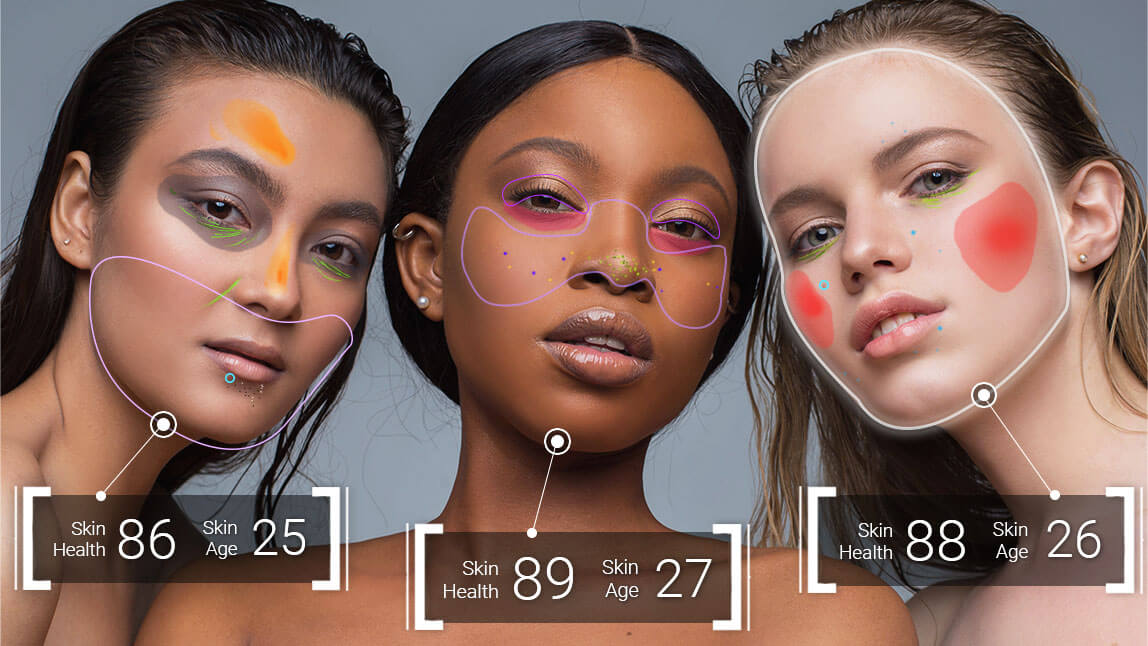
For anyone buying or building in this space, that converts into a specific, answerable question. Not "is your system accurate", but "what does your validation look like broken down by Fitzpatrick type". A vendor that cannot answer that has not measured it.
What Has Been Published on This Specific Technology?
Unusually for the category, the YouCam skin analysis engine has been examined in peer reviewed journals rather than only in vendor white papers. Four publications are relevant.
| Publication | Journal and year | What it examined |
|---|---|---|
| Initial validation of a new device for facial skin analysis | Journal of Dermatological Treatment, 2022, 33(8) | First validation of the system against clinical assessment |
| Comparison of two devices for facial skin analysis | Journal of Cosmetic Dermatology, 2022 | Head to head against an established clinical imaging system |
| Validation of a new facial skin analysis device across Fitzpatrick skin types | Journal of Cosmetic Dermatology, 2024 | Performance across the full Fitzpatrick range, which is the question above |
| Validity of facial skin analysis pore detection: a comparative analysis | Journal of Cosmetic Dermatology, 2024 | One concern examined in isolation, which is how rigorous validation works |
Alongside these, a review by Dr Steven R. Feldman, Professor of Dermatology at Wake Forest School of Medicine, compared the software against both physician assessment and a clinical imaging system, reporting test to retest reliability above an intraclass correlation of 0.90 and results produced substantially faster than the comparison device.
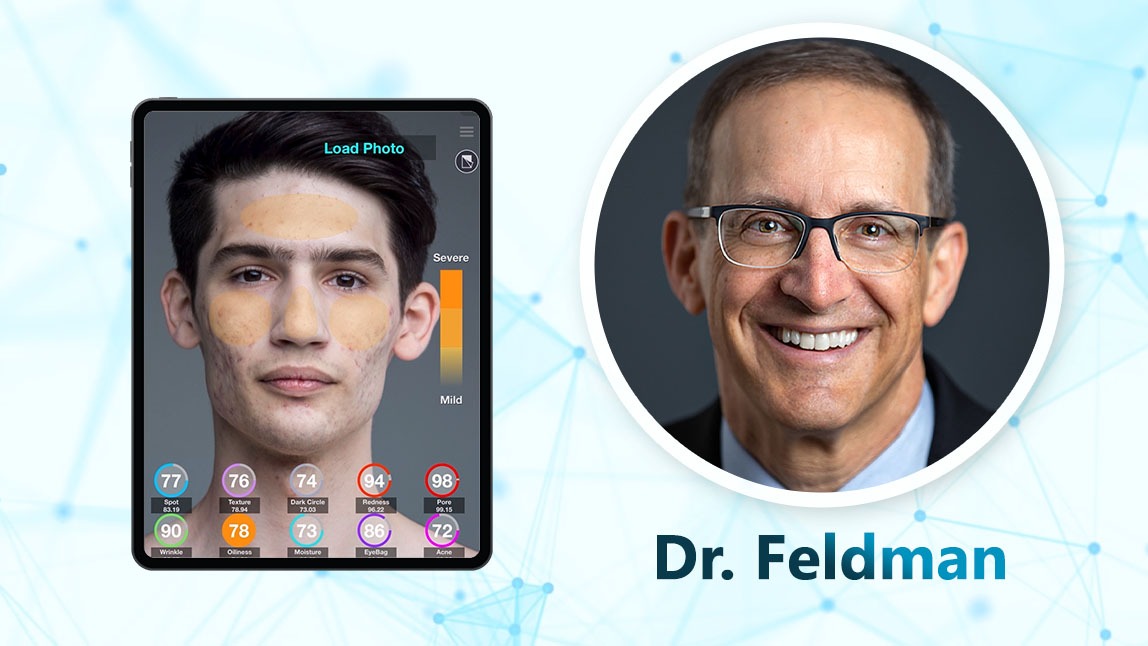
The pattern worth noting is the sequence: validate against clinical assessment, then against an established device, then across skin types, then concern by concern. That is what an evidence base looks like, and it is a more useful signal than any single accuracy percentage.See Journal of Dermatological Treatment 2022;33(8), doi:10.1080/09546634.2022.2127305; Journal of Cosmetic Dermatology 2022, doi:10.1111/jocd.15434; Journal of Cosmetic Dermatology 2024, doi:10.1111/jocd.16024; and Journal of Cosmetic Dermatology 2024, doi:10.1111/jocd.16412
The company reports 95% test-retest reliability and correlation above 80 percent with professional physician assessment on its skin analysis demo, with the engine trained on more than 70,000 clinical images. As with any vendor figure, the useful follow up questions are which concerns those numbers cover and under what capture conditions they were produced, which is exactly what the papers above exist to answer.
What Affects Accuracy Most in Real Use?
Capture, by a distance. The gap between a published figure and what a customer experiences is mostly the photograph.
| Factor | Impact | What to do about it |
|---|---|---|
| Light direction and type | Very high. Radiance and texture are functions of how light hits the surface | Guide the user to even indirect light. Reject obvious failures |
| Flash or ring light | Very high. Flattens texture, can manufacture apparent radiance | Standardise one setup and enforce it across scans |
| Resolution and focus | High for fine detail such as pores and texture | Enforce a minimum, reject motion blur before uploading |
| Makeup or product on the skin | High. The surface is what gets scored | Require bare skin and say why |
| Face size and angle in frame | High. Changes which regions are measured | Framing overlay, held at eye level |
| Recent activity | High on redness and oiliness specifically | Ask users to wait after exercise, heat or alcohol |
| Time of day | Moderate. Oiliness and redness drift across a day | Recommend a consistent slot, ideally morning |
| Device differences | Moderate. Sensors and processing differ | Compare scans from the same device where possible |
A system with excellent published accuracy and a careless capture flow will underperform a modest system with a disciplined one. If you are evaluating vendors, spend as much time on the camera experience as on the validation study.
Why Do Two Tools Give Different Results on the Same Face?
Because they are not answering the same question, even when the labels match.
- Different scales. There is no cross industry standard, so a 70 from one system and a 70 from another are not comparable statements.
- Different definitions. One system's texture may include congestion that another scores separately under pores.
- Different reference standards. Calibrated against a clinician, a device, or an internal panel, each producing a different baseline.
- Different display adjustment. Many systems adjust the raw value before showing it, for presentation reasons.
- Different reference populations. Age and demographic baselines shift what counts as average.
- Different capture handling. One may normalise lighting, another may not.
This is why the only comparison that holds is within one system, under matched conditions, over time. Disagreement between two tools is not evidence that either is wrong.
What Is a Realistic Expectation?
| Use case | Realistic? | Why |
|---|---|---|
| Tracking one person's change over time | Yes, and this is the strongest use | Reliability is the property these systems are best at |
| Ranking a person's own concerns | Yes | Relative ordering survives absolute calibration error |
| Routing product recommendations | Yes, on combinations rather than single scores | Combination logic is more robust than any one value |
| Replacing a questionnaire | Yes, and it is a clear improvement | The alternative is a customer guessing their skin type |
| Giving an absolute verdict on skin quality | No | No universal scale exists to be absolute against |
| Diagnosing a condition | No | These are cosmetic assessments, not diagnostic devices |
| Assessing a changing mole or lesion | No, and this needs a clinician | Outside what cosmetic scoring is built or validated for |
The last two rows are not hedging. A cosmetic skin analysis tool returning a score near something that needs medical attention is not an assessment of it, and any responsible implementation says so in the interface rather than in a footer.
What Should You Ask a Vendor?
Seven questions that separate a validated system from a confident one.
- Which of the three accuracies is your number? Agreement, reliability, or sensitivity and specificity.
- Against what reference standard? A dermatologist panel, a clinical device, or an internal label set.
- On how many images, and whose? Size matters less than whether the set resembles your customers.
- Broken down by Fitzpatrick type? The single most revealing question in the list.
- Which concerns does the figure cover? Per concern performance varies widely, and averages hide the weak ones.
- Is any of it independent or peer reviewed? Internal validation is not worthless, but it is not the same thing.
- What is the test to retest reliability? If you are building a progress feature, this is the number that decides whether it works.
A vendor that answers all seven precisely is telling you more than one that quotes 98 percent and declines to elaborate.

How Do You Measure It Yourself?
You can run a credible internal check in an afternoon, and it is worth doing before committing.
- Reliability test. Scan the same ten faces three times each, same session, same light, no changes in between. Compare the spread. Anything scoring wildly differently on identical conditions will not support a progress feature.
- Capture sensitivity test. Scan the same face under a window, under a ring light and under office lighting. The size of that gap is the capture discipline your product will need to enforce.
- Representativeness test. Run faces across the full Fitzpatrick range and across ages, not only the team. Look for concerns where performance drops rather than for an overall average.
- Face validity test. Have an esthetician or dermatologist review twenty results blind and flag anything clearly wrong. You are looking for systematic bias in one direction, not perfect agreement.
- Change detection test. Scan someone before and after two weeks of a hydration routine. Moisture is the fastest moving score, so if the system cannot detect that change, it will not detect subtler ones.
The easiest way to start is simply to run your own face through a live implementation and look at the per concern output. The skin analysis demo returns the full grouped breakdown with an estimated skin age and a skin type classification, so you can repeat it under two different lighting setups in a couple of minutes and see the capture sensitivity question for yourself rather than taking anyone's word for it.
For integration level testing against your own image set, the YouCam API Playground lets you run real photographs through the skin analysis API before writing any code. If you are evaluating hardware rather than software, our guide to choosing an AI skin analysis machine covers that side.

How Accurate Is AI Skin Analysis FAQ
How accurate is AI skin analysis compared to a dermatologist?
Published meta analyses of image based AI report performance broadly comparable to expert clinicians on specific visible tasks, with the difference against experts described as statistically significant but minimal in practice. It is not a replacement for a consultation, because it assesses visible signs only, without history, palpation or context.
Is 95 percent accuracy a meaningful claim?
Only once you know what it measures. 95% test to retest reliability means the system is consistent on the same face, which is a different and more modest claim than agreeing with a dermatologist 95 percent of the time. Always ask which of the two is being quoted.
Can AI skin analysis diagnose skin conditions?
No. Cosmetic skin analysis tools score visible characteristics for skincare purposes. They are not diagnostic devices and are not validated for assessing moles, lesions or medical conditions, which require a clinician.
Does AI skin analysis work on dark skin?
It depends entirely on the training data. Research in Science Advances documented a measurable performance gap across skin tones in dermatology algorithms, and also showed the gap could be narrowed by tuning on more diverse data. Ask any vendor for validation broken down by Fitzpatrick type.
Why does the same tool give me different scores on different days?
Capture conditions are the usual cause rather than real change. Lighting direction, flash, resolution, makeup, time of day and recent exercise all move the numbers, particularly redness and oiliness. Match your conditions before concluding anything from a difference.
Why do two skin analysis apps disagree about my skin?
Because there is no shared scale. Different systems measure different things under the same labels, calibrate against different references and adjust values differently before display. Comparing across tools is not meaningful, and disagreement does not mean one is broken.
Which matters more, accuracy or consistency?
For most commercial uses, consistency. A system that reads slightly low but reads it the same way every time can still track progress reliably, while a system that averages out correct but swings between scans cannot.
Has AI skin analysis been studied in peer reviewed journals?
Yes, including validation of this specific technology in the Journal of Dermatological Treatment in 2022 and in the Journal of Cosmetic Dermatology in 2022 and 2024, the last covering performance across Fitzpatrick skin types and a dedicated examination of pore detection.
Is AI skin analysis accurate enough for a retail recommendation?
For routing a customer to a sensible starting routine, yes, and it is more reliable than the self assessment or questionnaire it typically replaces. Route on combinations of concerns rather than on a single score, and attach a realistic timeline to whatever you recommend.
How can I test accuracy for my own use case?
Scan the same faces repeatedly under identical conditions to check reliability, then deliberately vary the lighting to measure capture sensitivity, then run a Fitzpatrick range rather than just your team. Those three tests tell you more about real world performance than any published figure.
Ask What the Number Measures
AI skin analysis is accurate enough to be genuinely useful and not accurate enough to be treated as a measurement, and both halves of that sentence matter. The evidence base supports consistent, repeatable scoring of visible features at a level broadly comparable to trained assessment on the specific tasks involved, with documented weaknesses around skin tone representation and a heavy dependence on capture conditions. What it does not support is an absolute verdict on skin quality or anything resembling a diagnosis.
So the practical standard is not a percentage. It is whether a vendor can tell you which accuracy they measured, against what, on whose faces, and broken down by skin type, and whether their capture flow is disciplined enough for those numbers to survive contact with a customer's bathroom mirror.
Run your own face through the skin analysis demo and repeat it under different lighting to see the capture question first hand, test the API against your own images in the YouCam AI Playground, or contact Perfect Corp to request the validation detail for your use case.