 Author:


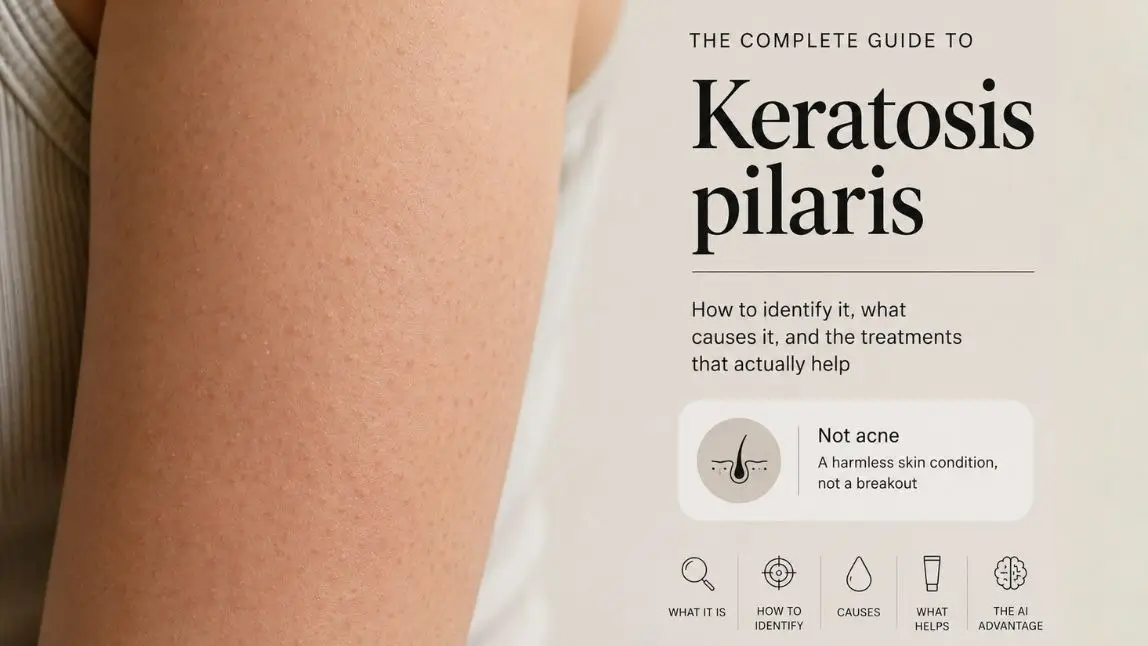
The backs of your arms have felt like fine sandpaper for as long as you can remember. You have tried acne body wash. You have tried scrubbing. Neither did much, and scrubbing arguably made it angrier. That is because keratosis pilaris is not acne, is not caused by clogged pores in the way acne is, and does not respond to the ingredients that clear a breakout. It affects a large share of the population, it is entirely harmless, and it is genuinely improvable with the right approach. This guide covers how to tell it apart from acne and from fungal bumps, what actually works, what makes it worse, and how objective texture scoring changes the way progress gets measured.
Table of Contents
- What is keratosis pilaris?
- How do you tell it apart from acne?
- Can you get keratosis pilaris on your face?
- What actually works for keratosis pilaris?
- What makes it worse?
- How long does it take to improve?
- How does AI texture analysis help?
- Keratosis pilaris FAQ
What is keratosis pilaris?
Keratosis pilaris is a buildup of keratin around hair follicles. The protein hardens into a small plug that caps the follicle opening, producing the characteristic rough bump. Often a fine hair is trapped underneath, which is why the bumps sit in a regular pattern matching follicle distribution.

Two features distinguish it from almost everything else. It is symmetrical, showing up on both arms or both thighs in roughly equal measure. And the bumps are strikingly uniform in size, because each one is the same structure at the same stage.
It is extremely common, it runs in families, and it tends to be worse in people with dry skin or eczema. It is also self-limiting in a loose sense: many people find it improves through their thirties and forties, though that is a slow trend rather than a reliable resolution.
Most importantly, it is harmless. No infection, no risk, no progression. What it does affect is how people feel about wearing short sleeves, which is a real cost even if it is a cosmetic one.
How do you tell it apart from acne?
| Signal | Keratosis pilaris | Body acne | Fungal (Malassezia) |
|---|---|---|---|
| Texture | Rough, sandpaper-like across a wide area | Individual raised lesions, smooth skin between | Small uniform bumps, less rough overall |
| Symmetry | Both sides, roughly equal | Often asymmetric | Can be either |
| Location | Outer upper arms, front thighs, buttocks, cheeks | Chest, upper back, shoulders | Chest, upper back, shoulders, forehead |
| Lesion variety | All the same | Mixed: comedones, papules, sometimes cysts | All the same |
| Itch | Occasionally mild | No | Often, and a strong signal |
| Onset | Childhood or adolescence, persistent for years | Can start at any age, fluctuates | Often sudden, tied to heat or humidity |
| Contents | A hard keratin plug, sometimes a coiled hair | Sebum and cellular debris | Nothing expressible |
Symmetry and duration do most of the work. Body acne rarely mirrors itself precisely across both arms, and it rarely stays identical for a decade. Keratosis pilaris does both.

The overlap nobody mentions
You can have both. Keratosis pilaris on the arms and genuine acne on the back is a common combination, and treating the back regimen across the arms is why so many people conclude that nothing works. The arms need urea and lactic acid. The back needs benzoyl peroxide or a retinoid. Same person, two different plans.
Can you get keratosis pilaris on your face?
Yes, and this is where it gets misdiagnosed most often. Facial keratosis pilaris typically appears on the outer cheeks and sometimes the sides of the forehead, often with a pink or reddish cast to the surrounding skin. It is particularly common in children and younger adults.

Two things it gets mistaken for. Acne, because bumps on cheeks read as acne by default, which leads to months of benzoyl peroxide that does nothing except irritate. And rosacea, because the pink base looks like flushing, which leads to a different set of wrong products.
The distinguishing features on the face are the same as elsewhere: uniformity, symmetry across both cheeks, roughness rather than individual spots, and no lifecycle. A cheek that has felt slightly rough and looked slightly pink in the same pattern for three years is not breaking out.
Facial keratosis pilaris also requires gentler handling than the body version. Urea concentrations that are appropriate for arms are too aggressive for cheeks, which is a common source of irritation among people who correctly identify the condition and then over-treat it.
What actually works for keratosis pilaris?
The strategy is dissolve and soften, not scrub and remove. Keratin plugs need chemical breakdown, and the surrounding skin needs enough moisture that new plugs form less readily.
| Ingredient | What it does | Typical strength | Time to visible change |
|---|---|---|---|
| Urea | Breaks down keratin and hydrates simultaneously | 10 to 20% for body, lower for face | 2 to 4 weeks |
| Lactic acid | Exfoliates and holds moisture, gentler than glycolic | 5 to 12% | 3 to 6 weeks |
| Salicylic acid | Clears the follicle opening | 2% body formulations | 4 to 6 weeks |
| Glycolic acid | Surface exfoliation, faster acting but more irritating | 8 to 15% | 3 to 5 weeks |
| Topical retinoid | Normalizes turnover so plugs form less often | As tolerated | 8 to 12 weeks |
| Occlusive moisturizer | Reduces the dryness that worsens plug formation | Applied over the active | Immediate comfort, weeks for texture |
Urea is the standout for body keratosis pilaris because it does both jobs at once. Most people get furthest with a urea or lactic acid product applied consistently, a rich moisturizer layered over it, and patience.

Application matters more than product choice. Apply to damp skin straight after a shower, and treat it as a daily habit rather than an occasional intervention. Keratosis pilaris returns within weeks of stopping, so this is a management routine rather than a course of treatment.
What makes it worse?
- Physical scrubbing. The most common mistake. Rough exfoliation irritates the follicle and inflames the surrounding skin, turning flesh-colored bumps into red ones. The plug stays where it is.
- Dry air and winter. Almost everyone reports a seasonal pattern. Central heating and low humidity worsen it reliably.
- Hot showers. Strip surface lipids and leave the skin drier than before.
- Harsh soaps. Same mechanism, compounding through the day.
- Picking. Extracting individual plugs leaves marks that outlast the bump, especially on deeper skin tones where post-inflammatory pigmentation is more persistent.
- Stopping too soon. Four weeks of consistency followed by a month off returns you to baseline.

The pattern here mirrors closed comedones and sebaceous filaments: force yields short-term satisfaction and medium-term regression, while gentle consistency yields the opposite.
How long does it take to improve?
Texture usually improves before color does. That order surprises people, because redness is the more visible complaint.
| Period | What changes |
|---|---|
| Week 1 to 2 | Skin feels softer. Bumps still visible but less rough to the touch |
| Week 3 to 6 | Noticeably fewer raised bumps. Texture is the first real win |
| Week 6 to 12 | Redness begins to settle, which is the slower half |
| Ongoing | Maintenance. Stopping returns you to baseline within about a month |

Realistic expectation setting matters here more than in most conditions, because keratosis pilaris cannot be cured. What is achievable is skin that feels smooth and looks noticeably calmer, maintained indefinitely. Anyone promising permanent clearance is describing something the condition does not do.
How does AI texture analysis help?
Gradual texture change is the hardest kind of progress to perceive. You see your arms every day, the improvement is incremental, and there is no dramatic before and after moment. Plenty of people abandon a routine that was working because they could not tell it was working.

Perfect Corp's AI Skin Analysis scores 15 concerns from a single photo, texture and redness among them, and maps them by zone. It is built on more than 70,000 medical-grade images across a range of skin tones and ages, with a clinical study reporting 95% test-retest reliability. Repeatability is the whole point for a slow-moving concern: a score that drifts between sessions cannot show a twelve week trend.
Two boundaries worth stating plainly. The analysis is designed for facial skin, so it applies to facial keratosis pilaris rather than to arms and thighs. And it scores concerns rather than diagnosing conditions, so a clinician still owns the diagnosis.
Within those limits, it does three useful things:
- Separates texture from redness. Since texture improves first and color follows, tracking them independently shows progress at week four that a mirror does not.
- Maps symmetry objectively. Bilateral, evenly distributed cheek texture is characteristic. Asymmetric clusters point elsewhere.
- Creates a baseline before you start. The comparison point people always wish they had.
You can run a scan through the free AI skin analysis demo, or read our wider guide to facial skin analysis for how each concern is scored.
What this means for brands and clinics
Keratosis pilaris is a long-tenure category. Nobody buys once. Customers stay with the product that visibly maintains their skin, which makes demonstrating gradual improvement a retention mechanic rather than a marketing extra.
That is the reasoning behind more than 800 brand partners integrating AI skin assessment into their customer journey. Beekman 1802 reported a 50% engagement lift after adding an AI skin experience, and Kanebo's COFFRET D'OR saw a 2.48x increase in time on page. For clinics, a scored baseline makes the difference between a client who returns for maintenance and one who concludes after six weeks that it did not work. Teams building this in can start with the API Playground.
Keratosis pilaris FAQ
Is keratosis pilaris a form of acne?
No. Acne involves sebum, clogged pores, and usually bacteria. Keratosis pilaris is keratin hardening around the follicle opening. Different mechanism, different treatment, and acne products will not resolve it.
Does keratosis pilaris go away?
It cannot be cured, but it is manageable and it often becomes milder with age. Many people find it noticeably better by their forties. Treatment controls appearance while it is being used.
What is the fastest way to get rid of keratosis pilaris bumps?
A urea cream at 10 to 20% applied daily to damp skin, with a rich moisturizer over the top. Most people notice a texture change within two to four weeks. Scrubbing feels faster and delivers less.
Can you get keratosis pilaris on your face?
Yes, usually on the outer cheeks and sometimes the sides of the forehead, often with a pink cast. It is commonly mistaken for acne or rosacea. Use gentler concentrations on facial skin than on the body.
Why is my keratosis pilaris red?
Some presentations include inflammation around the follicle, and physical scrubbing makes it considerably worse. Redness is also the slower half of any improvement, typically lagging texture by several weeks.
Does exfoliating help keratosis pilaris?
Chemical exfoliation helps. Physical exfoliation generally does not, and often aggravates it. Urea, lactic acid, and salicylic acid dissolve the plug. Scrubs and brushes irritate the surrounding skin while leaving the plug intact.
Is keratosis pilaris caused by a vitamin deficiency?
It is primarily genetic and associated with dry skin and eczema. Deficiency is not a recognized cause, and supplements are not an established treatment. Topical management remains the evidence-backed route.
Will keratosis pilaris come back if I stop treating it?
Yes, generally within about a month. It is a maintenance condition rather than a curable one, which is why sustainable daily routines outperform aggressive short bursts.
The takeaway
Keratosis pilaris is symmetrical, uniform, rough to the touch, and has probably been there for years. Acne is none of those things. Once you have identified it correctly, the treatment is unglamorous and reliable: dissolve the keratin with urea or lactic acid, keep the skin well moisturized, stop scrubbing, and accept that this is maintenance rather than cure. The people who get the best results are not using anything exotic. They are just doing it every day.