Author: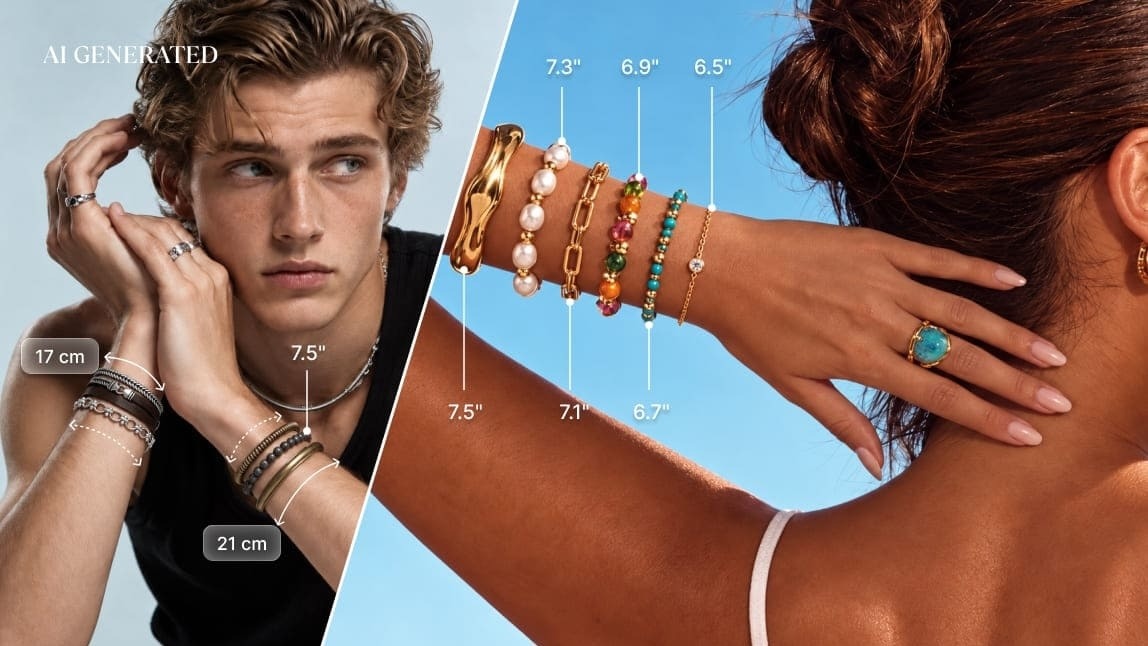
Disclaimer: Some images in this article may have been created or modified by AI
Here is the mistake that sends most bracelets back: shoppers measure their wrist, then order a bracelet in that exact size. Your wrist size is not your bracelet size. A bracelet needs extra room to move, and how much room depends on the style. A chain bracelet, a bangle, a cuff, and a tennis bracelet all size differently. This bracelet size chart converts your wrist measurement into the right bracelet length for every major style, with charts for men, women, and kids. For jewelry brands, we also show how AI wrist sizing and virtual try-on take the math off the shopper's plate entirely.
Table of Contents
- What Is a Bracelet Size Chart?
- What Size Bracelet Should You Get for Your Wrist?
- How Much Should You Add to Your Wrist Measurement?
- What Are the Standard Bracelet Sizes for Women?
- What Are the Standard Bracelet Sizes for Men?
- How Do You Size a Bangle?
- How Do You Size a Cuff, Tennis, or Beaded Bracelet?
- What Bracelet Size Fits Kids and Teens?
- What If You Are Between Two Bracelet Sizes?
- How Can AI Find Your Bracelet Size Automatically?
- Bracelet Size FAQ
What Is a Bracelet Size Chart?
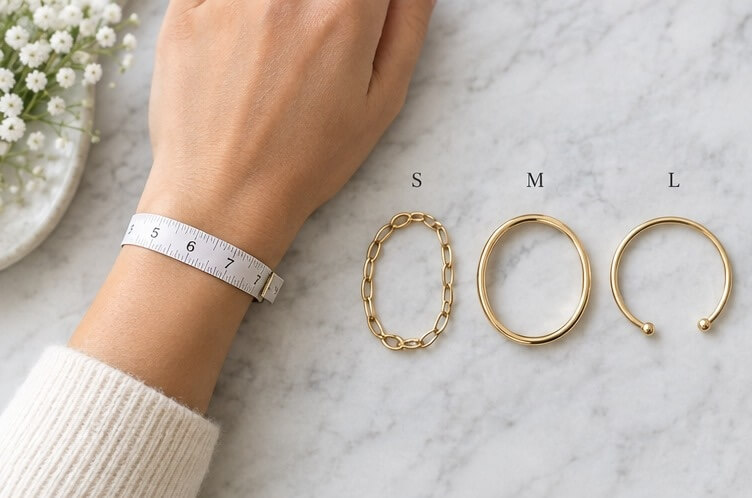
A bracelet size chart converts your wrist circumference into a recommended bracelet length. The basic formula is simple: bracelet length = wrist size + comfort allowance. Most people add 0.5 to 1 inch (about 1.3 to 2.5 cm), depending on how snug or loose they want the fit. A 6.5 inch wrist, for example, usually wears a 7 to 7.5 inch bracelet.
Do not know your wrist size yet? Start with our online wrist sizer and wrist size chart, then come back here to convert that number into a bracelet size.
What Size Bracelet Should You Get for Your Wrist?
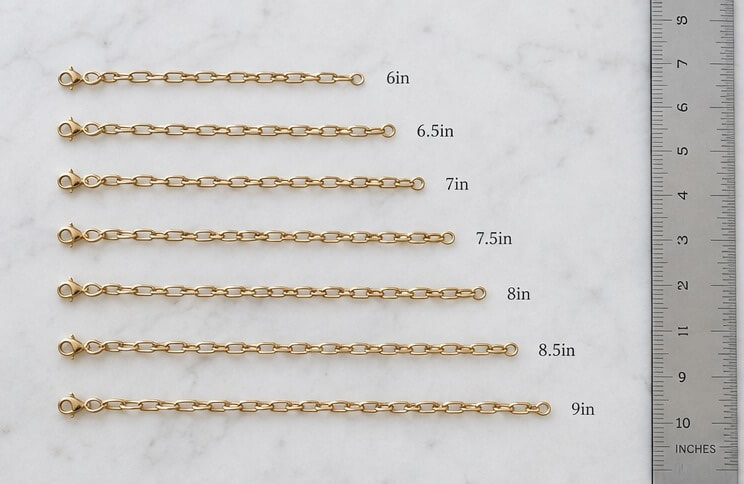
Use this chart to go straight from wrist measurement to bracelet length for a standard chain or link bracelet.
| Wrist size | Snug fit (+0.5") | Comfort fit (+0.75") | Loose fit (+1") |
|---|---|---|---|
| 5.5" (14 cm) | 6" (15.2 cm) | 6.25" (15.9 cm) | 6.5" (16.5 cm) |
| 6" (15.2 cm) | 6.5" (16.5 cm) | 6.75" (17.1 cm) | 7" (17.8 cm) |
| 6.5" (16.5 cm) | 7" (17.8 cm) | 7.25" (18.4 cm) | 7.5" (19 cm) |
| 7" (17.8 cm) | 7.5" (19 cm) | 7.75" (19.7 cm) | 8" (20.3 cm) |
| 7.5" (19 cm) | 8" (20.3 cm) | 8.25" (21 cm) | 8.5" (21.6 cm) |
| 8" (20.3 cm) | 8.5" (21.6 cm) | 8.75" (22.2 cm) | 9" (22.9 cm) |
| 8.5" (21.6 cm) | 9" (22.9 cm) | 9.25" (23.5 cm) | 9.5" (24.1 cm) |
How Much Should You Add to Your Wrist Measurement?
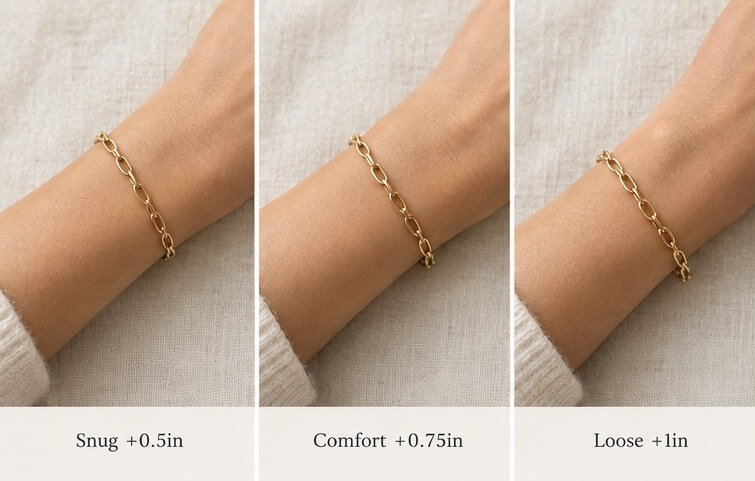
The allowance depends on two things: the fit you like, and how thick the bracelet is.
- Snug (+0.5 inch / 1.3 cm): sits close to the wrist with little movement. Good for fine chains and tennis bracelets that should not spin.
- Comfort (+0.75 inch / 2 cm): the most popular fit. Moves freely without sliding toward the hand.
- Loose (+1 inch / 2.5 cm or more): a relaxed drape. Great for chunky chains and charm bracelets.
Adjust for thickness, too. Thick or wide bracelets (over about 5mm) take up more room on the inside, so add an extra quarter inch. Wearing a bracelet next to a watch? Size up slightly so it does not pinch the strap.
What Are the Standard Bracelet Sizes for Women?
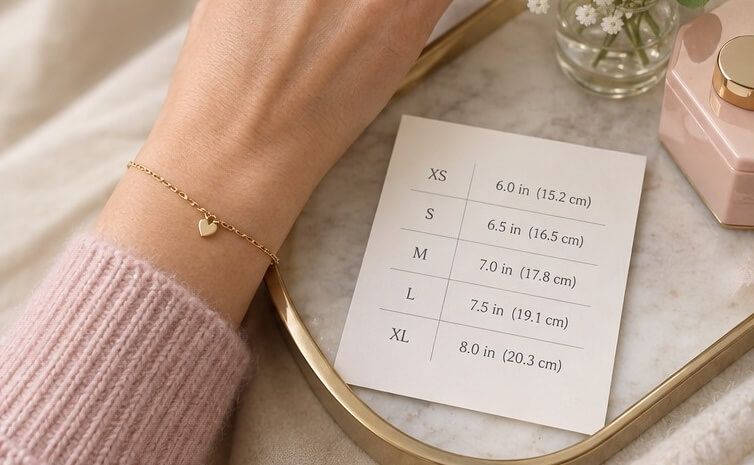
The average women's wrist measures roughly 5.5 to 6.5 inches. Most retailers label women's bracelet sizes like this.
| Size | Bracelet length | Fits wrist size |
|---|---|---|
| XS | 6" (15.2 cm) | 5" to 5.5" |
| S | 6.5" (16.5 cm) | 5.5" to 6" |
| M | 7" (17.8 cm) | 6" to 6.5" |
| L | 7.5" (19 cm) | 6.5" to 7" |
| XL | 8" (20.3 cm) | 7" to 7.5" |
Buying a gift without knowing her wrist size? A 7 inch bracelet with an extender chain is the safest choice and fits most women.
What Are the Standard Bracelet Sizes for Men?
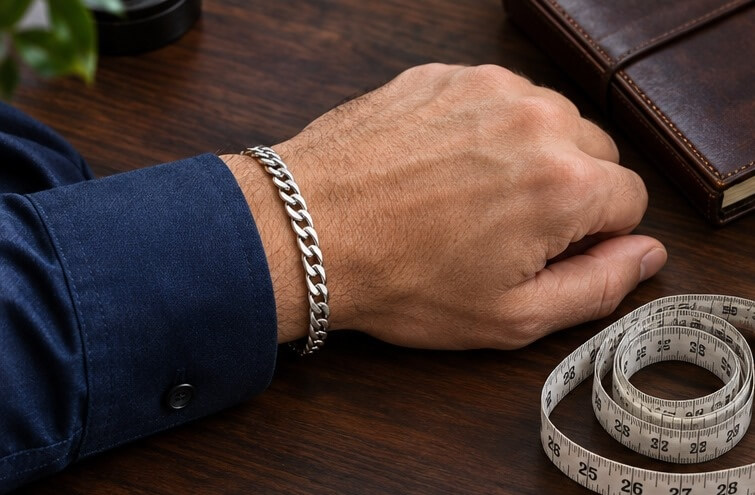
Men's wrists average around 7 inches, with most falling between 6.5 and 7.5 inches. Men also tend to prefer a slightly looser fit, so men's bracelets typically run 8 to 8.5 inches.
| Size | Bracelet length | Fits wrist size |
|---|---|---|
| S | 7.5" (19 cm) | 6" to 6.5" |
| M | 8" (20.3 cm) | 6.5" to 7" |
| L | 8.5" (21.6 cm) | 7" to 7.5" |
| XL | 9" (22.9 cm) | 7.5" to 8" |
| XXL | 9.5" (24.1 cm) | 8" and up |
How Do You Size a Bangle?
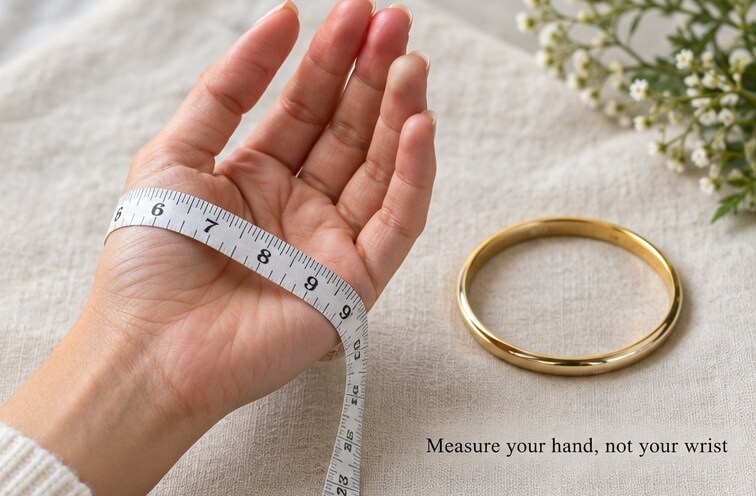
Bangles are the exception to every rule above, because a solid bangle has no clasp. It has to slide over your hand, so you size it by your hand, not your wrist.
- Bring your thumb and little finger together, as if you were slipping on a bangle.
- Wrap a soft tape around the widest part of your hand, across the knuckles.
- Match that measurement to the bangle size chart below.
| Hand measurement | Bangle size | Approx. inner diameter |
|---|---|---|
| Up to 7" (17.8 cm) | XS | 2.25" (5.7 cm) |
| 7" to 7.5" (17.8 to 19 cm) | S | 2.4" (6.1 cm) |
| 7.5" to 8" (19 to 20.3 cm) | M | 2.5" (6.4 cm) |
| 8" to 8.5" (20.3 to 21.6 cm) | L | 2.65" (6.7 cm) |
| 8.5" to 9" (21.6 to 22.9 cm) | XL | 2.75" (7 cm) |
Sizes vary between brands, so always check the retailer's own chart. Hinged and oval bangles open up, so they can fit closer to the wrist.
How Do You Size a Cuff, Tennis, or Beaded Bracelet?
Cuff Bracelets
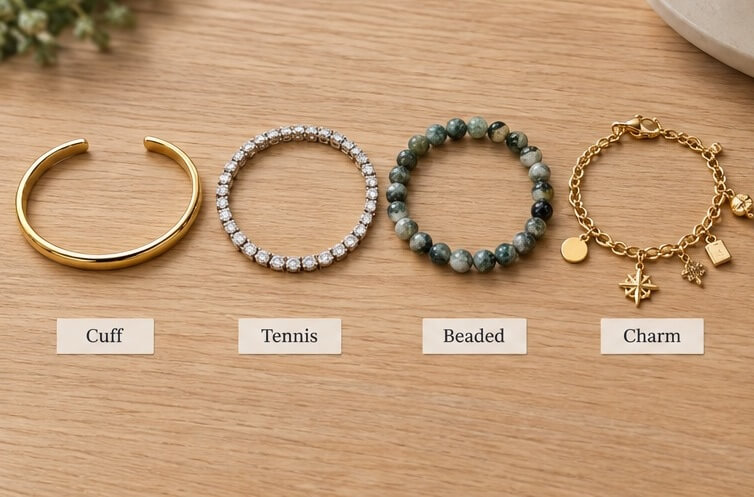
Cuffs have an open gap and slip on from the side of the wrist. Look for a cuff whose inner length is about 1 inch shorter than your wrist circumference, leaving a gap of roughly 1 to 1.5 inches. Many cuffs can be gently adjusted, but bending precious metal repeatedly can weaken it.
Tennis Bracelets
Tennis bracelets should sit close so the stones face up and do not spin. Add 0.5 to 0.75 inch to your wrist measurement. Too loose, and the clasp rotates to the top.
Beaded and Stretch Bracelets
Stretch bracelets need a closer fit so they do not sag. Add about 0.5 inch. Larger beads take up more space inside the bracelet, so add a little more for beads over 8mm.
Charm Bracelets
Charms hang inward and take up room. Add about 1 inch, and a little more if you plan to add many charms over time.
What Bracelet Size Fits Kids and Teens?
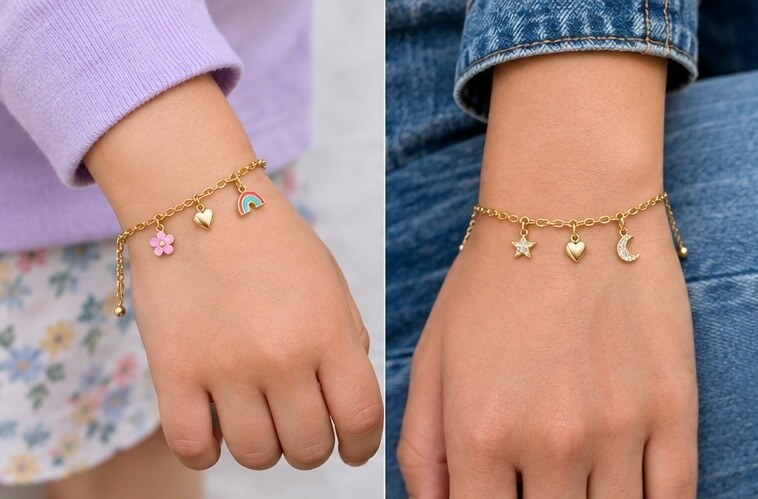
Kids' wrists are smaller and grow quickly, so adjustable styles are the smartest buy. As a rough guide:
| Age | Typical bracelet length |
|---|---|
| Baby (0 to 12 months) | 4" to 4.5" |
| Toddler (1 to 3 years) | 4.5" to 5" |
| Child (4 to 8 years) | 5" to 5.5" |
| Preteen (9 to 12 years) | 5.5" to 6" |
| Teen (13+) | 6" to 7" |
Measure whenever possible, since kids of the same age can differ by an inch or more.
What If You Are Between Two Bracelet Sizes?
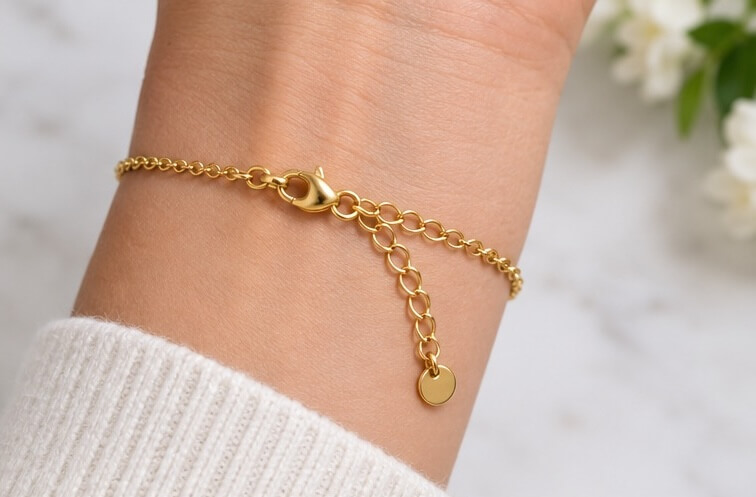
Size up. A bracelet that is a little loose is comfortable and easy to wear. A bracelet that is too tight will dig in, and you cannot add length to a solid chain without a jeweler. Other tips:
- Choose a bracelet with an extender chain or an adjustable slider clasp.
- Measure in the evening, when wrists are typically slightly larger.
- Measure twice on different days for the most reliable number.
- If the bracelet will share a wrist with a watch or a stack, lean toward the larger size.
How Can AI Find Your Bracelet Size Automatically?
Charts work, but they still ask shoppers to find a tape measure, do math, and trust a guess. AI wrist sizing skips all of that.
Perfect Corp's AI Bracelet Virtual Try-On estimates wrist circumference from the phone camera, converts it into a recommended bracelet length, and shows the bracelet on the shopper's own wrist in the same session. Here is how it works:
- Point the camera. The shopper holds up a bare wrist. No printed marker or paper band needed.
- AI maps the wrist. AgileHand™ technology reads wrist shape and angle in real time.
- Get the size and see the fit. The wrist size appears in inches or centimeters next to the recommended length, while the bracelet renders photorealistically on the wrist.
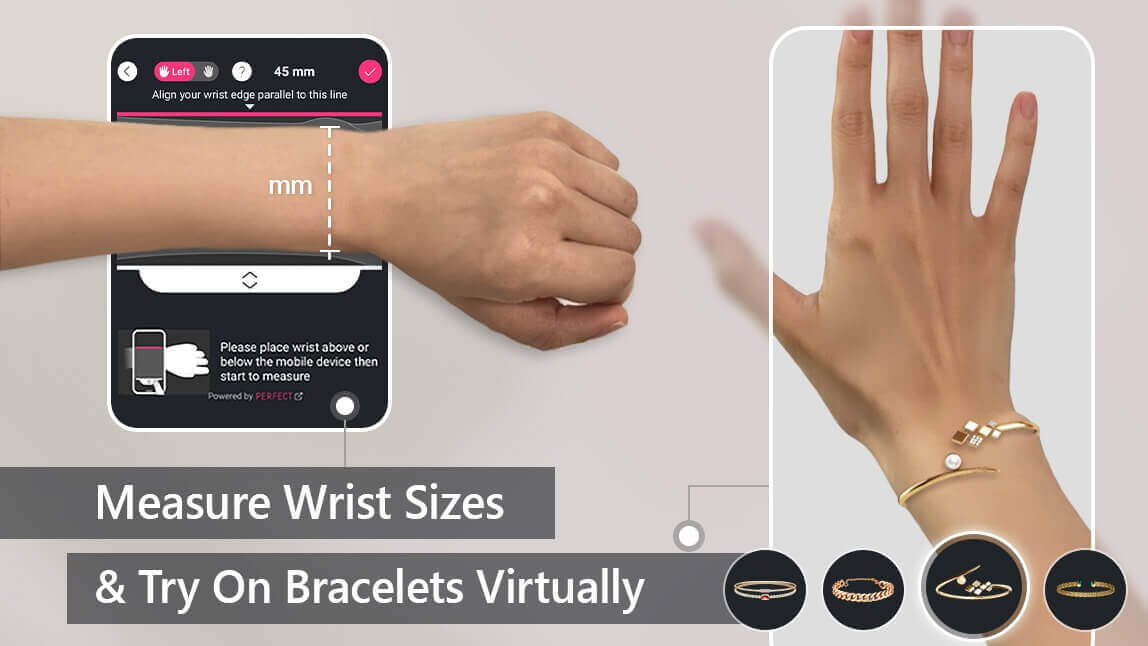
Find your size in seconds: try the free online wrist sizer and bracelet try-on demo.
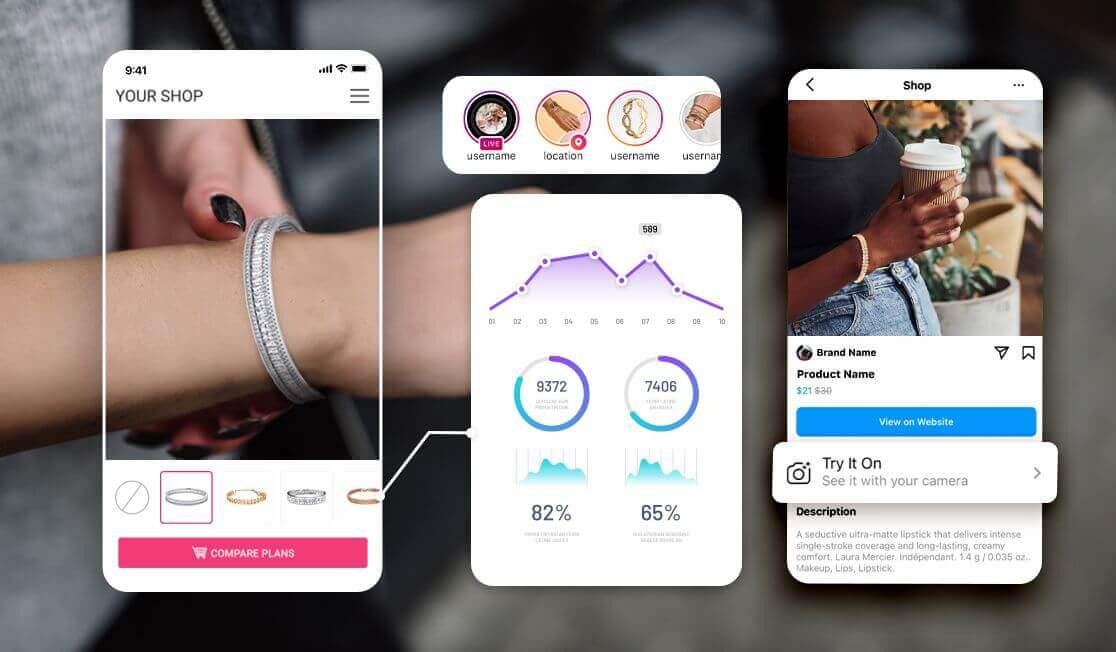
For jewelry brands, this removes the two biggest reasons a bracelet gets returned: the wrong size and "it looked different on me." 3D bracelet assets are built to true product dimensions, so a 16 cm bangle never renders like an 18 cm one. And catalogs scale quickly, because a single 2D product photo can become a wrist-ready try-on asset. The technology is trusted by 800+ beauty and fashion brands and is available as an ecommerce web module, an API, and mobile SDKs. Developers can start in the YouCam AI API playground.
Want the deeper business case? Read how AI camera sizing reduces bracelet returns.
Ready to add wrist sizing to your store? Contact Perfect Corp. for a free demo.
Bracelet Size FAQ
What is the most common bracelet size?
For women, 7 inches is the most common bracelet size. For men, 8 to 8.5 inches is most common.
What size bracelet should I get for a 6 inch wrist?
A 6.5 inch bracelet for a snug fit, 6.75 inches for a comfortable fit, or 7 inches for a loose fit.
What size bracelet should I get for a 7 inch wrist?
A 7.5 inch bracelet for a snug fit, 7.75 inches for comfort, or 8 inches for a looser drape.
Is a 7 inch bracelet small or large?
A 7 inch bracelet is a standard medium for women. For men, it is on the small side, since most men wear 8 inches or more.
How do I measure my wrist for a bracelet without a tape measure?
Wrap a strip of paper or string around your wrist just below the wrist bone, mark where it meets, and measure it against a ruler. Or use an online wrist sizer with your phone camera.
Should a bracelet be tight or loose?
Most people prefer a comfort fit, where you can slide one finger between the bracelet and your wrist. Tennis and fine chain bracelets look best snug, while charm and chunky chain bracelets look best a little loose.
How do I know my bangle size?
Measure around the widest part of your hand with your thumb and little finger pressed together, then match that number to a bangle size chart.
Do bracelet sizes include the clasp?
Yes. Bracelet lengths are measured end to end, clasp included.
Can I find my bracelet size online?
Yes. AI wrist sizers measure your wrist through your phone camera and recommend a bracelet length. You can try one for free on Perfect Corp's bracelet demo.