 Author:
 ![Build Your Own Face Analysis with Claude in 1 Prompt! [2026]](https://plugins-media.makeupar.com/smb/blog/post/2026-08-08/webp_a54e1345-43b9-4a35-be2e-89f2f46229a4.jpg)
Tried every face detection tool out there, only to find their scoring systems bizarre? What if, instead of using someone else's face analysis website, you built your own, and maybe even made money from it?
Good news. With Claude, you can spin up a working face analysis web app from a single prompt. No engineering degree required.
3 Steps to Build Your Own Face Analysis With Claude
Instead of trusting a stranger's server with your face, you can build the tool yourself. Claude can write the entire app for you, front end, backend, and the API call, from one clear prompt. You stay in control of the code, the data, and whether anyone else ever sees your photo.
Step 1: Open Claude & Get An API
- Claude (Please use Claude Code mode)
- Go to YouCam page, get a free API key, which comes with 40 free credits to test with
Step 2: Give Claude This One Prompt
Open Claude Code in your project folder and paste this in. Feel free to tweak the details, this is just a solid starting point.
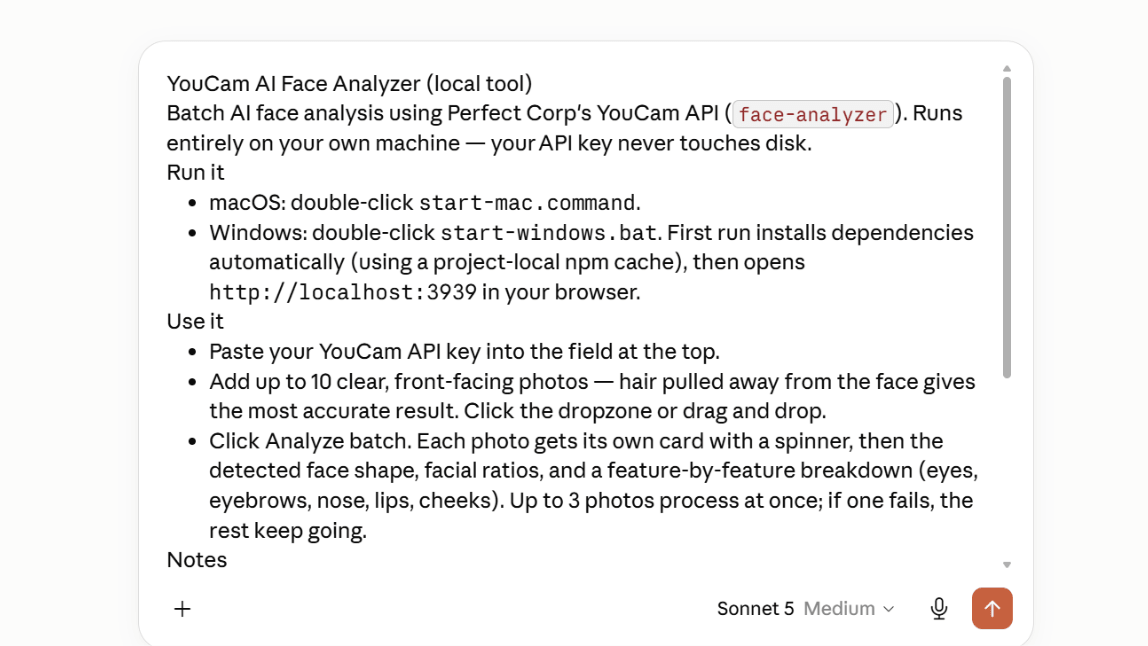
Prompt started ----------
YouCam AI Face Analyzer (local tool)
Batch AI face analysis using Perfect Corp's YouCam API (face-analyzer). Runs entirely on your own machine — your API key never touches disk.
Run it
- macOS: double-click
start-mac.command. - Windows: double-click
start-windows.bat. First run installs dependencies automatically (using a project-local npm cache), then openshttp://localhost:3939in your browser.
Use it
- Paste your YouCam API key into the field at the top.
- Add up to 10 clear, front-facing photos — hair pulled away from the face gives the most accurate result. Click the dropzone or drag and drop.
- Click Analyze batch. Each photo gets its own card with a spinner, then the detected face shape, facial ratios, and a feature-by-feature breakdown (eyes, eyebrows, nose, lips, cheeks). Up to 3 photos process at once; if one fails, the rest keep going.
Notes
- The browser only talks to the local server at
localhost:3939; the local server proxies requests toyce-api-01.makeupar.comserver-side (the API is server-to-server and blocks direct browser calls with CORS errors). - Your API key is held in a JS variable in the browser and sent per-request via the
Authorization: Bearerheader. The server never writes it to disk or logs it. - Analysis is asynchronous — the tool creates a task via
POST /s2s/v2.0/task/face-analyzer, then pollsGET /s2s/v2.0/task/face-analyzer/{task_id}until each photo's result is ready.
Prompt ends ----------
From prompt to a running app on screen, most people land somewhere between five and fifteen minutes, depending on how much back and forth they want on the design.Step 3: Run It And Get Your Score
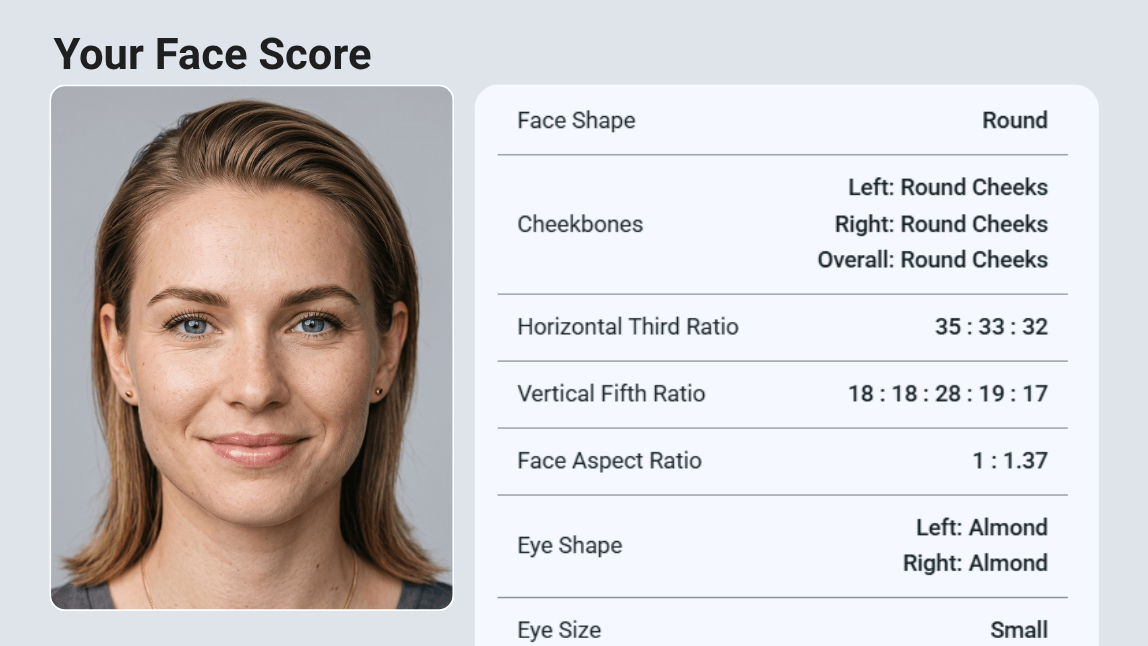
Run the install and start commands Claude gives you, open the local address in your browser, and upload a photo.
Within seconds you'll have your own face score, generated by code you can actually read, on a server you actually control.
3 Tips to Get Better Results From the Prompt
Test with a well lit, front facing photo first.
It's the fastest way to confirm the API call is wired up correctly before you troubleshoot lighting edge cases.
Ask Claude to add basic input validation.
A quick follow up prompt like "reject uploads that aren't clear front facing photos" saves you from confusing error messages later.
What Will Your App Actually Report Back?
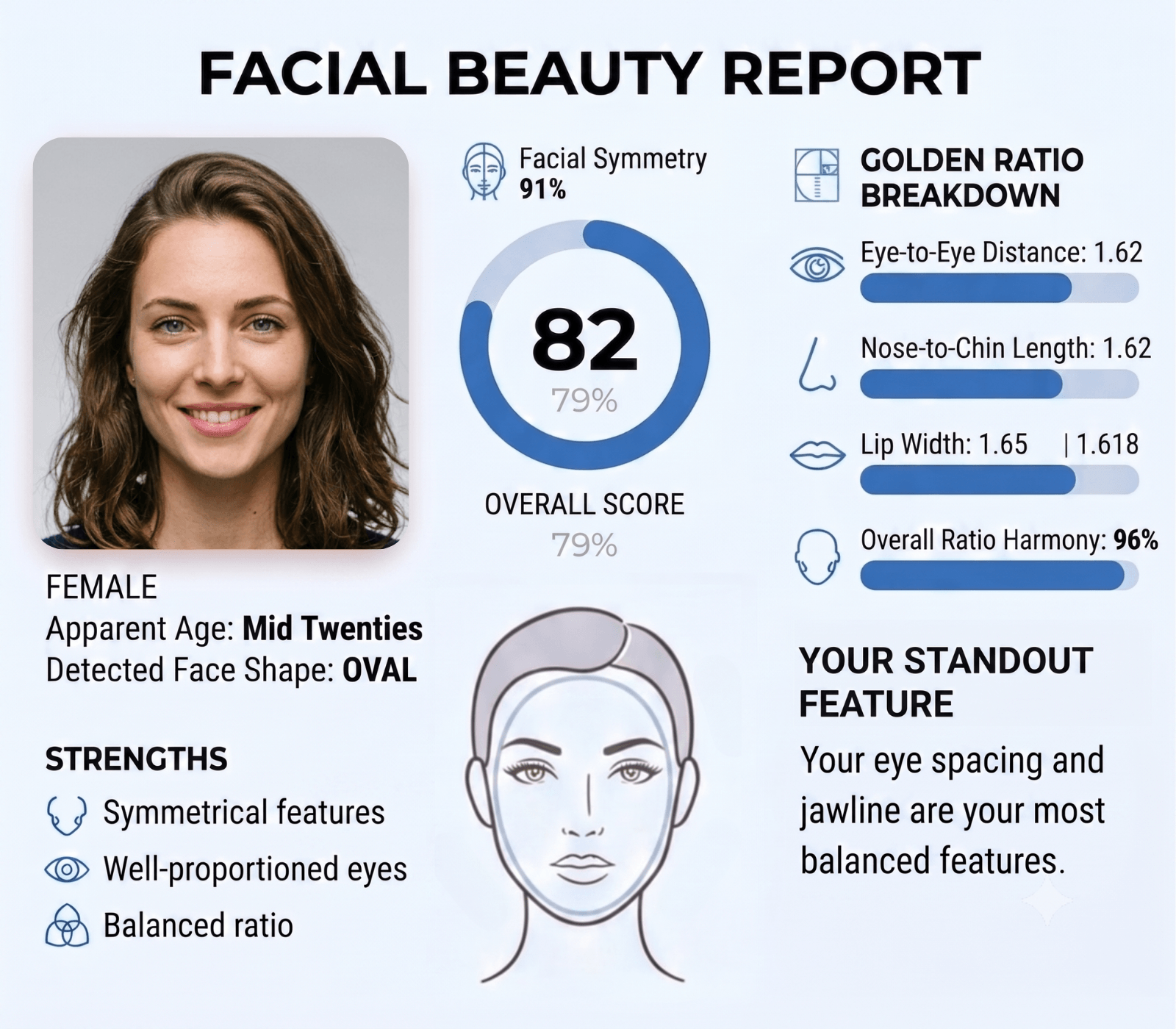
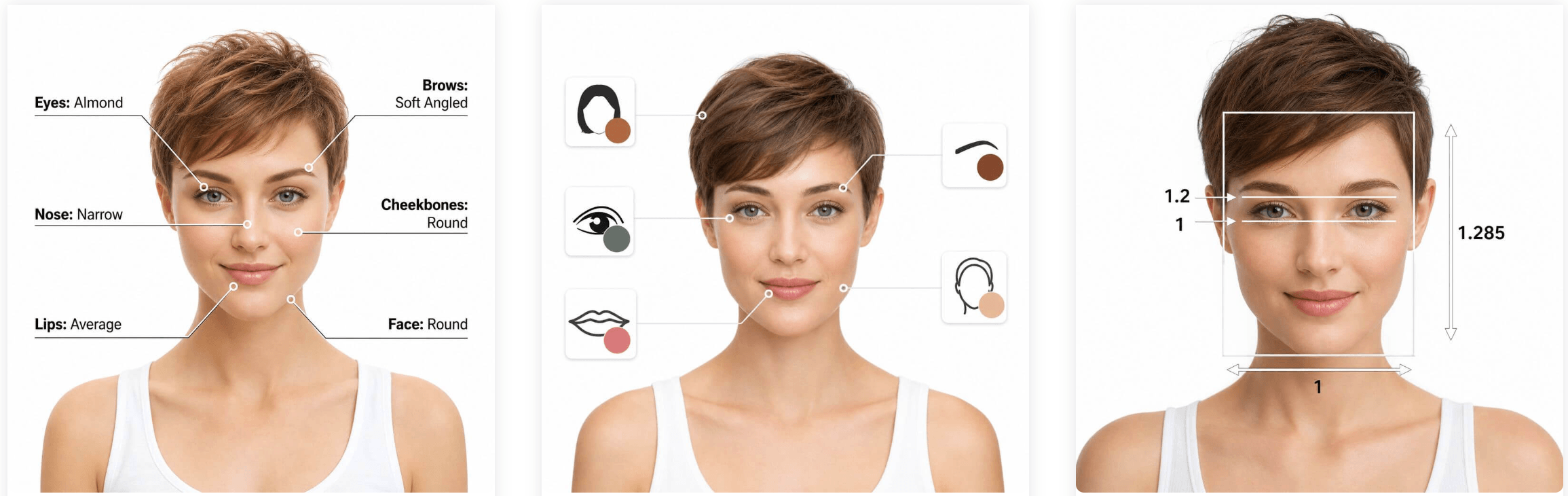
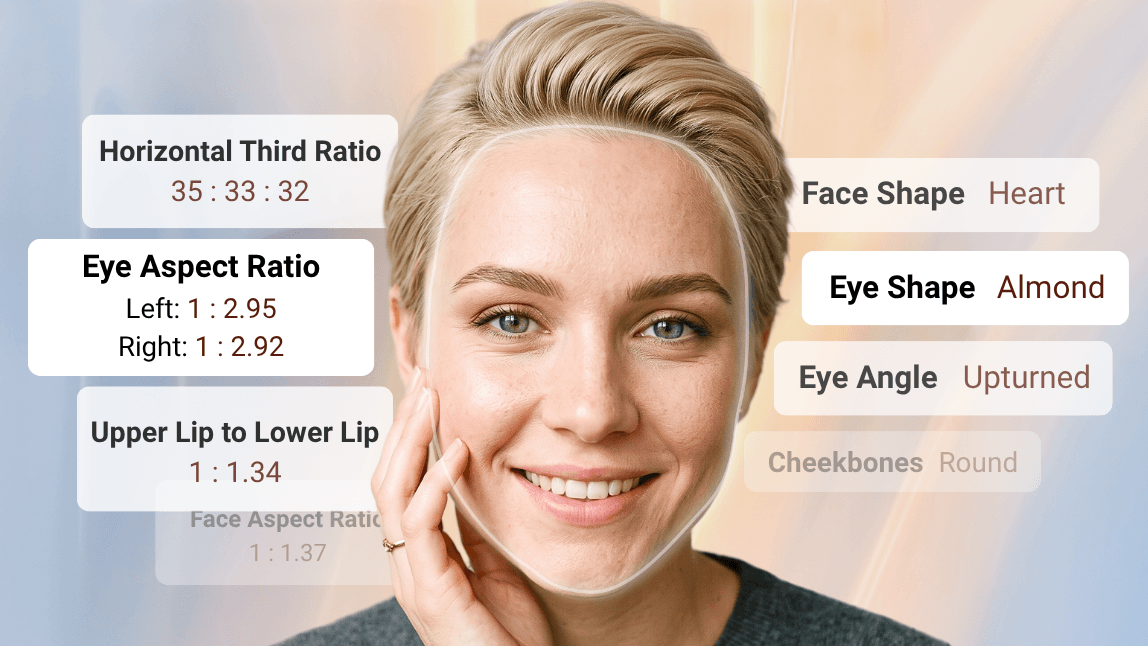
Once it's running, expect your app to hand back something like this: an overall score out of 100, a labeled face shape, a symmetry percentage, a facial ratio breakdown comparing key measurements against the golden ratio, an estimated age range, and a short list of standout features written in plain, friendly language rather than clinical terms.
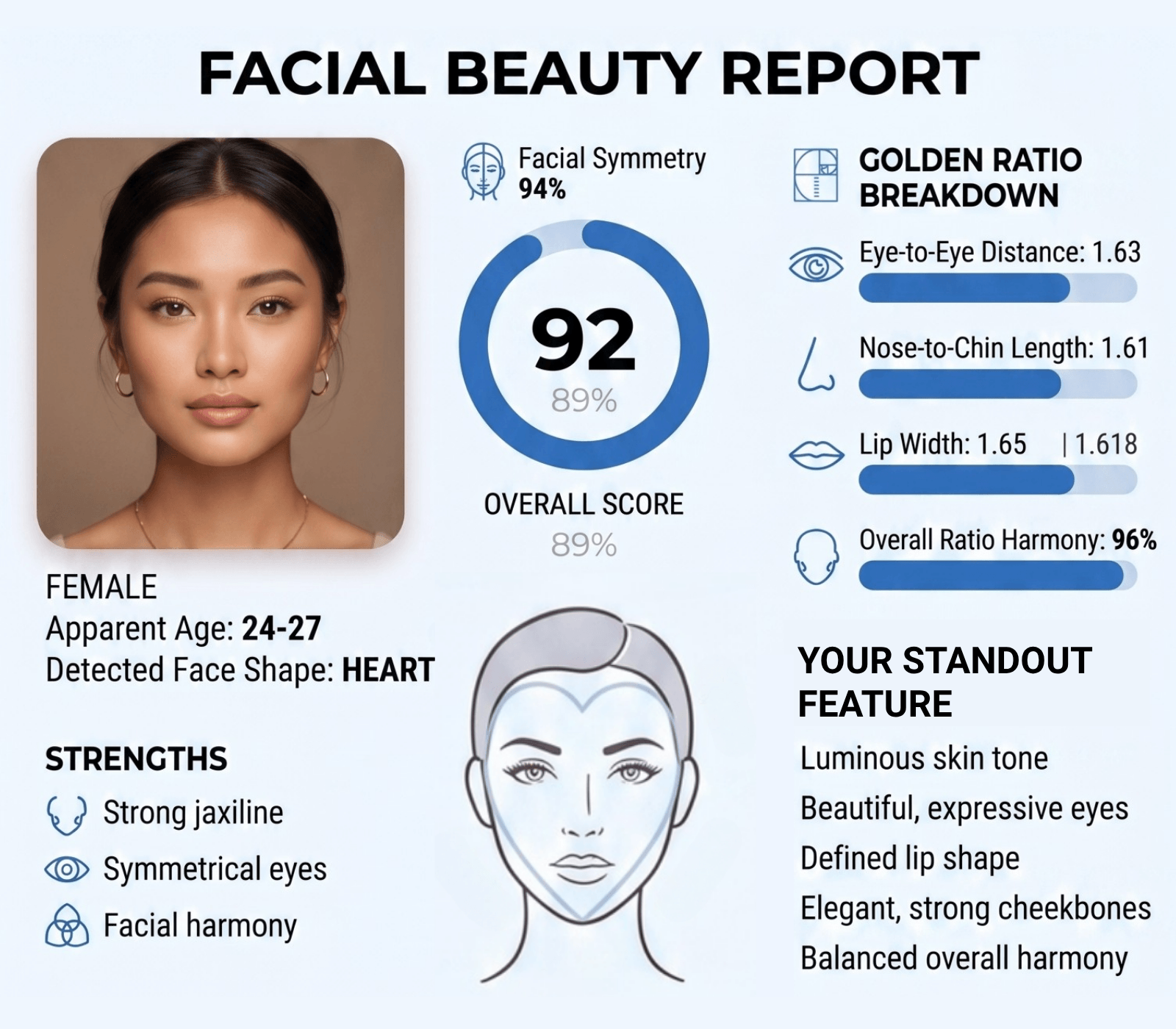
A sample result card might read something like this: overall score 82 out of 100, face shape oval, symmetry 91 percent, facial ratio close to the golden ratio around the eyes and nose, estimated age range mid twenties, and a note that "your eye spacing and jawline are your most balanced features."
None of that is a diagnosis. It's a snapshot, generated instantly, that you can tweak the wording and presentation of however you like since you own the code.
What Is Face Analysis, Exactly?
Face analysis is the use of AI to measure and score facial characteristics, such as symmetry, proportions, shape, and perceived age, from a single photo. Tools translate these measurements into a report, often including a numeric score, a face shape label, and a ratio breakdown.
It sits at the intersection of computer vision and beauty tech, and it's the same underlying technology that powers virtual try-on filters, skincare diagnostics, and hairstyle recommendation tools.
What Do Face Analysis Tools Actually Measure?
Not every "face score" app measures the same things, but most pull from a similar set of core metrics. Here's the breakdown:
| What It Looks At | What It Measures |
|---|---|
| Symmetry | How closely the left and right halves of the face mirror each other |
| Face shape | Oval, round, square, heart, diamond, and so on |
| Facial ratios | Distance between eyes, nose to chin length, golden ratio comparisons |
| Perceived age | An AI's best guess at how old a face looks |
| Eye shape and tilt | Almond, round, hooded, upturned or downturned corners |
| Skin tone and attributes | Undertone, evenness, and general skin impression |
Perfect Corp's own AI Face Analyzer covers most of this list in a single scan, which is exactly the kind of engine you'll be wiring into your own app in a few minutes.
Why Trust the Score? A Quick Note on Accuracy
Facial detection models have gotten dramatically better over the past decade.
Perfect Corp's face and skin analysis technology already runs across scans for 800+ brand partners, which is a useful reference point when you're deciding which API to plug into your own app.
A model tested at a big scale has seen a lot more variety in faces, lighting, and camera quality than one trained on a small dataset.
The Problem With Most "Free" Face Score Sites
It's Not Free
Here's the part nobody puts in their marketing copy. A lot of "free" face analysis tools aren't really free. The scan is free. The actual report, the one with your face shape, symmetry percentage, and detailed breakdown, is often locked behind a paywall that can run you upward of ten to twenty dollars for a single report.
Data Issue
Then there's the data question. Many of these tools ask for an email or account before showing you anything, and their privacy pages are vague about how long your photo sits on their servers, or who else might see it. If you've ever hesitated before uploading a selfie to a random site, that instinct is worth listening to.
The Scores Are Inconsistent
And even when a tool is genuinely free, the scoring can feel inconsistent from one site to the next. Upload the same photo to three different face analyzers and you can walk away with three different symmetry scores. There's no shared standard, so results vary with whatever algorithm sits behind the curtain.
None of this makes these tools bad, exactly. It just means you're trusting a third party with your face, your email, and sometimes your credit card, in exchange for a number you could generate yourself in about the same amount of time it takes to fill out their signup form.
Could This Actually Make You Money?
Once your app works, you're not far from a real product. A few directions worth considering:
- Add a freemium layer. Keep the basic score free, charge a small fee for the full breakdown or a downloadable report.
- License it to beauty or skincare brands.
- Turn it into a lead magnet. Salons, dermatology clinics, and eyewear retailers can use a face analysis tool to start a conversation before a booking.
- Build an audience feature. A shareable "what's your face score" result page is the kind of thing people post, which brings in traffic without ad spend.
None of this requires a big team. It requires one working prototype, which you now know how to build in an afternoon.
The gap between "fun weekend project" and "small side business" is usually a handful of extra features, a payment provider, and a reason for people to come back.
Face Analysis vs. Face Shape Detector vs. Beauty Score Calculator: What's the Difference?
These terms get used interchangeably, but they're not quite the same thing, and knowing the difference helps you decide what to actually build first.
| Tool | What It Focuses On | Typical Output |
|---|---|---|
| Face analysis | The full picture: symmetry, ratios, shape, age, skin, and more | A multi part report |
| Face shape detector | Just the shape category (oval, round, square, and so on) | A single label plus styling tips |
| Beauty score calculator | A single composite number, usually based on symmetry and proportion | One score out of 100 |
If you only need a shape label for a hairstyle app, a face shape detector is enough. We actually put eight of them head to head in a separate test. But if you want the full picture, symmetry, ratios, age, and shape together, face analysis is the broader, more useful tool, and it's the one worth building first.
FAQ: Building Face Analysis With Claude
Is face analysis accurate?
It's a reasonable estimate, not a scientific measurement. Results depend on lighting, camera angle, and the underlying model, so treat scores as directional rather than exact.
Is it safe to use AI face analysis tools?
It depends entirely on who built the tool and what they do with your photo afterward. That's the whole argument for building your own: you decide where the image goes, and you can set it up so the photo never touches a disk at all.
Do I need to know how to code to build this?
No. Claude Code writes the front end, backend, and API integration for you from the single prompt above. Basic comfort with a terminal helps, but it's not required.
How much does it cost to build a face analysis app with Claude?
The YouCam API offers 40 free credits to start, and Claude Code itself runs on your existing Claude plan. Your only real cost is the small amount of API usage once you go beyond the free tier.
Can I turn this into a real business?
Yes. Freemium reports, brand licensing, and lead generation for salons or skincare retailers are all realistic paths once your prototype is working.
What's the difference between face analysis and a beauty filter?
A beauty filter changes how your face looks. Face analysis measures and reports on your face as it already is, without altering the image.
Can I deploy this app publicly once it works?
Yes. Once you've confirmed it locally, ask Claude Code to walk you through deploying the frontend and backend separately, and remember to keep your API key on the server side, never in client side code.
What happens if the API call fails?
A well built prompt already asks Claude to add error handling, so your app should show a clear message instead of a blank screen. If it doesn't, ask Claude to add a specific error state for failed uploads and expired or missing API keys.
Build It Before Someone Else Does
You've got the prompt, the API, and the plan. The only thing left is opening Claude Code and running it. Whether you're doing this for fun, for a portfolio project, or as the first version of a real product, the barrier to entry has never been lower.