 Author:


A watch is the only piece of jewelry most people wear every single day, and it is the one they think about least. Wrong wrist, wrong tightness, wrong case for the arm it is sitting on, and a very good watch starts looking borrowed. The good news is that wearing a watch well is not a matter of taste. It is a matter of proportion, placement, and a handful of rules that have survived a century of dress codes. This guide covers all of them, then goes one step further into the part nobody talks about, which is how to check the fit before you spend the money. AI sizing tools and AR try-on have quietly turned "I hope it looks right" into something you can see in about ten seconds.
What this guide covers:
- What does it actually mean to wear a watch well?
- Which wrist should you wear a watch on?
- Where should a watch sit on your wrist?
- How tight should a watch be?
- What size watch should you wear for your wrist?
- How do you match a watch to your outfit?
- Should your watch go over or under your sleeve?
- How do you wear a watch with bracelets or a smartwatch?
- How do you wear a watch on a very small or very large wrist?
- Does wearing a watch work differently for women?
- How can you tell if a watch suits you before you buy it?
- What are the most common watch-wearing mistakes?
- Watch-wearing FAQ
What Does It Actually Mean to Wear a Watch Well?
Wearing a watch well means the case sits just behind the wrist bone on your non-dominant arm, the band is snug enough that the watch does not slide more than about half an inch, and the case diameter stays in proportion to your wrist so the lugs never hang over the edge. Everything else, including brand, price, and complications, is decoration.
That is the whole discipline in one paragraph. The rest of this article is the reasoning behind it, because the rules bend in interesting ways once you know why they exist.
Try the AR Watch Try-On and Wrist Sizer, or test the technology in our AI API Playground if you want to build it into your own storefront.
Which Wrist Should You Wear a Watch On?
The default answer is the non-dominant wrist. For roughly 90 percent of people that means the left. The logic is mechanical rather than ceremonial. Your dominant hand does the writing, the lifting, and the door handles, and a watch on that arm collects knocks, catches on cuffs, and interrupts the movement it is strapped to. Crowns also traditionally sit at three o'clock, which digs into the back of the hand when the watch is worn on the right and the wrist is flexed.
So the rule is not "left". The rule is "the arm you use less".
Is It Wrong to Wear a Watch on Your Right Hand?
No. Left-handed wearers have been putting watches on the right wrist for as long as wristwatches have existed, which is exactly why "destro" cases with the crown at nine o'clock are a category and not a curiosity. Plenty of right-handed people also wear right, usually because they type all day and the case rubs the desk. Nobody in the room will notice. If it bothers you, a destro or a screw-down crown solves the comfort problem entirely.
Why Do Some People Wear the Dial Facing Inward?
This one is not a style choice, at least not originally. Soldiers, pilots, and mechanics turned the dial to the underside of the wrist so the glass would not glint, would not smash against equipment, and could be read while both hands were occupied on a control or a steering wheel. Motorcyclists still do it because a hand on the throttle puts the inner wrist right in the line of sight.
Worn indoors with a jacket, an inward dial reads as either deeply practical or slightly affected, depending on the room. It is not a mistake. It is just a statement, so make it deliberately.
Where Should a Watch Sit on Your Wrist?
Just behind the ulna, the knobby bone on the outside of your wrist, with the case body resting on the flat of the forearm. Not on top of the bone, which makes the watch rock every time you move. Not down toward the hand, which is where a loose bracelet always ends up and which is the single most common reason a well-chosen watch looks sloppy.
There is a simple test. Rest your forearm flat on a table, palm down. The watch should stay put. If it slides toward your hand under its own weight, the band is too long, not the watch too large.

Sports watches are the one accepted exception. Divers and chronographs with thick cases are often worn a touch further back on the arm so the case clears the wrist bone during movement, which is also why dive bracelets have micro-adjustment in the clasp.
How Tight Should a Watch Be?
Snug, with about a finger's worth of give. The classic test is to slide one fingertip between the band and your wrist. If it goes in without a fight and cannot be joined by a second finger, the fit is right. The watch should be able to rotate slightly and travel no more than roughly half an inch when you shake your arm.
Too tight leaves a red band and, on a metal bracelet, pinches skin at the clasp. Too loose is worse, because the watch migrates onto the back of the hand, catches every cuff, and reads instantly as a hand-me-down.
| What you notice | What it means | The fix |
|---|---|---|
| Watch slides toward your hand when you lower your arm | Band is one or two links too long | Remove a link, or move to the next strap hole |
| Red indentation after a few hours | Too tight, restricting circulation | Add a half link or use the clasp micro-adjustment |
| Watch rocks or taps when you type | Case is sitting on top of the wrist bone | Slide it back along the forearm and re-tighten |
| Strap tail flaps loose | Strap length is wrong for your wrist | Switch to a shorter strap or a keeper loop |
| Fit is perfect in the morning, tight by evening | Normal wrist swelling of up to 5 percent | Fit for the afternoon, not first thing |
That last row is the one people miss. Wrists swell through the day, in heat, and after exercise. Size a bracelet in the evening and it will be comfortable at every other hour.
What Size Watch Should You Wear for Your Wrist?
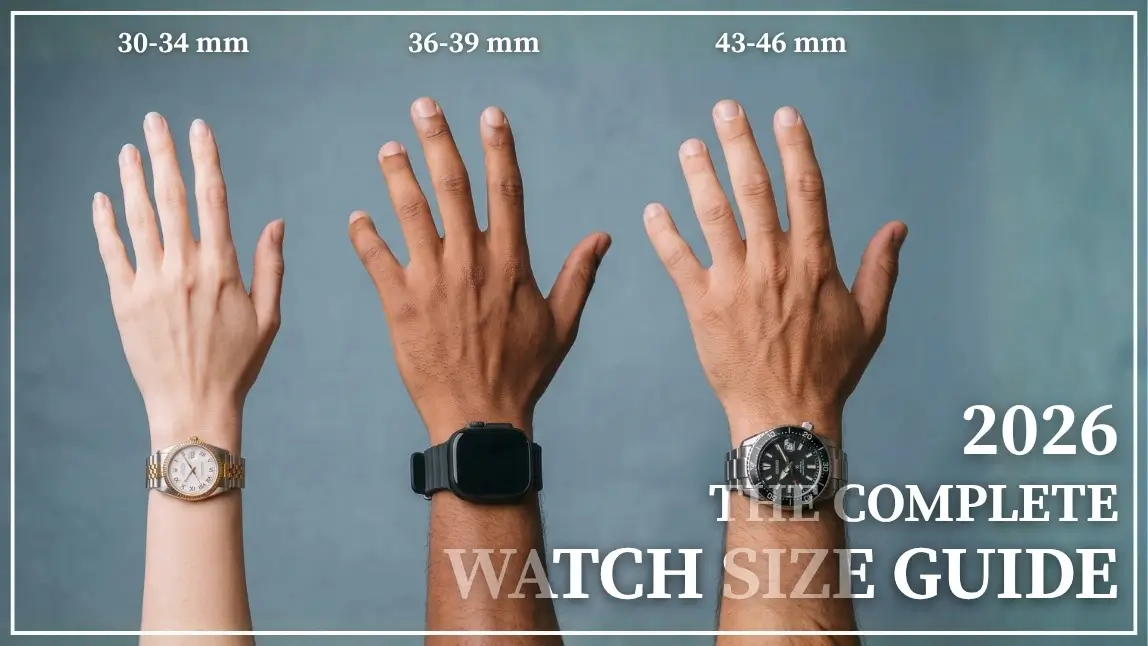
Case diameter should track wrist circumference. The proportions below are the working consensus across most retailers and they hold up well in practice.
| Wrist circumference | Case diameter | Maximum lug-to-lug |
|---|---|---|
| Under 6 inches (15 cm) | 32mm to 36mm | 44mm |
| 6 to 6.5 inches (15 to 16.5 cm) | 36mm to 38mm | 46mm |
| 6.5 to 7 inches (16.5 to 18 cm) | 38mm to 40mm | 48mm |
| 7 to 7.5 inches (18 to 19 cm) | 40mm to 42mm | 50mm |
| 7.5 inches and up (19 cm plus) | 42mm to 46mm | 54mm |
Here is the number that matters more than diameter, and that most size charts skip. Lug-to-lug is the distance from the tip of one lug to the tip of the other, and it decides whether the watch physically fits the flat part of your arm. A 40mm case with long lugs can overhang a 6.5 inch wrist while a 42mm case with short curved lugs sits perfectly. If the lugs extend past the edge of your wrist, the watch is too big, whatever the diameter says.

Thickness is the third variable. Anything over about 13mm starts to fight a shirt cuff, which matters more than it sounds and gets its own section below. For the full breakdown of case dimensions and how to measure yours, see our watch size guide.
How Do You Match a Watch to Your Outfit?
Two rules do most of the work, and both are about matching materials rather than colors.
Do You Have to Match Your Watch to Your Belt and Shoes?
Match leather to leather and metal to metal. A brown leather strap belongs with brown shoes and a brown belt. A black strap belongs with black. That is the rule people quote, and it is worth following in formal settings because the eye genuinely does read a mismatched strap as an accident.
The metal rule is the one that gets ignored more often and shows more. Your watch case, buckle, belt hardware, cufflinks, and ring should broadly agree. Yellow gold with yellow gold. Steel with silver. Mixing metals is now common and can look deliberate, but only if it is repeated somewhere else in the outfit rather than appearing exactly once on your wrist.

Steel bracelets are the escape hatch. They are close enough to neutral that they work with almost anything, which is part of why the steel sports watch became the default of the last decade.
Which Watch Goes With Which Dress Code?
| Dress code | Watch that works | What to avoid |
|---|---|---|
| Black tie | Slim dress watch, under 9mm thick, black leather or precious metal | Dive watches, rubber straps, anything oversized |
| Business formal | 36mm to 40mm dress or classic steel watch, leather or bracelet | Loud dials, bright NATO straps, chunky chronographs |
| Business casual | Steel sports watch, field watch, GMT | Formal gold dress watches, which read as costume |
| Smart casual and weekend | Anything you like, including color, canvas, and rubber | Overthinking it |
| Outdoor, gym, travel | Dive watch, tool watch, smartwatch, rubber or nylon | Leather straps, which sweat and stain |
One useful heuristic runs underneath the whole table. The more formal the outfit, the thinner and quieter the watch. Formality has always been about restraint, and a watch is the easiest place to lose it.

Should Your Watch Go Over or Under Your Sleeve?
Under, with the shirt cuff just covering the case and the watch appearing when you move your arm. That flash of dial is the entire point of wearing a watch under a jacket, and it only happens if the case can clear the cuff without a struggle.
Which is where thickness quietly decides your wardrobe. A dress watch of 7mm to 9mm slips under any cuff. A 12mm sports watch is workable with a slightly loose cuff. Anything past 14mm will snag, ride up the sleeve, and eventually wear a shine into the fabric. If you live in tailored shirts, case height matters more than case diameter.
Over the sleeve, sometimes called the Agnelli, is a real style with a real history and no place at all in a business meeting. Wear it on a knit or a sweater cuff if you like it. Do not wear it with a dress shirt and expect it to read as anything other than a choice.
How Do You Wear a Watch With Bracelets or a Smartwatch?
Stacking is where modern watch wearing has drifted furthest from the old rulebook, mostly because a lot of people now have a fitness tracker and a mechanical watch and only two wrists.
Three practical guidelines cover almost every case. First, keep the bracelet stack on the same side as the watch only if the pieces are slim and the metals agree, and always leave the dial fully visible. Second, put anything bulky on the opposite wrist, because a chunky bead bracelet next to a 42mm case scratches the case and crowds the arm. Third, if a bracelet's clasp or beads can contact the crystal, move it. Sapphire resists scratching, but a steel bracelet edge against a polished case flank does real damage.
Double-wristing, meaning a smartwatch on one arm and a mechanical watch on the other, is now completely normal and reads as practical rather than eccentric. The alternative is a hybrid arrangement, tracker on the underside of the same wrist, which works but looks exactly like what it is.

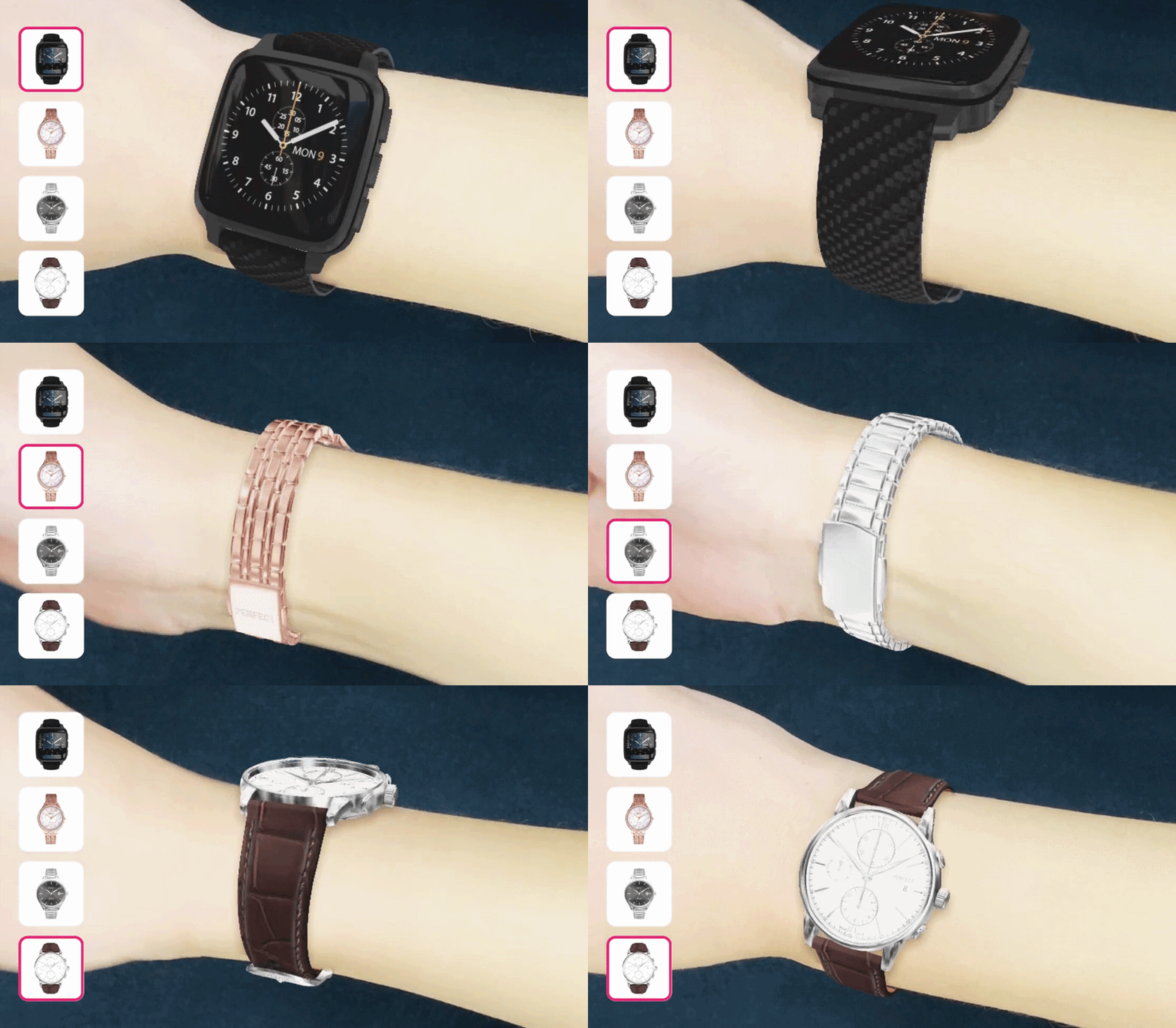
For stacking specifically, sizing is the failure point. A bracelet that fits a 6.5 inch wrist on its own can be uncomfortable once a watch bracelet takes up space on the same arm. Brands solve this with sizing tools such as virtual watch try-on, which measures wrist circumference from a phone camera and shows the stack before it is bought.
How Do You Wear a Watch on a Very Small or Very Large Wrist?
The proportion rules do not change at the extremes. What changes is how much margin for error you have, and the answer at both ends is very little.
Small Wrists, Under 6.5 Inches
Lug-to-lug is your governing measurement, not diameter. On a 6 inch wrist almost nothing above 46mm lug-to-lug will sit flat, which rules out plenty of 38mm watches with long straight lugs while leaving 40mm watches with short curved lugs entirely wearable. Look for tapering bracelets, which narrow toward the clasp and visually slim the whole package, and avoid tall bezels, which make a case read larger than its diameter.
The other lever is strap width. A 20mm strap on a 6 inch wrist covers a large share of the visible arm. Dropping to 18mm, where the lug width allows, makes the same watch look considerably more balanced.

Large Wrists, Over 7.5 Inches
The instinct is to go big, and it is usually right, but not past the point where the watch becomes the outfit. A 44mm case on an 8 inch wrist is proportional. A 50mm case is a conversation you did not ask to have. Bracelet length is the practical problem here, since many watches ship with bracelets that max out around 7.75 inches and need an extension link ordered separately. Check the maximum bracelet size before buying, not after.
Thicker straps and wider lug widths are the friend of a larger wrist. A 22mm or 24mm strap fills the arm properly where an 18mm strap looks like a shoelace.
Does Wearing a Watch Work Differently for Women?
The mechanics are identical. Non-dominant wrist, behind the wrist bone, one finger of give. What has changed is the sizing convention, and it has changed fast.
For decades women's watches were sized 26mm to 34mm by default, and anything larger was sold as a men's watch. That distinction has mostly collapsed. Case sizes between 34mm and 38mm are now the busiest part of the market and are worn by everyone, which means a woman with a 6.5 inch wrist has the entire vintage-proportioned catalog available to her rather than a small corner of it.

The practical guidance is the same as for anyone else. Measure the wrist, respect lug-to-lug, and ignore whether the model sits under a men's or women's heading on the website. A 36mm case on a 6 inch wrist is well proportioned regardless of what the product page calls it.
Where women's watch wearing does diverge is stacking, which is far more common, and metal coordination with existing jewelry, which is usually already established. If you wear yellow gold rings daily, a yellow gold case will simply work harder than a steel one.
How Can You Tell If a Watch Suits You Before You Buy It?
Traditionally you could not, which is why watch return rates have always run high in online retail and why "it looked bigger in person" is one of the most common complaints in the category. A product photo shot on a 6.5 inch model wrist tells you almost nothing about how the same case will sit on a 7.5 inch arm. Two pieces of technology have closed that gap, and they work best together.

Try the AR Watch Try-On and Wrist Sizer, or test the technology in our AI API Playground if you want to build it into your own storefront.
Step 1: Measure Your Wrist Without a Tape Measure
AI wrist sizing tools measure circumference from a phone or laptop camera, usually by asking you to hold a reference object such as a credit card next to your wrist for scale. The output is a measurement in inches or centimeters, which is the input every sizing chart in this article needs. It takes a few seconds and does not require a tape measure, which almost nobody actually owns.
Step 2: See the Watch on Your Own Wrist in AR
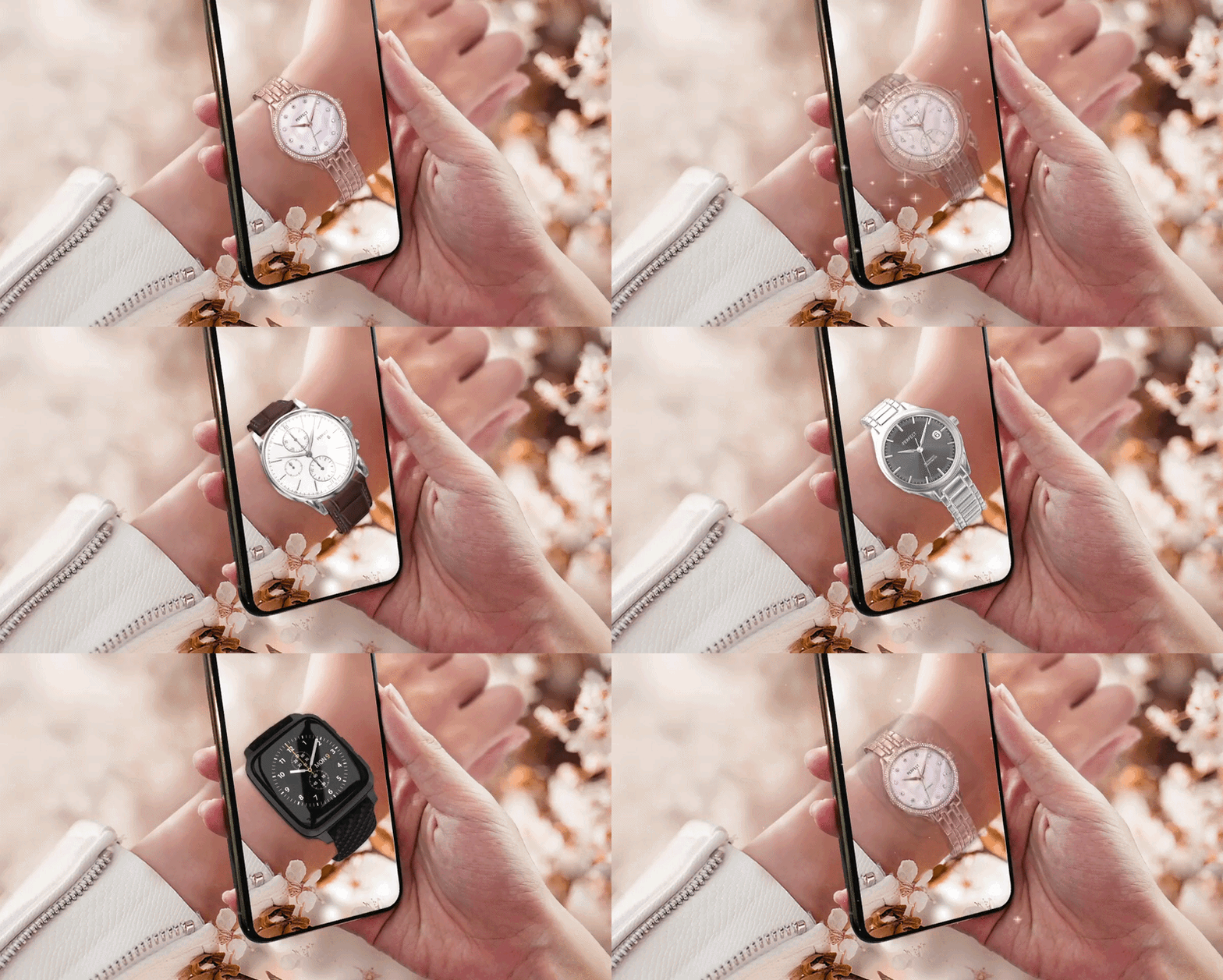
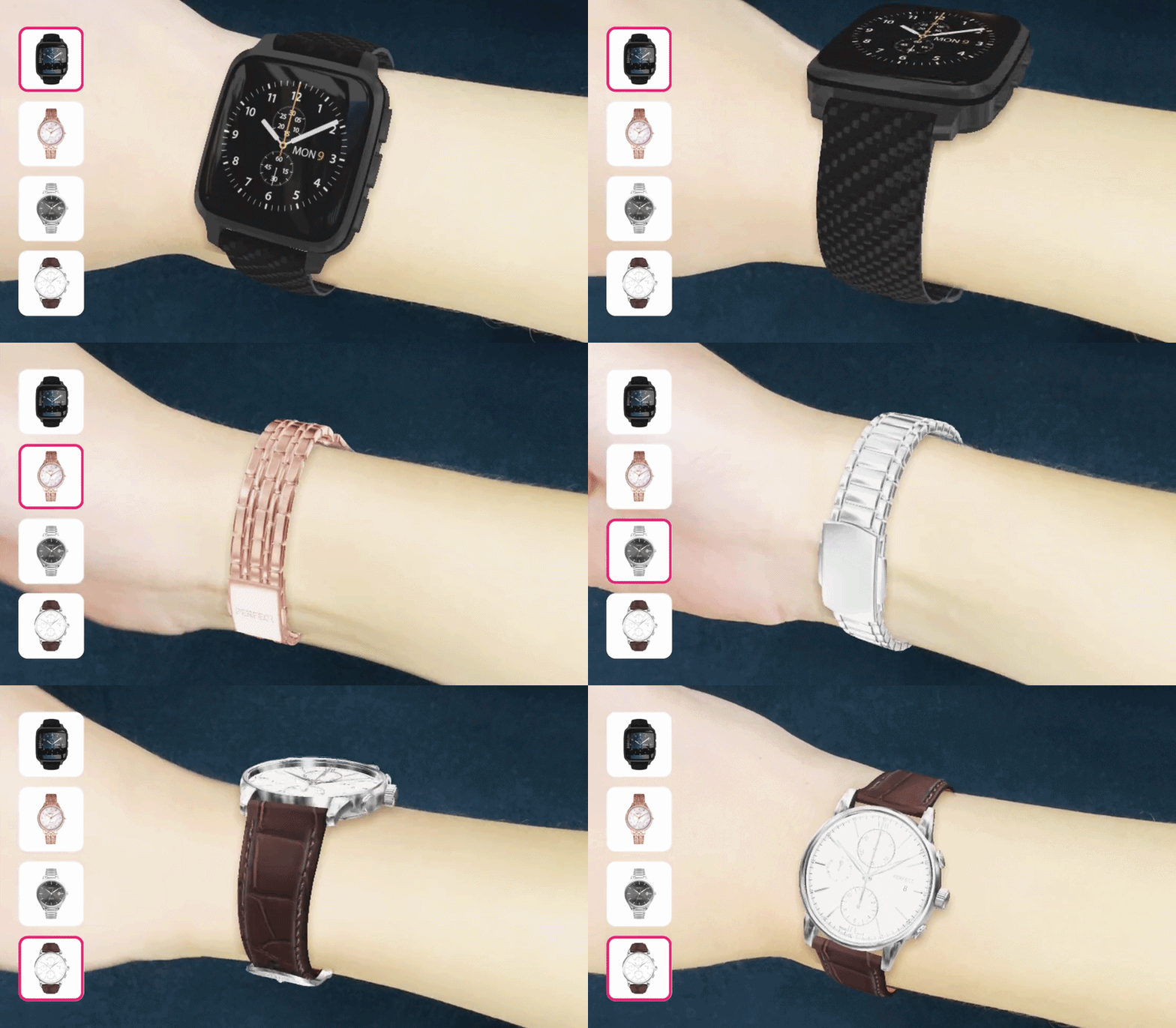
AR try-on renders a 3D model of the specific watch onto your wrist in real time, tracking as you rotate your arm. Modern implementations use physically based rendering, which means the metal reflects and the crystal catches light the way the real object would rather than looking like a sticker. You see the actual case-to-wrist proportion, the lug overhang, and whether the dial color works against your skin tone, all before checkout.
This is the part the top style guides skip, and it is the part that changes decisions. You can test the entire proportion rule from this article in about ten seconds instead of trusting a chart. Perfect Corp's AR watch try-on combines both steps, with wrist sizing and 360 degree 3D try-on running in a browser with no app download.
Try the AR Watch Try-On and Wrist Sizer, or test the technology in our AI API Playground if you want to build it into your own storefront.
Why Watch Retailers Care About This
For brands, the business case is straightforward. Sizing uncertainty is the main reason a watch shopper hesitates and the main reason a watch comes back. Letting a customer see correct proportion on their own wrist addresses both at once, which is why virtual try-on has moved from novelty to standard fitting in jewelry and watch ecommerce. Perfect Corp works with more than 800 brand partners across beauty and fashion tech, and the same AR and AI sizing stack that powers virtual makeup and jewelry try-on now covers watches, rings, bracelets, and eyewear.

Ready to see it work? Try the AR Watch Try-On and Wrist Sizer, or test the technology in our AI API Playground if you want to build it into your own storefront.
What Are the Most Common Watch-Wearing Mistakes?
Most watch mistakes are not taste failures. They are fit failures wearing a taste costume.
| Mistake | Why it reads badly | Fix |
|---|---|---|
| Bracelet left at factory length | Watch slides onto the back of the hand | Remove links until it travels less than half an inch |
| Case too large for the wrist | Lugs overhang the arm and the watch tilts | Check lug-to-lug, not just diameter |
| Thick sports watch under a tailored cuff | Snags, rides up, and wears the fabric | Keep case height under 12mm for shirt days |
| Brown strap with black shoes | The single most visible mismatch in an outfit | Own one brown and one black strap, or a steel bracelet |
| Dress watch on a rubber strap | Mixes two opposing formality levels | Match strap material to case formality |
| Leather strap worn swimming or to the gym | Sweat and water destroy leather quickly | Keep a rubber or nylon strap for active days |
| Buying online without checking proportion | Product photos are shot on one wrist size | Use AR try-on and wrist sizing before checkout |
Watch-Wearing FAQ
Which wrist should a man wear a watch on?
The non-dominant wrist, which is the left for most people. It keeps the watch out of the way of writing and daily impacts, and it stops the crown from pressing into the back of the hand. Left-handed wearers should use the right.
Is it OK to wear a watch on your right hand?
Completely. It is standard for left-handed wearers and increasingly common for everyone. If the crown is uncomfortable, look for a destro case with the crown at nine o'clock.
Where should a watch sit on your wrist?
Just behind the wrist bone, on the flat of the forearm, with the case body fully supported. If it rests on top of the bone it will rock, and if it sits toward the hand the band is too long.
How tight should a watch be?
Tight enough that you can slide one fingertip underneath but not two, and loose enough that it can rotate slightly. Total travel when you shake your arm should be under half an inch. Size it in the afternoon, since wrists swell through the day.
Should you wear a watch over or under your sleeve?
Under, in almost every situation. The cuff should just cover the case and reveal the dial when you move. Over the sleeve is a deliberate style with an Italian pedigree, but it does not belong with formal tailoring.
Do you have to match your watch to your belt and shoes?
In formal settings, yes for leather. Brown with brown, black with black. Metals should broadly agree too, so the case and buckle sit comfortably with your belt hardware and rings. A steel bracelet is neutral enough to skip the whole question.
Why do some people wear a watch with the dial facing inward?
It began with soldiers, pilots, and riders who needed to avoid glare and impact while their hands were occupied. Today it is mostly personal preference, and it still makes practical sense on a motorcycle or a keyboard.
How large or small should my watch be?
Match case diameter to wrist circumference, roughly 36mm to 38mm for a 6 to 6.5 inch wrist and 40mm to 42mm for a 7 to 7.5 inch wrist. Then check lug-to-lug, because a long-lugged 40mm case can overhang a wrist that a compact 42mm case fits comfortably.
Can you wear a watch with a suit?
Yes, and it is expected. Keep it slim, ideally under 12mm thick and between 36mm and 40mm across, on leather or a steel bracelet. Save the dive watch and the chronograph for less formal tailoring.
Can women wear men's watches?
Yes, and the categories are mostly marketing at this point. The 34mm to 38mm range works beautifully on a 6 to 6.5 inch wrist regardless of which section of the site it is listed under. Judge by measurements, not labels.
Is it OK to wear two watches at once?
Wearing a smartwatch on one wrist and a mechanical watch on the other is now common and entirely acceptable. Two watches on the same wrist is a fashion statement and should be treated as one.
Bracelet or strap: which should you choose?
A steel bracelet is the most versatile single option and handles sweat and water without complaint. Leather is dressier and more comfortable in cold weather but hates moisture. Rubber and nylon are for sport and travel. Owning two straps for one watch is the cheapest wardrobe upgrade in the category.
Should you wear a watch to a job interview?
Yes, and choose a quiet one. A modest dress or classic steel watch signals attention to detail. Anything conspicuously expensive or oversized shifts attention away from you, which is the opposite of what an interview needs.
Are there any occasions when you should not wear a watch?
Contact sports, weight training, and anywhere a hard case can injure someone or get crushed. Some formal traditions still frown on checking the time at a wedding or a funeral, so if you wear one, do not look at it.
Is it still OK to wear a pocket watch?
With a waistcoat or three-piece suit, absolutely, and it is a genuinely elegant option for black tie. With anything else it becomes a costume, which may or may not be the goal.
How do you know a watch will suit you before buying online?
Measure your wrist, check the case diameter and lug-to-lug against the charts above, then use an AR try-on tool to see the watch rendered on your own arm. Product photography is shot on one wrist size, so seeing it on yours is the only reliable proportion check short of visiting a store.
Want to test the fit rules from this article on your own wrist? Explore Perfect Corp's AR Watch Try-On and Wrist Sizer and see the proportions for yourself in a few seconds.