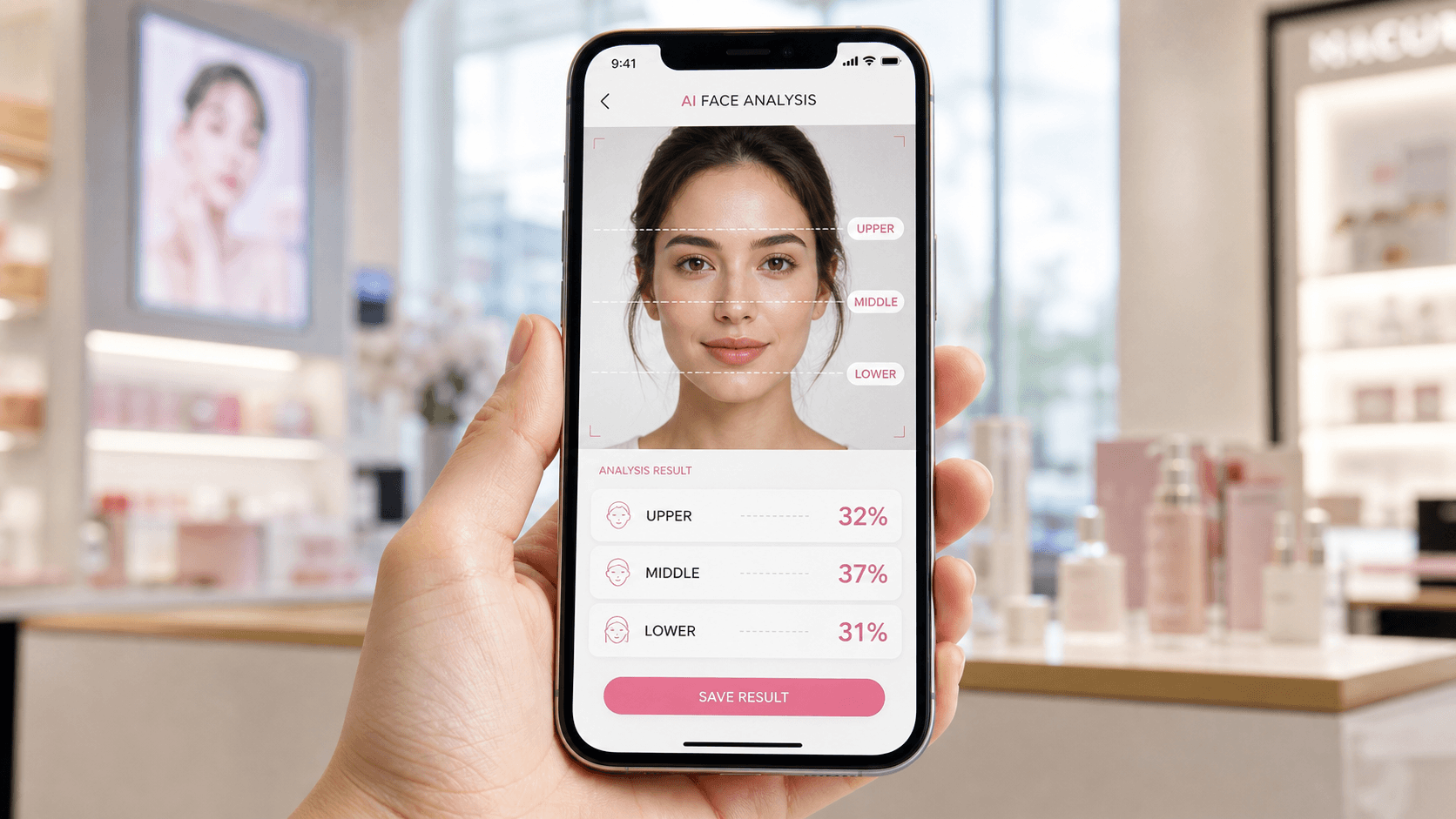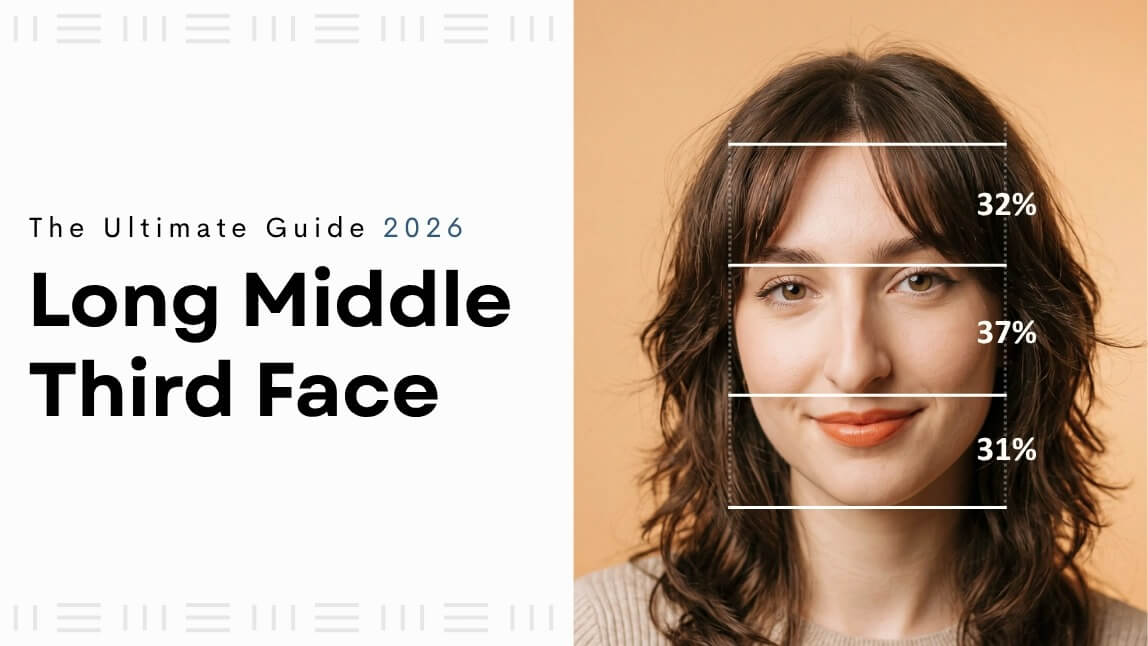
A long middle third face is a face where the section from the brow line to the base of the nose takes up noticeably more height than the other two thirds. In a balanced face, each third sits near 33 percent. When the middle band pushes past roughly 36 percent, the face reads longer, flatter through the cheeks, and slightly older than it is. It is a proportion, not a flaw.
That single sentence is most of what people are actually searching for. The rest of this guide is the part nobody explains properly: how to measure it without guessing, what the real numbers are, what causes it, what genuinely changes the look, and what only pretends to.
Fair warning. This topic has become a magnet for anxiety. Half the internet will tell you your midface is ruining your life. It is not. But proportion is real, it is measurable, and it is useful, both for people choosing a fringe and for brands building beauty tech. We will cover both.
What Is a Long Middle Third Face?

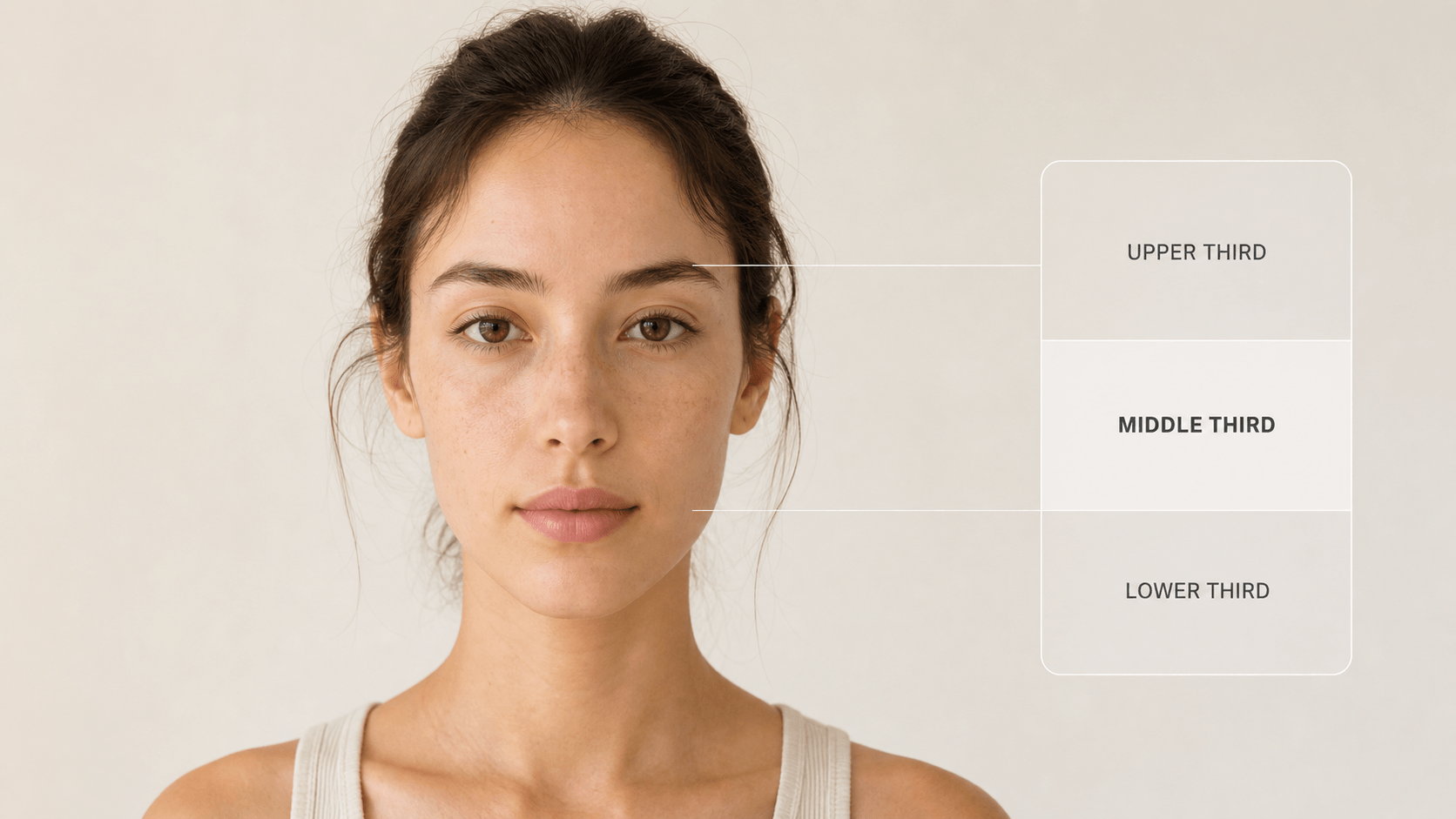
Your face divides into three horizontal bands. Artists have used them since the Renaissance, surgeons still plan around them, and AI facial analysis now measures them in under a second.
The three facial thirds, quickly
| Third | Runs from | Runs to | Contains |
|---|---|---|---|
| Upper third | Hairline | Brow line | Forehead |
| Middle third | Brow line | Base of the nose | Eyes, cheekbones, nose |
| Lower third | Base of the nose | Bottom of the chin | Lips, jaw, chin |

Classical proportion says all three should be roughly equal. Real faces almost never are, and that is fine. What people perceive as a "long middle third" is when that centre band clearly outruns the other two, usually because the distance from brow to nose base is stretched, the cheek area is flat, or the chin is short enough to shrink the bottom band by comparison.
Long middle third, long face, long midface: what is the difference?
These three phrases get used as if they mean the same thing. They do not, and mixing them up is why so much advice online misses.
| Term | What it actually describes | Measured how |
|---|---|---|
| Long middle third | The centre band takes up more than its share of face height | Middle third height compared with total face height |
| Long face pattern | The whole face is tall relative to its width | Total face height compared with face width |
| Low midface ratio | Eye width is small relative to eye to lip distance | Interpupillary distance divided by pupil to upper lip distance |
You can have a long middle third on a short, wide face. You can have a perfectly average middle third on a long face. They are different measurements answering different questions, and the fix for one is not the fix for another. Our companion piece on the midface ratio goes deeper on the third row of that table.
How Do You Know If You Have a Long Middle Third?
Three methods, in rising order of accuracy. Do at least two of them before you conclude anything.
Method 1: The photo and ruler test

- Take a front facing photo in even light, chin level, hair off the forehead, no smile.
- Mark three points: the natural hairline, the brow line (the top of the brow bone, not the drawn brow), and the base of the nose where it meets the upper lip.
- Measure hairline to brow, brow to nose base, and nose base to chin bottom.
- Divide each by the total, then multiply by 100.
If the middle number lands above about 36 percent, you have a long middle third. Between 30 and 36 percent is the ordinary range. Below 30 percent reads as a compact or short midface.
Method 2: The two finger check
Rough, fast, surprisingly decent. Place two fingers horizontally between the base of your nose and the bottom of your chin. Most balanced lower thirds fit roughly two finger widths. Then do the same from brow to nose base. If the middle needs noticeably more room than the lower, your centre band is the long one. It is a screening test, not a measurement, so treat it as a prompt to do method 1.
Method 3: AI facial analysis
The ruler method fails on the exact thing that matters most: consistency. Your hairline is fuzzy, the brow bone is a judgement call, and a two degree head tilt shifts everything. Facial analysis software solves that by detecting the same anatomical references the same way on every photo, then returning the ratios as numbers.
You can run this on yourself in a browser with the AI facial ratio analyzer, which returns your three thirds as percentages along with related proportions. It takes about as long as a selfie.
Try it yourself: Run the free Golden Ratio Face Calculator
What Counts as a "Long" Middle Third? The Actual Numbers
Here is where most articles wave their hands. Real reference ranges exist, and they are not the same for everyone.
| Middle third share of face height | Reads as | Roughly how common |
|---|---|---|
| Under 30% | Compact midface | Uncommon |
| 30% to 33% | Balanced, slightly compact | Very common |
| 33% to 36% | Balanced, slightly long | Very common |
| Over 36% | Long middle third | Common enough to be unremarkable |
Anthropometric research also reports the middle to lower third ratio, where a value near 1.00 means the two bands are equal. Published population averages differ by ancestry, which is the single most important caveat on this whole page.
What Causes a Long Middle Third?
Four causes account for nearly all of it, and they respond to completely different interventions.
Genetics and growth pattern
The dominant factor. Vertical maxillary growth, the height of the cheek and upper jaw region, is largely inherited. If your parents have tall midfaces, you probably do too. Nothing topical changes bone height.
Chronic mouth breathing during growth
This one is genuinely evidence backed and genuinely overstated online. Long term mouth breathing in childhood, often from enlarged adenoids or allergic congestion, is associated in the orthodontic literature with a more vertical growth pattern and a longer lower face. It is a childhood development factor, not something you can reverse in an adult by taping your mouth at night. If a child in your life snores, mouth breathes constantly, or has persistent congestion, that is a conversation for an ENT or orthodontist, and it is worth having early.
Midface volume loss with age
This is the one most adults are actually noticing. Cheek fat pads descend and shrink from the mid thirties onward. The bone did not get longer, but the light does not catch the cheek the way it used to, so the middle band looks flatter and taller. This cause is very responsive to makeup, and it is the reason a long middle third often reads as "tired" rather than "long".
A short lower third creating contrast
Sometimes the middle third is ordinary and the chin is simply short or recessed, which shrinks the bottom band and makes the middle look oversized by comparison. Worth checking before you spend a year trying to shorten a midface that is not long.
Does a Long Middle Third Actually Look Bad?
No. And the honest answer deserves more than one word.
Perceived attractiveness research consistently finds that no single measurement predicts much on its own. Faces are judged as wholes. Plenty of faces widely considered striking have middle thirds well outside the "ideal" band, because a long midface paired with strong cheekbones and a defined jaw reads as elegant, while the same length paired with a flat cheek and soft jaw reads as long. The proportion is not doing the work by itself.
What proportion analysis is genuinely good for is decision making. Knowing your middle third is 38 percent tells you which fringe will suit you, where blush belongs, whether tall glasses frames will help or hurt, and what a filler consultation should focus on. That is a practical use. Scoring yourself out of ten is not.

How Do You Shorten a Long Middle Third Without Surgery?
You cannot change the bone. You can change every single thing about how it is perceived, and the effect is larger than people expect. The governing principle is simple: break the vertical, add horizontal. Anything that draws a strong sideways line across the centre of the face shortens it visually.
Makeup and contour
| Technique | What to do | Why it works |
|---|---|---|
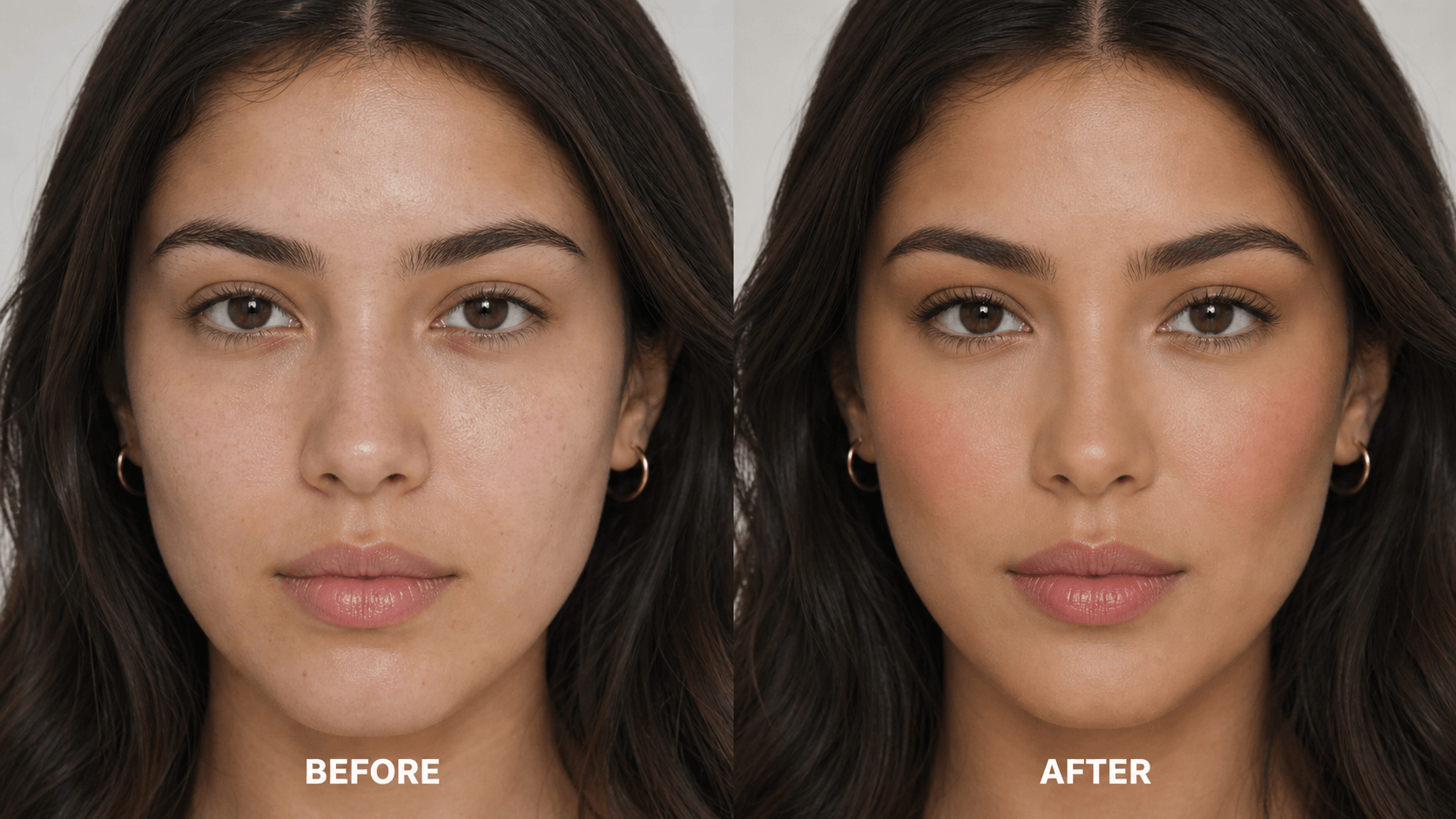
| Blush placement | High on the cheek, swept outward toward the temple, not down toward the jaw | Creates a horizontal band across the midface |
| Cheek highlight | A short horizontal sweep on the top of the cheekbone | Pulls the eye sideways at the widest point |
| Nose base shading | A whisper of shadow directly under the nose tip | Visually lifts the base of the nose, shortening the band |
| Under eye brightening | Brighten the tear trough, not the whole cheek | Restores the light the cheek used to catch |
| Brow shape | Slightly straighter, extended outward rather than arched high | A high arch adds vertical height to the band |
| Lip focus | Fuller, more defined lip colour | Weights attention toward the lower third |
The mistake almost everyone makes is contouring down the sides of the nose to slim it. On a long middle third, a long vertical nose shadow makes the whole band taller. Shade the base, not the length.
Hair and fringe

Hair is the highest leverage change available, because a fringe physically shortens the visible face and lowers the apparent hairline.
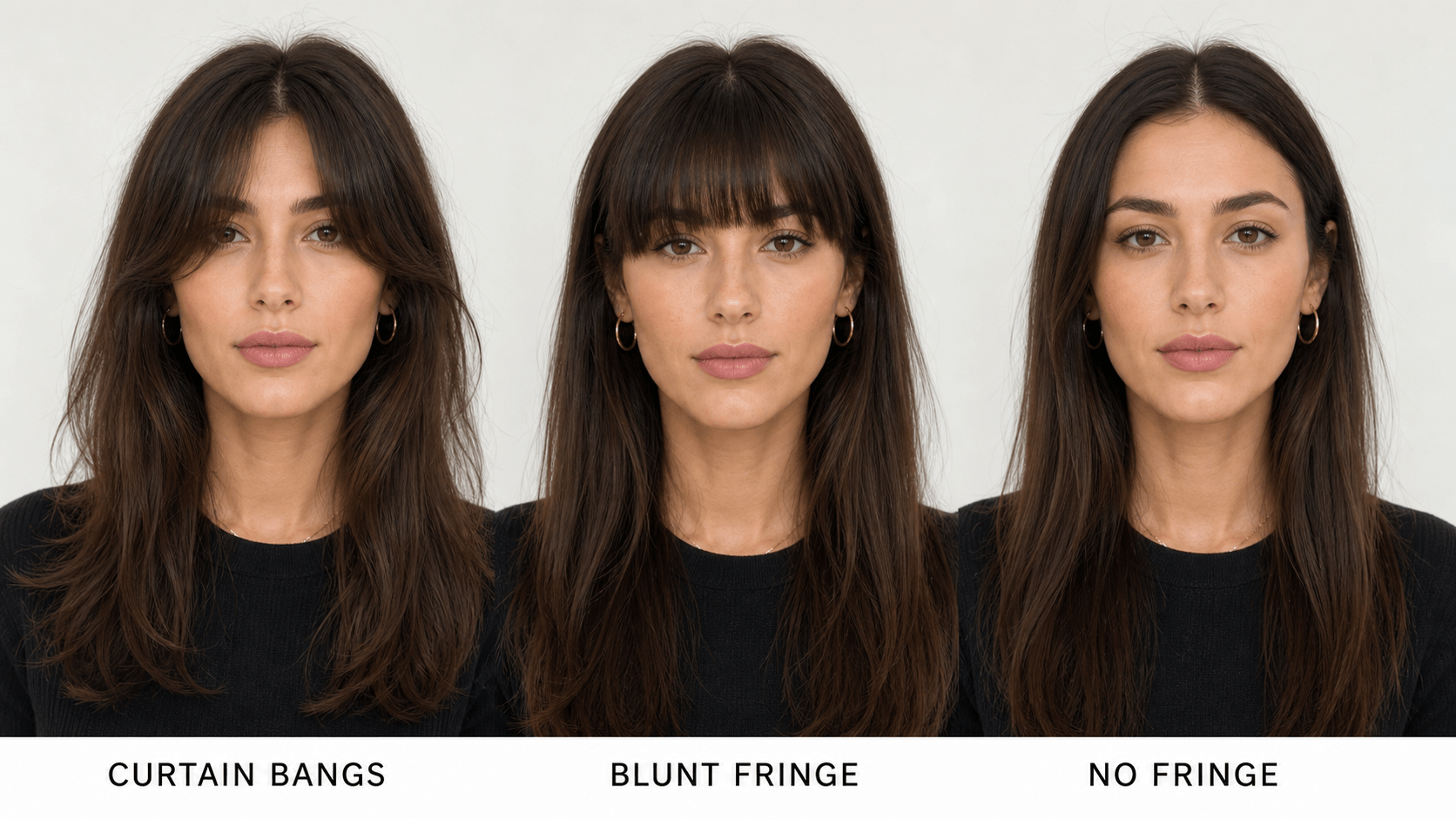
- Blunt fringe just above the brows. The strongest option. It caps the top of the middle third with a hard horizontal line.
- Curtain bangs. Softer, less commitment, adds width at the cheekbone while covering forehead height.
- Volume at the sides, not the crown. Height on top stretches everything. Width at ear level does the opposite.
- Avoid a severe centre part with flat, long hair. It draws two vertical lines straight down the face.
- Chin length and collarbone length cuts put a horizontal end point near the lower third, which helps the balance.
Eyewear

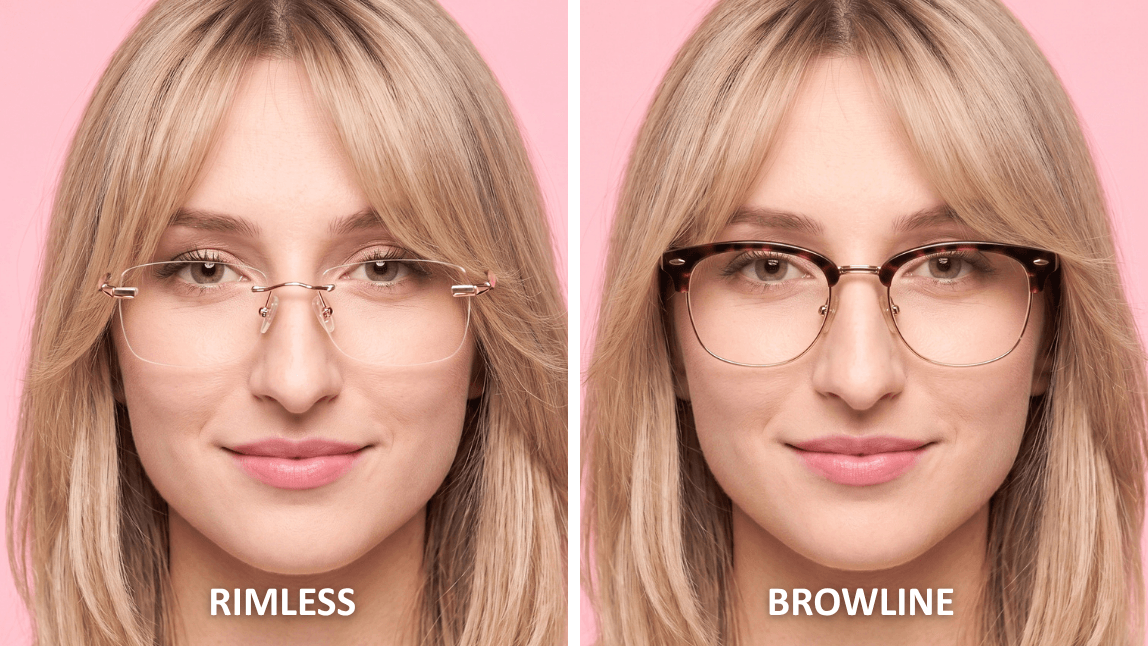
Glasses sit exactly across the middle third, which makes them unusually powerful. Choose frames that are tall enough to occupy real vertical space and wide enough to reach the outer edge of the face. Bold or contrasting upper rims work like a second brow line. Small, thin, low sitting rimless frames leave the band bare and let it read at full height.
Photography and angles
This section is missing from almost every guide on this topic, and it explains a lot of the anxiety.
A phone camera held at arm's length uses a short effective focal length. That exaggerates whatever is closest to the lens and stretches the centre of the face. Your midface genuinely looks longer in a selfie than it does in a mirror or to another person.
Shoot from about two metres away with the zoom at 2x or 3x, keep the lens at eye level rather than below the chin, and compare that photo to your selfie. Many people discover their "long midface problem" was partly a lens problem. Use the same setup every time when you measure, or your numbers will drift.
How Does AI Measure the Middle Third?

The short version: facial detection models identify the anatomical reference positions on a face, the system normalizes for head tilt and camera angle, and the ratios are computed from the corrected geometry.
The reason this beats a ruler is repeatability. A human measuring the same face twice will get two different brow line positions. A model applies the same definition every time, so a change in the number reflects a change in the face rather than a change in the measurer. That matters enormously for anything longitudinal, like tracking the result of a treatment, and it matters commercially, because a recommendation engine built on noisy measurements produces noisy recommendations.
Three practical accuracy notes worth knowing:
- Hairline detection is the weakest input. Receding, covered, or heavily styled hairlines reduce upper third accuracy. Measuring from the brow line is more stable.
- Head tilt is the biggest source of error in casual photos. Good systems correct for it, but a chin down selfie is still a worse input than a level one.
- Population reference matters. A result should be interpreted against relevant population data, not a single universal ideal, for the reasons in the ancestry table above.
Frequently Asked Questions About a Long Middle Third Face
What is a long middle third of the face?
It is a face where the band from the brow line to the base of the nose takes up more than roughly 36 percent of total face height, compared with the balanced range of about 30 to 36 percent. It affects how long the face reads, particularly through the cheek area.
How do I know if my middle third is long?
Take a level, front facing photo, mark the hairline, brow line, nose base, and chin bottom, then measure each of the three sections and convert to percentages of the total. If the middle section clears 36 percent, it qualifies. AI facial analysis gives the same result more consistently.
What is a good midface ratio?
For the interpupillary version of the measurement, roughly 0.95 to 1.05 is the commonly cited balanced range, with values meaningfully below 0.90 reading as a long midface. Note that this is a different measurement from the facial thirds percentage, and population averages vary by ancestry.
Can you fix a long middle third without surgery?
You cannot change the underlying bone height, but you can substantially change how long it reads. A fringe, horizontal blush and highlight placement, taller eyewear frames, straighter brows, and better camera distance all shorten the perceived middle third. Fillers and thread lifts offer a temporary structural adjustment without surgery.
Does a long middle third make you look older?
It can, though usually the causation runs the other way. Midface volume loss from the mid thirties onward flattens the cheek and makes an existing middle third look longer and more hollow. Restoring light and width across the cheek, with makeup or with volume treatment, reverses most of that impression.
Do bangs help a long middle third?
Yes, more than almost anything else. A blunt fringe sitting just above the brows caps the top of the middle band with a strong horizontal line and reduces visible face height. Curtain bangs achieve a softer version of the same effect while adding width at the cheekbone.
Can mouth breathing cause a long midface?
Chronic mouth breathing during childhood growth is associated in orthodontic research with a more vertical facial growth pattern. It is a developmental factor, so addressing it matters for children rather than adults. If a child snores, mouth breathes persistently, or has ongoing nasal congestion, an ENT or orthodontic assessment is worthwhile.
Is a long middle third the same as long face syndrome?
No. Long face syndrome describes a whole face that is tall relative to its width, often with an open bite and excessive gum display, and it is a clinical pattern. A long middle third is simply one band of the face taking up more than its share, and most people with one do not have the other.
Do selfies make my middle third look longer?
Yes. A phone camera at arm's length uses a short effective focal length that stretches the centre of the face. Shooting from about two metres away at 2x or 3x zoom, with the lens at eye level, gives a far more accurate picture. Always measure from the same setup so your numbers stay comparable.
How accurate is AI facial proportion analysis?
Modern facial detection systems measure the same reference positions the same way on every image, which makes them far more repeatable than manual measurement. Accuracy depends on input quality, so even lighting, a level head position, and a visible hairline all improve the result. Treat any single measurement as one data point rather than a verdict.
How do beauty brands use middle third analysis?
Brands use measured facial proportions to personalize contour and blush guidance, recommend hairstyles and eyewear, tailor product suggestions, and support aesthetic clinic consultations with consistent documentation. The analysis is typically delivered through a facial analysis API embedded in an app, website, or in store experience.
The Takeaway
A long middle third face is a measurement, not a diagnosis. Measure it properly, once, from a photo taken at a sensible distance. Compare it against a population reference rather than a single internet ideal. Then use the number for what it is genuinely good for: choosing the fringe, placing the blush, picking the frames, and skipping the advice that was never going to work on your face anyway.
And if you are building the tool rather than using it, the demand is already there. People are measuring their own faces today with rulers and bad selfies. Giving them an accurate answer is the easy part.
Ready to see your own numbers? Analyze your facial thirds with AI
Author: