Author:
Disclaimer: Some images in this article may have been created or modified by AI
Gray in the beard arrives faster than gray on the head, and it never asks permission. That is why men's beard dye has quietly become one of the busiest aisles in men's grooming, sitting somewhere between a five minute confidence fix and a decision people genuinely lose sleep over. The tricky part was never the dyeing. It was the guessing. One shade too dark and you look like a stencil. One shade too warm and your beard glows orange in daylight. The good news in 2026 is that you no longer have to find out after the fact, because AI and AR try-on can show you the result on your own face first. Here is the full playbook, from shade math to skin stains.
Table of Contents
Can You See Your Beard Color Before You Commit?
Yes, and this is the single biggest change in how men shop for beard dye. Instead of reading a shade name on a box, squinting at the tiny swatch, and hoping, you can now preview the color on your own beard in real time.
See it on your own beard: try the free Beard Dye Simulator.
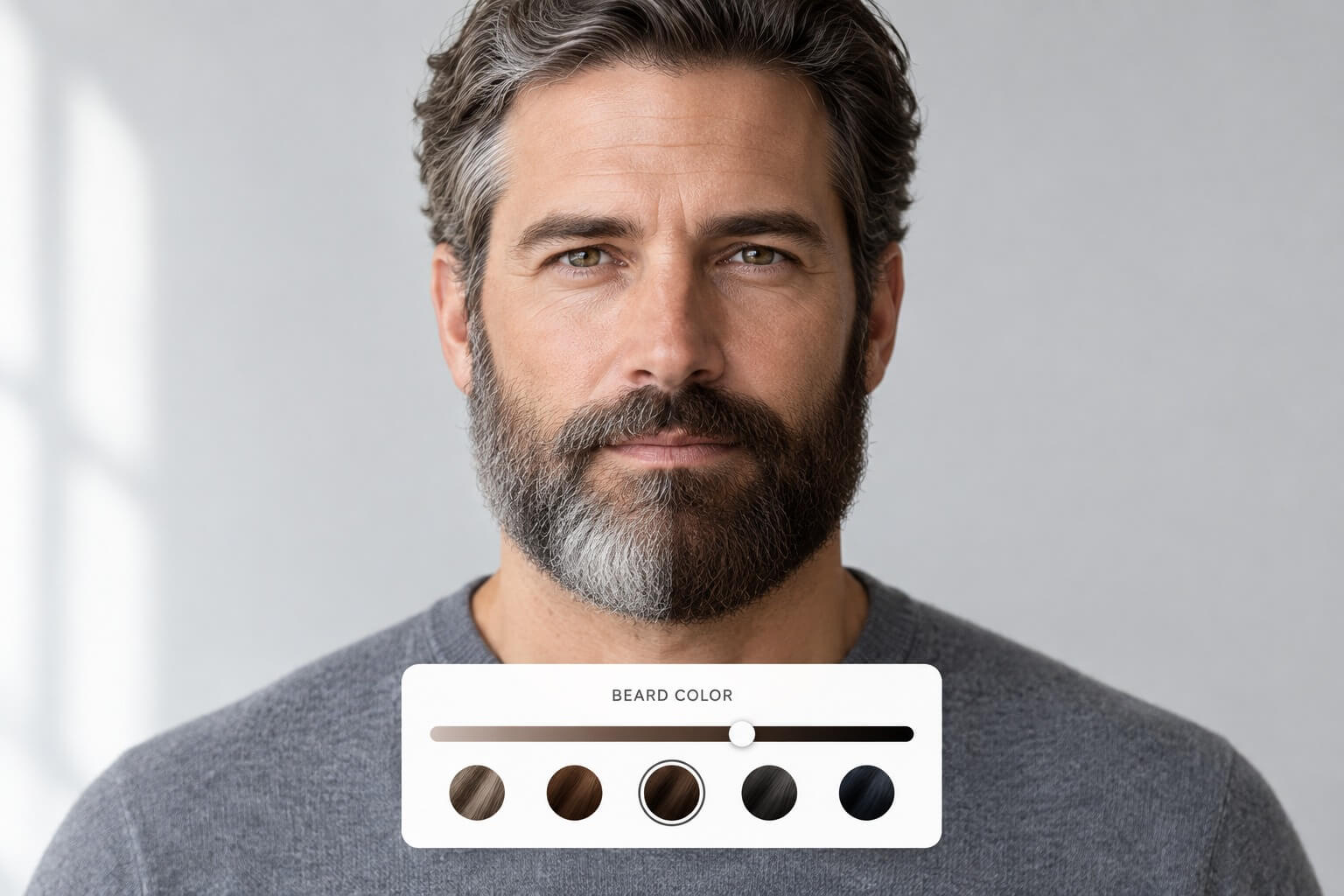
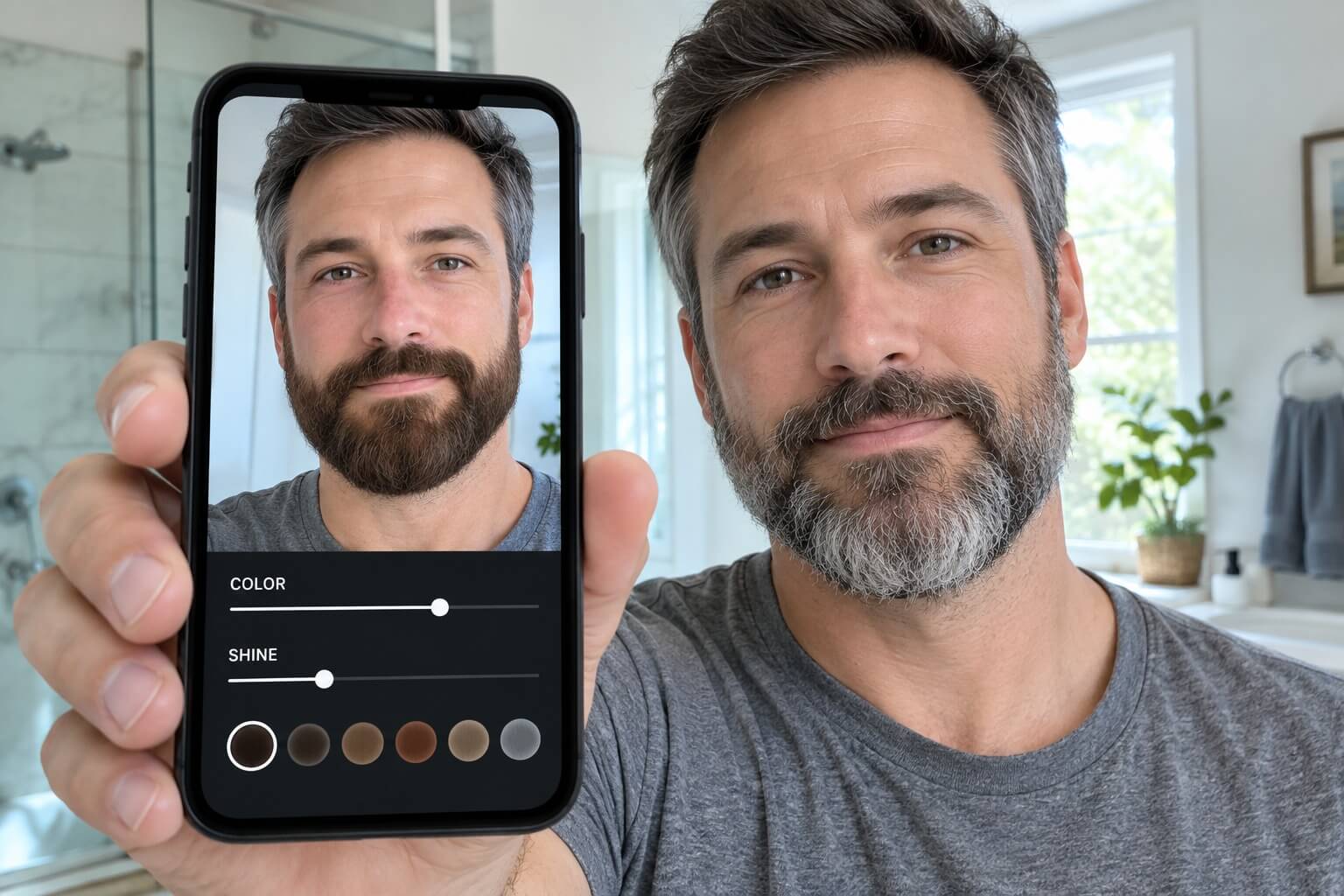
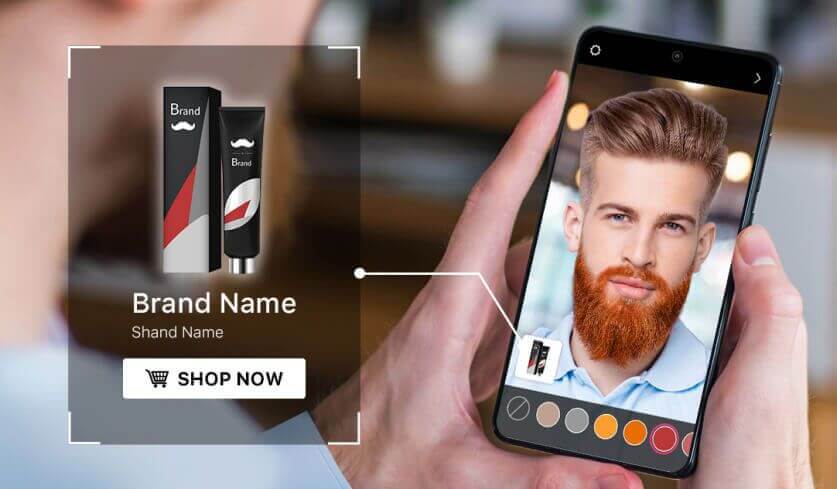
Perfect Corp's beard dye simulator runs in the browser, uses your camera or a photo, and applies realistic beard color with adjustable intensity and shine. It uses facial analysis to find the exact boundary of your facial hair, then renders the new shade only where hair actually grows, which is why the result looks like a beard and not a painted patch. Move a slider and the color shifts live. Reset and you are back to your natural shade.
Two minutes with the simulator answers the questions no product page can:
- Does dark brown read as "natural" on me, or as "obviously dyed"?
- Is jet black going to fight my skin tone?
- Would blending the gray instead of erasing it actually look better?
- Do I want the shine turned down so the color looks matte and lived in?
It costs nothing, it takes less time than reading the instructions on the box, and it removes the one risk that makes men avoid beard dye entirely: the fear of an irreversible mistake sitting on their face for three weeks.
What Is Men's Beard Dye, Exactly?
Men's beard dye is a color product formulated specifically for facial hair, designed to cover or blend gray in shorter application times (usually 5 to 15 minutes) and at lower peroxide levels than scalp hair color. Beard hair is coarser, drier, and grows from more sensitive skin, so beard formulas trade some staying power for gentleness and speed.
That distinction matters more than the marketing suggests. Scalp dye is engineered to sit on hair for 30 to 45 minutes. Leave it on a beard that long and you get flat, matte, suspiciously uniform color, plus a jawline that is dyed along with the whiskers. Beard products are built for the shorter runway.
Three formats dominate the shelf:
- Color enhancers and gradual dyes, which deposit a little pigment per use and build over several days.
- Single process beard color, the classic mix and brush kits that cover gray in one sitting.
- Temporary color, including beard mascaras, tints, and fillers that rinse out and mostly exist for job interviews and weddings.
What Color Should You Dye Your Beard?
The default instinct is to match the beard you had at 25. That instinct is wrong, and it is the number one reason dyed beards look dyed. Your skin, brows, and hairline all aged alongside the beard. Reverting one element to a decade ago breaks the set.
Work from three inputs instead: your current hair color, your skin undertone, and how much gray you are dealing with.
Should Your Beard Match Your Hair Color?
Close, but not identical. Facial hair naturally grows slightly warmer and often a shade or two lighter or redder than scalp hair, and a beard that matches the head exactly looks pasted on. The rule most barbers use: go one shade lighter than your scalp hair, never darker.
If your scalp hair is also graying, dye the beard to the blended midpoint rather than to your original color. And if you shave your head, treat your eyebrows as the reference point, since they are the only remaining evidence of your natural pigment.
How Does Skin Undertone Change the Shade?
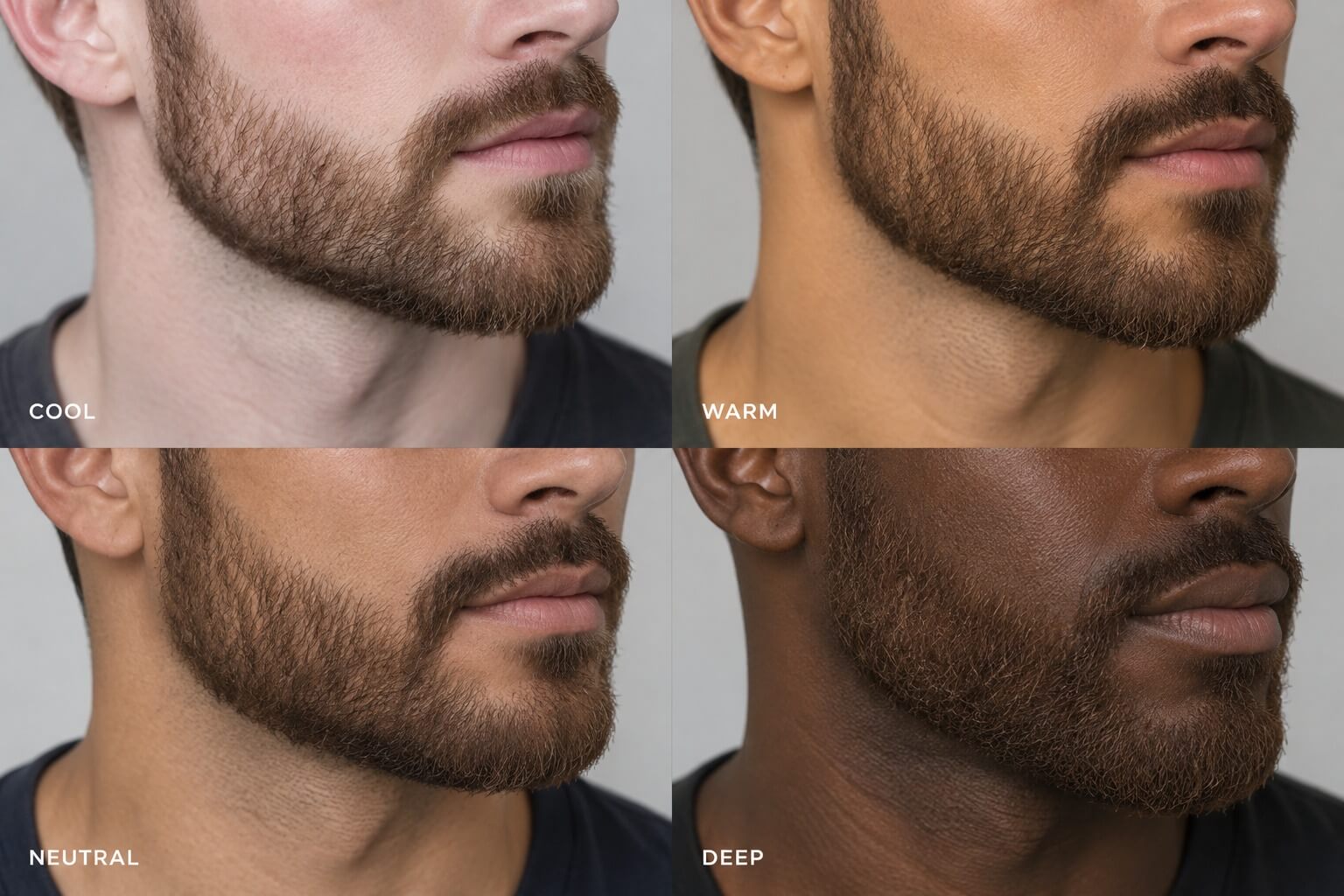
Undertone decides whether a color reads as warm and healthy or muddy and flat. It is easy to check in daylight: look at the veins on your inner wrist. Blue or purple suggests cool undertones, green suggests warm, and a mix suggests neutral.
| Skin undertone | Shades that work | Shades to avoid |
|---|---|---|
| Cool (blue or pink) | Ash brown, cool dark brown, soft black | Copper, golden brown, mahogany |
| Warm (golden or olive) | Chestnut, warm medium brown, dark auburn | Blue black, ash blonde |
| Neutral | Natural medium and dark brown | Anything at the extremes, jet black or bright red |
| Deep skin tones | True black, deep espresso, blue black | Light and medium browns that turn gray in photos |
This is exactly the kind of comparison that a photo swatch cannot settle for you, because the same "medium brown" behaves differently against different skin. Testing it virtually first is faster than testing it chemically.
Compare shades side by side in the AI Beard Dye demo.
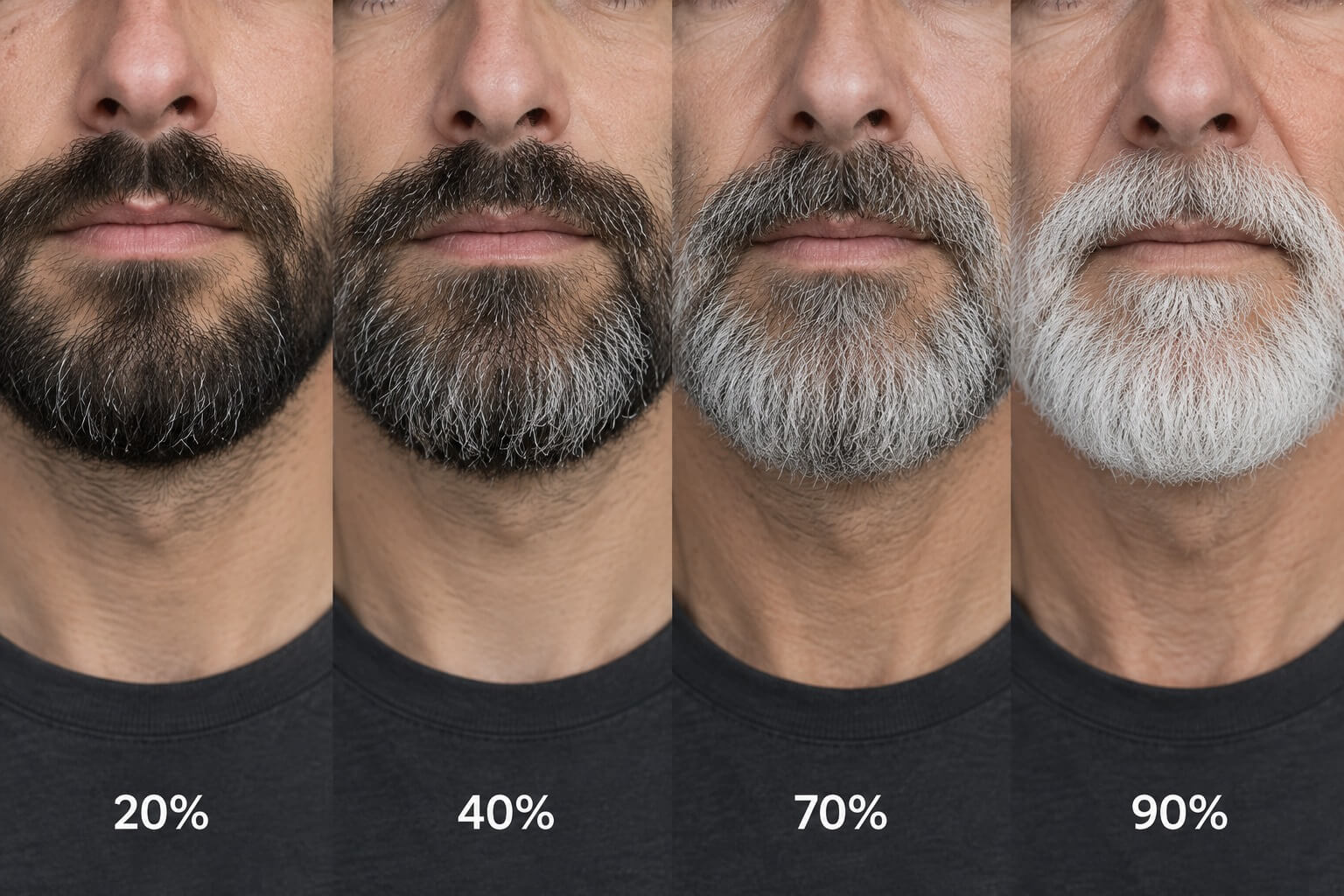
What If You Are Only 20 Percent Gray?
Then full coverage is probably the wrong goal. Light gray is a texture, not a flaw, and blending it keeps the beard looking three dimensional. Use gray percentage to choose your strategy:
| How much gray | Best approach | Product type |
|---|---|---|
| Under 20 percent | Blend, do not cover. Keep depth and dimension. | Gradual color enhancer |
| 20 to 50 percent | Partial coverage, one shade lighter than instinct | Semi-permanent beard color |
| 50 to 80 percent | Full coverage, expect regrowth lines in 2 weeks | Single process permanent kit |
| Over 80 percent | Consider going lighter overall, or embracing it | Soft black or medium brown, or no dye |
Permanent, Semi-Permanent, or Temporary: Which Beard Dye Should You Buy?
The formats are not better or worse than one another. They solve different problems, and most men eventually own two.
| Type | How long it lasts | Best for | Watch out for |
|---|---|---|---|
| Permanent (single process) | 3 to 6 weeks, until regrowth | Heavy gray, full coverage | Hard regrowth line, ammonia or PPD sensitivity |
| Semi-permanent | 2 to 4 weeks, fades gradually | Blending, first time users | Fades warm, may need touch ups weekly |
| Gradual color enhancer | Builds over 3 to 5 uses | Subtle results, no commitment | Slow, easy to overshoot if impatient |
| Henna and plant based | 4 to 6 weeks | Sensitive skin, warm tones | Long processing time, limited shade range |
| Temporary (mascara, tint, filler) | Until you wash it | Events, photos, patch filling | Transfers onto collars and pillows |
If this is your first time, start semi-permanent or gradual. If the result disappoints, you have lost a couple of weeks, not a season.
How Do You Dye Your Beard at Home Without Looking Fake?
The process takes about 20 minutes, and roughly 80 percent of the outcome is decided before the dye touches a hair. Preview the shade, do the patch test, and protect the skin. The rest is timing.
- Preview the shade. Use a virtual try-on to confirm the color, then buy that shade rather than the one with the nicest box.
- Patch test 48 hours ahead. Dab a small amount behind the ear or on the inner elbow. Skip this step and you are gambling with your face, not your arm.
- Wash and dry the beard. Clean, product free, completely dry hair takes color evenly. Skip conditioner, which blocks pigment.
- Barrier the skin. Run a thin line of petroleum jelly or a heavy balm along the cheek line, the lips, and the neckline. This is the difference between a dyed beard and a dyed jaw.
- Apply from the outside in. Start at the edges and jawline where hair is coarsest and grayest, then work toward the chin and mustache. Coarse gray needs the most contact time, so it goes on first.
- Watch the clock, not the mirror. Start at the low end of the recommended range, usually 5 minutes. Check a small section by wiping it clean. You can always add time. You cannot subtract it.
- Rinse with cool water only. Cool water closes the cuticle and locks pigment. Rinse until the water runs completely clear, then skip shampoo for 24 to 48 hours.
- Condition and oil. Beard oil or balm on day one. Dye leaves the hair thirstier than it found it, and dry beard hair looks dull, which reads as fake even when the color is right.
The single most common mistake is leaving the dye on too long "to be sure." Beard hair is porous and grabs pigment fast. Two extra minutes is the difference between "did you get some sun?" and "did you dye your beard?"
How Do You Keep Beard Dye Off Your Skin?
Prevention first, because removal is always the worse option. Barrier balm along the edges, gloves on both hands, and a towel you have already given up on.
If it stains anyway, work through these in order, gentlest first:
- Olive or coconut oil on a cotton pad, left for 5 minutes, then wiped. Works on fresh stains.
- Micellar water or an oil based makeup remover, which is formulated for exactly this job.
- A baking soda and dish soap paste, applied gently for 30 seconds, then rinsed. Effective but drying.
- Non-acetone nail polish remover on a cotton swab, edges only, as a last resort.
Avoid scrubbing and avoid acetone near the eyes. Most beard dye stains fade on their own within 1 to 2 days as skin cells turn over, so the least aggressive option that gets it to "barely noticeable" is the right one.
How Long Does Beard Dye Last?
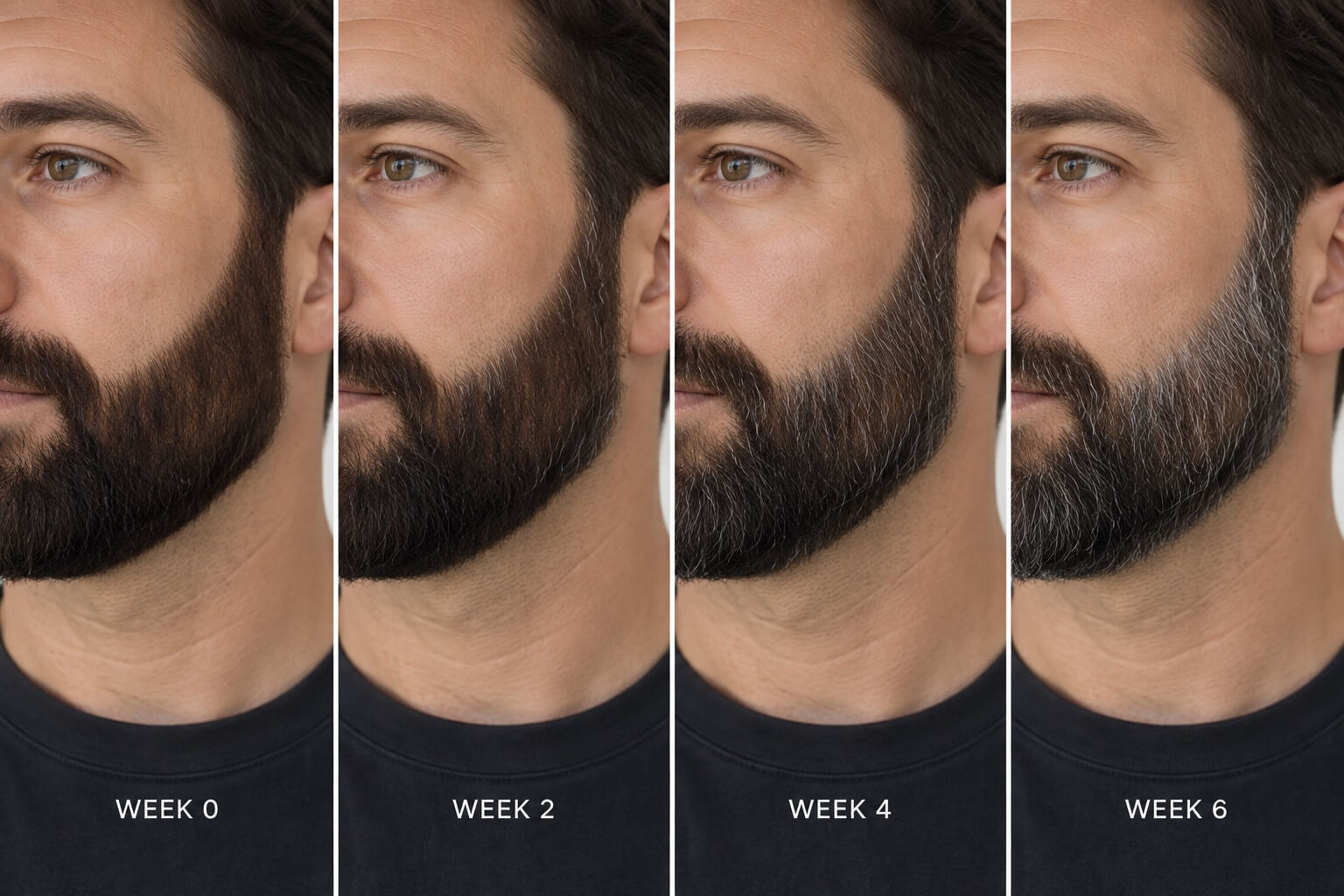
Two to six weeks depending on format, but "how long it lasts" is really two separate questions. The pigment fades gradually. The regrowth line appears on schedule.
Beard hair grows roughly 0.3 to 0.5 mm per day, so visible gray roots turn up at the 10 to 14 day mark regardless of how permanent your dye claims to be. That is why touch up cadence matters more than longevity claims. Three habits stretch the interval:
- Wash the beard with a sulfate free cleanser, and not every day.
- Rinse cool, always. Hot water strips color faster than anything else in your routine.
- Oil daily. Sealed cuticles hold pigment, and hydrated hair reflects light like healthy hair should.
Is Beard Dye Bad for Your Beard or Your Skin?
Used correctly, beard dye is low risk for most people. The real concerns are specific rather than general, and they are manageable.
The main irritant is PPD (paraphenylenediamine), a coloring agent used in most permanent dyes and a recognized contact allergen. Reactions range from mild itching to significant swelling, which is precisely why the 48 hour patch test is not optional advice. If you have reacted to hair dye or to a temporary tattoo before, look for PPD free or plant based formulas.
Beyond that, expect some dryness. Coloring opens the hair cuticle, and beard hair sits on skin that is often already dealing with wind, razors, and cold weather. Overlapping applications on the same section repeatedly, chasing perfect coverage, is what actually causes brittleness and breakage. Dye the regrowth, not the whole beard, once you are past the first application.
Anyone with active eczema, psoriasis, open cuts, or a diagnosed dye allergy should talk to a dermatologist before coloring facial hair.
How Do You Dye a Patchy or Short Beard?
Patchy beards and stubble need a different approach, because dye reveals gaps rather than hiding them. Color darkens the hairs you have. It does nothing for the skin between them, so contrast increases.
For patchy growth, a temporary beard filler or tinted pencil applied to the skin usually beats a full dye, since it addresses the actual problem. For short beards and stubble under 5 mm, halve the processing time and use a shade lighter than you would for a full beard. Short hair shows less length of color, so the same shade reads darker.
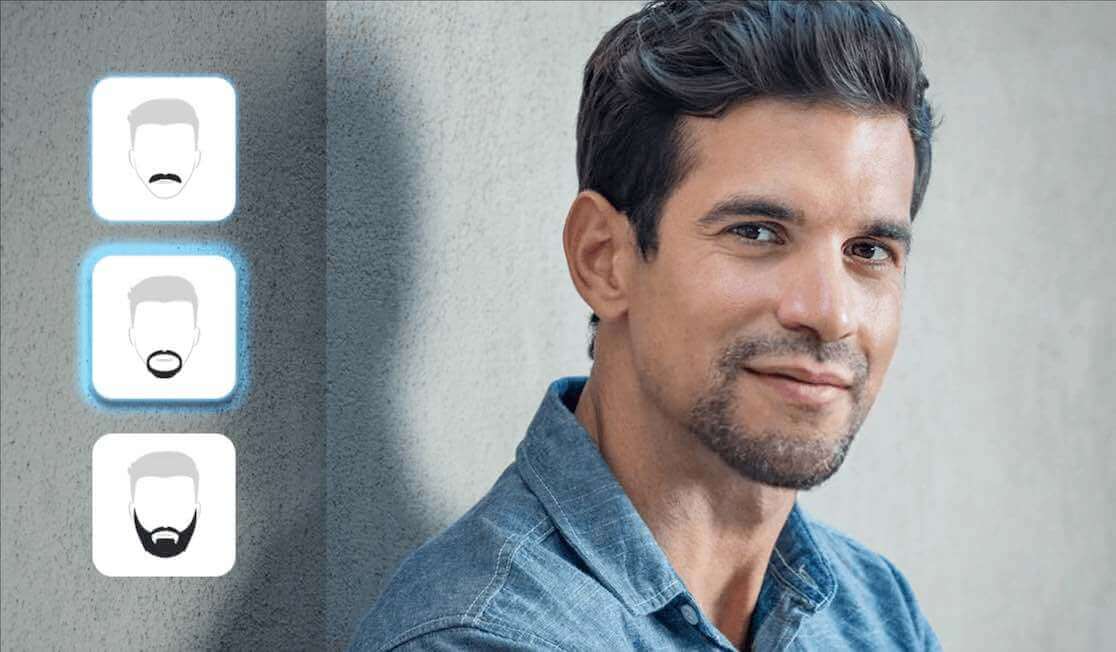
Test a new beard shape before you commit with the AI beard style filter.
It is also worth checking whether the shape is doing you any favors before you change the color. Beard geometry and jaw definition are closely linked, and our guide to men's face shapes covers which beard lines suit which proportions.
Why Are Grooming Brands Adding Virtual Beard Color Try-On?
Here is the part that explains why the try-on experience above exists at all. Beard dye has a structural problem in retail: it is a high anxiety, low information purchase. The shopper cannot test it, the shade names are inconsistent between brands, and the consequence of getting it wrong is visible to everyone they meet. So they either buy nothing, or they buy once, get it wrong, and never buy again.
Virtual try-on attacks that directly. When a shopper can see the shade on their own beard, shade selection stops being a gamble. Brands that deploy AR try-on across beauty and grooming categories consistently report the same pattern: longer time on page, higher add to cart rates, and fewer color related returns, because the customer chose with their eyes instead of a guess.
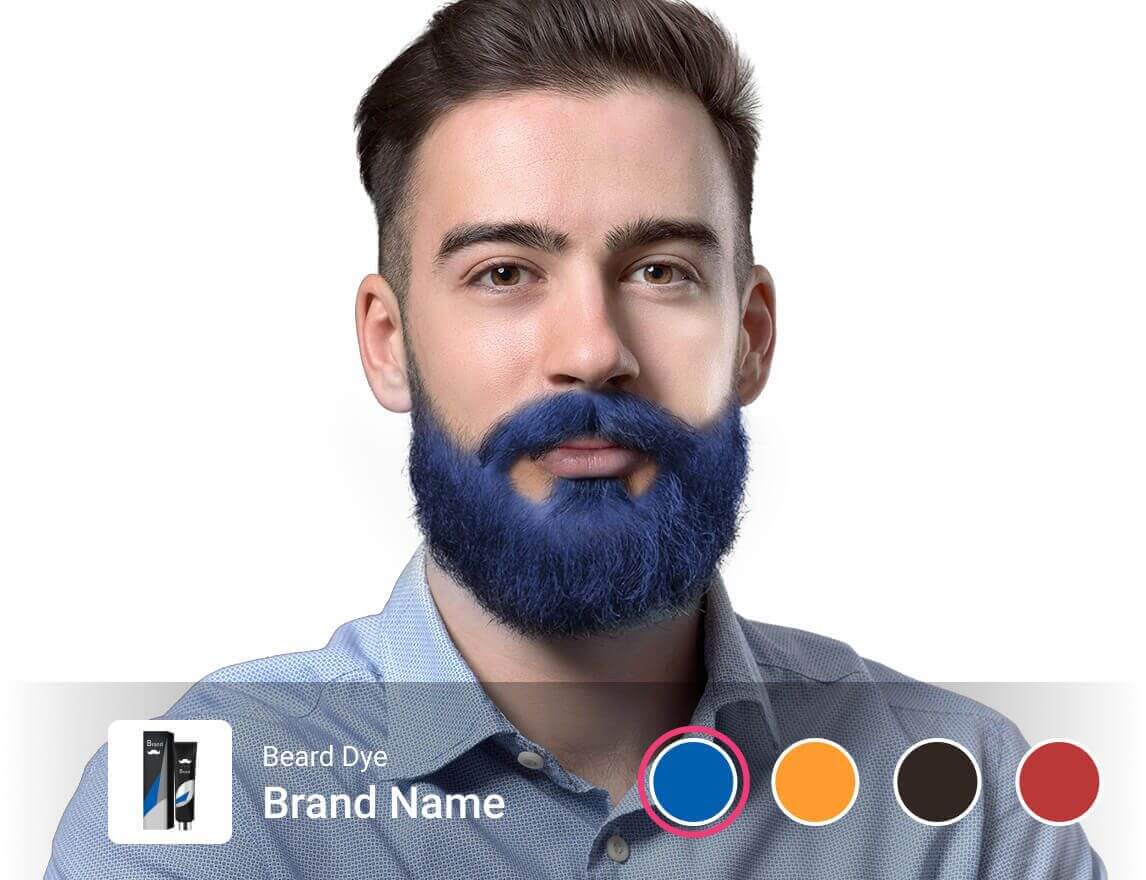
Want this on your product pages? Try the API in our AI Playground.
Perfect Corp works with 800+ brand partners across beauty and grooming, and the AI Beard Dye try-on solution is built for exactly this use case. It detects facial hair automatically, applies color and shine only where hair grows, runs live on a phone camera without an app download, and maps to a brand's real shade range so the preview corresponds to a product that actually exists in the catalog.
For teams that would rather build it into their own product experience, the same facial analysis and rendering capability is available through the API. You can send a photo and get a colored result back, which means the try-on can live inside an existing app, a product page, or an in-store kiosk.
Men's Beard Dye FAQs
How do you dye your beard at home?
Wash and fully dry the beard, apply a barrier balm along the cheek and neck lines, mix the dye, and brush it from the outer edges inward. Leave it on for the minimum recommended time, usually 5 to 10 minutes, check a small section, then rinse with cool water until it runs clear. Finish with beard oil. Patch test 48 hours beforehand.
What color should I dye my beard?
One shade lighter than your scalp hair, adjusted for your skin undertone. Cool undertones suit ash and cool browns, warm undertones suit chestnut and auburn tones. Previewing shades with a virtual try-on before buying is the fastest way to confirm it, since the same shade name looks different on different skin.
How long does beard dye last?
Permanent formulas hold 3 to 6 weeks, semi-permanent 2 to 4 weeks, and temporary color rinses out the same day. Visible gray regrowth usually appears at 10 to 14 days regardless of format, so most men touch up every 2 to 3 weeks.
Does beard dye look natural?
It does when the shade is close to your natural color and the processing time is short. Unnatural results almost always come from going too dark, leaving the dye on too long, or matching the beard exactly to scalp hair. Blending gray rather than fully erasing it also keeps dimension in the beard.
Is beard dye bad for your beard?
Occasional use is low risk. The realistic downsides are dryness and, for some people, sensitivity to PPD in permanent formulas. Repeatedly overlapping dye on the same hair causes most of the damage, so color the regrowth rather than the full beard after the first application, and always patch test.
How do you get beard dye off your skin?
Start with olive or coconut oil on a cotton pad for a few minutes, then try micellar water or an oil based makeup remover. A baking soda and dish soap paste works on stubborn stains but is drying. Most staining fades naturally within a day or two.
How often should you dye your beard?
Every 2 to 4 weeks for most men, driven by regrowth rather than fading. Coloring more often than every 2 weeks increases dryness and breakage without improving the result.
Can you use regular hair dye on your beard?
It is not recommended. Scalp dye typically has higher developer strength and longer processing times, which is a poor match for coarse facial hair on sensitive skin. If it is your only option, cut the processing time roughly in half and patch test first.
Should my beard match my hair color?
It should be close, not identical. Facial hair naturally grows warmer and slightly lighter than scalp hair, so an exact match reads as artificial. Go one shade lighter than your head hair, and if you shave your head, match to your eyebrows.
How do you dye a beard black without it looking fake?
Choose soft black or blue black rather than true black unless your natural hair is genuinely black, cut the processing time to the minimum, and consider leaving a small amount of gray at the temples for dimension. True black on lighter skin is the single most obvious dye job there is, which is why previewing it first saves a lot of regret.
How do you cover gray in a beard naturally?
Henna and other plant based dyes cover gray without PPD, though they lean warm and take longer to process. Gradual color enhancers are the other low commitment route, building pigment across several applications so the change looks like it happened on its own.
How much does beard dye cost?
Most single application kits run between 8 and 20 US dollars, and a multi-use kit typically covers 3 to 8 applications. Annual cost lands well under a single salon color service, which is a large part of the category's appeal.
The Bottom Line on Men's Beard Dye
Beard dye is not complicated. Shade selection is, and that is where nearly every bad result begins. Get the shade right for your skin and your gray percentage, go one step lighter than instinct, keep the processing time short, and the color will read as your beard rather than as a decision.
The easiest way to get that first choice right is to stop guessing. See the shade on your own face, adjust it, then buy the box.
Try the free Beard Dye Simulator now and find your shade in under two minutes.