Author:


Disclaimer: Some images in this article may have been created or modified by AI
Here is the part nobody puts in the buying guides: the online jewelry stores that keep showing up on best-of lists are not winning on inventory alone. Almost all of them sell similar metals, similar stones, similar price bands. What separates the top rated online jewelry stores in 2026 is how well their websites answer one silent question every shopper asks before checkout, which is simply "how will this look on me?" AI and AR are now the tools doing that work, from ring try-on and earring simulators to sizing calculators that eliminate return rates. This is a look under the hood at the technology stack behind the best jewelry e-commerce experiences, and how any brand can build the same thing.
Table of Contents
- What Actually Separates a Top Rated Online Jewelry Store From the Rest?
- Why Is Jewelry Still the Hardest Category to Sell Online?
- How Do Top Rated Online Jewelry Stores Use AR Virtual Try-On?
- How Does AI Solve the Sizing Problem Behind Most Jewelry Returns?
- Can You Launch Try-On Without Building 3D Models for Every SKU?
- How Are Jewelry Retailers Using AI Beyond Try-On?
- Which Perfect Corp Solutions Power the Jewelry and Watch Vertical?
- What Results Do Retailers Actually See After Launch?
- How Do You Roll This Out Without Rebuilding Your Store?
- Frequently Asked Questions
What Actually Separates a Top Rated Online Jewelry Store From the Rest?

See the try-on experiences these retailers are running
Read enough "best online jewelry stores" roundups and a pattern shows up fast. The criteria are almost always the same four: certification and materials, price transparency, shipping and return policy, and customer reviews. Those matter. They are also table stakes, and every serious retailer has cleared them.
The real gap sits somewhere the roundups rarely look, which is the on-site experience. Jewelry is bought emotionally and worn visibly, yet most jewelry pages still ask shoppers to buy from a photo shot on a mannequin hand under studio lighting. The stores currently rated highest have stopped doing that. Brilliant Earth pushes shoppers into a virtual try-on flow. Pandora rolled try-on across charms, bracelets, pendants, and rings. De Beers put a webcam earring try-on behind a single button on Forevermark product pages. Berganza serves WebAR ring try-on across a catalog of roughly 2,000 pieces with no app download. Baume et Mercier lets shoppers rotate a 3D watch render on their own wrist.
None of those brands describe themselves as a tech company. They just noticed the huge room for improvement in the jewelry e-commerce space, and that AI and AR fix the specific part of the purchaser journey that is broken.
What do jewelry e-commerce benchmarks actually look like?
Context first, because the numbers explain the urgency better than any pitch.
| Metric | Jewelry category benchmark | Why it matters |
|---|---|---|
| Conversion rate | Approximately 0.87% to 1.19% | Among the lowest of any tracked retail category |
| Average order value | Approximately $180 to $313 | Roughly double the broader e-commerce average, so every lost session is expensive |
| Return rate | Approximately 16.9% to 20% | Fit and appearance mismatch drive most of it |
| Cart abandonment | Approximately 81.4% | Reported as the highest of any category tracked |
| Customer acquisition cost | Approximately $70 to $91 | Fine jewelry runs far higher, often $150 to $300 per customer |
Put those side by side and the strategic picture is blunt. Traffic is expensive, intent is high, order values are healthy, and shoppers still walk away four times out of five. That is not a traffic problem. It is a confidence problem, and confidence is exactly what a try-on experience manufactures.
Why Is Jewelry Still the Hardest Category to Sell Online?

Apparel solved part of this years ago with size charts and generous returns. Jewelry cannot lean on either. Three things make it structurally harder.
Scale is invisible in a photo. A 14mm hoop and a 24mm hoop look nearly identical in a square product shot. On an actual ear they are completely different pieces. Shoppers know they are being shown something they cannot judge, so they hesitate.
Fit is not adjustable after purchase. A sweater that runs small is annoying. A ring that runs small is a resizing appointment, a shipping cycle, and sometimes a piece that cannot be resized at all without damaging the setting. That fear alone stalls a large share of engagement ring and fine jewelry carts.
The purchase is often emotional and time-boxed. Anniversaries, proposals, birthdays, holiday gifting. Shoppers under a deadline do not want to order three sizes and sort it out later. They want to know now.
AR try-on and AI sizing attack all three at once. Instead of asking a shopper to imagine, the page shows them. And critically, it shows them on their own hand, their own ear, their own neck, at true scale.
Does seeing it on yourself really change buying behavior?
It does, and the effect sizes in this vertical are unusually large. Perfect Corp. data across jewelry deployments points to conversion rates climbing as much as 2.5 times when AR try-on is in the flow, alongside an average reduction in returns of roughly 8%. On the beauty side of the same technology stack, KOSE America reported an 85% sales increase after adding virtual try-on, and Clinique saw baskets grow about 35% larger among shoppers who engaged with the try-on experience.
Those are not vanity numbers. A 2.5x lift applied to a category averaging around 1% conversion is the difference between a site that struggles to justify its ad spend and one that scales it.
How Do Top Rated Online Jewelry Stores Use AR Virtual Try-On?

Browse every jewelry try-on demo in one place
Virtual try-on is not one feature. In jewelry it splits into distinct technical problems, because a ring, an earring, a necklace, and a watch each sit on a different part of the body and each move differently. The retailers doing this well deploy category-specific try-on rather than one generic AR viewer.
Here is how each one works, and what separates a convincing implementation from a gimmick.
How does AR ring try-on work?

Try the live ring try-on demo on your own hand
Ring try-on is the hardest of the group and the most commercially valuable, because rings carry the highest average order values and the worst fit anxiety. A credible ring try-on has to do four things simultaneously: detect the hand and identify individual fingers, estimate finger width so the band renders at true scale, track the hand as it rotates and tilts, and light the metal and stone so the render does not float above the skin.
Perfect Corp.'s AR Ring Virtual Try-On handles hand tracking in real time in a browser, supports single-finger and multi-finger placement, and offers both 3D and 2D modes so brands can trade fidelity against catalog effort. The 3D mode is the showstopper for hero SKUs. The 2D mode is what lets a retailer cover 2,000 pieces instead of 20.

You can see the live behavior, including the 3D and 2D toggle and the multiple-finger mode, on the Perfect Corp. ring try-on and ring sizer demo.
How do virtual earring try-on and piercing simulators work?

Earrings are where AR gets genuinely fun, and where curated ear stacking has become a merchandising strategy in its own right. The technical requirement is different from rings: the system needs accurate facial detection to locate the ear, then has to render jewelry that dangles and swings with head movement rather than sitting rigid.
Perfect Corp.'s AR Virtual Earrings Try-On and Ear Piercing Simulator covers 13 piercing placement options across the lobe and outer ear, supports mix-and-match stacking in real time, and runs rigid body physics so drop earrings actually move with the shopper. That last detail is what makes the render read as real instead of pasted on.
The piercing simulator has a second use case that retailers often discover after launch. Shoppers considering a new piercing use it to preview placement before committing, which turns a product page into a planning tool and gives the brand a reason to be in the conversation months before the sale.
What about necklaces, bracelets, and watches?

Necklaces live or die on chain length. A 16-inch chain and a 20-inch chain sit in visibly different places, and no product photo communicates that. Necklace Virtual Try-On renders the piece against the shopper's own neck and collarbone so length becomes obvious rather than theoretical, which is exactly the kind of question that otherwise turns into a return.

See bracelet and watch try-on at true wrist scale
Bracelets and watches share a challenge, which is wrist circumference. Both AR Bracelet Virtual Try-On and AR Watch Virtual Try-On render at scale on the shopper's wrist, so a 42mm case on a slim wrist looks like what it actually is. For watch retailers this is often the single highest-impact addition to a product page, because case size is the most common source of buyer's remorse in the category.
Can shoppers stack and combine multiple pieces at once?

This is where AR stops being a confidence tool and starts being a revenue tool. Stacking rings, layering necklaces, and building a bracelet-and-watch set are all high-margin merchandising plays, and they are almost impossible to sell from static photography because every combination would need its own shoot.
Perfect Corp. built stacking directly into the jewelry try-on suite for rings, earrings, bracelets, and watch sets, so shoppers assemble a complete look in real time and add several pieces to one cart. The mechanism is straightforward and the effect on average order value is the point: a shopper who came for one ring leaves with a stack because they got to see it before believing in it.
Ready to see this on your own catalog? Try the API in our AI Playground and render a piece from your own product image in a few minutes.
How Does AI Solve the Sizing Problem Behind Most Jewelry Returns?

Measure your ring size with the free online ring sizer
Try-on answers "how does it look." Sizing answers "will it fit," and in jewelry the second question is where the money leaks. With category return rates running roughly 17% to 20%, and fit being a leading cause, sizing tools often deliver faster payback than the try-on itself.
The traditional workarounds are all bad. Printable paper ring sizers require a printer and get scaled wrong. String-and-ruler methods are unreliable. Ordering two sizes doubles shipping and guarantees a return. Sending a physical sizer kit costs real money per prospect and adds days to the funnel.

Perfect Corp.'s AI Ring Sizer replaces all of that with a device the shopper already owns. They place a finger against the phone screen, the tool measures finger width, and it returns a size recommendation that feeds straight into the product selection. It runs on web browsers and on iOS and Android, so there is nothing to install.
The same logic extends to wrists for bracelets and watch straps, using the phone camera to estimate circumference instead of asking shoppers to wrap a tape measure around their own arm one-handed.
Why does sizing accuracy matter more in jewelry than anywhere else?
Because the cost of getting it wrong is asymmetric. In apparel a wrong size is a return. In fine jewelry a wrong size can mean a resizing job on a pave band that risks the stones, a custom piece that cannot be altered at all, or a proposal that happens with a ring that does not fit. Retailers who put sizing in front of the purchase rather than behind it convert more shoppers and process fewer returns, and they also spend less on the post-purchase service labor that never shows up in conversion dashboards.
Can You Launch Try-On Without Building 3D Models for Every SKU?

Turn one product photo into a 3D try-on in the AI Playground
This is the question that historically killed jewelry AR projects, and it deserves its own section because the answer changed recently.
For years, high-quality jewelry try-on required a 3D model per SKU. That meant commissioning CAD files or 3D scans for every piece, at real cost and real turnaround time, for a catalog that refreshes seasonally. A brand with 3,000 SKUs did the math once and shelved the project. So AR stayed the privilege of a handful of luxury houses with the budget to model a capsule collection.
Perfect Corp.'s Image-to-VTO solution removes that gate. It takes a single ordinary 2D product image, the kind already sitting in every retailer's asset library, and generates a 3D virtual try-on from it, complete with lighting effects and physically accurate motion. No CAD file, no 3D scan, no modeling vendor. It covers rings, earrings, necklaces, bracelets, and watches.

The strategic consequence is bigger than the cost saving. It changes what a brand can put into try-on. Instead of choosing 20 hero pieces to model, a retailer can enable try-on across the entire catalog, including the long tail and the pieces that only exist for six weeks. Coverage is what makes shoppers trust the feature enough to use it, because a try-on button that appears on only some products trains people to ignore it.
What does the setup process actually involve?
| Approach | Input needed | Best suited to |
|---|---|---|
| Full 3D model try-on | CAD or 3D scan per piece | Hero SKUs, flagship collections, high-consideration fine jewelry |
| Image-to-VTO (2D to 3D) | One standard 2D product photo | Broad catalog coverage, seasonal drops, long-tail SKUs |
| 2D try-on mode | One product photo with clean edges | Fastest rollout, very large catalogs, fashion and demi-fine ranges |
Most of the strongest implementations mix all three. Hero pieces get full 3D treatment, the working catalog runs on Image-to-VTO, and the deep tail runs 2D. Shoppers see a try-on button everywhere, which is the outcome that matters.
Perfect Corp. has written more on how this changed the effort curve in its jewelry virtual try-on setup guide.
How Are Jewelry Retailers Using AI Beyond Try-On?
Test the AI Jewelry API endpoints before you integrate
Try-on is the visible layer. The less obvious work happens in content operations, and this is increasingly where top rated stores separate themselves on margin rather than just conversion.
Can AI replace part of the product photography workflow?
Partly, and the part it replaces is the expensive part. On-model jewelry photography means booking hand models, ear models, and neck models, plus a studio, plus retouching, repeated for every collection and every market. AI-driven rendering generates on-model imagery from existing product shots, which lets a brand publish full visual merchandising for a drop without a shoot cycle.
What does the AI Jewelry API do that a try-on widget does not?
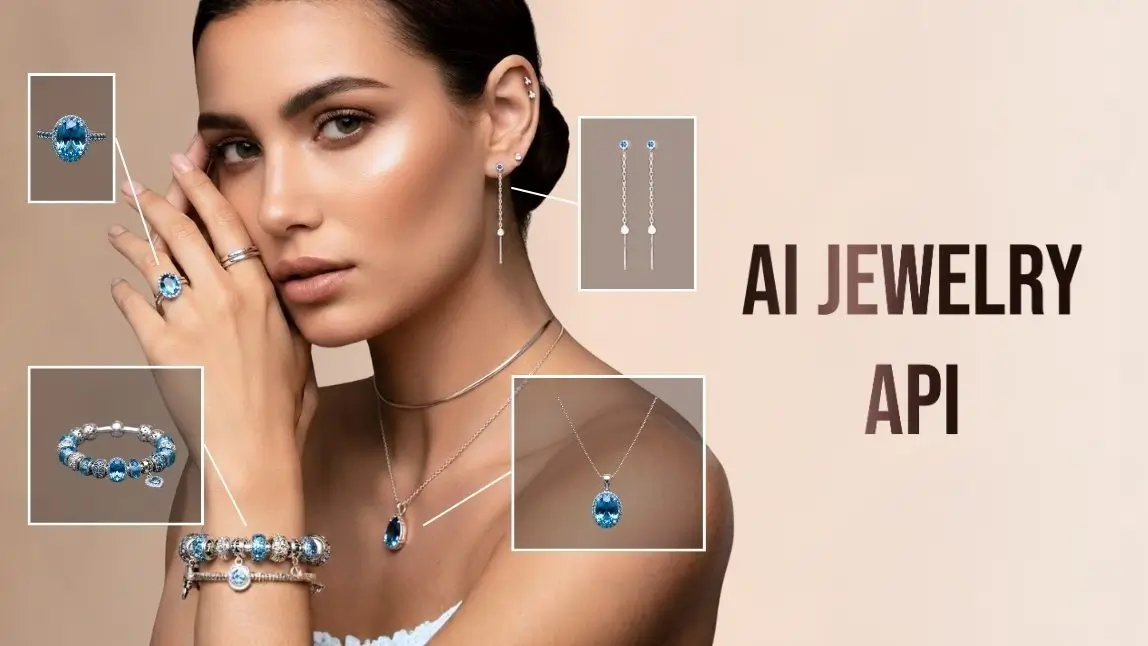
A widget serves shoppers. An API serves the business. Perfect Corp.'s AI Jewelry API is built for teams that want to generate try-on imagery programmatically inside their own systems, and it carries a set of controls that matter for brand-grade output:
- Precision lighting and shadow control, so a piece rendered on a hand matches the lighting language of the rest of the site
- Multi-jewelry stacking for rings and earrings, generated in a single call
- Automatic background removal, which cuts a manual retouching step out of the pipeline
- Edge fine-tuning, which is what stops a render from reading as a sticker pasted onto skin
- Detection of anatomical anchor points on the uploaded photo, so the piece maps to the hand or ear with millimetric placement
In practice this is how a retailer builds try-on into a mobile app, a marketplace listing, a personalized email, or a social ad rather than only a product page. You can test the endpoints directly in the YouCam API playground before writing any integration code.

Where do AI-driven recommendations fit?
Once shoppers are trying pieces on, the store learns something it never knew before, which is what they actually considered rather than only what they clicked. That signal feeds recommendation logic that is far more useful than browse history: a shopper who tried on three yellow-gold huggies and a pair of pearl studs has told you their taste in a way no page view can.
Which Perfect Corp Solutions Power the Jewelry and Watch Vertical?

See the full jewelry and watch solution lineup
Here is the full picture for anyone evaluating a build, mapped to the shopper question each solution answers.
| Solution | What it does | Shopper question it answers |
|---|---|---|
| AR Ring Virtual Try-On | Real-time hand tracking with 3D and 2D modes, single and multi-finger placement, ring stacking | How does this ring look on my hand? |
| AI Ring Sizer | Measures finger width using the phone screen, returns a size recommendation | What size do I actually need? |
| AR Virtual Earrings Try-On | 13 placement options across lobe and outer ear, mix-and-match stacking, rigid body physics for drop styles | How does this sit on my ear, and can I stack it? |
| Ear Piercing Simulator | Previews new piercing placements before committing | Where should my next piercing go? |
| Necklace Virtual Try-On | Renders chains and pendants at true length on the shopper's neck | Is this chain length right for me? |
| AR Bracelet Virtual Try-On | Renders bracelets and bangles at scale on the wrist, supports stacking | Will this fit and suit my wrist? |
| AR Watch Virtual Try-On | 3D watch rendering on the wrist from multiple angles, watch and bracelet set try-on | Is this case size too big for me? |
| Image-to-VTO | Turns one 2D product image into a 3D try-on, no CAD or 3D scan required | Why is try-on only on some products? (Answer: it no longer has to be) |
| AI Jewelry API | Programmatic try-on generation with lighting control, stacking, background removal, and edge refinement | Serves the brand rather than the shopper directly |
| 3D Product Viewer | 360-degree inspection of a piece before try-on | What does this look like from every angle? |
| YouCam Online Editor | Content and asset production for campaigns and product imagery | Supports the marketing pipeline behind the store |
Two things are worth noticing about that list. First, it is category-specific rather than one generic AR viewer, which is why the renders hold up. Second, it spans the full journey from discovery through sizing to post-purchase content, which is what turns a feature into an experience.
Retailers evaluating options can browse working examples across the vertical in the Perfect Corp. showcase.
What Results Do Retailers Actually See After Launch?

Numbers, with sources and appropriate hedging, because this section is where most vendor content stops being trustworthy.
| Outcome | Reported effect | Context |
|---|---|---|
| Conversion rate | Up to approximately 2.5x | Perfect Corp. data across AR jewelry try-on deployments |
| Returns | Reduced by approximately 8% on average | Attributed to better fit and appearance confidence pre-purchase |
| Sales lift | 85% increase | KOSE America, after adding virtual try-on to its digital experience |
| Basket size | Approximately 35% larger | Clinique, among shoppers who engaged with virtual try-on |
| Customer engagement | Approximately 200% boost | M.A.C, after deploying digital try-on tools |
| Tool-driven sales uplift | Up to 14x | Benefit, among shoppers engaging with an AI analysis tool |
A fair caveat: the KOSE, Clinique, M.A.C, and Benefit figures come from beauty deployments on the same underlying technology platform rather than from jewelry specifically. They are included because they show the mechanism at scale across categories, not because a jewelry brand should expect identical numbers. The jewelry-specific figures to plan around are the 2.5x conversion ceiling and the roughly 8% returns reduction.
The more useful way to model it is against your own funnel. If your jewelry site converts at the category average of around 1% and your AOV sits in the $180 to $313 band, even a fraction of the reported conversion lift moves revenue more than most site redesigns will, and it does it without touching acquisition spend.
How Do You Roll This Out Without Rebuilding Your Store?

Talk to us about web, app and in-store rollout
The implementation question usually decides whether a project happens, so it is worth being concrete. There are four deployment surfaces, and most retailers use more than one.
- E-commerce web module. A try-on experience embedded into existing product pages, running in the browser with no app download. This is the fastest path to live and the one that touches the most revenue.
- Mobile SDK. Native try-on inside an iOS or Android app, for brands with an installed base and loyalty program worth building around.
- API integration. Programmatic try-on generation for marketplaces, campaign assets, personalized email, social commerce, and anywhere else product imagery is needed at volume. Start in the AI Playground.
- In-store smart mirrors. The same try-on running on a mirror at the counter, which extends inventory beyond what is physically in the case and gives associates a selling tool rather than a catalog binder.
The sequencing that tends to work: launch the web module on a single category first, usually rings or earrings because they carry the clearest fit anxiety, pair it with the sizing tool so the funnel is complete, measure against a clean baseline, then expand catalog coverage with Image-to-VTO before adding new surfaces.

One implementation note that matters more than it sounds: put the try-on button where shoppers already look, which is beside the primary product image rather than buried in a tab. Coverage and placement do more for adoption than render quality does, and adoption is what produces the numbers.
Want a walkthrough on your own catalog? Contact Perfect Corp. for a demo and see your pieces rendered before you commit to anything.
Frequently Asked Questions
Is it OK to buy jewelry online?
Yes, and it is now the majority behavior in several jewelry segments. The precautions worth taking are unchanged: buy from retailers with clear certification and material disclosure, check the return and resizing policy before ordering, and read reviews on independent platforms rather than only on-site testimonials. What has improved is the confidence problem. Stores with AR try-on and AI sizing let you check appearance and fit before ordering, which removes most of the guesswork that used to make online jewelry buying feel risky.
How can you tell if an online jewelry store is legitimate?
Look for four signals: explicit metal and stone specifications including carat weight and treatment disclosure, independent grading certificates for significant stones, a plainly stated return window with who pays return shipping, and a real physical address plus reachable customer service. A well-built site experience is a supporting signal rather than proof, though the investment required to run genuine AR try-on and sizing tools does tend to indicate an established operation rather than a drop-shipping front.
Which online jewelry stores have virtual try-on?
Adoption is broad and growing. Publicly documented examples include Brilliant Earth, Pandora across charms, bracelets, pendants and rings, De Beers for Forevermark earrings, Baume et Mercier for Riviera watches, and Berganza for WebAR ring try-on across roughly 2,000 pieces. Because try-on is now available as an embeddable module and an API, it is appearing on mid-market and independent jewelry sites too rather than only luxury flagships.
Does virtual jewelry try-on actually look accurate?
Modern implementations are considerably better than the early ones, and the difference comes down to four things: real-time tracking so the piece stays anchored as you move, true-to-scale sizing rather than a fixed render size, lighting and shadow that match the environment, and edge refinement so the piece does not look pasted on. Physics simulation matters for anything that dangles. When those are in place the render is close enough to make a confident buying decision, though final color and finish still benefit from seeing the physical piece.
How does an online ring sizer work?
Screen-based sizers ask you to place your finger flat against your phone display, then measure finger width directly and convert it to a ring size. This avoids the two failure modes of printable sizers, which are print scaling errors and imprecise paper strips. Camera-based approaches use a reference object or on-device measurement to estimate circumference. Either way the recommendation should feed straight into the size selector on the product page so you are not left translating a number yourself.
Can you try on earrings virtually if your ears are not pierced?
Yes, and this is one of the more useful applications. An ear piercing simulator renders jewelry at different placements across the lobe and outer ear so you can preview a piercing before getting it done. Perfect Corp.'s implementation covers 13 placement options, which lets shoppers plan a curated ear over time rather than deciding at the studio.
Does virtual try-on reduce jewelry returns?
Reported reductions average around 8%, which is meaningful in a category running roughly 17% to 20% returns. The mechanism is straightforward: most jewelry returns come from appearance surprise or fit failure, and both are addressable before checkout. Pairing try-on with a sizing tool matters here, because try-on alone fixes the appearance half of the problem and leaves the fit half untouched.
Do jewelry brands need 3D models to offer virtual try-on?
Not anymore. Image-to-VTO technology generates a 3D try-on experience from a single standard 2D product photograph, with lighting effects and accurate motion, which removes the per-SKU 3D modeling cost that used to limit try-on to a handful of hero pieces. Full 3D models still produce the highest fidelity and remain worthwhile for flagship products, but they are no longer the entry requirement.
Is jewelry cheaper online than in stores?
Often, though not universally. Online-first retailers carry lower overhead than mall locations and pass some of that through, and lab-grown diamond specialists in particular price well below traditional retail. That said, the price you compare should account for shipping, insurance, resizing costs, and return shipping, since a slightly cheaper piece that needs a resize can end up costing more than the alternative.
What jewelry categories benefit most from AR try-on?
Rings and earrings see the strongest effect, for different reasons. Rings carry the highest fit anxiety and the highest order values, so removing uncertainty there has an outsized revenue impact. Earrings benefit from stacking and placement discovery, which drives multi-item baskets. Watches gain the most from scale accuracy, since case size is the most common source of regret. Necklaces resolve chain length questions that photography cannot answer at all.
How long does it take to add virtual try-on to a jewelry site?
An embedded web module on existing product pages is the fastest route and does not require rebuilding the storefront. Timelines depend on catalog preparation more than on integration, and Image-to-VTO shortens that considerably by working from product photos already on hand rather than requiring new 3D assets. Most teams start with one category, validate against a baseline, then widen coverage.
Does virtual try-on work on desktop, or only mobile?

Both. Webcam-based try-on runs on desktop browsers, and mobile browsers use the device camera. Some retailers add a QR code handoff so desktop shoppers can continue the try-on on their phone, which tends to produce a better experience for hand and ear try-on since the phone is easier to position. Perfect Corp.'s modules support desktop and mobile browsers, in-app SDK deployment, and in-store smart mirrors from the same underlying technology.