


 Face
Face
 Eyes
Eyes Brows
Brows Lips
Lips Nose
Nose cheekbones
 Hair
Hair


Bigonial Width Ratios Detector
Upload one photo and get your bigonial width and jaw ratio score in seconds, powered by Perfect Corp's AI facial analysis.
What Is Bigonial Width?
Bigonial width is the straight-line distance across your lower jaw, measured between the two points where the jawbone turns from the body of the mandible up toward the ear (the gonion on each side). It is one of the biggest drivers of how square, round, or tapered your lower face looks, and it shows up constantly in jaw contouring consultations, orthodontic planning, and facial symmetry research. A wider bigonial width tends to read as strong and angular, a narrower one reads as soft and oval, and neither is inherently better. It just depends on the ratio to the rest of your face.
How to Use the Bigonial Width Ratios Detector? Two Simple Steps!
Upload a Front-Facing Photo
Snap or upload one well-lit, front-facing photo with your hair pulled back from your jawline. No filters, no tilted chin, just a clear, neutral shot for the AI to work with.

Get Your Instant Ratio Breakdown
The detector maps your jaw width against your bizygomatic width and total face height in seconds, then returns your bigonial width ratio, a benchmark against ideal ranges, and a plain-language read of your face shape.
Who Actually Needs to Know Their Bigonial Width Ratio?
More people than you'd think, and Perfect Corp's AI makes it a five-second lookup instead of a caliper appointment.

Jaw Contouring and Aesthetic Consultations
Clinics and med spas use bigonial width as a baseline before jaw slimming, filler, or contouring treatments, so patients can see a measurable before-and-after instead of just a feeling.

Content Creators and Selfie Optimization
Creators use their bigonial width ratio to pick flattering angles, contour placement, and hairstyles that balance a wider or narrower jaw before they ever pick up a camera.
Orthodontic and Facial Symmetry Assessment
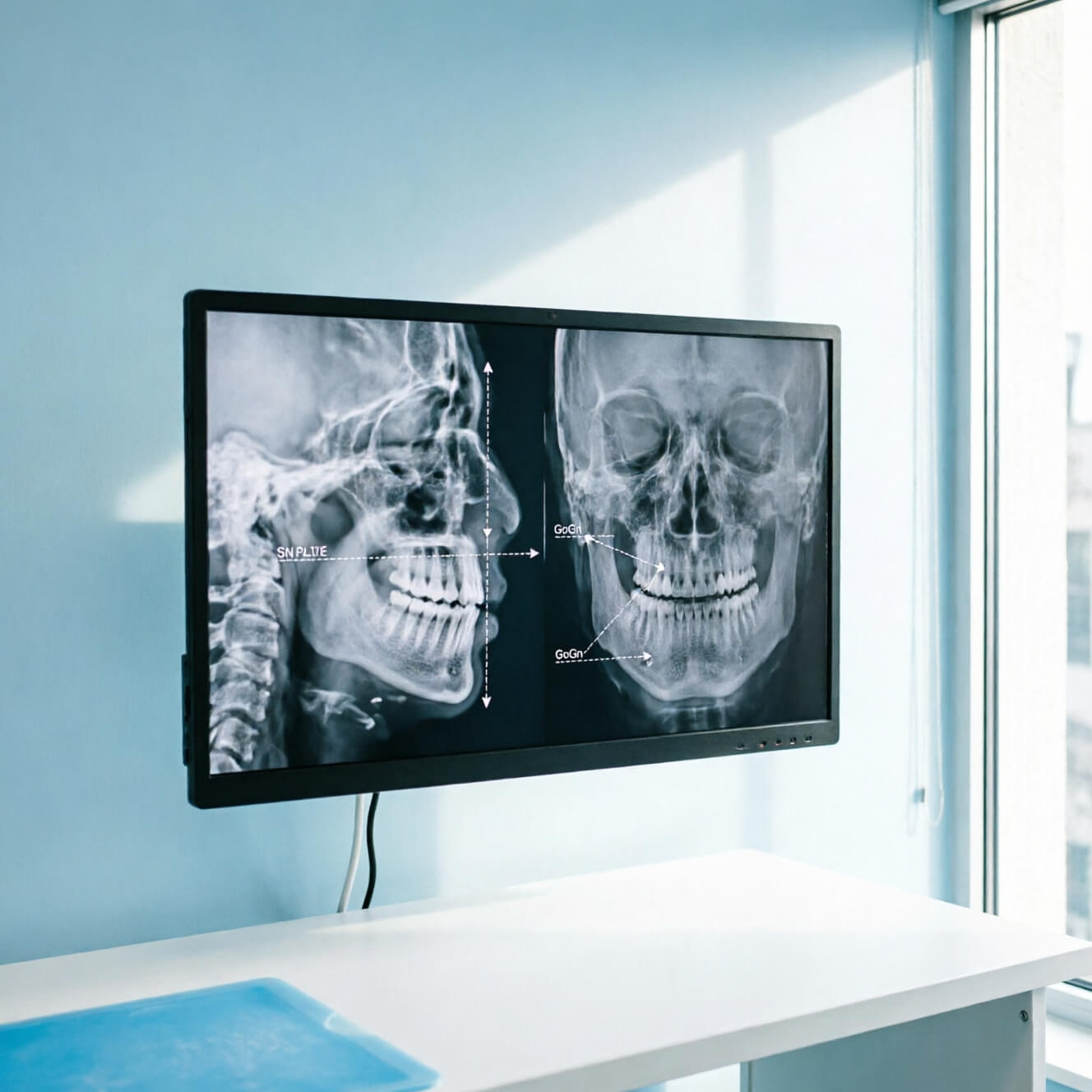
Orthodontists and researchers reference bigonial width alongside mandibular arch and facial height to track jaw growth, symmetry, and treatment progress over time.
HOW IT WORKSHow the AI Measures Your Bigonial Width
How the AI Measures Your Bigonial Width
Perfect Corp's facial detection technology plots the outer contour of your jaw and identifies the exact points where the mandible angle sits on each side. From there it calculates the straight-line distance between them and cross-references it against your bizygomatic width and total face height. The result is a set of ratios instead of a single raw number, because a jaw only looks wide or narrow relative to the rest of your face. The same engine powers Perfect Corp's face shape and fWHR tools, so the reading is consistent with over a decade of AI beauty tech development and 800+ brand integrations.
THE DATA BEHIND ITBigonial Width, Gender, and Facial Attractiveness
Bigonial Width, Gender, and Facial Attractiveness
Bigonial width does not read the same way across genders. Research on facial proportion consistently shows a narrower face-width-to-bigonial-width ratio in men, around 1.12, compared to roughly 1.18 in women, which is part of why a strong jaw reads as masculine and a softer taper reads as feminine in most facial harmony studies. There is no single ideal number. What matters is how your bigonial width sits against your own bizygomatic width and face height, and that context is exactly what the detector gives you instead of a flat pass or fail score.
Bigonial Width Ratios Detector FAQ
What is bigonial width?

Bigonial width is the distance across the lower jaw, measured between the two points where the jawbone angle sits on each side of the face. It is one of the main measurements used to describe how wide or narrow the lower third of the face appears.
How is bigonial width measured?
Traditionally it is measured with calipers on a skull or an X-ray, marking the widest point of the jaw angle on each side and taking the straight-line distance between them. Perfect Corp's AI detector does the same calculation from a single front-facing photo, so no calipers or clinic visit are required.
What is a good bigonial width ratio?
There is no universal ideal number, since bigonial width is only meaningful relative to your bizygomatic width and face height. As a general reference, studies on facial proportion put the average face-width-to-bigonial-width ratio at approximately 1.12 for men and 1.18 for women, with plenty of natural variation on either side.
Does bigonial width differ between men and women?
Yes. On average, men tend to have a wider bigonial width relative to their overall face width, which contributes to a more square or angular jawline, while women tend to have a narrower ratio, which reads as a softer, more tapered jaw.
Can I reduce my bigonial width?
Options like botulinum toxin injections to the jaw muscle, jaw contouring surgery, or targeted facial exercises are commonly discussed for reducing the appearance of a wide bigonial width, though results and suitability vary by person. A qualified provider should always assess your face before any treatment decision.


