 Author: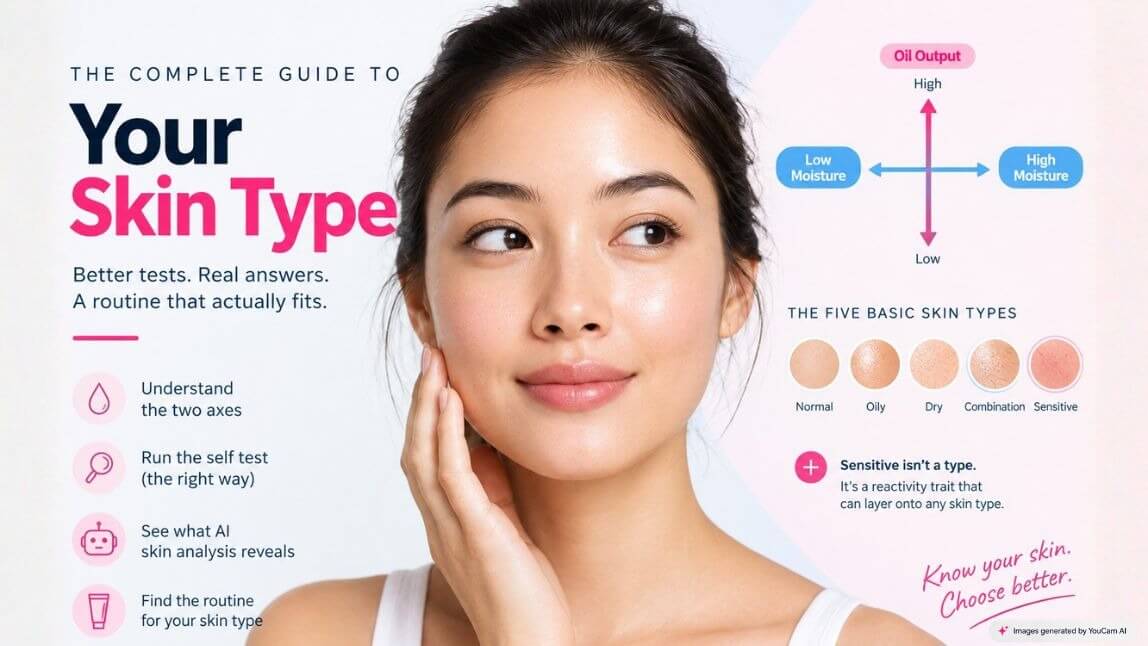
Images generated by YouCam AI
Almost every skin type guide hands you the same five buckets and the same blotting paper test from a decade ago. The problem is that the test measures one thing, oil, and then asks it to explain a face where oil and water behave independently. That is how a dehydrated, oily forehead gets labelled combination, gets prescribed an astringent, and gets worse. This guide replaces the five buckets with two measurable axes, gives you a self test that actually controls for the variables, separates skin type from skin tone from Fitzpatrick type, and shows what an AI skin type test reads that a paper strip cannot.
What this guide covers
How Do You Know Your Skin Type?
Wash your face with a gentle cleanser, apply nothing at all, and wait four hours in a stable indoor environment. Then check two separate things: how much shine has returned, and whether the skin feels tight. Shine measures oil output. Tightness measures moisture retention. They are independent, and you need both readings.

That is the whole method, and the four hour wait is the part everyone skips. Thirty minutes after cleansing, every skin type feels tight, because you just removed its surface lipids. Judging at that moment is how dry skin gets diagnosed in people who do not have it.
What Are the Five Basic Skin Types?
The conventional set, so we are working from the same vocabulary.
| Type | How it behaves four hours after cleansing | Typical pore appearance |
| Normal | Comfortable, light shine at most, no tightness | Small and even |
| Oily | Noticeable shine across forehead, nose and often cheeks | Visible, especially centrally |
| Dry | Tight, sometimes flaking, little to no shine | Fine and hard to see |
| Combination | Shine down the centre, comfortable or tight at the outer cheeks | Visible centrally, fine at the edges |
| Sensitive | Reacts, stings or reddens easily. Can sit on top of any of the four above | Varies, often with visible redness |
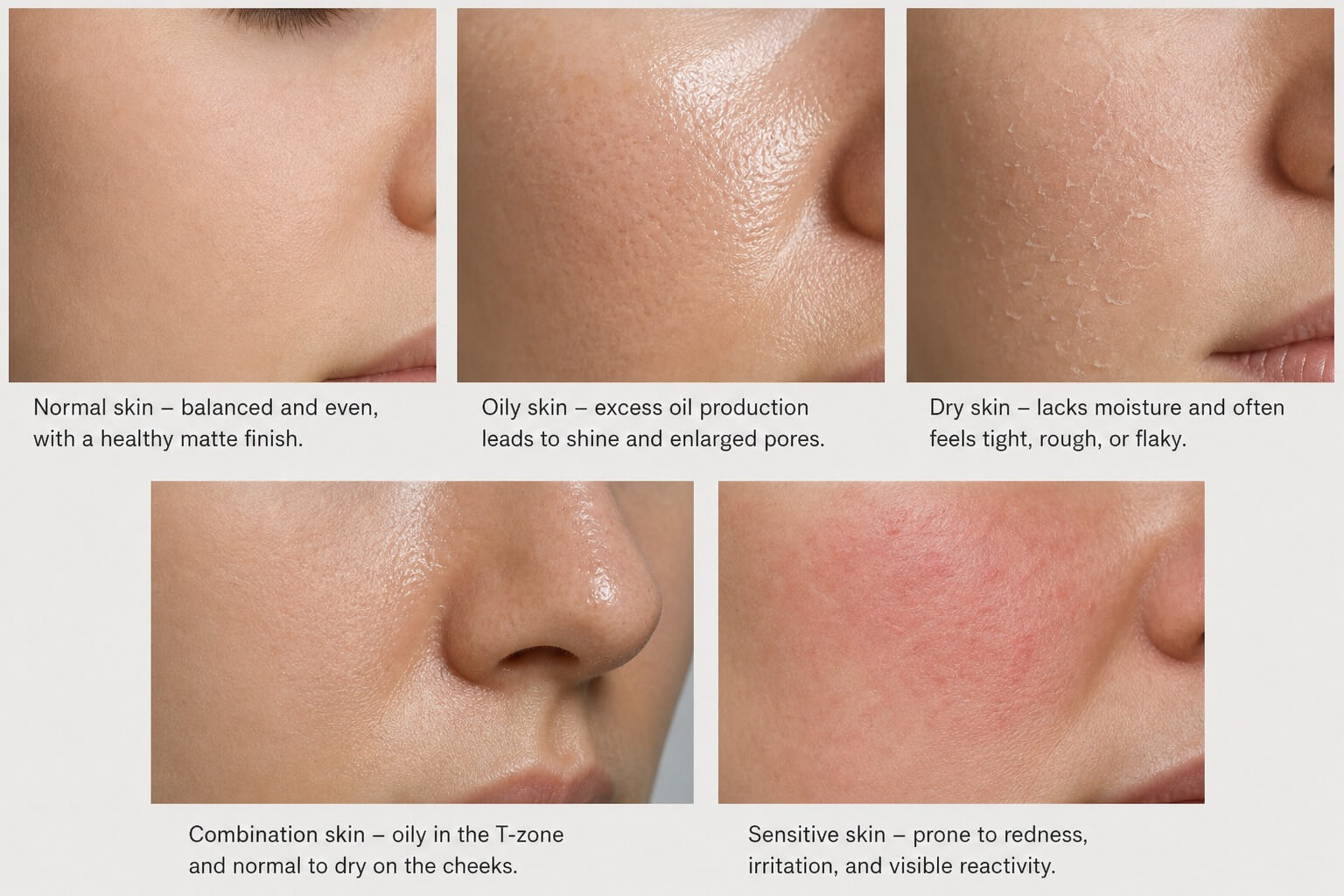
Note the last row. Sensitive is not a fifth peer category, it is a reactivity trait that layers onto whichever type you are. Plenty of people are oily and sensitive, or dry and sensitive, and treating sensitivity as a type on its own is a common source of wrong routines.
Why Does the Blotting Paper Test Get It Wrong?
Because it measures sebum and nothing else, then that single number gets asked to describe a face that has two independent variables.
Three specific failure modes:
- It cannot see dehydration. Skin can produce plenty of oil and still be short of water. The paper comes back oily, the person buys a foaming cleanser and an astringent toner, and the tightness gets worse while the shine stays.
- It is timing sensitive. Blot at one hour and almost everyone reads dry. Blot at six hours and almost everyone reads oily. Published guides rarely specify the wait, so results are not comparable between two people or even between two days.
- It is environment sensitive. Humidity, air conditioning, a flight, a cold snap, and a hot shower all move the result. A test that moves with the weather is measuring the weather.
None of this makes the blot test useless. It makes it one of two measurements, reported as if it were both.
What Are the Two Axes That Actually Define Skin Type?
Here is the reframe that makes the rest of this straightforward. Stop sorting yourself into five buckets and place yourself on a grid instead.
| Low oil output | High oil output | |
| Good moisture retention | Normal to dry, comfortable. Needs lipids, little else | Oily and well hydrated. Needs oil control, not moisture |
| Poor moisture retention | Truly dry and dehydrated. Needs humectants plus lipids, avoid all stripping | Oily and dehydrated. The most misdiagnosed skin on earth. Needs humectants and a gentler cleanser, not an astringent |
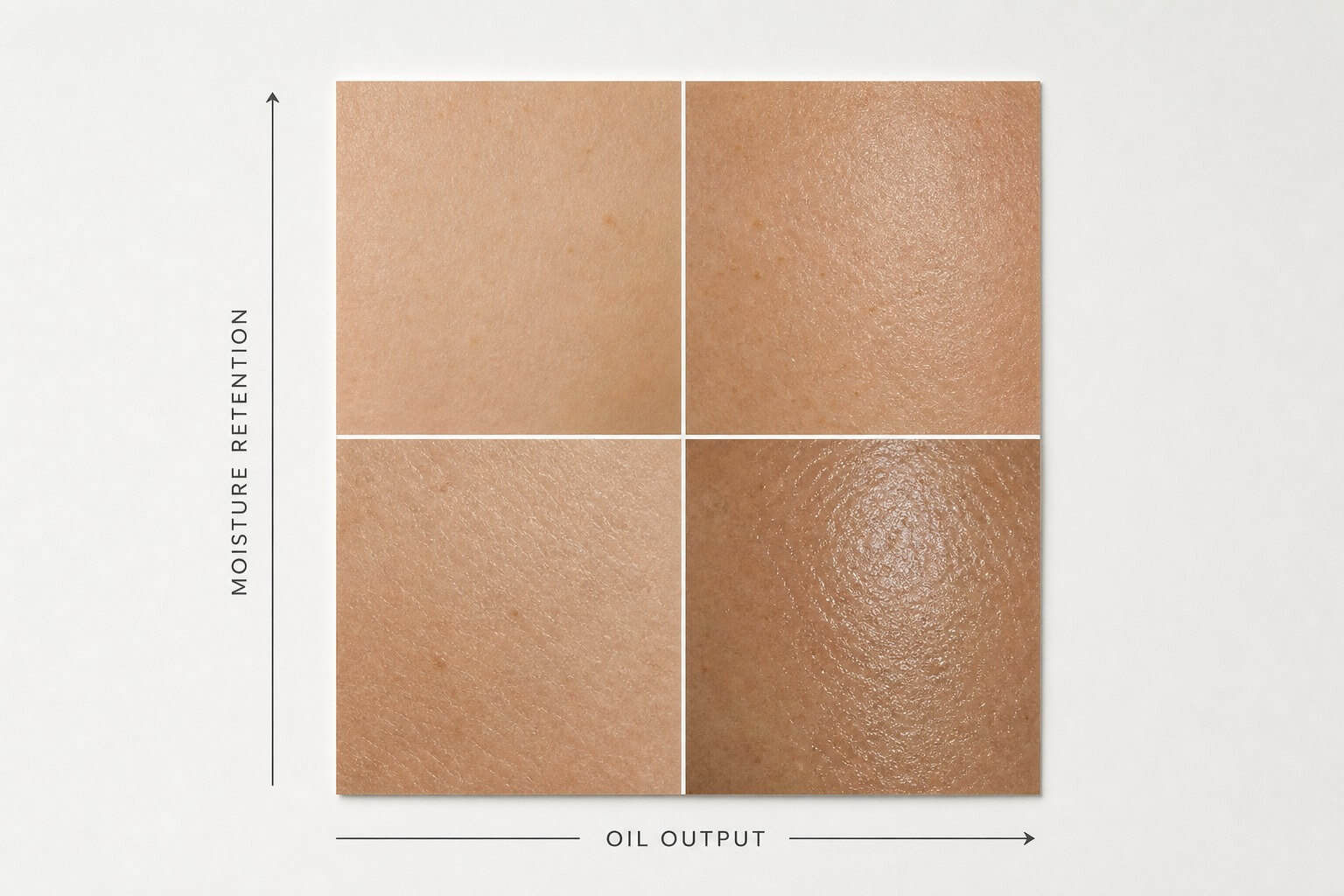
The bottom right quadrant is the one worth memorizing. Shiny by lunchtime and tight at the same time is not a contradiction, it is the single most common mismatch between what people have and what they buy. If that is you, every product marketed at oily skin is likely making the tightness worse without fixing the shine.
Combination skin fits on this grid too. It simply means different zones of your face sit in different quadrants, which is why one product rarely suits the whole face and why zone by zone reading beats a single label.
How Do You Run the Self Test Properly?
Four steps, and the controls matter more than the observations.
1. Clean the slate
Wash with a gentle, non-foaming cleanser in the evening. Apply nothing afterwards. No moisturizer, no serum, no sunscreen, since you are going to sleep.
2. Wait four hours, in one environment
Morning works well: wash, then assess four hours later without having applied anything. Stay indoors, avoid a hot shower in between, and do not do this the day after a flight or during the first cold week of the year.
3. Take the two readings separately
| Reading | How to take it | What it tells you |
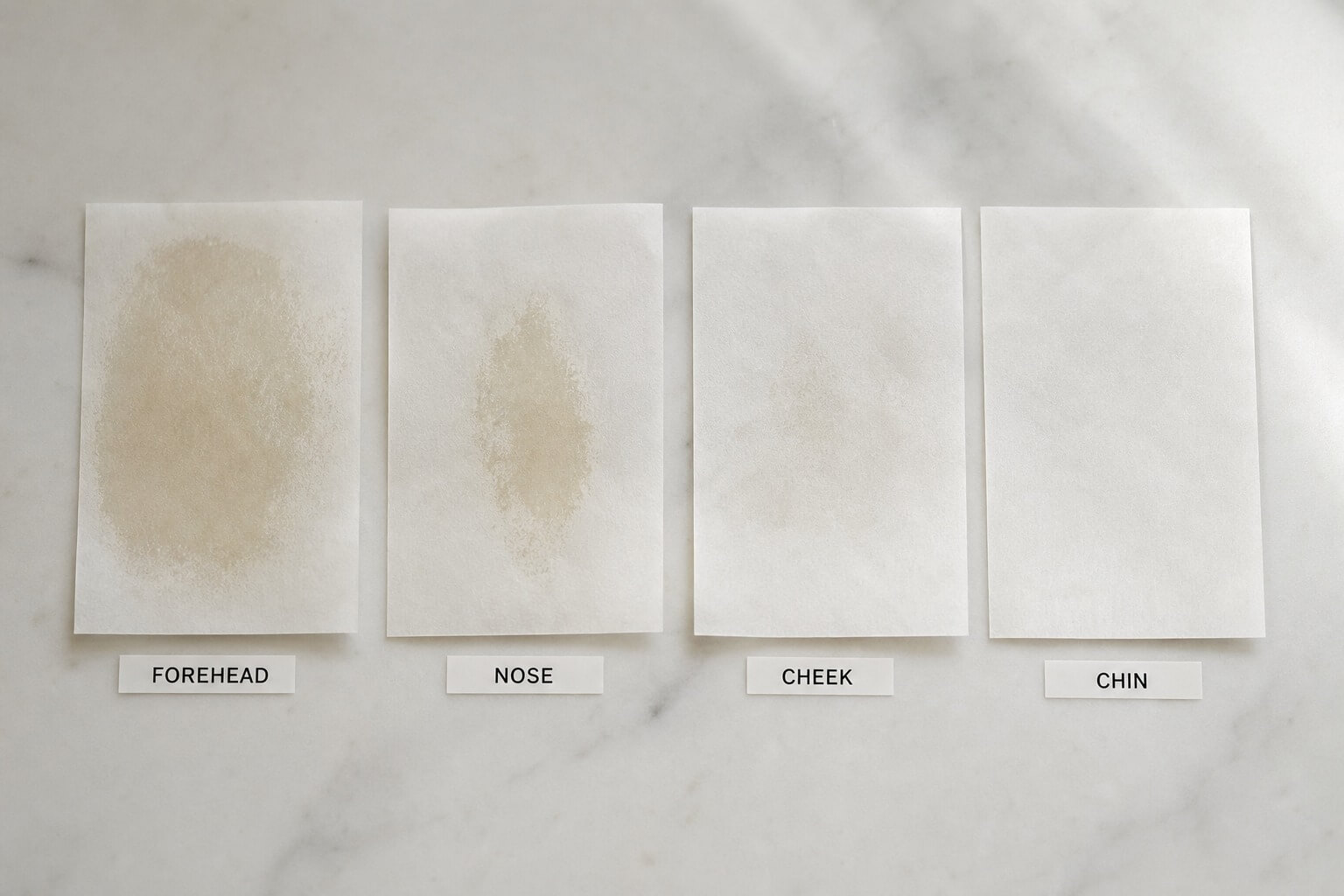
| Oil output | Press a blotting sheet on forehead, nose, each cheek and chin, one at a time, and compare | Where you sit on the oil axis, zone by zone |
| Moisture retention | Note tightness, any fine flaking, and whether fine lines look exaggerated | Where you sit on the moisture axis |
| Pore appearance | Photograph in side lighting, not flat frontal light | Supports the oil reading, since visible pores track sebum |
| Reactivity | Note any stinging, flushing or lingering redness over the four hours | Whether the sensitive trait applies on top |
4. Repeat in the opposite season
One reading is a snapshot. Two readings six months apart tell you your actual range, which is what a routine needs to accommodate.
Is Dehydrated Skin a Skin Type?
No, and this is the distinction the five bucket model hides. Dry is a type, driven by low oil production. Dehydrated is a condition, driven by water loss, and any type can have it including very oily skin.
| Dry skin | Dehydrated skin | |
| What is missing | Lipids, oil | Water |
| How long it lasts | A lifelong tendency | Temporary, responds in days |
| How it looks | Flaky, fine textured, dull, rarely shiny | Tight, dull, fine lines exaggerated, can still be shiny |
| What it needs | Ceramides and occlusives | Humectants, gentler cleansing, barrier support |
If your skin can be shiny and tight in the same afternoon, you are looking at dehydration sitting on top of normal or oily skin, and the fix is the opposite of what oily skin marketing suggests. Our full breakdown of dry versus dehydrated skin goes deeper on separating the two.
Can Your Skin Type Change?
Yes, and more than most people assume. The underlying tendency is fairly stable, but where you land on the grid moves with all of the following.
- Age. Oil production generally declines over time, so teenage oily skin often becomes adult normal or combination.
- Season and climate. Cold dry air and indoor heating push almost everyone toward the poor retention side of the grid.
- Hormonal shifts. Cycle, pregnancy and menopause all move sebum output measurably.
- Medication. Some treatments change oil production substantially, in either direction.
- Your own routine. Over-cleansing and over-exfoliating can manufacture the appearance of oily, sensitive or dehydrated skin that was not there to begin with.
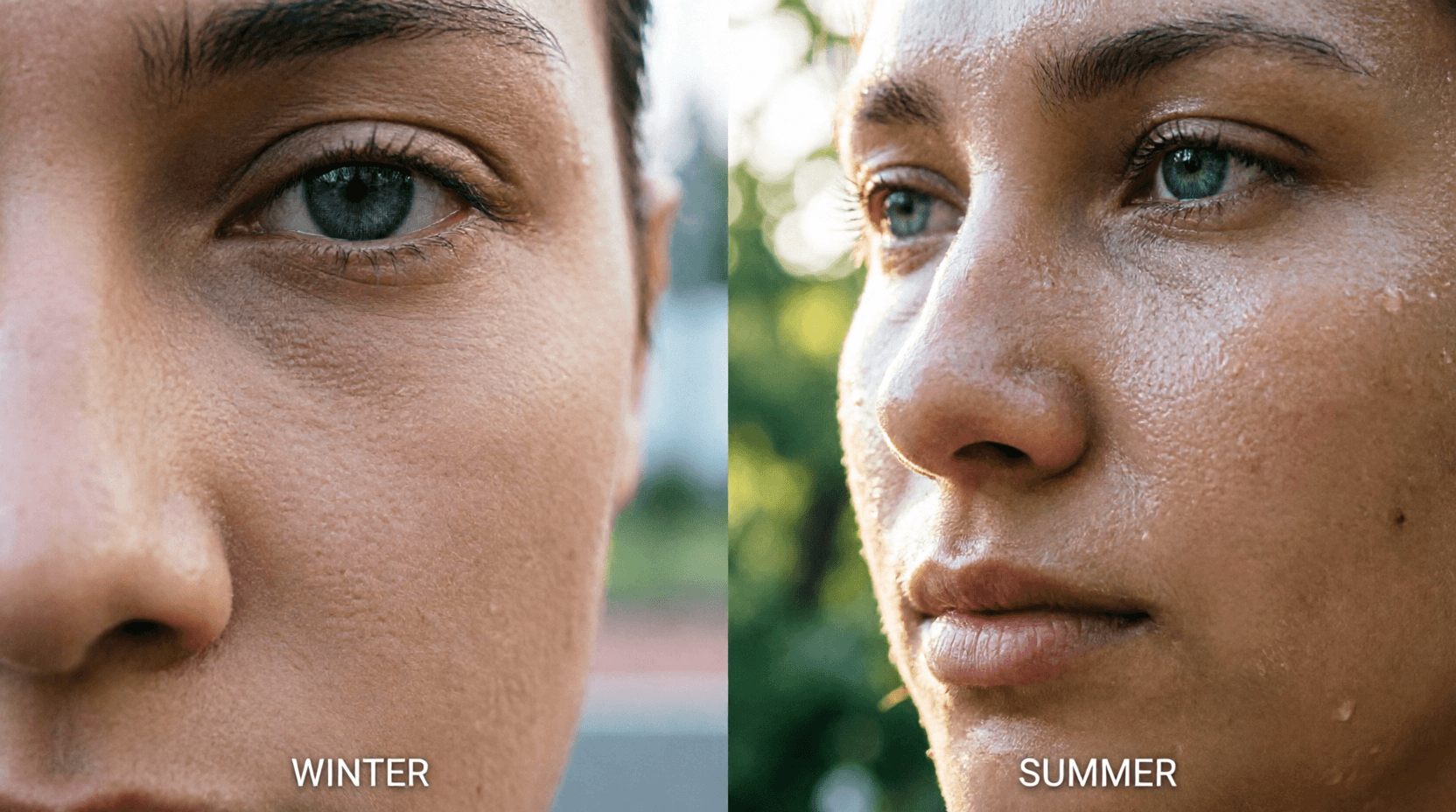
The practical implication: a skin type you determined once at 22 is not a permanent classification, and re-testing twice a year is more useful than any single verdict.
What Is the Difference Between Skin Type, Skin Tone and Fitzpatrick Type?
Three separate classifications, constantly used interchangeably, and mixing them up leads to genuinely bad product decisions.
| Classification | What it describes | What it is used for |
| Skin type | How your skin behaves: oil output and moisture retention | Choosing cleansers, moisturizers, treatment textures |
| Skin tone | The colour and undertone of your skin | Shade matching for foundation and concealer |
| Fitzpatrick type | How your skin responds to UV, from always burns to never burns | Sun protection guidance, laser and peel settings, pigmentation risk |
You have all three at once, and they are independent. Someone can be oily, deep toned, and Fitzpatrick type V, and each of those facts drives a different decision. Fitzpatrick matters most when professional treatment enters the picture, since resurfacing settings depend on it. If that is the one you need, the guide to skin complexion types covers tone and its undertones in detail.
How Does AI Skin Analysis Determine Skin Type?
By reading the two axes separately from a single photograph, which is exactly what the paper strip cannot do.
A modern engine scans up to 15 skin concerns and returns oiliness and moisture as their own scored dimensions, alongside texture, pores, redness and the rest. Three consequences:
| What you get | Why it beats a self test |
| Oiliness and moisture as separate numbers | Places you on the grid instead of in a bucket, so oily and dehydrated stops being invisible |
| Zone by zone values | Turns the vague label combination into specific readings for forehead, nose, cheeks and chin |
| A comparable baseline | Re-testing in the opposite season becomes a real comparison rather than a memory |
The same caveat as any photo based reading applies: it is an estimate from visible signs, and it only stays comparable if the capture conditions repeat. Same room, same time of day, same distance, beauty filters off. Change the light and you change the apparent shine on identical skin.
Teams who want to build this into their own flow can test the scoring against real images in the YouCam AI API Playground first. Perfect Corp works with 800+ brand partners running exactly this pattern: read the skin, route the recommendation, then re-read to prove the routine worked.
What Routine Suits Each Skin Type?
Sorted by quadrant rather than by bucket, because that is what changes the answer.
| Where you sit | Cleanser | Core step | What to avoid |
| Low oil, good retention (normal to dry) | Gentle, non-foaming | Ceramide moisturizer | Over-exfoliating in pursuit of glow |
| Low oil, poor retention (dry and dehydrated) | Cream or oil based | Humectant layered under an occlusive | Foaming cleansers, high strength acids, hot water |
| High oil, good retention (oily) | Gel, once or twice daily | Lightweight hydration plus niacinamide, BHA where clogging exists | Skipping moisturizer entirely, which rebounds |
| High oil, poor retention (oily and dehydrated) | Gentle, non-stripping | Humectant serum plus a light gel cream | Astringents, alcohol toners, daily strong acids |
| Mixed zones (combination) | Gentle across the whole face | Different moisturizer weight by zone, or targeted application | Treating the whole face as its oiliest part |
| Sensitive trait on top of any row | Fragrance free, minimal ingredients | Barrier repair first, introduce actives one at a time | Layering multiple new products in one week |
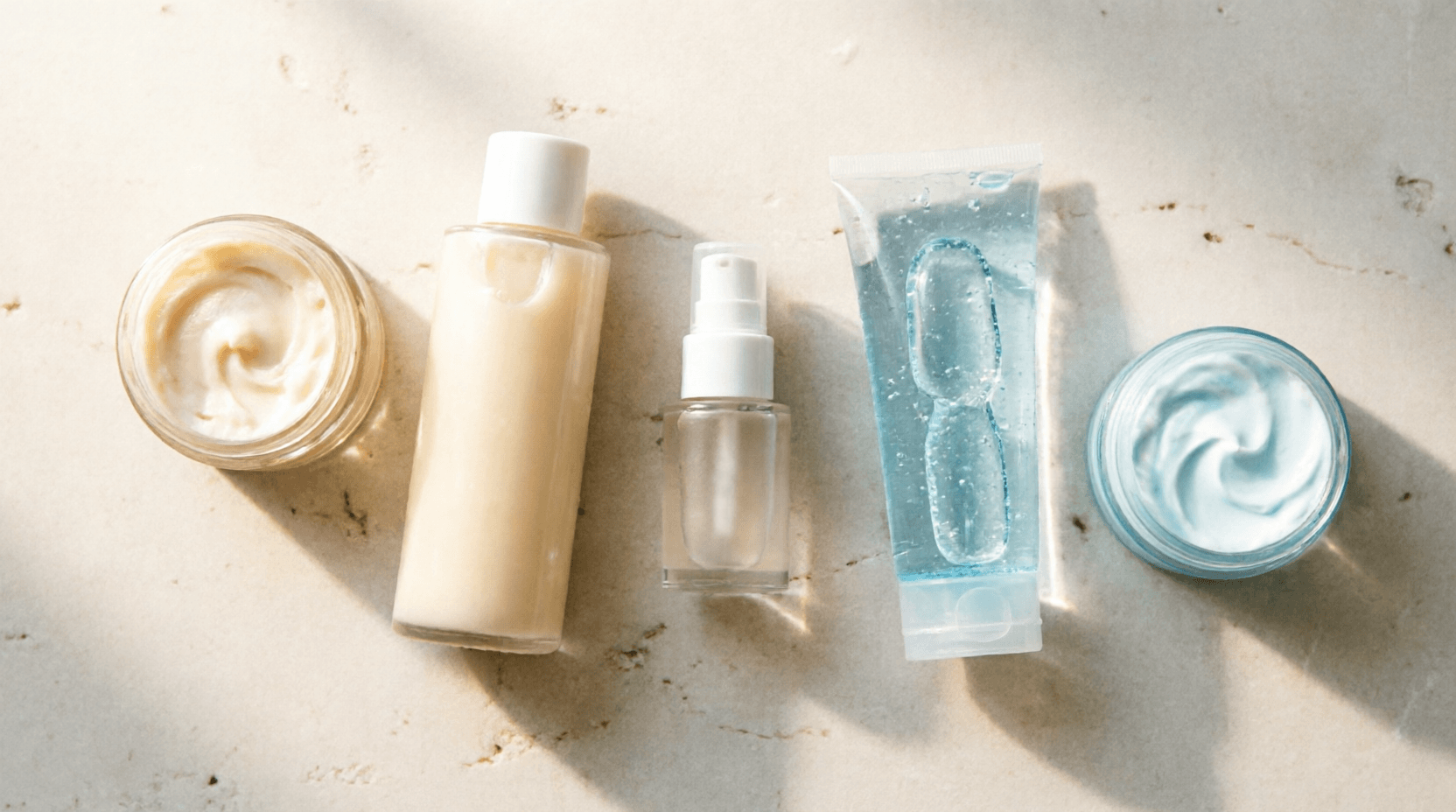
Everyone, in every row, needs broad spectrum SPF every morning. That is the one line of a routine that does not change with skin type.
Skin Type FAQ
How do I know my skin type?
Cleanse with a gentle product, apply nothing, wait four hours in a stable indoor environment, then take two separate readings: how much shine has returned, and whether the skin feels tight. Shine is oil output, tightness is moisture retention, and you need both.
What are the five basic skin types?
Normal, oily, dry, combination and sensitive. Worth knowing that sensitive is really a reactivity trait that layers on top of the other four rather than a peer category, and that combination simply means different zones behave differently.
What is the most common skin type?
Combination is the most frequently self-reported, which makes sense once you realize it describes a face whose zones sit in different places on the oil and moisture grid rather than a single uniform behavior.
Can you have oily and dry skin at the same time?
Yes, in two different ways. Different zones can have different oil output, which is combination skin. Or the whole face can produce plenty of oil while still losing water, which is oily dehydrated skin and the most commonly mistreated state of all.
Is dehydrated skin a skin type?
No. Dry is a type driven by low oil production. Dehydrated is a temporary condition driven by water loss, and it can occur on any type, including very oily skin. Dry needs lipids. Dehydrated needs humectants and gentler cleansing.
Can your skin type change?
Yes. Oil production generally declines with age, and season, climate, hormones, medication and your own routine all shift where you sit. Re-testing twice a year, in opposite seasons, tells you your real range.
What is the blotting paper test and is it reliable?
You press a sheet onto each area and compare oil absorption. It is a reasonable measure of sebum and a poor measure of skin type, because it cannot detect dehydration, and its result shifts with timing and environment. Use it as one of two readings, not as the verdict.
How long should I wait before checking my skin type?
Four hours after cleansing, with nothing applied. At thirty minutes almost every skin reads tight because you just removed its surface lipids, and at six hours almost every skin reads oily.
What is the difference between skin type and Fitzpatrick skin type?
Skin type describes behavior, meaning oil and moisture. Fitzpatrick describes how your skin responds to UV, from always burns to never burns. Fitzpatrick drives sun protection advice and professional treatment settings, not your choice of moisturizer.
Does skin type determine which products I need?
It determines the base of your routine, meaning cleanser strength and moisturizer weight, and it rules certain things out. It does not determine your treatment actives, which follow your concerns such as texture, pigmentation or lines. Type sets the foundation, concerns set the targets.
Two Numbers Beat Five Labels
Skin type is not a personality, it is a pair of measurements that drift with age, season and whatever you have been doing to your face. Read oil and moisture separately, place yourself on the grid rather than in a bucket, re-read in the opposite season, and the routine decisions that used to feel like guesswork become obvious. Above all, if you are shiny and tight at the same time, stop buying products designed for shine alone.
Run a free AI skin analysis for zone by zone oiliness and moisture readings, or contact Perfect Corp for a demo if you are building skin type detection into your own product experience.