 Author:



Images designed by YouCam AI
"Beauty sleep" sounds like something your grandmother said to get you off the phone. Turns out she was onto something. While you are out cold, your skin runs its most intense shift of the day: cells divide faster, blood flow climbs, and damaged proteins get cleared out. The catch? Nobody can see it happening. That is why most night creams are sold on promises, not proof.
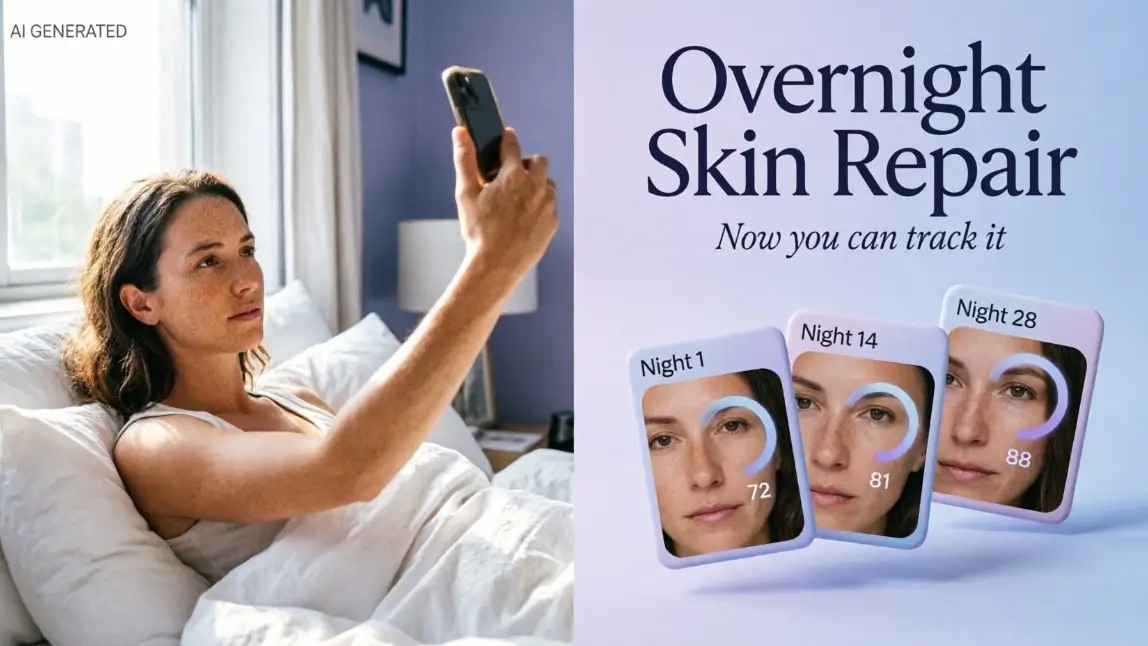
Overnight skin repair tracking changes the deal. With AI skin analysis, a simple morning selfie becomes a data point, and 28 mornings become a trend line. For skincare brands, that is the difference between "feels smoother" and "texture score up 12%."
Table of Contents
- What actually happens to your skin overnight?
- Why is overnight skin repair so hard to measure?
- How does AI track overnight skin repair?
- Which skin metrics should you track at night vs. morning?
- How can skincare brands use overnight repair data?
- How do you build a 28-day overnight tracking routine?
- FAQ
What Actually Happens to Your Skin Overnight?

Your skin follows its own 24-hour clock, the circadian rhythm, and it is controlled by clock genes inside skin cells. By day, skin plays defense against UV, pollution and friction. By night, it flips into rebuild mode.
Does skin really regenerate faster at night?
Yes. Research on the skin's circadian clock shows that cell division in the basal layer peaks at night, roughly around midnight, when there is no UV exposure to damage new DNA. Daytime is for protecting; nighttime is for producing.
Why does skin lose more water at night?
Transepidermal water loss (TEWL) is higher in the evening and overnight, and the barrier becomes more permeable. That is bad news for hydration, and great news for actives. It is a big reason dermatologists push retinoids, peptides and heavy occlusives into the night routine.
What does poor sleep do to your skin?
A frequently cited study from University Hospitals Case Medical Center found that good sleepers recovered from barrier disruption about 30% better than poor sleepers, and showed fewer signs of intrinsic aging. Another study published in The BMJ found that people photographed after sleep deprivation were rated as looking more tired and less healthy. Sleep is not a luxury for skin. It is maintenance.
| Time window | What skin is doing | What that means for skincare |
|---|---|---|
| Evening (9 PM to 11 PM) | Barrier becomes more permeable, TEWL rises | Best time to apply actives and occlusives |
| Deep night (11 PM to 4 AM) | Cell division and blood flow peak | Repair ingredients have the most to work with |
| Early morning (4 AM to 7 AM) | Skin shifts back toward defense mode | Morning selfie captures the "overnight result" |
Why Is Overnight Skin Repair So Hard to Measure?
Repair is slow, subtle and invisible night to night. You do not wake up with visibly new skin on day two. Changes show up over weeks, and human memory is a terrible lab instrument. Mirror checks change with lighting, mood and how much coffee you have had.
Clinical tools exist, of course. Corneometers measure hydration, TEWL meters measure barrier function, and imaging devices count spots and wrinkles. But they live in labs and clinics. Most consumers will never see one, and most brands cannot afford to put one in every customer's bathroom.
- Lighting changes: bathroom light, daylight and phone flash all change how skin looks.
- Memory bias: people remember the best or worst day, not the trend.
- Slow signal: visible texture and tone changes usually take 2 to 4 weeks.
- No baseline: without a "Day 1" record, "better" has nothing to compare to.
How Does AI Track Overnight Skin Repair?

AI skin analysis turns a regular selfie into a structured skin report. Perfect Corp's AI Skin Analysis detects 14 skin concerns from a photo, including wrinkles, spots, texture, pores, redness, moisture, dark circles and more. It reports a 95% test-retest reliability rate, according to a report by Dr. Steven R. Feldman, Professor of Dermatology at Wake Forest School of Medicine. That repeatability is exactly what tracking needs: if the same face gets the same score twice, a change in score means a change in skin.
Why is repeatability more important than a single score?
One reading is a snapshot. Tracking is a movie. For overnight repair, the question is not "how good is my skin?" but "is it getting better since I started this serum?" Consistent scoring under similar conditions is what makes a 28-day chart trustworthy.
Can AI skin analysis run inside an app or website?
Yes. Brands can add skin analysis to a website or mobile app through plug-and-play integration, or build a custom flow with the skin analysis API. Developers can test it first in the AI Skin Analysis API Playground.
Want to see your own skin report? Try AI Skin Analysis on a selfie and see all 14 concern scores in seconds.
Which Skin Metrics Should You Track at Night vs. Morning?

The smartest setup uses two check-ins: one before bed and one right after waking up. The gap between them is the closest thing you can get to an "overnight delta" without a sleep lab.
| Metric | Why it matters overnight | Best check-in | Typical time to see change |
|---|---|---|---|
| Moisture | Shows if occlusives are stopping nighttime water loss | Night and morning | Days |
| Redness | Signals barrier calm or irritation from actives | Morning | Days to 2 weeks |
| Dark circles | Closely linked to sleep quality and duration | Morning | Days |
| Texture | Reflects cell turnover and exfoliation results | Morning | 2 to 4 weeks |
| Wrinkles and fine lines | Long-term marker for retinoid and peptide claims | Morning | 4 to 12 weeks |
| Spots | Tracks brightening and pigment-fading ingredients | Morning | 4 to 8 weeks |
Struggling with a stressed barrier? Pair tracking with a quick skin barrier online test to see where you are starting from.
How Can Skincare Brands Use Overnight Repair Data?

Night creams, sleeping masks and overnight serums are some of the most crowded shelves in beauty. Everyone says "repairs while you sleep." Few can show it. Tracking data gives brands something competitors cannot copy: evidence from their own customers.
Turn claims into receipts
Run a consumer tracking program where buyers scan before starting and every few days after. Aggregated score changes can support marketing stories and guide claim testing, alongside proper clinical studies where regulations require them.
Recommend the right night routine
Skin scores can drive personalized product suggestions. High redness? Suggest a barrier cream before a retinoid. Low moisture? Push the sleeping mask. The AI skin analysis flow can connect concern results to product recommendations automatically.
Keep customers coming back
Progress is addictive. A weekly "your skin this week" report gives shoppers a reason to reopen the app, and a reason to reorder when the bottle runs out.
Feed R&D with real-world data
Formulation teams can see which concerns move fastest for which skin types, and where a product underperforms, using anonymized, consented data at scale.
How Do You Build a 28-Day Overnight Tracking Routine?

One skin cycle in adults takes roughly four weeks, so 28 days is a fair first test for any night product. Here is a routine that keeps the data clean:
- Take a baseline: scan on Day 1 before starting the new product.
- Lock the conditions: same time, same spot, same light (a window in the morning works well), no makeup.
- Change one thing: add one new night product at a time, or you will not know what worked.
- Log your sleep: note hours slept, since short nights can show up in dark circles and redness.
- Compare weekly: look at week-over-week trends, not day-to-day noise.
- Review on Day 28: compare the baseline report with the final one, concern by concern.
Building a skincare app or night-care launch? Add tracking powered by AI Skin Diagnostic and let your customers see their overnight progress.
FAQ
How does skin repair itself overnight?
At night, skin cells divide faster, blood flow to the skin increases and the body clears damaged proteins. The barrier also becomes more permeable, which is why ingredients applied at night can be more effective.
How many hours of sleep does skin need to repair?
Most adults need 7 to 9 hours of sleep. Research links consistently poor sleep to slower barrier recovery and more visible signs of aging.
Can you see overnight skin repair results?
Day-to-day changes are subtle. Hydration and puffiness can shift overnight, while texture, spots and fine lines usually take weeks. AI skin analysis makes those slow changes visible by tracking scores over time.
Is night skincare better than morning skincare?
They do different jobs. Morning skincare protects, with sunscreen and antioxidants. Night skincare supports repair, with retinoids, peptides and rich moisturizers.
Can AI really track skin improvement?
Yes, when scans are taken in consistent conditions. Perfect Corp's AI Skin Analysis reports 95% test-retest reliability, so changes in scores over weeks reflect real changes in the skin rather than random noise.
Does lack of sleep cause dark circles and wrinkles?
Short sleep is strongly linked to dark circles, puffiness and dull skin. Over the long term, chronic poor sleep is associated with more fine lines and slower recovery from skin stress.