Author:


A bangle size chart matches the inner diameter of a rigid bangle to the widest part of the shopper's hand, not the wrist. Because a closed bangle has no clasp, chain or stretch, it has to slide over the folded knuckles, and there is no way to adjust it afterward. That makes bangles the least forgiving item in a jewelry catalog: a bracelet that is a little loose still gets worn, while a bangle that is a few millimeters too small simply does not go on, and usually comes back.
For jewelry and fashion retailers, that turns the size chart into a returns problem. This guide explains how bangle sizing works, why standard charts often fall short, and how retailers can help shoppers choose the right size before they buy.
At a Glance
- Closed bangles are sized by hand measurement across the knuckles; cuffs and many hinged styles sit closer to wrist sizing.
- Inner diameter and inner circumference are linked by a simple formula: circumference ÷ π (about 3.14) = diameter.
- Size labels such as S, M and L are not standard across brands, so publish millimeter values.
- A rigid piece has no adjustment range, so a sizing miss is more likely to become a return than with a chain bracelet.
Why Is Bangle Sizing Different From Bracelet Sizing?
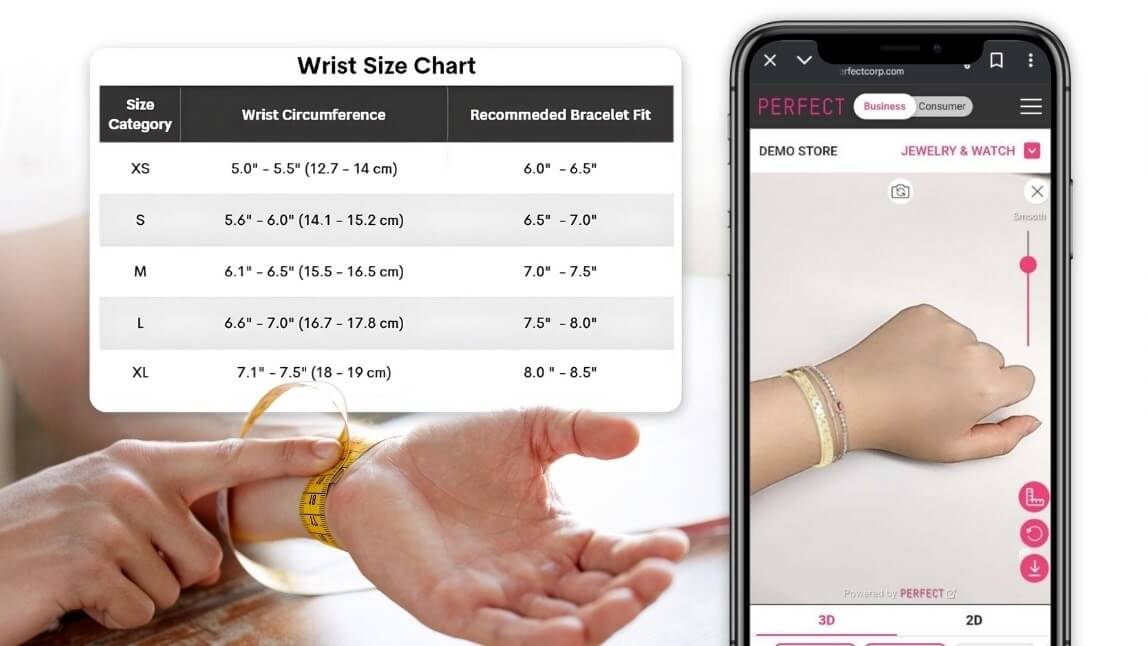
Most bracelets are sized from wrist circumference plus a comfort allowance. Perfect Corp's bracelet size chart guide covers that method for chains, tennis bracelets, beaded styles and charms, where an extender or slider clasp can absorb small errors.
A solid bangle breaks that logic in three ways:
- It must clear the hand. The limiting measurement is the folded hand at the knuckles, which is usually larger than the wrist.
- It cannot be adjusted. There is no spare link to remove or add, and resizing a finished metal bangle is often impractical.
- Construction changes the fit. Closed, hinged, oval and open-cuff bangles sit on the wrist differently even when the stated size is the same.
How Does a Bangle Size Chart Work?

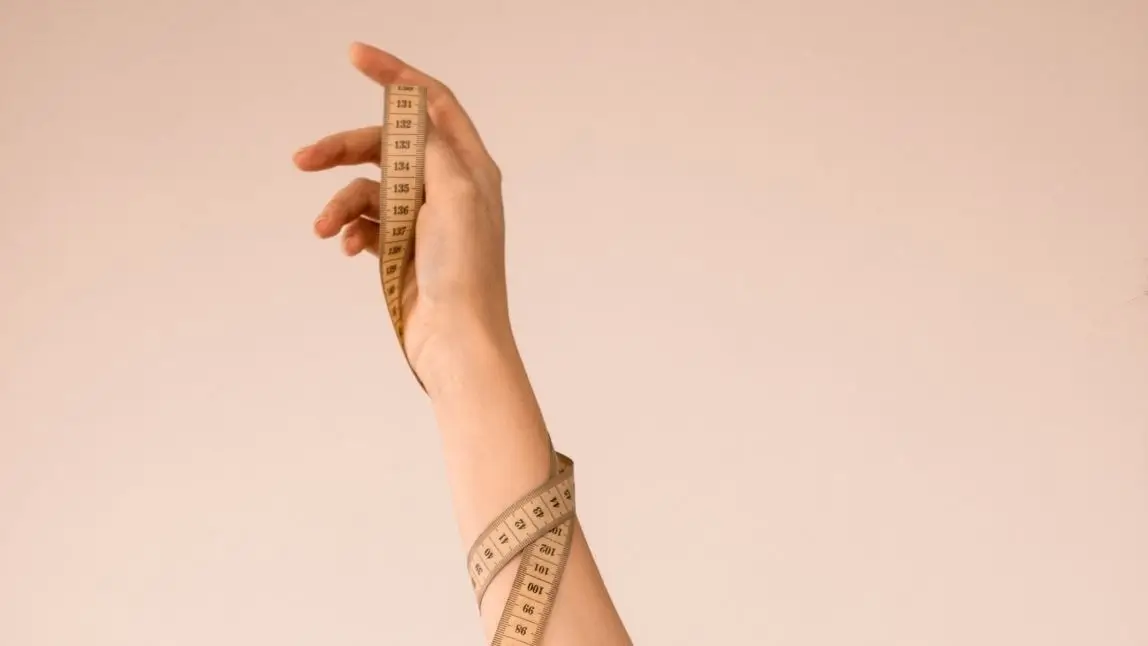
To measure, the shopper brings the thumb toward the little finger, as if putting on a bangle, then wraps a soft tape around the widest part of the hand across the knuckles. That reading is compared with the bangle's inner circumference. To convert, divide circumference by π to get inner diameter, or measure edge to edge inside a bangle that already fits.
The reference table below shows how common inner diameters convert to inner circumference. It is a conversion aid, not a universal standard: labels and recommended ranges differ between brands.
| Inner diameter (mm) | Inner diameter (in) | Inner circumference (cm) | Inner circumference (in) |
|---|---|---|---|
| 54 | 2.13 | 17.0 | 6.7 |
| 57 | 2.24 | 17.9 | 7.1 |
| 60 | 2.36 | 18.8 | 7.4 |
| 63 | 2.48 | 19.8 | 7.8 |
| 65 | 2.56 | 20.4 | 8.0 |
| 67 | 2.64 | 21.0 | 8.3 |
Closed, Hinged, Oval and Open Bangles
Closed round bangles follow the hand measurement most strictly. Hinged bangles open to go around the wrist, so they can fit closer to wrist size. Oval bangles follow the wrist's shape and may sit more snugly at the same nominal size. Open cuffs are usually sized from the wrist and the gap. Size guides should say which rule applies to each product, rather than offering one chart for the whole category.
Why Do Bangle Size Misses Become Returns?
Returns are already a large cost for retailers. The National Retail Federation estimated that 19.3% of U.S. online sales would be returned in 2025, with total returns of nearly $850 billion, and 40% of retailers cited rising processing costs as a reason for charging for returns.
Bangles add a category-specific risk. A shopper who orders a size too small cannot wear the piece at all, and a shopper who orders too large may see it slide off the hand. Common causes of a miss include:
- Measuring the wrist instead of the folded hand.
- Relying on S/M/L labels that mean different things at different brands.
- Applying a closed-bangle chart to a hinged or oval style, or the reverse.
- Stacking a new bangle with existing pieces of a different size.
How Can Retailers Reduce Bangle Returns?
Practical steps that support confident sizing:
- Publish millimeters on every product page. List inner diameter and inner circumference, not just a size label.
- Explain the rule for each construction. Tell shoppers whether to use a hand or wrist measurement for that specific style.
- Offer a "measure a bangle you own" option. Many shoppers already have a bangle that fits well.
- Show realistic scale. Product photos on a model do not show how a piece will look on the shopper's own wrist.
- Add digital sizing and try-on. Camera-based tools can reduce reliance on string and paper measurements and help shoppers visualize fit.
How Perfect Corp Supports Bangle Sizing and Try-On

Perfect Corp's AI Bracelet Virtual Try-On lets shoppers see bracelets and bangles on their own wrist through a phone camera, in the mobile browser without an app download. According to the product page, AgileHand™ technology reads wrist shape and angle frame by frame, and the same camera pass can estimate wrist circumference and recommend a size.
For rigid jewelry, scale accuracy matters. Perfect Corp builds try-on assets to true product dimensions, so a 16 cm bangle does not render like an 18 cm one, and shoppers can layer bangles with bracelets and watches to preview a stack.
Brands can deploy it as a web module, native iOS and Android SDKs, or an API. Retailers can explore how camera sizing fits the returns workflow in this guide to AI wrist size calculators, or see where wrist technology is heading in what an AI bracelet is. A live bracelet try-on and wrist sizer demo is also available.
Give Bangle Shoppers a Clearer Sizing Story
Perfect Corp's AI jewelry try-on and wrist sizing can help your customers see true-to-scale bangles on their own wrist before they choose a size. Talk with our team about bringing virtual try-on and sizing into your jewelry product pages.