 Author:



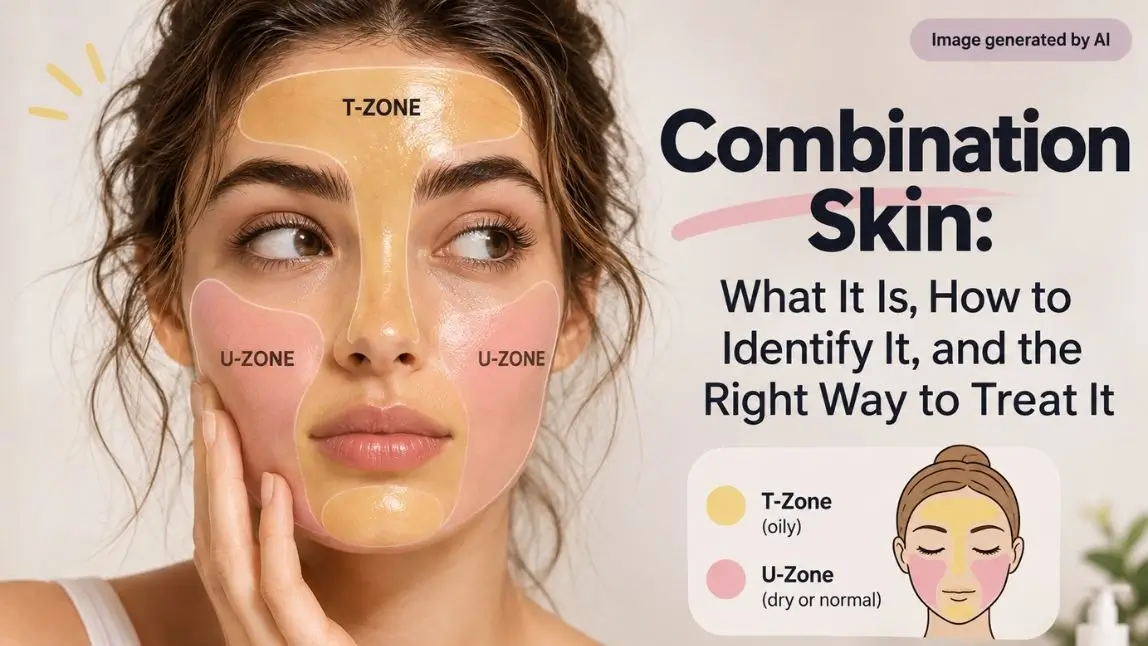
Images generated by AI
Combination skin is the most commonly claimed skin type and the most commonly misidentified one. Ask a room of people and roughly half will say they have it, usually on the strength of a shiny nose. Ask them which parts are oily and which are dry, and the answers get vague, because almost nobody has actually checked. The standard test every brand site recommends, wash your face and see how it feels four hours later, measures how your skin feels rather than what it is doing, and those two things diverge more than you would expect.
This matters because combination skin is the one type where a whole face routine is actively wrong. Treat the dry cheeks and the T zone stays slick. Treat the T zone and the cheeks tighten, flake and start producing more oil in protest. The fix is not a better product. It is knowing which zone is which, with enough precision to treat them differently.

What Is Combination Skin?
Combination skin means different areas of the same face behave differently: typically an oilier T zone covering the forehead, nose and chin, with a drier or normal U zone across the cheeks and jawline. The split is not arbitrary. Sebaceous gland density is genuinely higher across the central face, so the T zone is producing more oil on the same face at the same time.

That makes combination skin less a type than a measurement of difference. Oily skin is a level. Dry skin is a level. Combination is a gap between two levels on the same face, which is why a single number can never describe it.
| Zone | What it covers | Typical behaviour |
|---|---|---|
| T zone | Forehead, nose bridge, chin | Higher gland density, visible shine, larger pores, congestion |
| U zone | Cheeks, jawline, outer face | Lower gland density, tightness, flaking, sensitivity to actives |
| The gap | The difference between the two | This is the actual diagnosis, not either zone alone |
How Do You Know If You Have Combination Skin?
The four hour test is not useless, it is just imprecise. It returns one impression of the whole face, filtered through how the skin feels rather than how it looks, and feel is dominated by hydration while shine is dominated by sebum. Those are separate things, which is the single biggest source of error in self assessed skin type.

A measured approach separates the zones. A facial skin analysis scores skin type three ways in the same scan: the whole face, the T zone and the U zone independently. The gap between the last two is what identifies combination skin, and the direction of the gap decides the routine.
| T zone | U zone | What you actually have | What to do about it |
|---|---|---|---|
| Oily | Normal | Classic combination skin | Zone treatment. Mattify the T zone only, leave the cheeks alone |
| Oily | Dry | Combination with a compromised barrier | Repair the barrier first. Oil control second, never a stripping cleanser |
| Oily | Oily | Uniformly oily, not combination | Whole face oil control works here, and only here |
| Normal | Dry | Dry leaning, not combination | Hydration and barrier support across the whole face |
| Normal | Normal | Balanced. Shine is situational | Maintenance. Blot rather than treat |
Rows two and three are where most routines go wrong. A person with oily cheeks does not have combination skin and does not need zone treatment. A person with dry cheeks and an oily forehead has a barrier problem wearing an oiliness costume, and the standard combination routine will make it worse.
Is Combination Skin Oily or Dry?
Both, in different places, and sometimes neither in the way the question implies. The trap is assuming that oil and hydration are opposite ends of one scale. They are not. Sebum output and surface hydration are separate measurements, and a face can score low on both at once.
| Oiliness | Moisture | Pattern | What goes wrong if you misread it |
|---|---|---|---|
| High oil | Good hydration | Genuinely oily zone, barrier intact | Nothing. Standard oil control works |
| High oil | Low hydration | Dehydrated oily skin | Oil control alone drives oil production up, not down |
| Low oil | Low hydration | Dry or dehydrated, not oily at all | Occasional shine gets read as oiliness and the wrong tier gets bought |
| Low oil | Good hydration | Balanced | Nothing. Maintain |
Row two is the most common misread in the whole category, and it is worth reading more about the difference between dry and dehydrated skin before building any routine around it. A dehydrated T zone produces more oil because the barrier is signalling that it has lost water, and stripping it harder is the one response guaranteed to extend the cycle.
What Causes Combination Skin?
Mostly anatomy, partly behaviour, and more than people expect, the products already in use.
| Cause | What it does | Can you change it? |
|---|---|---|
| Gland distribution | Higher sebaceous density across the central face | No. This is the baseline |
| Genetics | Sets how reactive those glands are | No |
| Over cleansing | Strips the U zone while barely denting the T zone | Yes, and this is the fastest fix |
| Harsh actives on the whole face | Treats cheeks that did not need treating | Yes |
| Season and humidity | Widens or narrows the gap between zones | Partly. Adjust the routine, not the diagnosis |
| Age | Sebum output declines, so the gap usually narrows over time | No, but expect the routine to need revisiting |
The third and fourth rows deserve attention because they are self inflicted. A great many people who describe themselves as combination are running a whole face oil control routine that created the dry cheeks they are now trying to fix. Removing the cause is cheaper than buying a product to counteract it.
Sebum output varies with season, time of day, ambient temperature and age, which is why a single self description of skin type is a poor basis for a long term routine.Youn, S. W. et al., Regional and seasonal variations in facial sebum secretions, Skin Research and Technology
How Do You Treat Combination Skin?
The governing principle is that shared steps should be gentle enough for the driest zone, and anything stronger should be applied only where it is needed. Most routines invert this, picking products for the oiliest zone and applying them everywhere.
| Step | Apply where | What to use | Why |
|---|---|---|---|
| Cleanse | Whole face | Gentle, non foaming, pH balanced | Pick for the driest zone. A stripping cleanser cannot be undone later in the routine |
| Treat | T zone only | Salicylic acid or a mattifying serum | This is the step that should be zoned, and almost never is |
| Hydrate | Whole face, two textures | Light gel on the T zone, richer cream on the U zone | Hydration is needed everywhere. The texture is what changes |
| Barrier support | U zone, or wherever it is dry | Ceramides, niacinamide, fatty acids | Fixes the actual problem rather than managing its symptoms |
| Protect | Whole face, daily | Broad spectrum SPF in a finish you will tolerate | Non negotiable. Finish is a texture decision, not a skip reason |
What does not work
Three things, consistently. Stripping the whole face and hoping the cheeks recover, which they do not. Buying a product labelled for combination skin and applying it uniformly, which simply averages two problems into one mediocre answer. And treating the oiliness as the whole story when the moisture reading says the barrier is the real issue.
Does Combination Skin Change Over Time?
Yes, in both directions. Sebum output generally declines with age, so the gap between zones tends to narrow and many people who were combination at twenty five read as normal or dry leaning at forty five. Season moves it too: the same face can test as combination in August and dry in January.
That is an argument for re-measuring rather than for picking a type once and buying against it for a decade. Oil control is also one of the few categories where change shows up inside a month, which makes a thirty day re-scan realistic in a way that pigment or firmness programmes never are.
How Does a Skin Analysis API Score Combination Skin?
Combination skin is unusual among skin concerns in that detecting it requires comparing two measurements rather than reading one. The YouCam Skin Analysis API returns skin type for the whole face, the T zone and the U zone as independent values within a set of 28 diagnostics across 16 skin concerns, which is what makes the comparison possible from a single selfie.

| Reading | What it contributes |
|---|---|
| Skin type, T zone | The zone that drives most combination skin complaints |
| Skin type, U zone | Catches the dryness that oily customers routinely over treat |
| Skin type, whole face | The headline the customer recognises, useful only alongside the other two |
| Oiliness | Severity, separate from classification |
| Moisture | The reading that proves dehydrated oily skin is real |
| Pore, by region | Forehead, nose, cheek and whole face. Pore visibility tracks oil closely |
| Acne and texture | Separates rough congestion from plain shine |
For a brand, the commercial value is in row two. A customer whose cheeks are dry and whose forehead is oily, sold a full strength oil control routine on the strength of a whole face score, strips the barrier, produces more oil in response and returns the product. Zone level reading prevents that specific sequence, which is the clearest argument there is for measuring rather than asking. The live skincare demo runs the full flow if you want to see the zone split before deciding how to deploy it.
How Do You Track Whether a Zoned Routine Is Working?
Measure both zones, not the overall impression. A successful combination routine narrows the gap: the T zone score improves while the U zone score holds or improves alongside it. A routine that improves the T zone while the U zone falls is not working, however much better the forehead looks.
| Interval | What to compare | What good looks like |
|---|---|---|
| Day 0 | Baseline T zone, U zone, moisture | A record, taken bare faced in even light |
| Day 30 | Same three readings, same time of day | T zone improved, U zone holding |
| Day 60 | Gap between zones | Narrowing, with moisture stable or up |
| Day 90 | Whether zoned treatment is still needed | Sometimes it is not. Step down rather than continuing by habit |
Two capture rules make this comparison meaningful: a bare face, because powder suppresses the oiliness reading and highlighter inflates it, and a consistent time of day, because sebum output varies across the day. Break either and the comparison tells you about your lighting rather than your skin.
What Does Combination Skin Look Like?
Visible signs are more reliable than feel, because they come from the same surface properties an analysis reads. Four of them do most of the identifying work.
| Sign | Where it appears | What it tells you |
|---|---|---|
| Shine that returns by midday | Forehead and nose bridge, rarely the cheeks | Classic T zone oiliness. If it appears on the cheeks too, the skin is uniformly oily |
| Visibly larger pores | Nose and inner cheek | Pore prominence tracks oil output closely, so it maps the T zone boundary |
| Flaking or tightness after cleansing | Outer cheeks and jawline | The U zone is dry or the cleanser is too strong. Timing tells you which |
| Makeup behaving differently by area | Slides on the T zone, clings or cracks on the cheeks | Often the earliest sign, and the one people notice before any skincare symptom |
The makeup row is worth taking seriously. Foundation performance is an unusually honest texture and oiliness test, because it reacts to the surface rather than to how the surface feels. Someone whose base separates on the nose by lunch and flakes on the cheekbone by evening has already run the diagnostic without realising it.

Combination Skin and Other Concerns
Zone differences rarely travel alone. Reading combination skin alongside the concerns that cluster with it is what turns a classification into a routine.
| Concern | How it relates | Where to read more |
|---|---|---|
| Enlarged pores | Concentrated in the same T zone region, and improve alongside oil control | Large pores |
| Congestion and closed comedones | Common where oil is high and exfoliation is absent, usually chin and forehead | Closed comedones |
| Barrier damage | The usual cause of dry cheeks on an oily face | Damaged skin barrier |
| Redness | Appears on the U zone when the barrier has been over treated | Facial redness |
| Texture | Rough T zone usually means congestion, rough U zone usually means dryness | Skin texture |
The last row is a useful shortcut. Rough skin in two different zones has two different causes and two different answers, and that distinction is invisible to any assessment that returns one number for the whole face.
When Should You See a Professional?
Combination skin on its own is a cosmetic pattern, not a medical one. A few situations are different. Persistent redness that does not settle when the routine is simplified, flaking that spreads beyond the usual dry areas or responds to nothing, painful or cystic breakouts rather than surface congestion, and any sudden change in oil output without a change in products or climate all warrant a clinician rather than another serum.
An AI skin analysis is a cosmetic assessment designed to guide product selection and track visible change. It is not a diagnosis, and nothing in it should delay getting a persistent problem looked at properly.

Combination Skin FAQ
Is combination skin the most common skin type?
It is the most commonly self reported one. Measured prevalence is lower, because a shiny nose on an otherwise normal face often gets classified as combination when the gap between zones is small.
Can combination skin be cured?
It is not a condition to cure. Gland distribution is anatomy. What can change is the gap between zones, which narrows when over cleansing and whole face actives stop widening it.
Should I use different products on different parts of my face?
For the treatment step, yes. For cleansing and sun protection, no. Share the gentle steps across the whole face and zone only the active ones.
Why is my T zone oily but my cheeks are flaky?
Either genuine combination skin, or a barrier that has been stripped by a routine chosen for the T zone and applied everywhere. Check how long the cheeks have been flaking. If it started after a new cleanser, the routine is the cause.
Does drinking water fix dehydrated oily skin?
Not on its own. Surface hydration depends mostly on barrier function and the humectants and occlusives applied to it. Hydration helps general health but does not substitute for barrier repair.
Can combination skin use retinol?
Usually, with care about where and how often. Build tolerance on the T zone first and keep a barrier supporting moisturiser on the U zone. Starting at full frequency across the whole face is how most people end up abandoning it.
Why does my skin type seem to change with the seasons?
Because it does. Sebum output responds to temperature and humidity, so the same face can test as combination in summer and dry in winter. Re-measure seasonally rather than committing to one answer.
Is an AI skin analysis better than the four hour test?
It is more precise about location, which is what combination skin turns on. The four hour test returns one impression of the whole face. An analysis returns the T zone and U zone separately, which is the comparison the diagnosis actually requires.
Treat the Gap, Not the Average
Combination skin is the one type where the average is the least useful number you can have. A single whole face score describes neither zone correctly and recommends a routine that suits neither. The useful question is not how oily your skin is, it is how far apart your two zones are and in which direction.
Measure both, treat only the zone that needs it, keep the shared steps gentle enough for the driest part of your face, and re-check in a month. That is the whole routine, and it costs less than the one most people are currently running.