 Author:



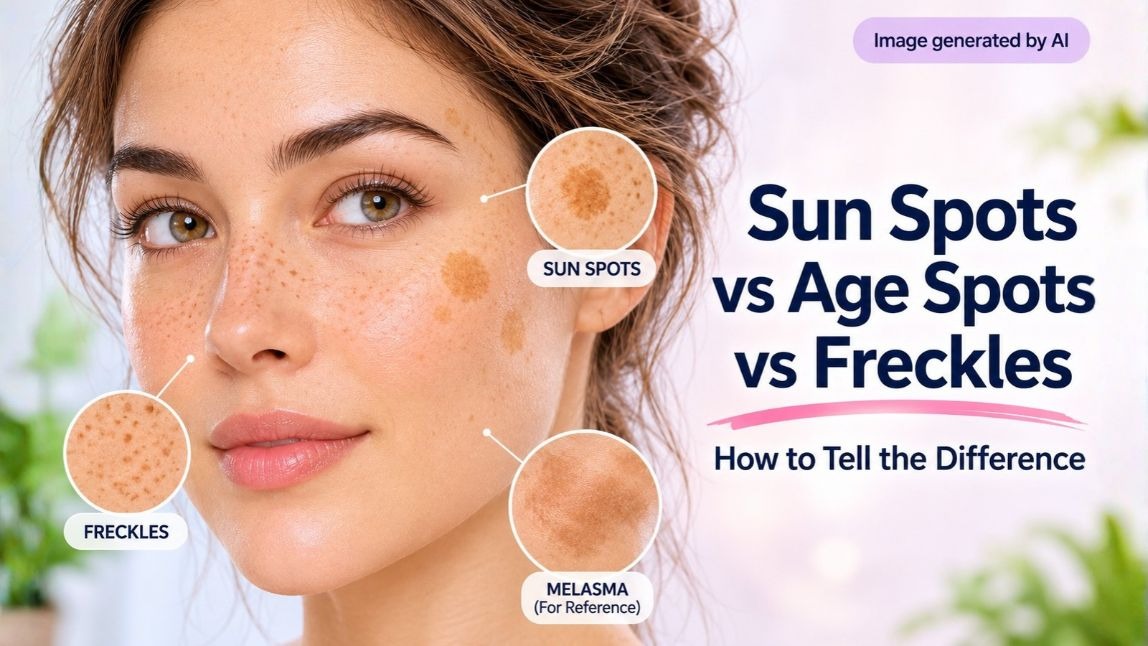
Three words get used interchangeably for brown marks on the face, and two of them are the same thing. Sun spots and age spots are different names for one condition. Freckles are genuinely different, and the difference is not cosmetic trivia: it changes what causes them, what they respond to, and whether they will come back after treatment.

There is also a fourth category hiding in this conversation that matters more than the other three combined. Some brown marks are not any of these, and the distinguishing features are specific enough to be worth knowing before you spend anything on fading them.
Sun Spots vs Age Spots vs Freckles: The Short Answer
| Freckles | Sun spots / age spots | |
|---|---|---|
| Also called | Ephelides | Solar lentigines, liver spots. The same condition under all three names |
| When they appear | Childhood, often by age five | Usually from the thirties onward |
| Size | 1 to 3mm, small and uniform | Larger, 5mm upward, variable |
| Edges | Softer, less defined | Sharply defined borders |
| Seasonal | Yes. Darken in summer, fade in winter | No. Persist year round |
| Distribution | Clustered, often symmetrical across nose and cheeks | Scattered on the most exposed areas |
| Who gets them | Strongly genetic, more common with fair skin and red hair | Anyone with cumulative sun exposure |
| What they are | Increased pigment production, normal cell numbers | Increased pigment production and increased pigment producing cells |
| Will they fade on their own | Partly, every winter | No |
The seasonal row is the fastest home test. A mark that was clearly darker in August and noticeably lighter by February is a freckle. One that looked identical in both months is a sun spot.
Why Sun Spots and Age Spots Are the Same Thing
They are. The clinical term is solar lentigo, and the two common names describe the same mark from different angles: one names the cause, the other names when people notice it. The marketing habit of treating them as separate problems with separate products is the source of most of the confusion here.
Calling them age spots is also slightly misleading, because age is not the cause. Cumulative ultraviolet exposure is, and age is simply how long that exposure has had to accumulate. Two people of the same age with very different sun histories will not have the same number of them, which is what sun damage on the face actually looks like in practice.
What About Melasma?
Melasma is the fourth category, and it behaves differently enough that treating it like a sun spot tends to make it worse.
| Feature | Sun spots | Melasma |
|---|---|---|
| Shape | Discrete round marks with clear borders | Larger symmetrical patches with blurred edges |
| Where | Scattered across exposed areas | Cheeks, forehead, upper lip, typically both sides |
| Main driver | Cumulative UV | Hormonal, with UV and heat as triggers |
| Triggered by heat | No | Yes, including heat without sunlight |
| Response to aggressive treatment | Generally good | Can rebound worse. Needs a cautious approach |
| Recurrence | Preventable with sun protection | Frequently recurs even with good protection |
The heat row surprises people. Melasma can be triggered by a hot kitchen, a sauna or a hairdryer, with no ultraviolet involved at all. Melasma versus general hyperpigmentation covers that distinction in more detail, and it is worth reading before starting any aggressive brightening routine.
When a Brown Mark Is Not Any of These
This section matters more than everything above it. Most brown marks are harmless. Some are not, and the features that separate them are well established and easy to remember.
| Feature | What to look for |
|---|---|
| Asymmetry | One half does not match the other |
| Border | Irregular, scalloped or poorly defined edges |
| Colour | More than one colour within a single mark, or black, red, white or blue tones |
| Diameter | Larger than about 6mm, though smaller lesions can matter too |
| Evolving | Changing in size, shape, colour or sensation. The most important sign of all |
A mark that itches, bleeds, crusts or does not heal also warrants attention regardless of how it looks. Nothing in this article, and no skin analysis tool of any kind, is a substitute for a dermatologist looking at a specific mark. Telling a mole from a dark spot goes into this further, but the right response to any uncertainty is a professional opinion rather than more reading.

What Causes Each One?
| Type | Primary cause | Secondary factors |
|---|---|---|
| Freckles | Genetics, specifically melanocortin receptor variants | Sun exposure makes existing freckles darker, it does not create the tendency |
| Sun spots | Cumulative ultraviolet exposure over years | Fair skin, outdoor work or hobbies, tanning history, no protection habit |
| Melasma | Hormonal influence | Pregnancy, oral contraceptives, UV, visible light, heat |
| Post inflammatory marks | Previous inflammation such as acne | Picking, darker skin tones, sun exposure during healing |
That last row is the one most often misidentified as a sun spot. A brown mark sitting exactly where a spot used to be is almost certainly post inflammatory pigmentation, and it fades on its own over months in a way a solar lentigo never will. The red and brown versions of that mark behave differently too.
What Actually Works on Each?
| Approach | Freckles | Sun spots | Melasma |
|---|---|---|---|
| Daily broad spectrum SPF | Prevents darkening | Prevents more forming. Essential | Essential, and should include visible light protection |
| Vitamin C | Modest | Modest, better as support than as a lead | Useful as part of a gentle routine |
| Niacinamide | Modest | Moderate, and well tolerated | Moderate, and one of the safer options here |
| Retinoid | Limited | Good over months, via cell turnover | Use cautiously. Irritation can worsen it |
| Azelaic acid | Limited | Moderate | Often a first choice, including during pregnancy |
| Chemical peels | Can lighten temporarily | Effective in a course | Risky without expertise. Rebound is common |
| Laser and IPL | Effective, but they return with sun | Most effective option | High risk. Wrong settings make it considerably worse |
Read the last two rows across rather than down. The treatment that works best on sun spots is the one most likely to worsen melasma, which is why identifying the mark before treating it is not pedantry. It is the whole decision.
Pigmentary disorders differ substantially in their response to physical and chemical interventions, and misclassification before treatment is a recognised cause of paradoxical worsening, particularly in melasma.Ortonne, J. P. et al., Treatment of solar lentigines, Journal of the American Academy of Dermatology
Can You Prevent Them?
Sun spots, substantially yes. They are the accumulated record of ultraviolet exposure, and the rate at which new ones form is directly modifiable. Daily broad spectrum sun protection is the intervention with genuine randomised evidence behind it, and it works prospectively rather than retrospectively: it stops the next decade's spots rather than fading this decade's.
Freckles, not really, and there is no particular reason to. The tendency is genetic. Sun protection keeps existing ones lighter, which is a reasonable goal if you want it and an entirely optional one.
Melasma, partly. Protection from ultraviolet, visible light and heat reduces flares, but the hormonal driver remains and recurrence is common even with excellent habits. Framing it as management rather than cure saves a great deal of frustration.
How Does a Skin Analysis API Score Pigmentation?
Pigmentation is one of the concerns where a measured score is genuinely more useful than a mirror, because the change is slow enough that nobody can judge it by memory. The YouCam Skin Analysis API returns spots as an independent score within a set of 28 diagnostics across 16 skin concerns, alongside the readings that give it context.
| Reading | What it contributes |
|---|---|
| Spots | Discrete pigmented marks, scored on a 1 to 100 scale where higher means fewer visible |
| Detection masks | Returned as images, so the customer sees which marks were counted rather than a bare number |
| Skin tone and evenness | Separates scattered discrete spots from broad uneven tone, which is the melasma pattern |
| Redness | Distinguishes a red post inflammatory mark from a brown one |
| Texture | Sun damage usually arrives with surface change, which supports the photoaging read |
| Wrinkles and firmness | Cumulative UV affects these together, so they corroborate each other |
The important limitation should be said plainly: an image based analysis counts and scores visible pigmented marks. It does not diagnose what any individual mark is, and it cannot tell a benign lentigo from something that needs a biopsy. It is a cosmetic tracking tool, and anything about a specific mark belongs with a clinician.
Where it earns its place is the tracking. A spots score that holds steady across two years of daily sun protection is the clearest evidence a prevention routine can produce, and it is invisible without measurement. The live skincare demo returns the spots score with its detection mask if you want to see the pairing.

How Do You Track Pigmentation Change?
| Interval | What to expect |
|---|---|
| 4 weeks | Essentially nothing. Pigment is one of the slowest concerns |
| 3 months | The earliest honest comparison, and often still subtle |
| 6 months | Where a working routine becomes measurable |
| 12 months | Where prevention becomes demonstrable rather than theoretical |
One capture rule matters more than all the others here. Scan in the same season, or at least note the season. Freckles and some pigmentation genuinely darken with summer exposure, so a December scan compared against an August scan will show an improvement that has nothing to do with the routine. Telling customers this in advance is cheap and prevents a false conclusion in both directions.
Where Do They Appear?
Distribution is a surprisingly reliable identifier, because each type follows a different logic about where it shows up.
| Type | Typical locations | What the pattern tells you |
|---|---|---|
| Freckles | Nose bridge, cheeks, shoulders, forearms. Often strikingly symmetrical | Follows where sun lands on a genetically freckle prone person |
| Sun spots | Backs of hands, forehead, upper cheeks, chest, the left side of the face in left hand drive countries | Follows cumulative exposure, including exposure nobody counted as sunbathing |
| Melasma | Cheeks, forehead, upper lip, jawline, almost always both sides | Symmetrical patches rather than scattered marks |
| Post inflammatory marks | Wherever a spot, cut or irritation was | Follows the history of the skin, not the sun |
The driving side detail in row two is worth knowing because it convinces people in a way that general advice does not. Decades of commuting with one side of the face at a window produces a visible asymmetry, and almost nobody counted those hours as sun exposure.
Building a Routine for Each
The routines overlap more than the conditions do, with one important divergence.
| Step | Sun spots | Melasma |
|---|---|---|
| Morning | Vitamin C, then broad spectrum SPF | Antioxidant, then SPF with visible light protection such as tinted mineral |
| Evening | Retinoid, building frequency gradually | Azelaic acid or a gentler agent. Retinoid cautiously if at all |
| Support | Niacinamide, well tolerated alongside anything | Niacinamide, and a calm barrier focused base |
| In clinic | Laser, IPL or a peel course | Only with a practitioner experienced in melasma specifically |
| Reassess | 6 months | 3 months, because worsening needs catching early |
The divergence is aggression. Sun spots reward a firm approach. Melasma punishes one. If you are unsure which you have, start with the melasma routine, because the cautious version does no harm to sun spots while the reverse is not true. A compromised barrier also makes pigmentation worse in both cases, so keeping the barrier intact is a prerequisite rather than an optional extra.
Related Concerns Worth Reading Together
| Concern | How it relates | Where to read more |
|---|---|---|
| Sun damage on the face | Pigmentation is one visible component of a broader process | Sun damage on face |
| Hyperpigmentation | The umbrella term all of these sit under | Hyperpigmentation |
| Mole vs dark spot | The distinction that matters for safety rather than appearance | Mole vs dark spot |
| Dull and uneven skin | Scattered pigmentation is a major contributor to a flat complexion | Dull skin |
| Fitzpatrick skin type | Determines both susceptibility and treatment risk | Fitzpatrick skin type |
The last row is more than a formality. Treatment risk for pigmentation varies considerably across skin tones, and an approach that is routine on one is a meaningful risk of post inflammatory darkening on another.
When Should You See a Professional?
Any mark that is changing, asymmetrical, multi coloured, irregularly bordered, growing, itching, bleeding or not healing. Any new mark appearing after about forty. Any mark that looks different from all the others on your skin. And melasma before starting any laser or peel, because the wrong intervention is a genuine setback rather than a disappointment.
An AI skin analysis is a cosmetic assessment that scores visible pigmentation and tracks change over time. It is not a diagnosis, it does not screen for skin cancer, and nothing in it should delay having a specific mark examined.
Sun Spots, Age Spots and Freckles FAQ
Are sun spots and age spots the same thing?
Yes. Both are common names for solar lentigines. One names the cause and the other names when people tend to notice them, but the condition is identical.
How can I tell a freckle from a sun spot at home?
Season and size. Freckles are small, appear in childhood, cluster symmetrically and visibly fade in winter. Sun spots are larger, have sharper borders, appear from the thirties onward and do not fade.
Do freckles turn into age spots?
No. They are different conditions with different mechanisms. A person can have both, and freckled skin tends to accumulate sun spots more readily, which is where the impression comes from.
Can sun spots be removed permanently?
Existing ones can be cleared effectively, laser and IPL being the most effective options. Permanence depends on sun protection afterwards, since the same exposure that created them will create more.
Why did my pigmentation get worse after a treatment?
The most common reason is that it was melasma rather than sun spots. Melasma can rebound after aggressive treatment, which is why identifying the pattern before intervening matters so much.
Does sunscreen fade existing spots?
Not directly. It prevents further darkening and stops new ones forming, which over time makes a visible difference, but it is a prevention tool rather than a correction tool.
Can an AI skin analysis tell me what kind of mark I have?
No. It scores and maps visible pigmented marks and tracks how that score changes over time. Identifying a specific lesion requires a clinician, and the analysis should never be used to decide whether a mark is safe.
How long before a brightening routine shows results?
Three months for the earliest honest comparison and six for a clear one. Anything promising visible pigment change in two weeks is describing surface exfoliation rather than pigment correction.
Identify First, Treat Second
Two of these three names describe the same mark, the third is a different condition entirely, and the fourth category that nobody asked about is the one where the treatment choice actually carries risk. That is the whole practical content of this topic.
So before buying anything: check whether it fades in winter, check whether the edges are sharp or blurred, check whether it is one mark or a symmetrical patch, and check it against the asymmetry, border, colour, diameter and evolution features. Then protect daily, measure in months rather than weeks, and get anything that is changing looked at by someone qualified to look at it.