 Author:



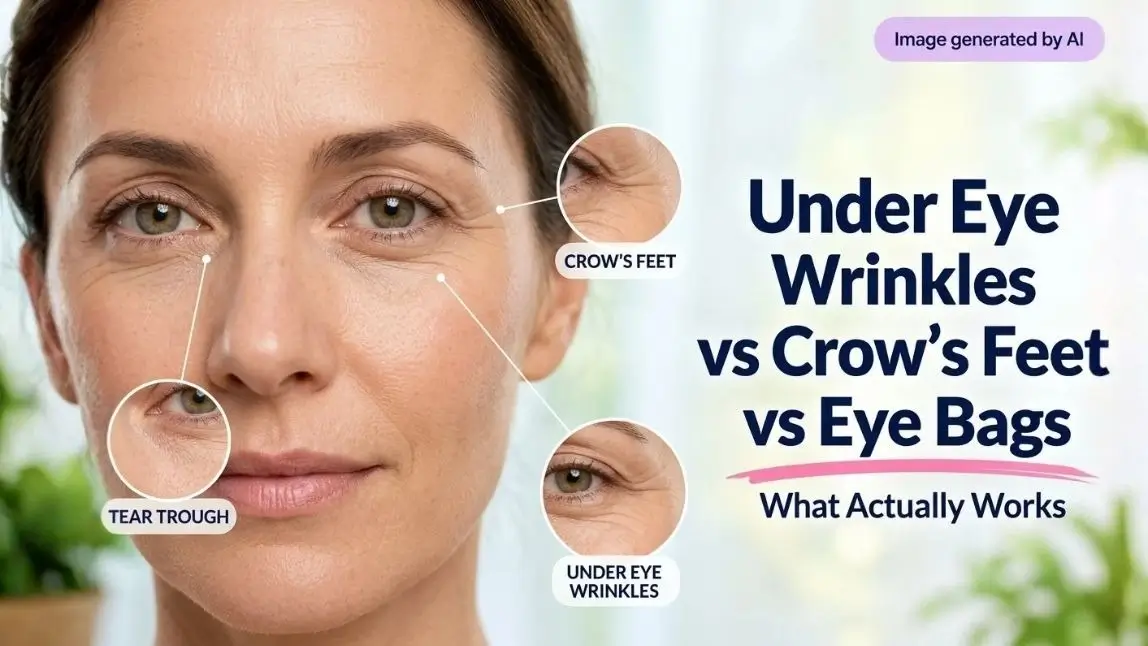
The under eye is the only part of the face where four different problems produce the same complaint. Someone says they look tired, points at the same half inch of skin, and could be describing fine lines, a shadow, a hollow or a bulge. They are not being imprecise. The area genuinely contains all four, often at once, and the mirror does not distinguish between them.

Under eye wrinkles specifically are the surface component: fine creases in the thinnest skin on the body, in the area that moves most and has the least structural support holding it together. They are also the component most likely to be treated with the wrong product, because the eye cream aisle is organised around puffiness and darkness rather than around texture.
What Are Under Eye Wrinkles?
Under eye wrinkles are fine lines running horizontally or in a fine mesh across the skin below the lower lash line. They are distinct from crow's feet, which radiate outward from the outer corner, although the two frequently appear together and get described with the same words.
| Concern | Where it sits | What it actually is | What it responds to |
|---|---|---|---|
| Under eye wrinkles | Directly below the lower lash line | Surface creasing in very thin skin | Hydration, barrier support, collagen stimulation |
| Crow's feet | Radiating from the outer corner | Expression driven creasing | Muscle relaxation, skin quality |
| Eye bags | Below the lash line, raised | Volume or fluid sitting forward | Sleep, salt, cooling, sometimes surgery |
| Tear trough | The groove toward the nose | A hollow, casting a shadow | Volume replacement. Nothing topical fills it |
| Dark circles | Across the whole under eye | Pigment or visible vasculature | Pigment correction or nothing, depending on type |
Rows three and four are the ones that waste money. An eye cream aimed at fine lines does nothing for a hollow, and a caffeine serum aimed at puffiness does nothing for crepey texture. Working out which one you have is worth more than any product decision that follows it, and how eye bags form is a useful companion read if the area is raised rather than lined.
Why Does the Under Eye Wrinkle First?
Four structural reasons, and they compound.
| Factor | Why it matters here |
|---|---|
| Thinnest skin on the body | Eyelid skin is a fraction of the thickness of cheek skin, so there is less tissue to resist creasing |
| Almost no sebaceous glands | Very little natural oil, so the barrier loses water faster and the surface dehydrates easily |
| Constant movement | Blinking, squinting and every expression that involves the eyes, repeated continuously |
| Little structural support | Minimal underlying fat and a thin dermis, so creases form earlier and settle sooner |
| Frequent mechanical stress | Rubbing, makeup removal and sleeping position all act on the most fragile skin on the face |
The second row explains a pattern most people notice without understanding. Under eye lines that look deep in the morning and softer by midday are usually dehydration creasing rather than established wrinkles, which is a far better problem to have and a much faster one to fix.
At What Age Do Under Eye Wrinkles Start?
| Age | Typical state | What is worth doing |
|---|---|---|
| Early 20s | Visible only on expression, gone at rest | Sunglasses and daily SPF. Nothing else is required |
| Late 20s | Faint fine lines at rest, often dehydration driven | Hydration, a gentle eye product, establish a baseline |
| 30s | Fine mesh texture becoming persistent | Retinoid introduced carefully, consistent SPF |
| 40s and beyond | Established creasing, often alongside volume change | Collagen support, and separate the texture from the structure |
The under eye is usually the second area to show change after crow's feet, which makes it an early indicator rather than a late one. The difference between fine lines and wrinkles matters more here than anywhere else, because the window where a line is still a fine line is where almost everything useful can be done.
What Causes Under Eye Wrinkles?
| Cause | Mechanism | Can you change it? |
|---|---|---|
| Sun exposure | Degrades collagen and elastin in skin with almost no natural protection | Yes. The highest value intervention on this list |
| Squinting | Repeated creasing, usually from bright light or uncorrected vision | Yes. Sunglasses and an eye test |
| Dehydration | Thin skin with few oil glands loses water fast and creases when it does | Yes, and quickly |
| Rubbing | Mechanical stress on the most fragile skin on the face | Yes. Often allergy related, so treat the cause |
| Sleeping face down | Hours of compression per night, every night | Partly |
| Harsh makeup removal | Dragging and stripping the barrier daily | Yes. Switch method before switching product |
| Collagen loss with age | Less recoil, so creases settle rather than recovering | No, but the rate is modifiable |
The rubbing row deserves more attention than it usually gets. People with seasonal allergies often rub their eyes several times an hour for months of the year, which is a significant mechanical load on skin that cannot tolerate it. Treating the allergy is an under eye intervention.
Among facial regions, periorbital skin shows the earliest and most pronounced age related change in clinical scoring, reflecting its reduced thickness and high mobility.Flament, F. et al., Facial skin aging and its perception, International Journal of Cosmetic Science
What Actually Works on Under Eye Wrinkles?
| Approach | Evidence | Realistic effect |
|---|---|---|
| Daily broad spectrum SPF | Strong. Randomised evidence for preventing photoaging | Prevention rather than correction, and the best value action available |
| Sunglasses | Strong, by mechanism | Removes the squinting that creates the lines in the first place |
| Hydration and barrier support | Strong for the dehydration component | Visible within days where dehydration is the driver |
| Topical retinoid, introduced slowly | Strong for collagen stimulation | Real improvement over months. Irritation risk is highest here of anywhere on the face |
| Peptides | Moderate | Supporting role, often in a well formulated eye cream |
| Caffeine | Weak for wrinkles | Targets puffiness, not texture. Commonly bought for the wrong reason |
| Eye massage and rollers | Weak for lasting change | Temporary fluid movement, plus added mechanical stress |
How to use a retinoid here without regretting it
This is the area where most people abandon retinoids, and it is almost always a frequency problem rather than a product problem. Start at twice a week. Apply moisturiser first and the retinoid over it for the first month. Keep it below the orbital bone rather than close to the lash line. Stop at the first sign of persistent redness or flaking and resume at a lower frequency rather than switching products. If the skin is already dehydrated or the barrier is compromised, fix that first, because a retinoid on a damaged barrier makes both problems worse.
What Does Not Work
Three things, consistently. A caffeine eye serum used for fine lines, which is a puffiness product doing nothing for texture. A rich occlusive cream used in the hope of plumping, which smooths the look temporarily and changes nothing underneath. And aggressive massage or rolling, which adds mechanical stress to skin whose main problem is mechanical stress.
There is also a timing trap worth naming. Under eye lines look worst first thing in the morning, when the skin is most dehydrated and has spent hours compressed against a pillow. Judging a product by how the area looks at 7am will make every product look like it failed.
How Does a Skin Analysis API Score the Under Eye?
The under eye is the clearest case in skin analysis for scoring regions separately rather than returning one eye area number. The YouCam Skin Analysis API returns the periocular region as one of seven independently scored wrinkle regions, alongside the other under eye concerns, within a set of 28 diagnostics across 16 skin concerns.
| Reading | What it contributes |
|---|---|
| Periocular wrinkles | The wider eye area, which catches the under eye creasing that crow's feet scoring misses |
| Crow's feet | The lateral lines, scored separately so the two can be told apart |
| Eye bags | Puffiness, which is volume rather than texture |
| Dark circles | Pigment and vasculature, a different concern with a different answer |
| Tear trough | A hollow. Important because nothing topical addresses it |
| Droopy lower eyelid | Position rather than surface, and not something a cream changes |
| Moisture | The reading that separates dehydration creasing from established wrinkles |
The last row is the most commercially useful one on this page. Read the periocular score against moisture and two different customers appear.32
| Periocular | Moisture | What it means | Route to |
|---|---|---|---|
| Low | Low | Dehydration creasing. Often looks worse than it is | Hydration and barrier repair. Re-measure in two weeks before anything else |
| Low | Normal | Established surface creasing | Retinoid introduced slowly, consistent SPF, three month horizon |
| Normal | Low | Dehydrated but not yet creasing | Prevention window. Hydrate and protect |
| Normal | Normal | Age appropriate | Sunglasses, SPF, maintenance |
Row one is where trust is won or lost. Selling a six month retinoid programme to someone whose lines will soften in a fortnight with a hydrating serum is both the wrong advice and the more expensive one. The live skincare demo returns both readings in the same scan if you want to see the pairing before deciding how to deploy it.
How Do You Track Whether Anything Is Working?
| Interval | What to expect |
|---|---|
| 2 weeks | Dehydration creasing softens. If nothing changed, it was not dehydration |
| 4 weeks | Texture improvement from a retinoid becomes measurable |
| 3 months | The honest first comparison for established lines |
| 6 months | Where consistent prevention becomes demonstrable |
Three capture rules make the comparison mean anything. Scan at the same time of day, because the under eye changes more between morning and evening than any other part of the face. Use even front lighting, because an overhead light casts a shadow that reads as both a line and a dark circle. And keep a neutral expression, because a slight smile recruits the whole periocular area and will make every scan inconsistent. If this sounds fussy, it is the same reason skincare progress photos lie so reliably.
Related Concerns Worth Checking
| Concern | Relationship | Where to read more |
|---|---|---|
| Crow's feet | The same thin skin, different mechanism. Usually appear first | Fine lines vs wrinkles |
| Dark circles | Often blamed on lines, and vice versa | Dark circles |
| Tear trough | A hollow that deepens the apparent creasing above it | Tear troughs |
| Dehydrated skin | The most common reversible cause of under eye lines | Dry vs dehydrated skin |
| Damaged barrier | Why a retinoid attempt went badly, nine times out of ten | Damaged skin barrier |
When Should You See a Professional?
Under eye wrinkles are cosmetic. A few things in the same area are not. Sudden drooping or asymmetry on one side, a lump or lesion that grows or bleeds, persistent swelling that does not settle through the day, vision changes, or skin that is cracking, weeping or intensely itchy all warrant a clinician rather than another eye cream. Eye area skin is also a common site for conditions that look like irritation and are not.
An AI skin analysis is a cosmetic assessment designed to guide product selection and track visible change. It is not a diagnosis, and nothing in it should delay getting a persistent or sudden change looked at properly.
Under Eye Wrinkles FAQ
Are under eye wrinkles the same as crow's feet?
No. Crow's feet radiate from the outer corner and are expression driven. Under eye wrinkles sit below the lash line and are mostly about thin skin, dehydration and collagen loss. They are scored as separate regions for exactly this reason.
Why do my under eye lines look worse in the morning?
Because the skin is most dehydrated overnight and has spent hours compressed against a pillow. If the lines soften by midday, dehydration is doing most of the work and that is highly treatable.
Can under eye wrinkles be reversed?
Dehydration creasing, yes, within weeks. Established fine lines can be meaningfully improved with a retinoid and consistent sun protection over months. Deep set lines with volume loss underneath are a structural conversation rather than a topical one.
Can I use retinol under my eyes?
Usually, with care. Twice a week to start, moisturiser first, retinoid over it, and keep it below the orbital bone. Most failures here are frequency problems rather than product problems.
Do eye creams actually work?
The useful ones work because of what is in them rather than because they are labelled for eyes. A hydrating, barrier supporting formula helps the dehydration component genuinely. A caffeine serum bought to treat fine lines is aimed at a different problem.
Does drinking water help?
Not on its own. Surface hydration in this area depends mostly on barrier function and on what you apply. It helps general health and does not substitute for a humectant and an occlusive.
Will sleeping on my back help?
It removes hours of nightly compression, which is a real mechanical load on the thinnest skin on the face. It is unlikely to reverse established lines on its own and it does reduce one ongoing cause.
Can an AI skin analysis measure under eye wrinkles?
Yes. The periocular region is scored independently from crow's feet and from eye bags, on a 1 to 100 scale where higher means fewer visible lines. It is a cosmetic assessment rather than a clinical measurement, and it is most useful read alongside the moisture score.
Check the Moisture Score Before Buying Anything
The single most useful thing to know about under eye wrinkles is that a good share of them are not wrinkles yet. Thin skin with almost no oil glands dehydrates faster than anywhere else on the face, and dehydrated skin creases along lines that disappear again once the water comes back.
So the order matters. Hydrate, repair the barrier, wait two weeks, and look again. What is still there after that is the actual problem, and it is a much smaller problem than the one you started with.