Author: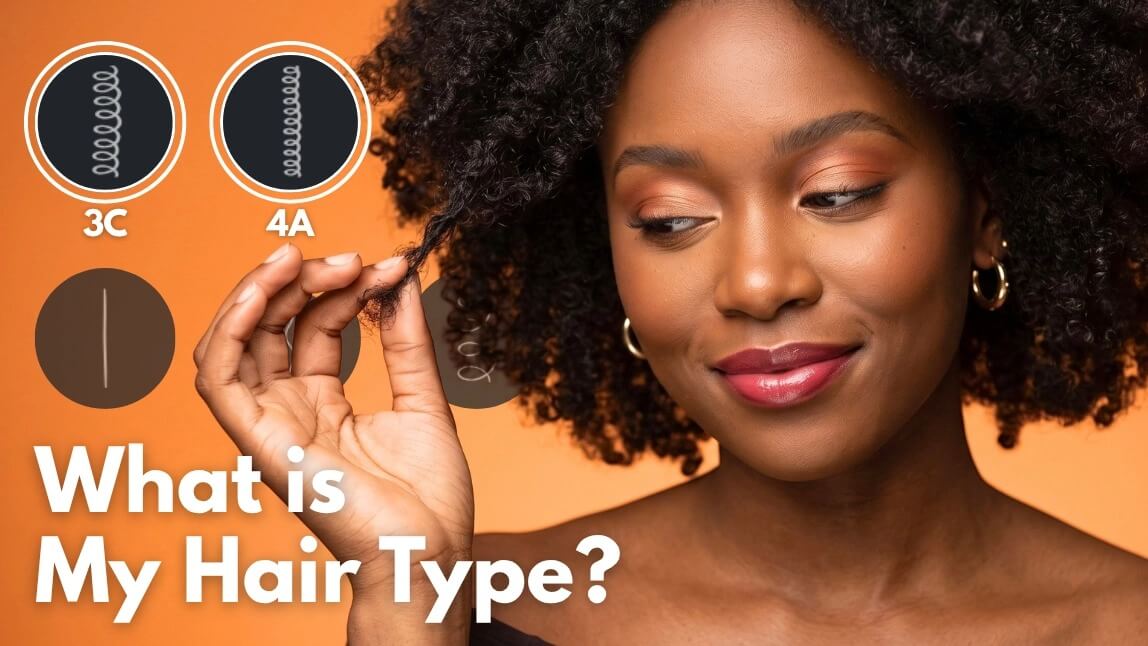
Disclaimer: Some images in this article may have been created or modified by AI
You have stood in the shampoo aisle reading "for 3B curls" and thought, is that me? You are not alone. Most people guess their hair type, guess wrong, and then wonder why a "miracle" curl cream turns their hair into a crunchy helmet. The good news: finding your hair type takes about five minutes, a clean head of hair, and a little honesty. The even better news: AI can now do it from a photo in seconds, which is exactly why beauty brands are putting hair type scanners on their product pages. Below you will find a simple at-home self-test, a cheat sheet for the confusing "is it 2C or 3A?" zone, and a look at how AI hair analysis turns one selfie into a routine.
Table of Contents
- What is my hair type, in plain English?
- What are the 4 hair types and 12 subtypes?
- How do I find my hair type at home?
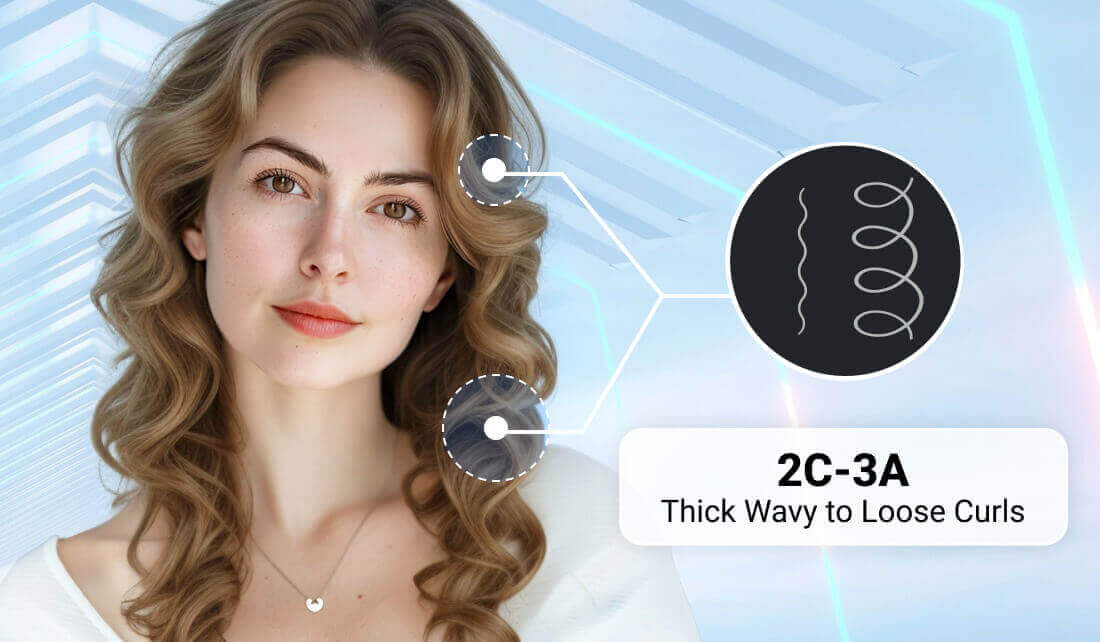
- How do I know if I am 2C or 3A (or 3C or 4A)?
- Can you have more than one hair type?
- Why does my hair type seem to change?
- Hair type vs. texture vs. porosity vs. density: what decides your routine?
- What hair care routine works best for my hair type?
- Is there an app that can tell my hair type?
- Why are beauty brands adding hair type scanners?
- What hair type mistakes fool almost everyone?
- What Is My Hair Type? FAQ
What Is My Hair Type, in Plain English?
Your hair type is the natural shape your strands take when they are clean, product free, and air dried. It is grouped into four families: Type 1 (straight), Type 2 (wavy), Type 3 (curly), and Type 4 (coily). Each family splits into A, B, and C subtypes, from the loosest pattern to the tightest.
That shape comes mostly from your follicle. A round follicle grows a straight strand. The more oval or hooked the follicle, the more the strand bends, twists, and coils as it grows. Which is why no amount of wishing (or sea salt spray) changes your base pattern for long.
Skip the guesswork: scan your hair type free in seconds.
What Are the 4 Hair Types and 12 Subtypes?
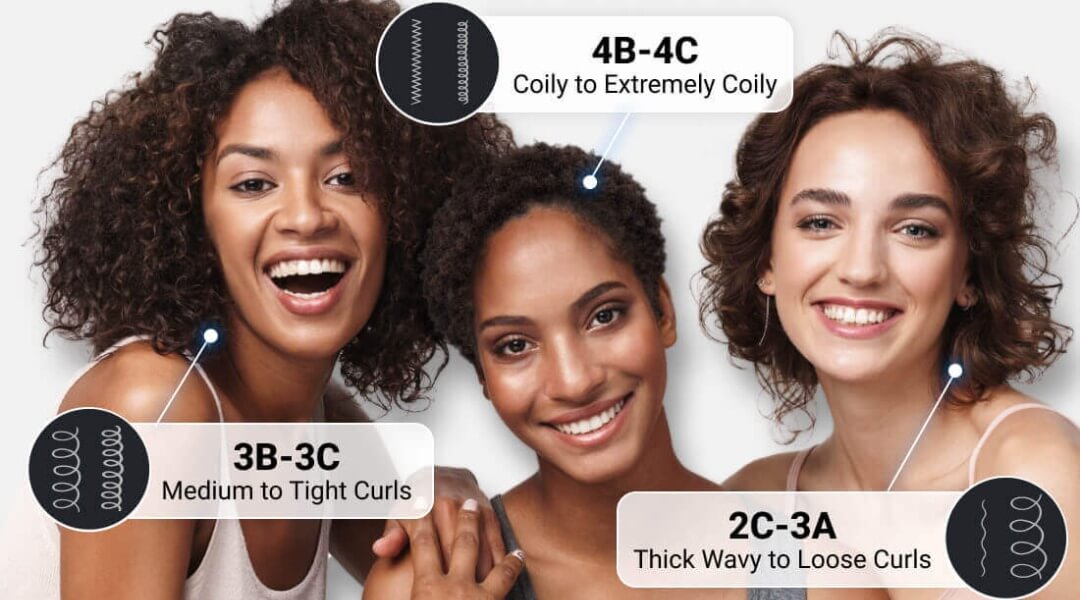
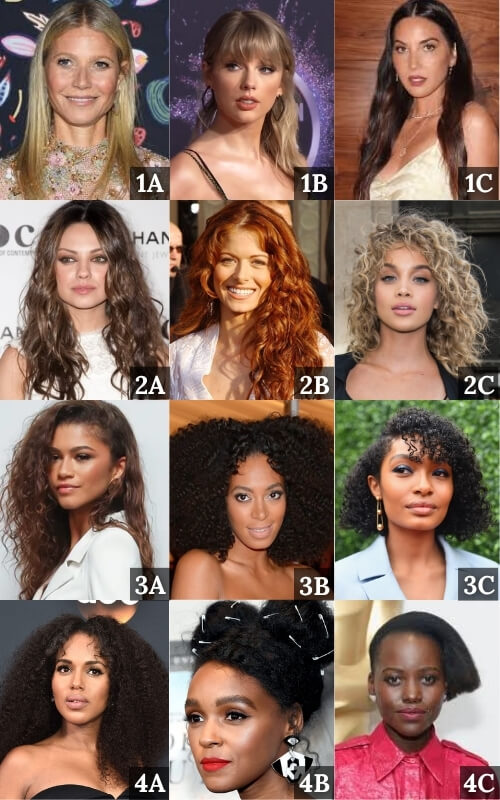
The chart most people use today traces back to celebrity stylist Andre Walker, who popularized the 1 to 4 system in the 1990s. Stylists and brands later expanded it into the A, B, C subtypes you see on labels. Strictly speaking, Type 1 is often split into 1A, 1B, and 1C, which gives you 12 subtypes in total. Many AI tools, including Perfect Corp's, treat straight hair as a single category and focus on the 9 wavy, curly, and coily subtypes where the differences actually change your routine, for 10 curl patterns overall.
| Type | What it looks like | How it usually behaves | Typical struggle |
|---|---|---|---|
| 1A | Pin straight, very fine | Shiny, slips out of clips | Gets oily fast, no volume |
| 1B | Straight with a little body | Holds a style better than 1A | Flat at the roots |
| 1C | Straight but coarse, slight bend | Thick, can frizz | Random kinks and frizz |
| 2A | Loose, stretched S shape | Almost straight at the root | Waves fall flat easily |
| 2B | Defined S waves from mid length | Beachy, some frizz | Frizz in humidity |
| 2C | Deep S waves starting near the root | Thick, a few ringlets | Frizz, heavy products weigh it down |
| 3A | Big, loose loops (think a sidewalk chalk width) | Bouncy, shiny curls | Loses definition when brushed dry |
| 3B | Springy ringlets (marker width) | Lots of volume | Dryness and frizz |
| 3C | Tight corkscrews (pencil or straw width) | Dense, high shrinkage | Dryness, tangles |
| 4A | Tight, defined S coils | Soft, visible coil pattern | Shrinkage, moisture loss |
| 4B | Z shaped zigzags, less defined | Fluffy, very high shrinkage | Breakage, dryness |
| 4C | Very tight zigzags, little visible pattern | Up to 75% shrinkage or more | Fragility, needs the most moisture |
Type 1: Straight Hair
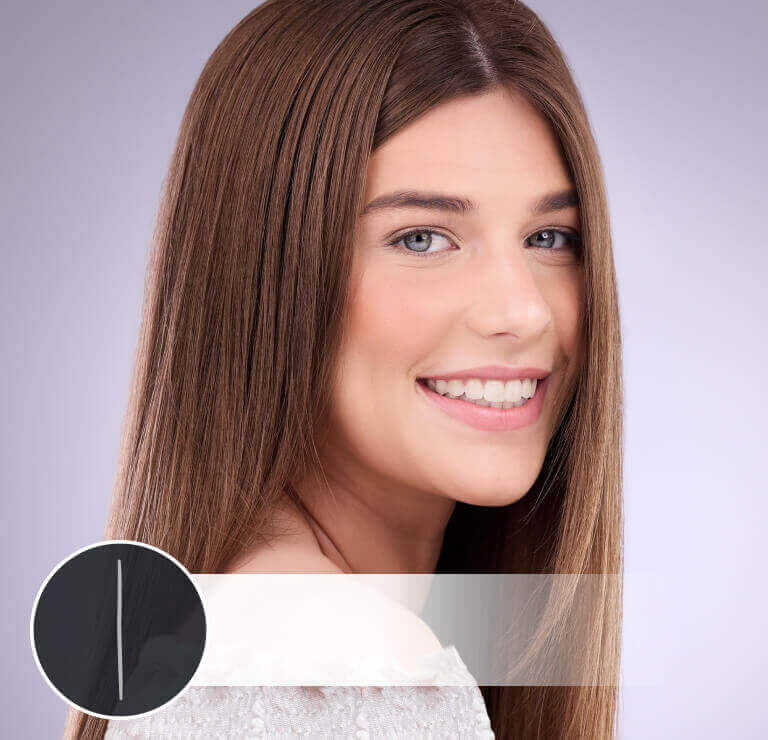
Straight hair has no natural curve. Light travels down the smooth cuticle, so it tends to look shiny. Oil from the scalp also travels down it easily, which is why Type 1 friends wash more often than anyone else. 1A is fine and flat, 1B has a bit more body, and 1C is coarse with an occasional rebellious bend.
Type 2: Wavy Hair
Wavy hair lives in an S shape that usually starts somewhere below the ears. 2A is barely there and flattens under anything heavier than a light mousse. 2B has clear waves from mid length. 2C starts waving close to the root and sometimes throws in a ringlet or two, which is how many 2C people discover they are "secretly curly."
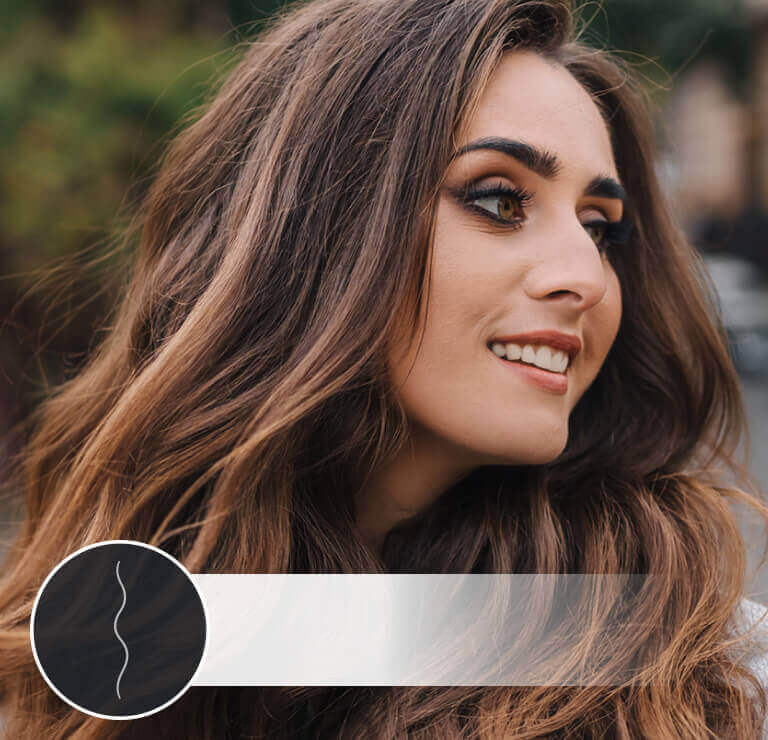
See how AI tells 2A, 2B, and 2C apart.
Type 3: Curly Hair
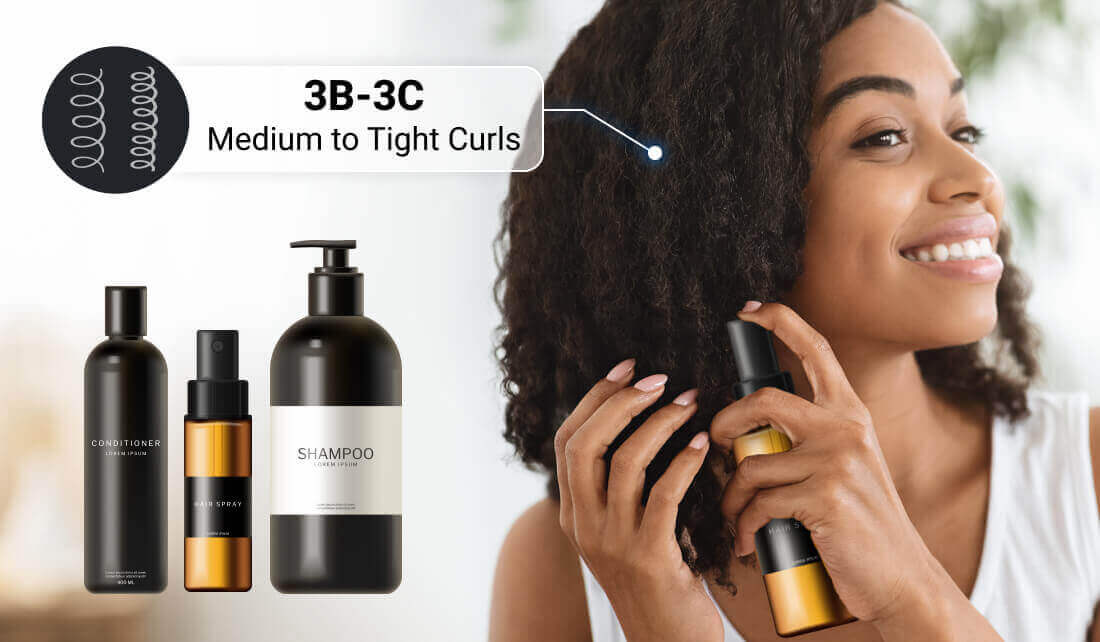
Type 3 curls form full loops. The easy way to subtype them is the "what would it wrap around" test. 3A loops would fit around a thick piece of sidewalk chalk. 3B ringlets fit around a marker. 3C corkscrews fit snugly around a pencil or a straw. Curls this defined love moisture and hate dry brushing.
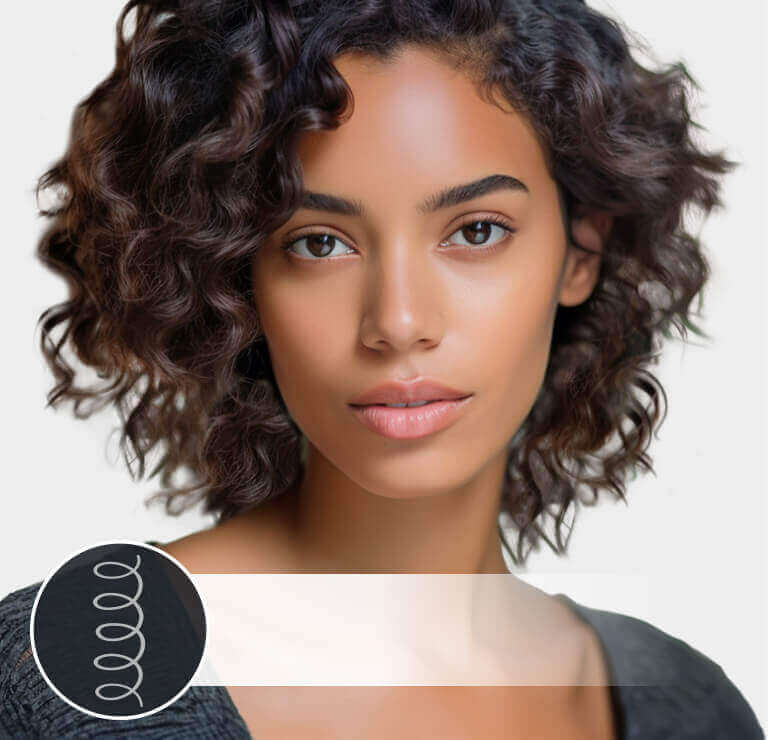
Type 4: Coily Hair
Coily hair has the tightest pattern and the most shrinkage, which means hair that reaches your shoulders when stretched can look chin length when dry. 4A has defined S coils. 4B bends in sharp Z angles. 4C has a zigzag so tight the pattern is hard to see with the naked eye. It is also the most fragile type, because every bend is a potential weak point.
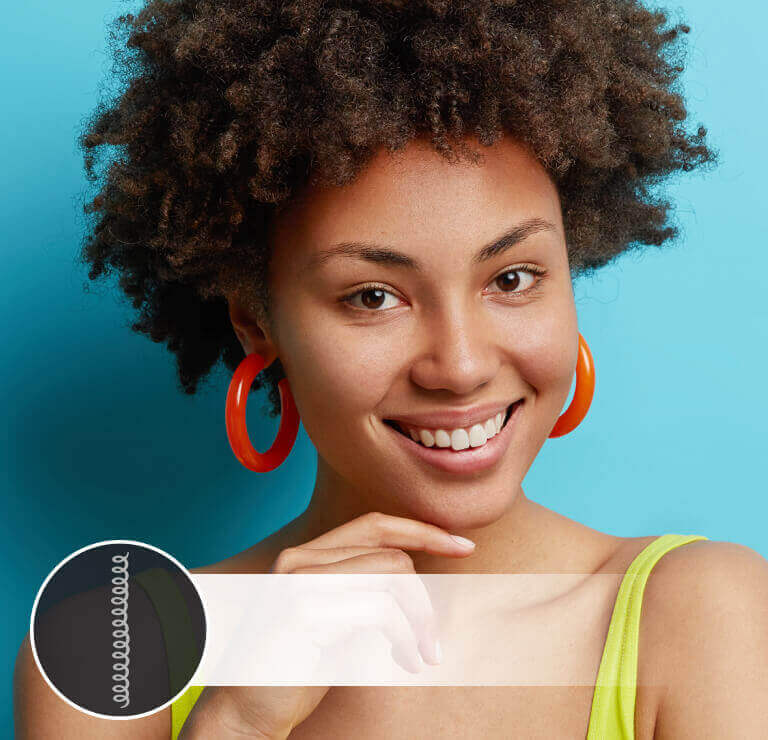
Building a hair care line for coily textures? Talk to our team.
How Do I Find My Hair Type at Home? The 5 Minute Self-Test
Here is the method stylists use, stripped down to what actually matters. Do it on a day when you have nowhere important to be, because step one involves letting your hair do whatever it wants.
No time for a wash day test? Try the free AI hair type scan.
- Wash with a basic shampoo and conditioner. Skip leave-ins, oils, gels, and mousse. Product changes the pattern.
- Let it air dry completely. No diffuser, no towel scrunching, no touching. Touching creates frizz, and frizz hides the real pattern.
- Look at the lengths, not the roots. Roots are often straighter because they are weighed down by the hair below. Check the middle and ends.
- Pull out a single strand and let it hang. Straight line? Type 1. Loose S? Type 2. A spiral you could wrap around a finger or marker? Type 3. Tight zigzag or coil? Type 4.
- Use the wrap test for subtypes. Compare your curl diameter to chalk (A), a marker (B), or a pencil or straw (C).
- Check at least three zones. Front hairline, crown, and the nape of your neck. If they disagree, congratulations, you are mixed (more on that below).
Want to go one step deeper? Add these two quick checks, since they matter as much as curl pattern when you shop for products:
- Strand thickness: Roll a single strand between your fingers. Can barely feel it? Fine. Feel it clearly? Medium. Feels like a thread? Coarse.
- Density: Part your hair in the middle under good light. Lots of visible scalp means low density. Hardly any means high density.
How Do I Know If I Am 2C or 3A (or 3C or 4A)?
This is where most self-tests fall apart. The hair chart looks tidy. Real heads are not. These are the three "border zones" where people get stuck most often, and the tie breakers that settle them.
| Border zone | Leans lower if... | Leans higher if... |
|---|---|---|
| 2C vs. 3A | Most strands form S waves that lie flat against the head | Most strands form full, round loops that spring back when stretched |
| 3C vs. 4A | Curls are round spirals with visible shine and clear definition | Coils are tighter than a straw, shrink heavily, and feel softer than they look |
| 4B vs. 4C | You can see a Z pattern when a section is stretched and released | The pattern is hard to see even when wet, with shrinkage well past 70% |
Still torn? Go with the tighter type when choosing moisture, and the looser type when choosing product weight. It is a practical cheat that saves a lot of wasted bottles.
Can You Have More Than One Hair Type?
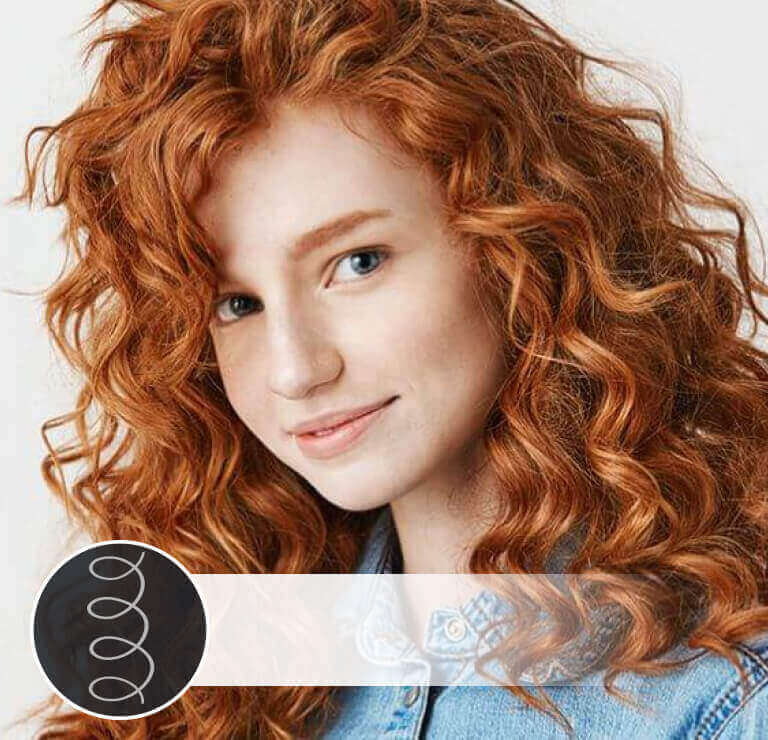
Yes, and most people do. It is common to have looser waves at the crown, tighter curls at the nape, and a stubbornly straight section right where your part sits. Stylists call this multi-textured hair. It is the main reason quizzes give inconsistent results: you answer based on the section you see in the mirror, not the whole head.
The fix is to identify your dominant type (whatever covers most of your head) and treat the outliers separately. Tighter sections may need a richer cream. Looser ones may need a lighter gel so they do not get weighed down.
See how AI detects mixed textures on one head.
Why Does My Hair Type Seem to Change?
Your follicle shape is mostly set by genetics, but the hair you see is influenced by a lot more than that. If your waves suddenly vanished or your curls appeared out of nowhere, one of these is usually the reason:
- Hormones: Puberty, pregnancy, and menopause are well known triggers for texture shifts, sometimes temporary and sometimes lasting.
- Age: Strands can become finer and drier over time, which can loosen or change how a curl pattern holds.
- Heat and chemical damage: Years of flat ironing, bleaching, or relaxers can weaken the pattern so curls look looser than your natural type.
- Length and weight: Long hair pulls curls straighter. A big chop often "reveals" curls that were there all along.
- Climate: Humidity swells the strand and can make waves look curlier. Dry winters can do the opposite.
- Your routine: Brushing curls dry, sleeping on cotton, or using heavy silicones can all mask your real type.
Because of this, it makes sense to recheck your hair type every year or after any big life change. What worked at 25 might not be what your hair wants at 40.
Hair Type vs. Texture vs. Porosity vs. Density: What Decides Your Routine?
Curl pattern gets all the attention, but it is only one of four traits that decide which products actually work. Two people with 3B curls can need completely different routines if one has fine, low porosity hair and the other has coarse, high porosity hair.
| Trait | What it measures | Quick at-home check | Why it matters |
|---|---|---|---|
| Hair type | Shape of the strand (1A to 4C) | Air dry and observe the pattern | Decides styling method and how much definition to chase |
| Texture | Width of each strand (fine, medium, coarse) | Roll one strand between fingers | Fine hair needs lightweight formulas; coarse hair can take richer ones |
| Porosity | How easily hair absorbs and holds moisture | Slide fingers up a strand: bumpy often means higher porosity | Low porosity needs light, warm applied products; high porosity needs sealing |
| Density | How many strands grow per area of scalp | Check how much scalp shows at your part | Guides product amount and haircut shape |
A quick note on the viral "float test," where you drop a strand into water: it is fun, but residue, oils, and water temperature can skew it. Treat it as a hint, not a verdict. Our complete hair chart guide goes deeper on porosity and texture if you want the full breakdown.
What Hair Care Routine Works Best for My Hair Type?
Knowing your type is only useful if it changes what you do on wash day. Think of the list below as a starting point, then fine tune it for your texture and porosity. The general rule: the tighter the pattern, the more moisture and the less manipulation your hair wants.
| Hair type | Wash frequency | Hero products | Styling tip | Skip this |
|---|---|---|---|---|
| Type 1 (straight) | Every 1 to 2 days | Lightweight shampoo, volumizing mousse, dry shampoo | Blow dry roots upside down for lift | Heavy oils and butters at the roots |
| Type 2 (wavy) | Every 2 to 3 days | Light conditioner, sea salt spray, flexible mousse | Scrunch in product on soaking wet hair, then leave it alone | Thick creams that flatten the S pattern |
| Type 3 (curly) | Every 3 to 5 days | Sulfate free shampoo, rich leave-in, curl cream plus gel | Apply on wet hair, diffuse on low, "scrunch out the crunch" once dry | Dry brushing and rough towels |
| Type 4 (coily) | Once a week or less | Co-wash or gentle cleanser, deep conditioner, butters and oils to seal | Protective styles and stretching methods like twists or braid outs | Frequent heat and tight, daily manipulation |
How Should Wavy and Curly Hair Be Treated Differently?
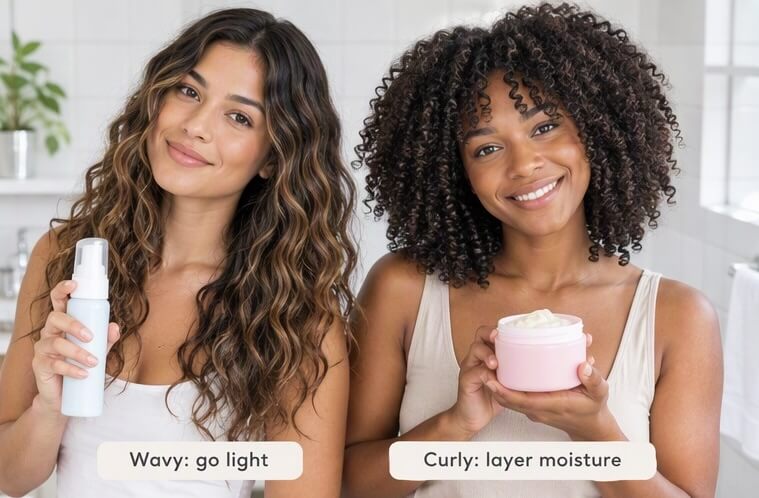
Waves are the most misunderstood type because they sit between two worlds. Treat 2A and 2B like curls and you get flat, greasy waves. Treat them like straight hair and you get frizz. The sweet spot is curl friendly technique (wet application, no dry brushing, low heat) with straight hair weight products (mousse and light gels instead of rich creams). Type 3 curls, on the other hand, usually need the richer layers: a leave-in for moisture, a cream for definition, and a gel to lock it all in.
What Changes for Coily Hair?
Type 4 hair is not "harder" to care for. It simply follows different rules. Because natural scalp oils struggle to travel down tight coils, the ends dry out quickly. That is why coily routines lean on the LOC or LCO method (liquid, oil, cream, in either order), wash less often, and focus on retaining length rather than chasing a defined curl every day. Gentle detangling with fingers or a wide tooth comb on conditioned hair makes a noticeable difference in breakage.
Do Men Need a Different Routine for the Same Hair Type?
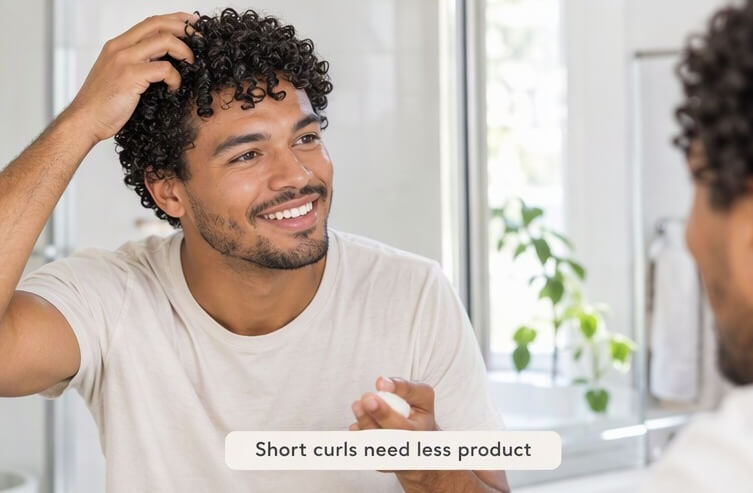
The hair type rules are the same, but shorter cuts change the math. Short curls get less weight pulling them down, so they often look tighter than the same curl pattern at shoulder length. Short hair also needs less product overall. If you are a guy trying to figure out if you are 2A or 3B, our men's hair type guide walks through it with examples.
For brands, this is exactly where a hair type result becomes revenue: each row in the table above can map to a product bundle, so a shopper goes from "what is my hair type?" to a complete routine in one click.
Is There an App That Can Tell My Hair Type?
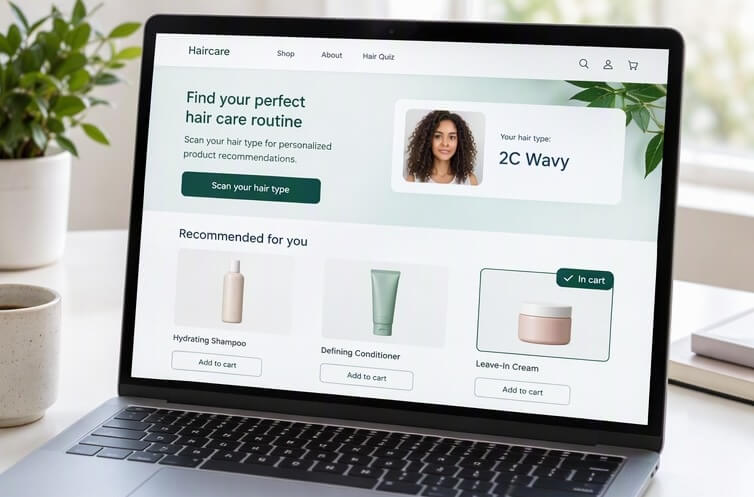
Yes. AI hair type scanners have gone from novelty to surprisingly reliable. Instead of asking you to describe your own hair (which is where quizzes go wrong), they look at it directly.
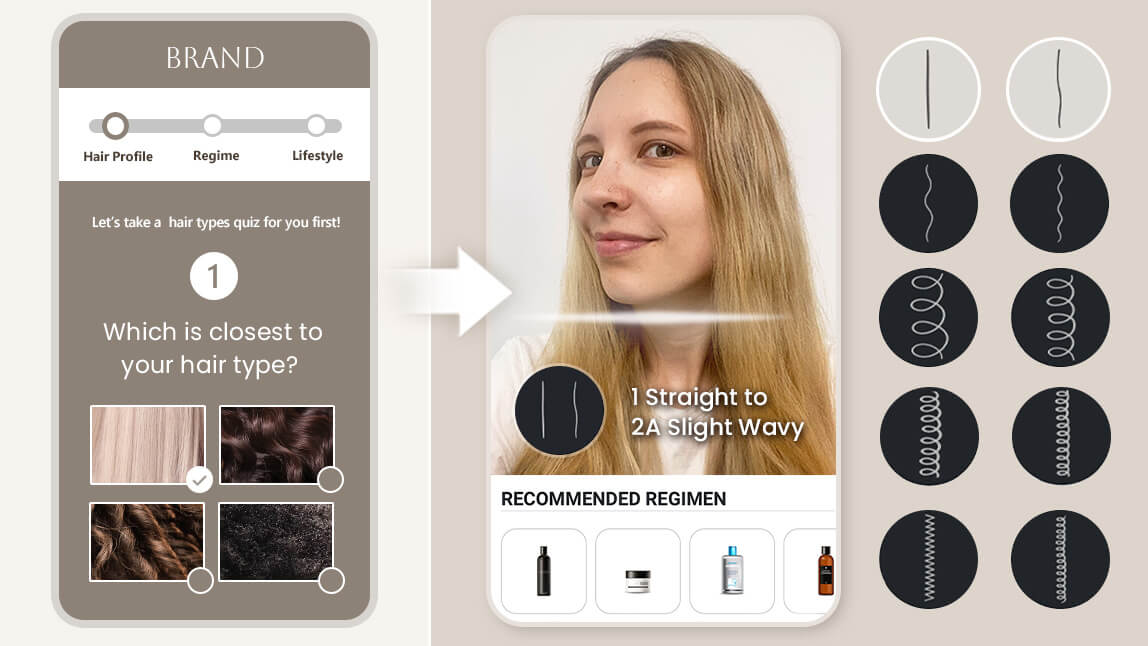
Here is what happens behind the scenes in a tool like Perfect Corp's AI Hair Type Analysis:
- You take or upload a photo. Hair should be visible and reasonably well lit.
- The AI isolates the hair from the background and face. It focuses only on strands, not your outfit or your wall color.
- It reads curl shape, spacing, and definition. The model was trained on a large, diverse library of hair images across all textures.
- It returns your type in seconds. Perfect Corp's analyzer detects 10 curl patterns from straight to 4C, and can flag mixed textures on the same head.
- It links results to real recommendations. Brands can map each type to routines, products, or even hairstyles you can preview with virtual hairstyle try-on.
| Method | Time | Objectivity | Handles mixed textures | Best for |
|---|---|---|---|---|
| Hair type quiz | 2 to 5 minutes | Low (self reported) | Rarely | A rough starting point |
| At-home self-test | A wash day plus 5 minutes | Medium | Yes, if you check several zones | People who like doing it themselves |
| Stylist consultation | 15 to 30 minutes | High | Yes | Big changes like color or a cut |
| AI hair type scanner | Seconds | High and consistent | Yes | Fast, repeatable results tied to products |

Want this scanner on your site? Contact our team.
Why Are Beauty Brands Adding Hair Type Scanners?
Because "what is my hair type?" is one of the most common questions shoppers ask before buying hair care, and the answer decides which product lands in the cart. A shopper who guesses wrong buys the wrong formula, gets bad results, and blames the brand. A shopper who gets an accurate answer in seconds is far more likely to trust the recommendation that comes next.
That is the business case in a nutshell:
- Less friction than quizzes. One photo replaces a string of questions shoppers often abandon halfway.
- Better product matching. Each hair type maps to a routine, so recommendations feel personal instead of generic.
- Fewer returns and complaints. Right product, first time.
- Useful first party data. Aggregated, anonymized hair type trends help teams plan launches and inventory.
- Works everywhere. The same analysis can run on a website, in an app, or on an in-store kiosk.
How Does the AI Hair Type Detection API Work?
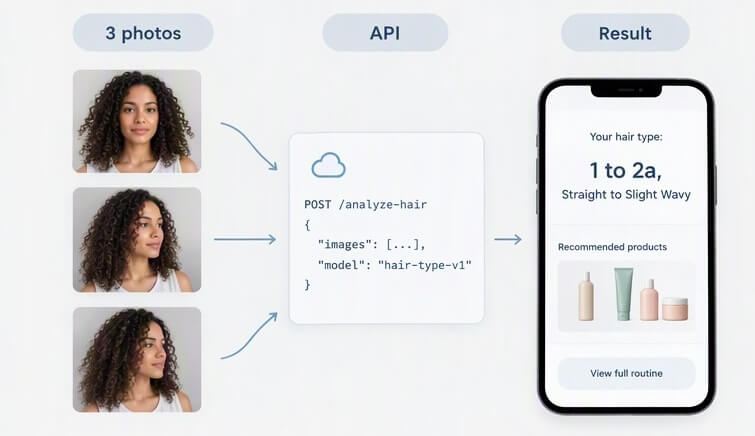
For developers and product teams, Perfect Corp offers hair type detection as an API, so you can build a "What is my hair type?" feature directly into your own site or app. The flow is simple:
- Input: Three photos (front facing plus left and right profiles at about 45 degrees), JPG or PNG, under 10MB each.
- Output: A hair type range (for example, "1 to 2a") plus a readable label your UI can display (for example, "Straight to Slight Wavy").
- Integration: Submit a task, poll for status, and pass the result into your product recommendation logic.
Perfect Corp's AI and AR technology already powers experiences for 800+ beauty and fashion brands, so the same stack can pair hair type results with hair color try-on, hairstyle simulation, and scalp or skin analysis for a full consultation flow.
See the hair type API in action in our live demo.
What Hair Type Mistakes Fool Almost Everyone?
- Checking right after styling. Gel, mousse, and heat all change the pattern. Clean and air dried is the only honest state.
- Judging by the roots. Roots are weighed down. The mid lengths tell the truth.
- Brushing curls dry. A brushed out 3A can look like frizzy 2B. Your hair did not change. The evidence got destroyed.
- Ignoring shrinkage. Coily hair can shrink to a fraction of its stretched length, so "short" does not mean "not growing."
- Treating one label as a life sentence. Hormones, damage, and haircuts shift how your hair behaves. Recheck every so often.
- Shopping by curl pattern alone. Porosity and texture decide whether a product absorbs or just sits there.
Ready to stop guessing? Explore the AI Hair Type Analyzer and see your result in seconds, or, if you are a brand, contact Perfect Corp. for a demo of hair type analysis on your own storefront.
What Is My Hair Type? FAQ
What are the four types of hair?
The four hair types are Type 1 (straight), Type 2 (wavy), Type 3 (curly), and Type 4 (coily). Each one is split into A, B, and C subtypes based on how loose or tight the pattern is.
How do I identify my hair type?
Wash your hair, skip all styling products, and let it air dry without touching it. Then look at the middle and ends of a single strand. Straight is Type 1, an S wave is Type 2, a spiral is Type 3, and a tight coil or zigzag is Type 4. For a faster, more objective answer, use an AI hair type scanner.
What is the rarest hair type?
There is no official global census of hair types, so any "rarest" claim is an estimate. Many sources point to 1A (completely pin straight, very fine hair) as one of the least common, while straight and wavy types overall are among the most common worldwide.
What is the most common hair type?
Straight and wavy hair (Types 1 and 2) are generally considered the most common worldwide, largely because of the sheer size of populations where straight hair dominates. In practice, most individual heads include more than one subtype.
Can your hair type change over time?
Your base pattern is largely genetic, but how it looks can change. Hormonal shifts (like pregnancy or menopause), aging, heat and chemical damage, haircut length, and climate can all make hair look straighter or curlier than before.
Can you have two hair types at once?
Yes. Multi-textured hair is very common. You might have 2C waves at the crown and 3B curls at the nape. Identify your dominant type, then adjust products for the sections that behave differently.
How do I know if my hair is 2A or 3A?
2A hair forms a loose, flat S shape and is nearly straight at the root. 3A hair forms full, round loops about the width of a thick piece of chalk. If your strands make complete circles, you are in Type 3 territory.
What does 4C hair look like?
4C hair has a very tight zigzag pattern that is often hard to see without stretching a strand. It has the highest shrinkage of any type, looks dense and cloud like, and needs the most moisture and gentle handling.
Is there an app that tells you your hair type?
Yes. AI hair type scanners analyze a photo of your hair and return your curl pattern in seconds. Perfect Corp's AI Hair Type Analyzer detects 10 curl patterns from straight to 4C and can identify mixed textures.
Are hair type quizzes accurate?
Quizzes are a decent starting point, but they rely on how you describe your own hair, which is where most errors come from. Photo based AI analysis is more consistent because it reads the actual strands instead of your best guess. For curly textures specifically, try the curly hair type identifier.
Is hair type genetic?
Mostly, yes. The shape of your hair follicle, which is inherited, is the biggest factor in whether hair grows straight, wavy, curly, or coily. Environment and hair care habits then influence how that pattern shows up day to day.